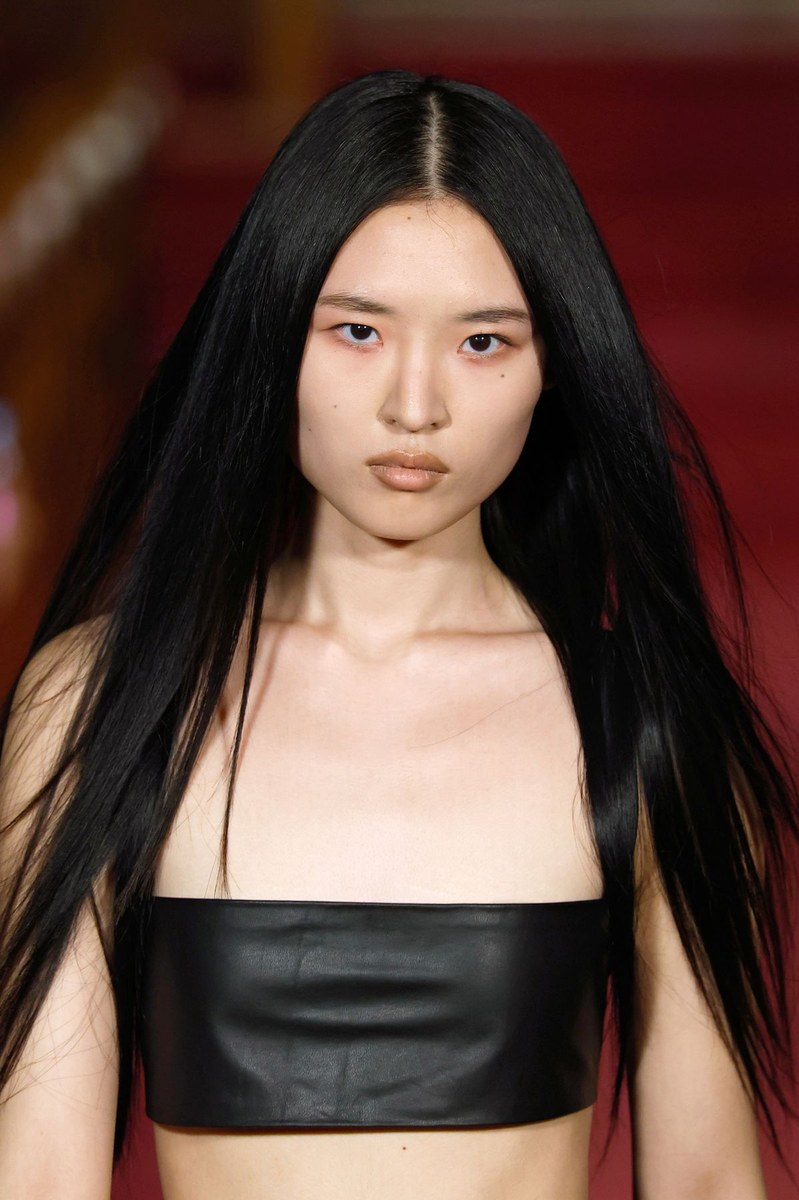
Area FW26 Women Looks Report
New York Fashion Week
Area FW26 builds its argument on collision: workwear denim and velvet turtlenecks sit beside rhinestone fringe skirts and sequined portrait-print coordinates, all held together by a consistent commitment to volume and texture contrast. For buyers navigating a market that wants both commercial entry points and high-impact statement pieces, this collection delivers a tiered range with clear sell-through potential at multiple price levels.
Silhouette and Volume
The collection alternates between body-skimming and architecturally generous with no middle ground. Mini skirts cut close to the thigh in Looks 1 and 16 read sharp against the wide-leg, floor-grazing trousers that dominate Looks 2, 3, 6, 11, and 18. Look 19 pushes volume to its conceptual limit, wrapping the body in sculpted ivory and black panels that read closer to wearable sculpture than to ready-to-wear. A high waist, dropped shoulder, and extended hem recur throughout with enough frequency to signal a deliberate house point of view rather than seasonal experiment.
Color Palette
Navy, black, and ivory form the backbone and appear across nearly every category from denim to organza. Burgundy enters in Looks 13, 14, and 16 as the sole warm accent, pairing against black velvet and rhinestone silver with enough contrast to read as a standalone color story for buyers building a capsule. Polka-dot prints in Looks 5, 7, and 9 stay within the navy-and-white axis, keeping the graphic moments consistent with the broader palette rather than breaking from it. One electric-blue stripe in Look 10 and the iridescent sequin multicolor of Looks 15 and 17 function as deliberate exits from the restraint, placed late in the sequence to build visual momentum toward the finale.

Materials and Textures
Dark indigo raw denim appears in three early looks and carries a structured, mid-weight hand with clean stitching detail and gold hardware at the pockets. Crushed velvet, used in Looks 5, 13, and 18, reads heavy and light-absorbent, creating a matte depth that anchors the more reflective pieces around it. Sheer polka-dot organza in Looks 5, 7, and 9 drapes loosely with visible body beneath, requiring lining decisions that buyers will need to confirm for commercial markets. Rhinestone fringe construction in Looks 14 and 16 uses vertical chains that move independently, adding kinetic surface quality that photographs well and performs on the floor.
Styling and Layering
A white turtleneck underlayer appears across Looks 2, 4, 8, and 11 and functions as the collection's primary system for connecting disparate garment categories. Coats in Looks 6, 8, 10, and 12 are worn with deliberate looseness, either open or draped off one shoulder, which signals to style directors that fit is meant to be relaxed rather than tailored. Footwear is predominantly a pointed-toe pump in black or silver, with Look 8 pivoting to a tan block-heeled boot that grounds the all-black volume of that look. Accessories are sparse, with the gold chandelier earring appearing on multiple models as the single recurring jewelry statement alongside small structured clutches in patent and suede.

Look by Look Highlights
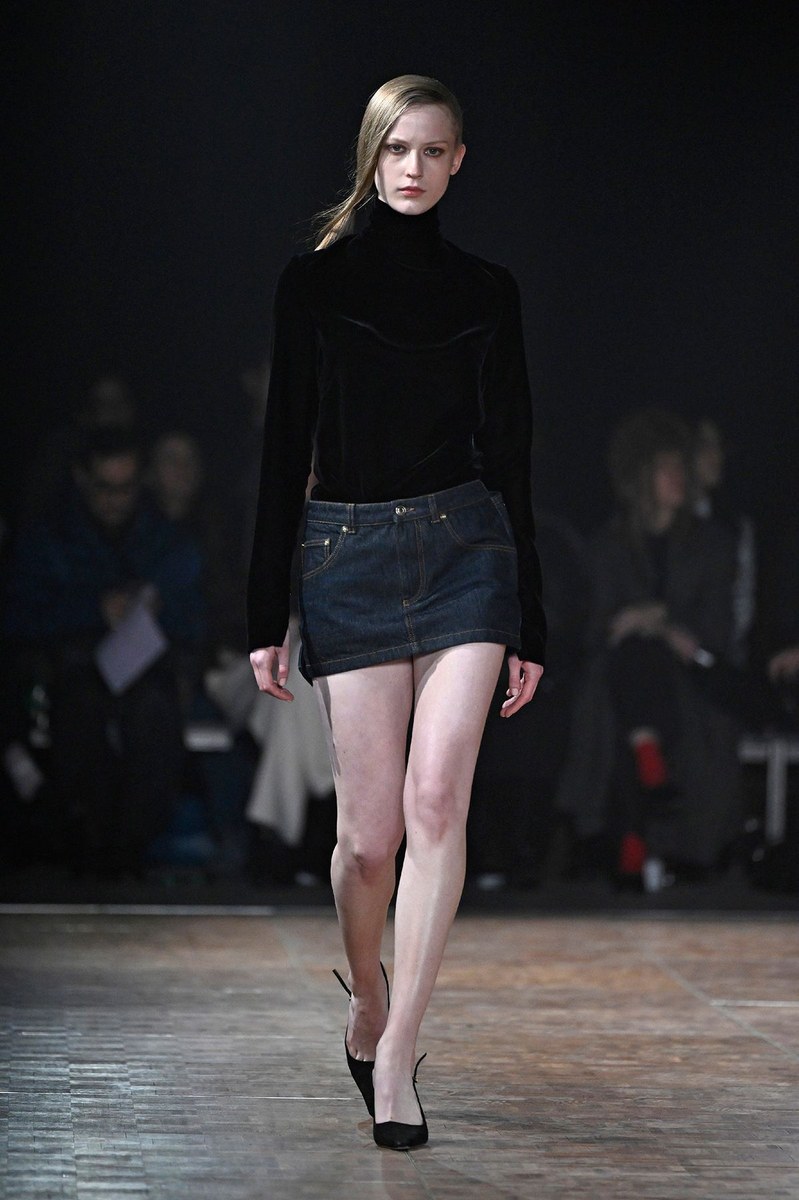
Look 1 pairs a black velvet turtleneck with a dark-wash denim mini skirt and black pointed pumps, making it the collection's most immediately commercial and least production-complex piece for mass-adjacent buyers.

Look 3 delivers a full dark indigo denim look, jacket over wide-leg trousers with a black turtleneck layer, giving denim-focused buyers a double-down proposition that works as a coordinated set.

Look 7 wraps the model's head and body in the same navy polka-dot organza, creating a full-look commitment to the print that amplifies its editorial impact while raising practical questions about commercial wearability that buyers should assess by market.

Look 12 combines a floor-length hooded wool coat in black with a bandana-print wrap skirt bearing visible brand label text, making it the most logo-forward piece in the collection and a viable candidate for brand-building wholesale placement.

Look 14 layers a rhinestone vertical-fringe dress with a burgundy zip-front sweatshirt worn open, a juxtaposition that signals the collection's core tension between sportswear codes and eveningwear construction, relevant for multi-category buyers building a full evening offer.

Look 17 presents a strapless bandeau top and midi skirt both covered in sequined pixel-mapped portrait imagery, a face rendered across the body in metallic and blush tones, making it the strongest candidate for editorial placement and the highest-complexity production piece in the range.

Look 19 closes the ready-to-wear sequence with a dramatic black gown wrapped in oversized ivory satin panels that extend past the shoulders in sculptural folds, a look that requires custom construction consideration and functions primarily as a brand-image rather than volume piece.
Look 9 assembles multiple polka-dot organza panels into a halter-neck ruched dress with a ruffled hem, demonstrating the designer's ability to extract full-look complexity from a single print, which lowers material SKU count while maintaining high visual differentiation.

Operational Insights
Denim entry tier: Looks 1, 2, and 3 form a self-contained denim capsule with a mini skirt, wide-leg trouser, and full denim co-ord that buyers can pull as a three-piece commercial drop without requiring the balance of the collection.
Rhinestone fringe production lead time: Vertical crystal-chain construction in Looks 14 and 16 is handwork-intensive and will carry significant lead time, so product managers should request production schedules early and confirm minimum order quantities against realistic sell-through projections before committing.
White turtleneck as system piece: A recurring white and black turtleneck underlayer across at least five looks reads as a branded essential that Area could develop as a standalone SKU, giving style directors a low-cost, high-frequency reorder option to anchor the seasonal buy.
Sequin portrait prints: Looks 15 and 17 use digitally mapped sequin imagery at a resolution level that demands quality control protocols around sequin placement consistency, and buyers should request pre-production samples to assess print registration before placing production orders.
Burgundy as a capsule anchor color: This colorway appears in three looks across sweatshirt, zip jacket, and layering categories, giving style directors a warm-tone capsule option within an otherwise cool-dominant palette that can target a separate consumer segment without requiring new silhouette development.
Complete Collection


About the Designer
Nicholas Aburn grew up in rural Maryland, at some distance from the obvious pathways into fashion. What he had instead was a Barnes & Noble with a magazine rack and a television set tuned, week after week, to Elsa Klensch's show Style on CNN, which in the 1990s was one of the few windows into the actual workings of the industry for anyone outside a major city. Those early images — the runway footage, the atelier access, the particular quality of glamour being argued over in real time — left a permanent mark on what he thought clothes could do and be. He found a way out of Maryland through Central Saint Martins in London, where he completed both his bachelor's and master's degrees, studying under Louise Wilson, the department's formidably demanding director whose forensic attitude toward creative decision-making ran through the program like a spine. The school produced the contacts and the credentials; the jobs came next.
He started at Tom Ford in London as an assistant designer for womenswear and VIP dressing, then moved to specializing in flou and eveningwear — the fluid, body-following work that requires the most intimate understanding of how fabric meets a figure. After more than four years at Ford, he crossed the Atlantic to New York and joined Alexander Wang as a senior womenswear designer, staying nearly four years and working across the runway collection and special-event pieces for clients including Beyoncé, Madonna, and Rihanna. In 2022 he moved back to Europe and joined Balenciaga's couture studio in Paris as a senior designer under Demna, working within a practice that treats couture as a laboratory for formal experimentation at the highest technical level. By the time he left, he had spent over a decade accumulating precisely the combination of skills — couture construction, celebrity dressing, commercial sense, and an appetite for spectacle — that Area would need from someone walking in cold.
Area's co-founder and creative director Piotrek Panszczyk departed in early February 2025, and the brand announced Aburn's appointment two days later. He joined in March and presented his debut Spring/Summer 2026 collection at New York Fashion Week in September 2025, showing in a bright space in deliberate contrast to the brand's established nocturnal energy. The collection kept Area's crystal-studded, maximalist DNA intact while pushing toward daytime legibility: a satin drop-shoulder hoodie, cummerbund-detail trousers, bedazzled sports jerseys reconstructed into dresses. Guests received scratchcard invitations with coins tucked inside. The approach was consistent with what he has said about the brand's potential: that it has lived at night long enough that bringing it into the day is the interesting move. He remains creative director, based in New York after years in Paris, and the Paris apartment — deep red velvet, parquet floors, a high-gloss table the color of dried red wine — still exists on his side of the screen.
"I want a fresh palette, fresh minds. I'd rather just swing now."
"I like taking really simple things and treating them with a reverence. New York has always inspired me with its mix of raw energy and glamour — Area truly embodies that spirit."
✦ This report was generated with AI — combining human editorial vision with Claude by Anthropic. Because the future of fashion intelligence is already here.