Ashlyn FW26 Women Looks Report
Ashlyn FW26 Women's Looks Report
New York Fashion Week
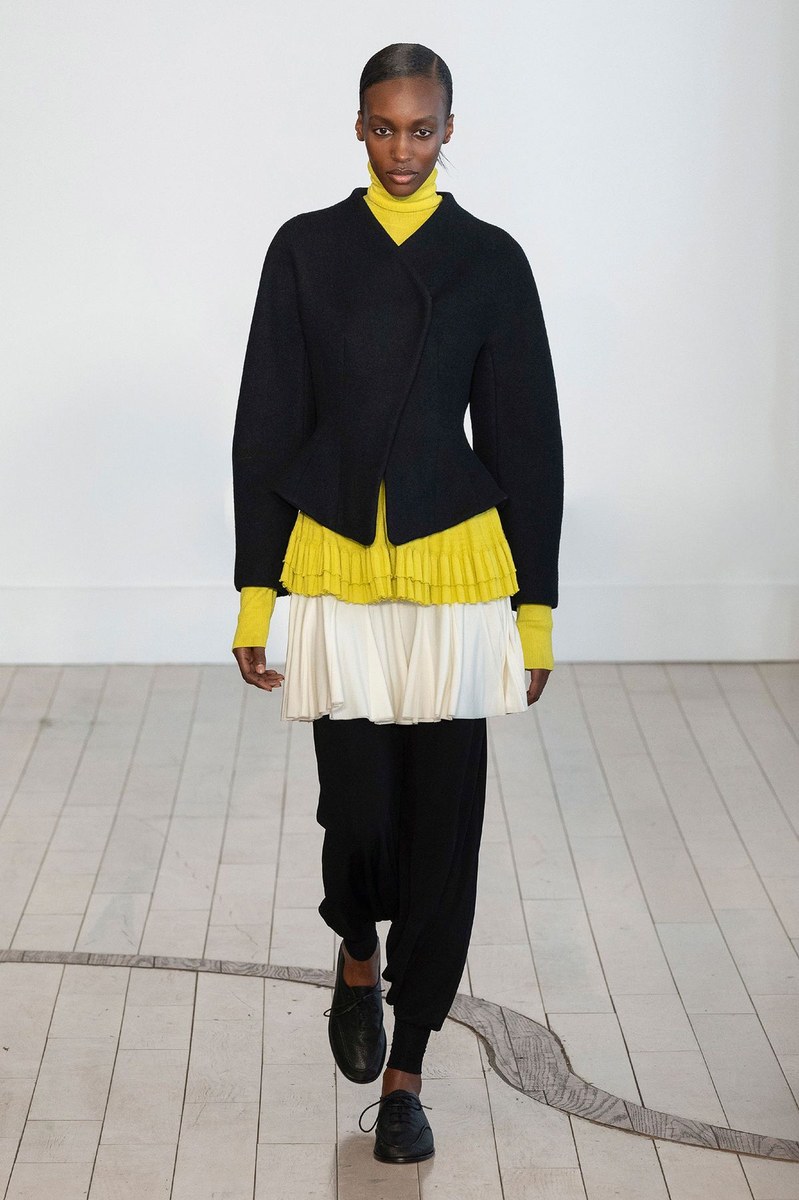
Ashlyn FW26 builds a wardrobe around controlled tension between architectural structure and fluid drape, using layering as both a construction method and a styling language. For buyers operating in a market hungry for pieces with clear visual purpose and cross-category versatility, this collection delivers strong stacking logic that supports multi-unit purchasing per customer.
Silhouette and Volume
Two dominant shapes anchor the collection: a cinched, waist-defined upper body that flares or trails below, and a broad, cocoon-like volume that reads monolithic from the front. Dropped crotch trousers recur across at least six looks, always tapered or gathered at the ankle, creating a weighted lower silhouette that grounds even the most layered tops. Look 8 and Look 20 sit at opposite poles of this spectrum. One is a voluminous sculptural white shirt, the other a floor-length ivory cape dress with near-religious restraint. Both share the same deliberate focus on how fabric fills space rather than follows the body.
Color Palette
A sharp yellow-black-ivory axis opens the collection, with acid yellow appearing as a turtleneck, a pleated hem layer, and a tweed weave across Looks 1 through 4, always paired against carbon black. Crimson enters in Looks 16 through 18 as a signal color, used in a compact cardigan, a turtleneck-and-fringe column, and a pleated skirt visible beneath a long black coat. Mid-collection neutrals, camel, warm beige, and a khaki-black tweed, act as a palate reset between the two chromatic bursts. Ivory closes the show in Look 20, functioning less as a bridal reference and more as a structural statement.

Materials and Textures
A black-and-yellow boucle tweed appears across Looks 2, 3, and 4 in three different formats: a trailing asymmetric panel, wide-leg trousers, and a fitted peplum jacket. This fabric versatility across a single material points to intentional pattern development rather than coincidental styling. Pleated chiffon or lightweight woven fabric in ivory and yellow recurs in Looks 1 and 15, adding mechanical texture contrast against matte jerseys and thick wools. Semi-sheer matte jersey appears in Look 2 and Look 19, checked wool canvas in Looks 9 through 11, textured herringbone tweed in Looks 12 and 13, and what reads as a bonded or felted double-faced wool in Look 20, where the fabric holds a sculptural cape shape without visible internal support.

Styling and Layering
Layering in this collection functions as a construction decision, not an afterthought. Separate pieces are styled so their hems read as one continuous garment. Look 1 layers a black jacket over a yellow turtleneck and tiered pleated skirt. Look 15 drapes a black top over ivory pleats over camel trousers. Footwear remains consistently a black or oxford-adjacent lace-up shoe across the full 20 looks, with white sneakers appearing twice in Looks 14 and 7 as deliberate softeners. Accessories stay spare, silver cuff bracelets appear on two looks, and the consistency of the flat shoe reinforces that this collection is built around movement and proportion, not occasion dressing.

Look by Look Highlights
Look 1 Layers a structured black wool jacket over a tiered yellow-and-ivory pleated hem and dropped-crotch trousers, making it the collection's clearest multi-SKU starting point for buyers planning coordinated separates.
Look 4 Pairs a fitted yellow-black boucle jacket with strong peplum and exaggerated sleeves against black pleated trousers and a black turtleneck, the most commercially direct tailoring option in the collection.

Look 6 Delivers a black wool suit with raw-edge white stitching running along every seam, a construction detail that reads as both a design element and a cost-manageable differentiator for production.

Look 8 Presents a voluminous white cotton shirt with ruched shoulder construction and a cinched waist, a statement top that works as a standalone hero piece without requiring coordinated bottoms.
Look 11 Combines a check wool sleeveless column dress with a floor-length dark tweed coat worn off the shoulders, making it the strongest layering proposition in the collection for a style director building a campaign around outerwear.

Look 17 Runs an all-crimson axis from ribbed turtleneck to floor-length fringe skirt, where the transition from knit to fringe at the hip is the single most visually arresting construction moment in the show.

Look 19 Uses a semi-sheer black jersey to create a center-gathered, ruched maxi dress with a deep front pull, a silhouette that translates directly to evening or resort without material changes.

Look 20 Closes with an ivory bonded-wool cape dress that holds a sculptural winglike shape from shoulder to floor, the collection's highest-price-point candidate and the piece most likely to drive editorial placement.
Operational Insights
Fabric investment: The boucle tweed developed in a black-yellow colorway appears across three completely different silhouettes in Looks 2, 3, and 4. Buyers can pitch co-investment on a single fabric development across a jacket, trouser, and accessory panel to reduce per-unit material cost.
Color phasing: The collection's palette runs in three distinct color chapters, yellow-black in Looks 1 to 4, neutrals in Looks 5 to 15, and red in Looks 16 to 18. This maps directly onto a phased delivery calendar with each chapter functioning as a coherent drop.
Layering as merchandising logic: The pleated hem piece in Look 1 and Look 15 appears styled under different outerwear and knitwear. A single SKU can be photographed in multiple configurations and drives attachment rate at point of sale.
Footwear uniformity: The near-total reliance on a black flat oxford across 18 of 20 looks signals that the designer intends the collection to be worn low to the ground and movement-forward. Style directors should avoid heel-heavy editorial styling that would misrepresent proportion.
Hero piece strategy: Look 20 and Look 17 both read as capsule anchors, high-construction, high-visibility pieces that carry editorial weight without needing to move in volume. Buyers should plan their buys with one or two of these as traffic-driving display pieces alongside the more accessible separates in Looks 4, 6, and 8.
Complete Collection


About the Designer
Ashlynn Park grew up in Seoul, the daughter of a father who ran a construction company and expected his children to follow respectable paths. Architecture appealed to her partly because of that background, and she enrolled at Ewha Womans University in Seoul with the intention of studying it. During her first summer break, she took fashion illustration lessons on an impulse, entered a government-run contest, and won. She changed her major to fashion design. Her earliest memory of fashion is older than that: at around five years old she was invited as a child model to a college fashion show, wore a sapphire glittery dress with a white bow collar, walked the runway, looked at the audience, and loved every second of it. That instinct and the technical discipline she acquired later have always existed in some tension inside her work, and the resolution of that tension is what Ashlyn is.
After Seoul she went to Japan, winning a scholarship and then completing a master's degree at Bunka Fashion Graduate University in Tokyo. In 2008 she won Japan's SO-EN Award — a competition in which two hundred pattern makers were asked to interpret the same sketch, and she placed first — which led to interviews at Junya Watanabe, Comme des Garçons, Issey Miyake, and Yohji Yamamoto. She joined Yamamoto as a pattern maker, not as a designer, and spent her first year at the studio doing nothing but stitching colleagues' samples. The studio operated like a regiment: everyone in all black, flat shoes to minimize noise, standing straight during design reviews and running immediately if Yamamoto moved a finger. She has described it as school, boot camp, and the formative experience of her professional life simultaneously. Every pattern from previous seasons was available to study and reconstruct; every decision — every pocket, every trim, every fabric choice — had to be answerable to a direct question about purpose. After three years she moved to New York in 2011, initially hired as a menswear pattern maker at Alexander Wang before shifting to the women's runway collection and producing special pieces for Beyoncé, Madonna, and Rihanna. Her most recent stint before launching her own label was alongside Raf Simons during his Calvin Klein tenure, working on menswear tailoring, jackets, and coats.
She launched Ashlyn in 2020, spending two years developing the debut collection before showing it. The brand operates on a zero-waste model: some garments are constructed from a single uncut piece of fabric, scraps become padding at the hips, everything is made to order or bespoke. Three pieces entered the permanent collection of the Metropolitan Museum of Art, including a zero-waste garment from the first season. The label was an LVMH Prize finalist in 2022. In 2025 Park won both the CFDA/Vogue Fashion Fund and the CFDA Emerging Designer of the Year award — at an age, she notes without false modesty, that gives her a clear understanding of what women actually want to wear. Her studio employees leave at five-thirty in the afternoon. She is actively training a new generation of patternmakers in the methods she received from Yamamoto, treating transmission as a responsibility equal to design. She continues as founder and creative director of Ashlyn, based in New York.
"When I interviewed at Yohji, I said, 'I am the white canvas, so you can dye me in any color, in your color.' That happened with each designer: Yohji Yamamoto at the start, then Alexander Wang, and finally Raf Simons."
"Since my background is as a technician, I think the craftsmanship is the most important thing in this industry and we are losing a lot of great artisans. There should be someone who passes down this great skill to the next generation, and I want to be the one."
✦ This report was generated with AI — combining human editorial vision with Claude by Anthropic. Because the future of fashion intelligence is already here.