Boy London FW26 Women Looks Report
New York Fashion Week
Boy London FW26 pulls the tension between ecclesiastical severity and subcultural transgression into a tightly edited wardrobe that crosses gender boundaries without apology. Buyers navigating a market hungry for androgynous tailoring and gothic edge with commercial wearability will find this collection perfectly timed.
Silhouette and Volume
Two dominant shapes drive the collection: the narrow, compressed column and the deliberately oversized shell. Cropped tops against floor-length skirts (Look 19) and banded leather bandeau against wide-leg trousers (Look 14) create a high-contrast proportion logic that runs consistently through both the womenswear and the gender-fluid looks. The belted midi and maxi coats in Looks 3 and 5 add a third register, structured at the shoulder but intentionally soft at the hem. Nothing drifts. Every silhouette is controlled.
Color Palette
Near-total black dominates the first two-thirds of the collection, broken only by a small red rectangular patch on the chest in Looks 6 and 18, which reads as an insignia or rank badge. Oxblood burgundy arrives in Looks 17 and 18, signaling a deliberate palette break, warm against the cold black that preceded it. Look 15 and Look 16 introduce off-white ivory satin, functioning as a subverted bridal or devotional counterpoint. The mood throughout is monastic and nocturnal with precise moments of blood-red punctuation.

Materials and Textures
Matte wool suiting in a medium-to-heavyweight construction carries most of the tailored pieces, giving the garments a dense, flat surface that reads as deliberate austerity rather than restraint. Black leather appears repeatedly as a trim and accessory material: wide waist belts, shoulder harnesses, cuffs, and gloves in Looks 2, 3, 5, 6, 7, 9, 12, and 18 all use it. Velvet surfaces in Look 4 and Look 12 add a crushed, light-absorbing texture that contrasts with the liquid silk charmeuse in Looks 15 and 16. The satin used in Look 19 for the mermaid skirt is structured enough to hold its fluted hem without boning.

Styling and Layering
Black leather gloves worn long to mid-forearm appear on nearly every look and function as the single most consistent styling signature across the entire collection. Footwear divides between pointed-toe ankle boots in patent or matte black leather and tall knee-high boots with buckle hardware, grounding even the most minimal looks with weight and edge. Belting strategy is architectural rather than decorative: the wide leather wraps and harness straps in Looks 2, 3, 5, and 7 define the waist without softening the silhouette. The cross-body leather strap in Look 5 and Look 8 reads more as structural detail than bag hardware, closer in logic to a military or bondage reference.

Look by Look Highlights
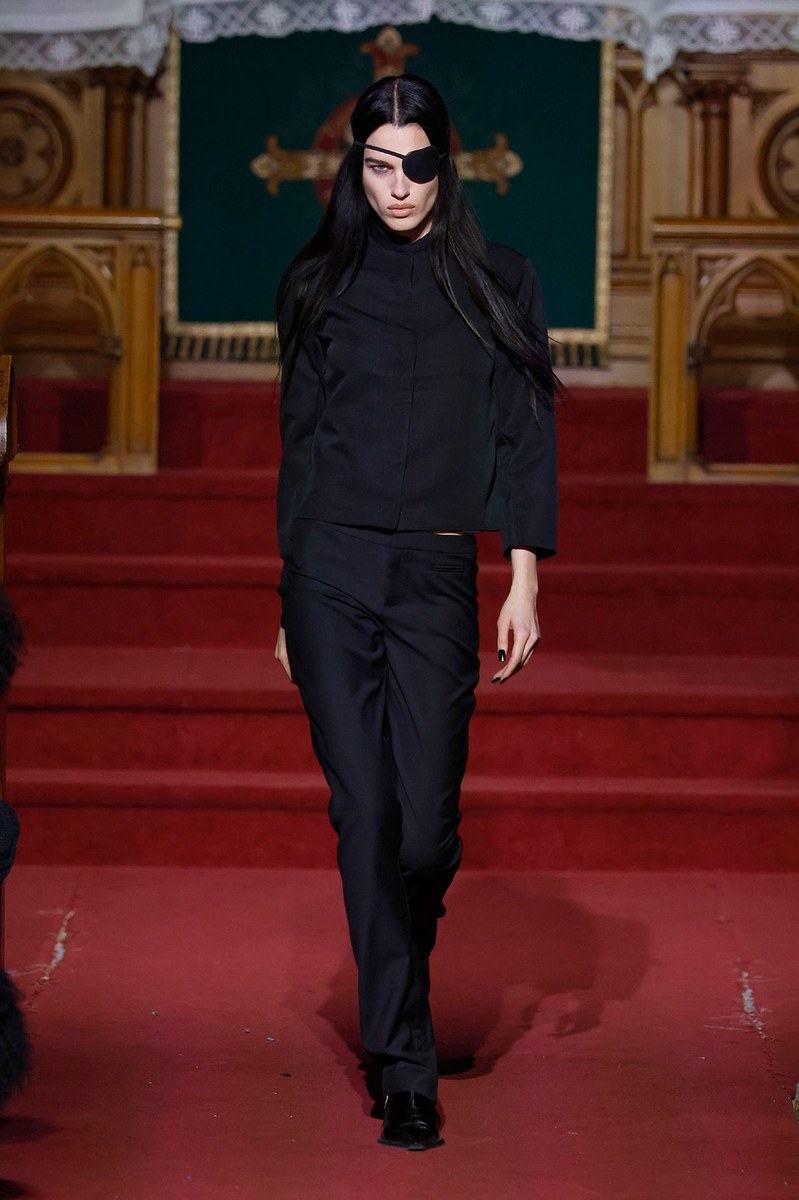
Look 1 A cropped black wool jacket with a mandarin collar and high-rise wide-leg trousers in matching black creates a complete coordinated set with strong sell-through potential as separates.

Look 3 The belted knee-length wool coat with knotted leather sash, leather cuffs over gloves, and buckled tall boots is the most complete outerwear proposition in the collection, production-ready as a hero coat.

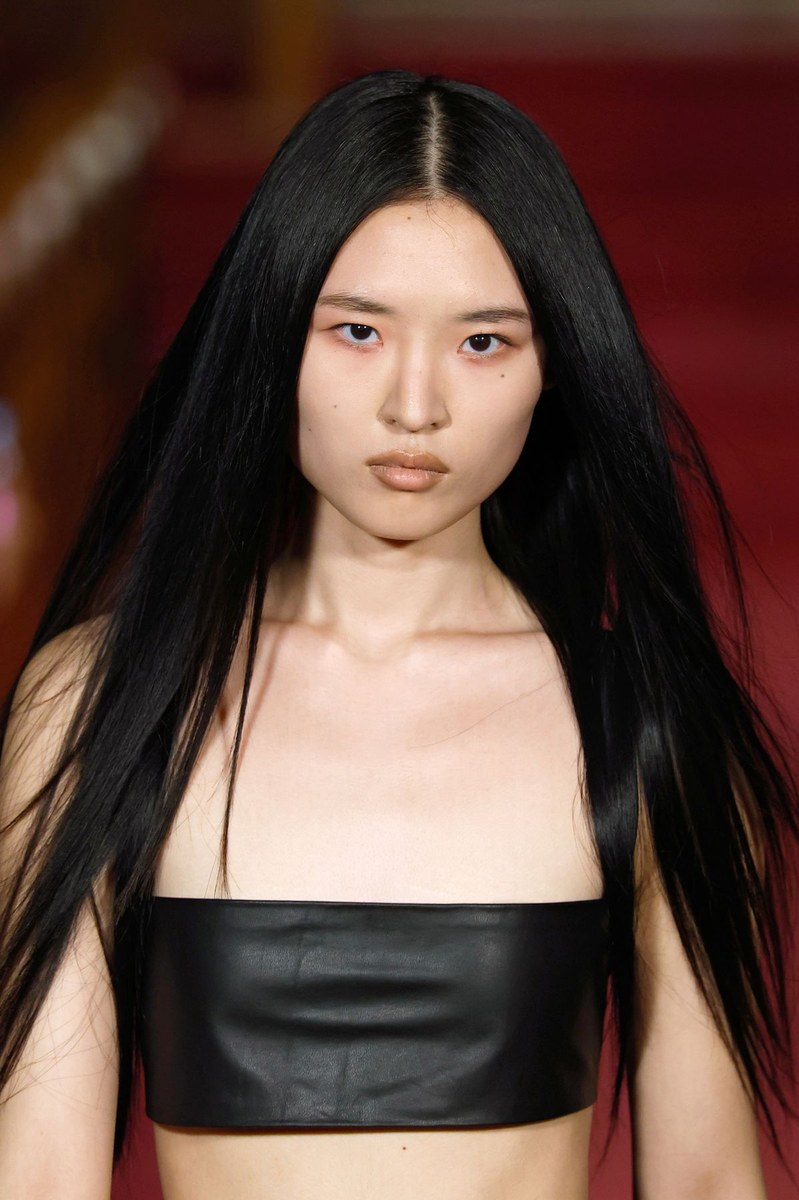
Look 6 A sharply shouldered black blazer worn as a mini dress with black leather gloves, sheer tights, and a small red chest patch delivers a wearable commercial look with an easy red accent SKU opportunity.

Look 12 The halter-neck satin bodysuit with corset lacing over velvet, sheer legs, leather cuffs, and black lipstick is the collection's most editorial moment and the one most likely to drive press placement and visual merchandising.

Look 14 A minimal leather bandeau top with wide-leg black wool trousers and studded leather cuffs isolates the accessory story most clearly, pointing buyers toward the cuff and glove category as a standalone margin driver.

Look 16 The ivory satin blouse with ruffled neck, D-ring hardware, cross pendant layering, fishnet tights, and black ankle boots is the strongest single unit for buyers targeting gothic bridal or occasion crossover customers.

Look 18 The oxblood double-breasted military blazer with silver buttons, black collar underneath, red pocket square, and leather gloves is the most immediately shoppable tailoring look in the collection with direct application across both women's and non-binary customer bases.

Look 19 A cropped black ribbed cardigan with choker-tied ribbon against a full mermaid-hem black satin skirt delivers a proportion contrast that works for evening and performs well in editorial context alongside the rest of the tailoring.
Operational Insights
Leather accessories Gloves, cuffs, wide belts, and harness straps appear in over 70 percent of looks, making them the collection's most scalable and margin-friendly category for buyers to develop as standalone accessories independent of the apparel.
Color entry point The burgundy oxblood in Looks 17 and 18 gives buyers a lower-barrier color entry into the collection for stores where head-to-toe black is a difficult buy, and it pairs directly back to the black leather accessories already in the range.
Unisex tailoring Looks 2, 7, 9, 10, 13, and 17 were styled on male models but cut in silhouettes with direct women's sizing applicability, giving style directors a clear gender-neutral tailoring capsule to position without separate design investment.
Red patch detail The small red rectangular chest emblem in Looks 6 and 18 is a low-cost, high-identity detail that product managers can use to create collection cohesion across multiple SKUs through patch or embroidery placement on otherwise straightforward garments.
Mermaid skirt construction The structured satin fluted skirt in Look 19 requires internal boning or interfacing at the hem to hold its shape in wear, which buyers should flag early in the production conversation to avoid fabric substitution errors that collapse the silhouette at retail.
Complete Collection


About the Designer
The biographical record on Can Tran is thin by design or circumstance — he has said almost nothing in public about where he grew up or what he was doing before he arrived at Boy London America. What he has said is that he was born on the thirteenth, a date that, written as digits, resembles a B, and that the number appeared early in his thinking about his debut collection for the brand. His first ideas for that collection came to him on No Kings Day. Whether those details are deliberately oblique or simply all that has been offered, they fit the sensibility of a designer who joined a fifty-year-old punk label specifically to move it away from logo-merchandising and back toward something with actual friction. He stepped into the creative director role for Boy London America in 2025 and spent much of that year doing archival research, reading into founder Stéphane Raynor's original vision for the King's Road store that opened in 1976, the clothes that Sid Vicious and Andy Warhol and Elton John wore before Boy London became a snapback and eagle-print streetwear machine.
His understanding of the brand, as he has described it, is historical rather than nostalgic. Raynor, in Tran's reading, predates Vivienne Westwood in his role as a galvanizing force in the DIY and punk ecosystem of late-1970s London, having shared designs with Westwood's then-boyfriend Malcolm McLaren before the scene had a name. The argument Tran is making with the brand is that there is a version of Boy London that never got fully expressed — the serious, craft-oriented, structurally rigorous version — because the logo-heavy commercial version got there first. His debut collection, "Guillotine," shown on February 13, 2026, at St. Paul's German Lutheran Church in New York, was built around bondage structures, medieval armor references, tartan, and elongated tailoring, with a quote from Camille Desmoulins in the show notes: "The blade arrives when silence is no longer possible." The womenswear was developed with Donna Kang and the menswear with Shaun Samson. The music came from Ho99o9.
Tran has spoken about wanting to occupy the price point between the fifty-dollar T-shirt and the five-hundred-dollar one — cashmere and wool at a cost that doesn't alienate the customer the brand historically attracted. It is a practical ambition as much as an aesthetic one, and it reflects a clear-eyed assessment of where Boy London lost its footing. The brand, in his framing, never fully left the American market; it simply lost its point of view. He is working to give it one again, beginning with a collection that insists punk in 2026 looks less like volume and more like control.
"Punk doesn't always have to scream. Sometimes the most radical thing you can do is refine it. We wanted discipline. Structure. Authority in silhouette. It's rebellion with control."
"I don't think you can do a brand like this justice without a lot of work on the research side. There, I understood what Stephane Raynor built 50 years ago. We're trying to honor that past."
✦ This report was generated with AI — combining human editorial vision with Claude by Anthropic. Because the future of fashion intelligence is already here.