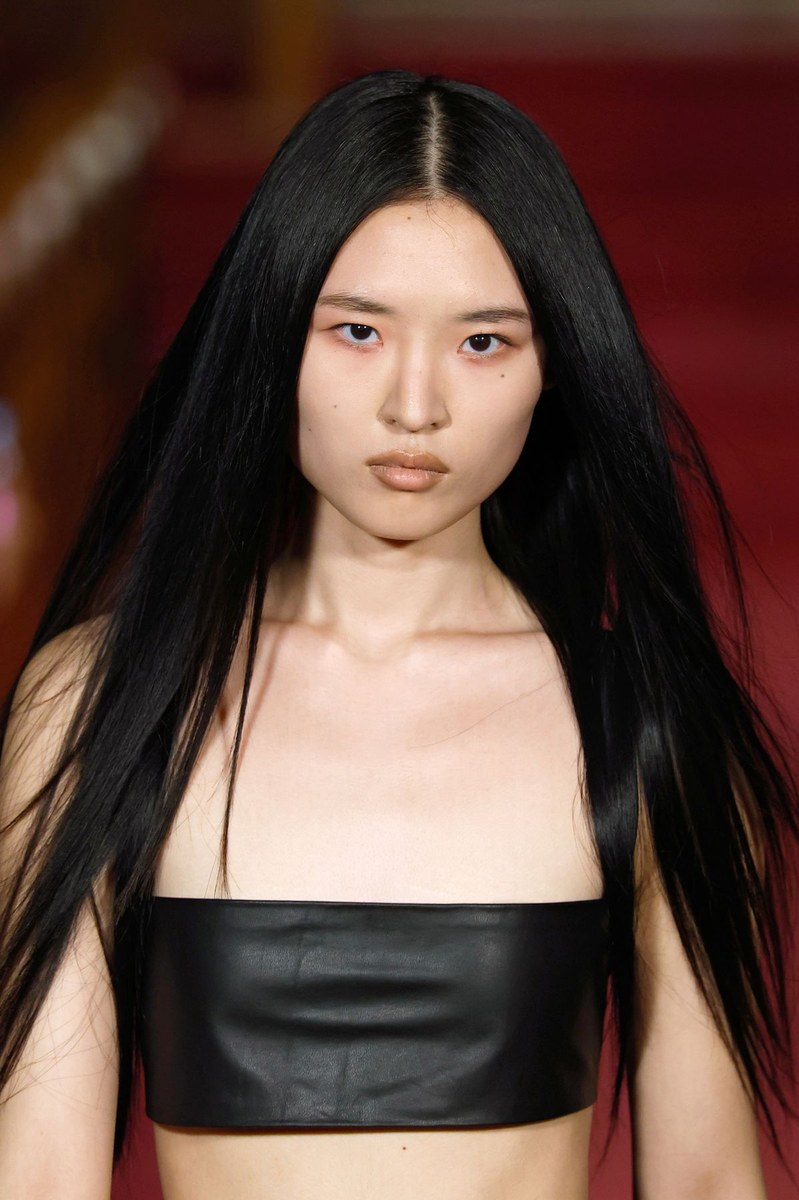
Carolina Herrera FW26 Women Looks Report
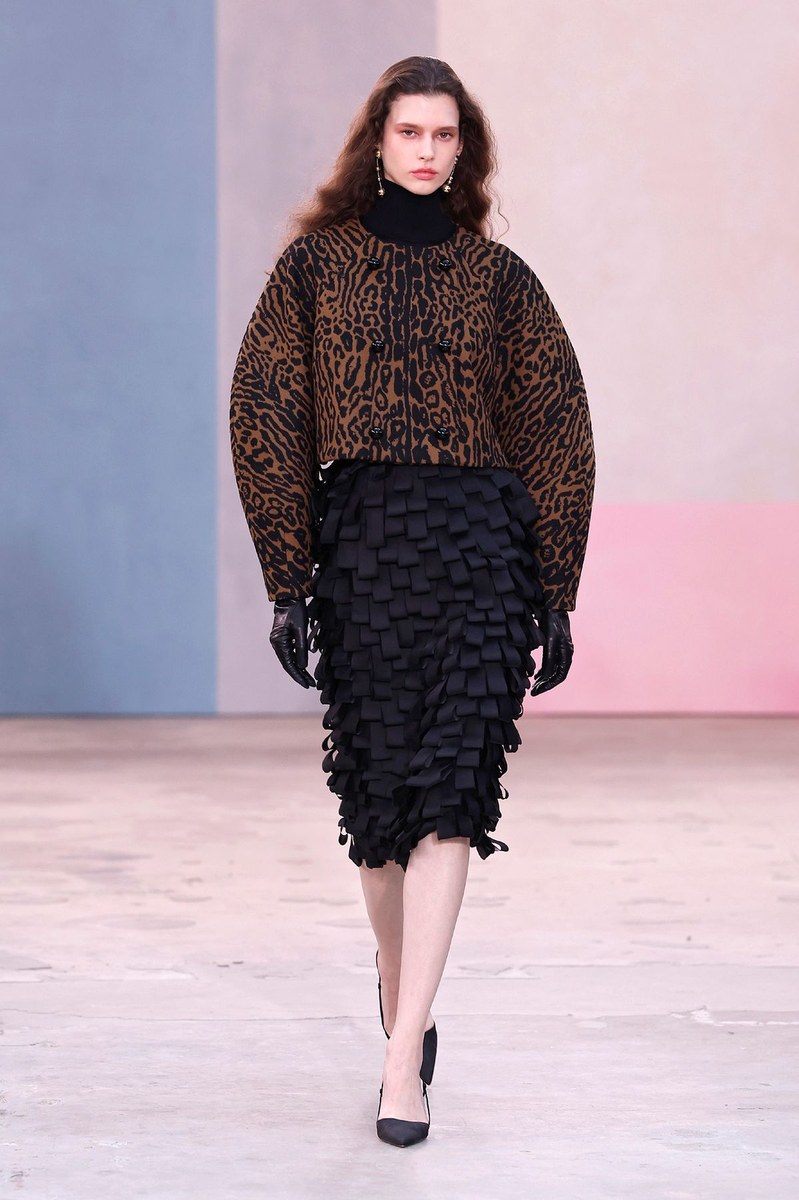
Carolina Herrera FW26 Women's Looks Report
New York Fashion Week
Carolina Herrera FW26 builds a tightly edited vocabulary around three recurring prints, two dominant silhouettes, and a red-to-black-to-white color progression that moves the eye from severity to celebration across nineteen looks. For buyers, this arrives at exactly the moment when clients are pushing back against quiet luxury and asking for clothes with graphic identity and event-readiness built in.
Silhouette and Volume
The collection divides cleanly between two bodies: a rounded, cocoon-style upper half with ballooned or dolman sleeves sitting over straight or tapered legs and pencil skirts, and a more fitted column that gains structure through seaming rather than boning. Look 1 and Look 8 both use that inflated upper torso to maximum effect, giving the torso architectural weight without adding fabric to the lower body. Look 2 pushes the volume logic to its extreme by covering a full coat silhouette in layered ribbon tabs, making the entire garment a surface construction rather than a cut story. Breaking both of those rules, Look 19 closes with a strapless drop-waist ball skirt, functioning as the one formal outlier in an otherwise daywear-weighted lineup.
Color Palette
Black anchors the first half with near-total commitment, appearing in jersey, bouclé, wool crepe, and that ribbon-layered coat in Look 2, never feeling repetitive because the texture shifts constantly. Look 9 introduces a sharp transition with a single-color scarlet red dress, and from that point forward red drives the narrative through suiting, turtlenecks, floral prints, and pumps. Functioning as a graphic bridge between those two poles, the black-and-white ocelot print appears in Looks 6, 7, and 8. Finally, Look 19 resets the palette to a formal, almost bridal register with its ivory-and-black lace stripe ball gown.

Materials and Textures
Wool crepe carries the structural pieces, appearing in the double-breasted coat of Look 4 and the tailored suiting of Looks 5 and 10, with enough body to hold a sculpted shoulder without visible padding. Reads as a stiff jacquard or woven brocade in Looks 1 and 8, the ocelot-print fabric gives the print dimensional weight rather than the flatness of a screen-printed surface. Bouclé and slubbed tweed anchor the grey looks in Looks 17 and 18, trimmed in multicolor embroidered florals that contrast the otherwise restrained surface. Representing the most labor-intensive construction in the collection, the ribbon-tab texture in Looks 1, 2, and to a lesser degree the skirt of Look 1 alone will command the highest production cost per unit.

Styling and Layering
Black leather gloves appear in nearly every look through the first third, pairing with everything from the ocelot jacket in Look 1 to the black coat in Look 4, functioning as a consistent tension point between severity and polish. Footwear splits between two types: a pointed-toe pump with a fabric bow at the toe cap, seen in Looks 3, 8, and 11, and a pointed-toe slingback or court pump without embellishment, with the bow version assigned almost exclusively to the more print-forward looks. Bags are small, structured, and boxy throughout, appearing in black, burgundy, red, and the black-and-white ocelot print, never exceeding top-handle minibag scale. Creating a monochromatic layering logic across Looks 9 through 14, the red accessories let buyers source the shoe and bag as a coordinated unit rather than a separate styling decision.
Look by Look Highlights
Look 2 layers black ribbon tabs across an entire coat and dress silhouette to create a surface that reads as both texture and print, making it the strongest statement piece for editorial placement and trunk-show lead.
Look 4 delivers a double-breasted black wool cocoon coat over a black-and-white ocelot turtleneck, producing a contrast-collar effect that gives buyers a separates story inside a single look.
Look 5 presents the most commercially transferable proposition in the collection, a slim black blazer with oversized white buttons paired with straight-leg black trousers, structured enough for corporate dress codes and graphic enough to avoid reading as basics.

Look 9 opens the red chapter with a draped scarlet midi dress cut with three-quarter balloon sleeves and a bow belt at the natural waist, clean enough for day and formal enough for evening with a shoe swap.

Look 11 pairs a red ribbed turtleneck with a white calla lily print asymmetric wrap skirt, the first look to mix a solid jersey top with the floral print and the most accessible price-point entry into the lily print story.

Look 17 uses a grey slubbed tweed column dress with a matching asymmetric cape and multicolor embroidered floral trim at collar and hem. A pivot look for buyers building a grey capsule, it introduces both a new color family and a new embellishment technique simultaneously.

Look 19 closes with a strapless ivory ball gown structured with drop-waist seaming and horizontal black guipure lace panels across the skirt, the only formal evening piece in the collection and likely to carry the highest wholesale price point by a significant margin.

Operational Insights
Print licensing: The collection runs three distinct prints: a tan-and-black ocelot, a black-and-white ocelot, and a red calla lily on ivory. All three appear across multiple silhouettes, so buyers should assess print exclusivity terms before committing to volume, as crossover with other stockists will dilute the in-store story.
Ribbon-tab construction: Looks 1 and 2 rely on a labor-intensive hand-applied ribbon tab technique. Style directors should confirm lead times and minimum order quantities early, as this construction is likely to face production bottlenecks that standard cut-and-sew pieces will not.
Color-coordinated accessory sets: The red pump and red minibag pairings in Looks 9 through 14 allow buyers to build coordinated accessory bundles that support higher basket value per transaction at retail.
Bow-toe pump as hero footwear: The pointed-toe pump with fabric bow appears in at least four looks and across three color ways: black, ivory with black leopard, and red. This single shoe style functions as the collection's footwear anchor and warrants a standalone reorder strategy separate from apparel buys.
Grey tweed capsule: Looks 17 and 18 together form a two-piece grey tweed grouping with strong gifting and occasion-dressing potential for the holiday floor set. The embroidered floral trim on Look 17 gives it a seasonal decoration hook without relying on overt holiday color, making it viable for November through January floor placement.
Complete Collection


About the Designer
Wes Gordon was born in Chicago in 1986 and raised in Atlanta, Georgia, in a family where creative ambition was indulged early and without much skepticism. His father played Big Ten football; his mother worked at an advertising agency and let her preschool-age son help select her outfits each morning. By kindergarten he was insisting on red suspenders and blue suede bucks. In high school at the Lovett School in Buckhead, he wore the uniform but pushed its edges with Italian shoes and a Prada fleece, and in the evenings paged through secondhand coffee-table books on Valentino and Erté — a Valentino tome in particular, which he still has, whose pages and smell he can recall precisely. At sixteen he found a sign in a window near Peachtree Battle advertising fashion design lessons and called the number: it was Nina Gleyzer, a couturier from Saint Petersburg who taught him sewing, cutting, and patternmaking after school for two years. The ball skirt with flame embroidery he made with her won him a place at Central Saint Martins in London, where he wanted to study specifically because John Galliano and Alexander McQueen had come from there. He had watched Galliano's Dior shows streaming on the brand's website and found them "bewitching and hypnotising — fashion with a capital F."
He moved to London in 2005, spent his summers interning at Oscar de la Renta in New York and at Tom Ford's Chelsea atelier, and — characteristically — spent his entire savings from a summer job at an Atlanta law firm on the wardrobe he wore to those internships: a full-on linen-suit, Brideshead Revisited dapperness that he refused to compromise by sitting on the subway. He graduated in 2009, moved immediately to a small live-work space in New York's Financial District, and launched his eponymous label the same month. Harrods and Saks Fifth Avenue picked it up right away, followed by Bergdorf Goodman and Kirna Zabête. The line dressed Michelle Obama, Gwyneth Paltrow, and Katy Perry, won him the Fashion Group International Rising Star Award, and brought a CFDA/Vogue Fashion Fund finalist nomination. In 2017, he paused the label to consult for Carolina Herrera. When Carolina Herrera stepped down as creative director the following year to become global brand ambassador, Gordon was appointed to succeed her — at thirty-one, inheriting a house with four decades of history.
His mission at the house, as he articulated it from the start, was not reinvention but intensification: to make Herrera synonymous with color, optimism, and the specific confidence of a woman who arrives in head-to-toe hot pink on a street full of people in gray. Every collection begins with a color palette of twelve to twenty precisely tuned shades. His references pull from art — Sonia Delaunay's Rhythm Color for Fall 2025 — and from cinema: Visconti films watched as a teenager in Atlanta, and Being There, whose protagonist's relationship to tending his garden he used as a meditation on how women curate their wardrobes. Since his debut collection for Spring 2019, Gordon has dressed Shakira, Demi Moore, Cynthia Erivo, Karlie Kloss, Meghan Markle, and Beyoncé, among many others, and published a Rizzoli book, COLORMANIA, with photographer Elizaveta Porodina. He has been at Carolina Herrera for over eight years, and lives in Tribeca with his husband and son.
"I always begin my collections with color. That's the most essential, foundational element. Everything comes from that. If you don't get color right at the beginning, it's hard to fix it later."
"Mrs. Herrera always talks about how the most rebellious thing you can do is to be elegant. I think about that a lot."
✦ This report was generated with AI — combining human editorial vision with Claude by Anthropic. Because the future of fashion intelligence is already here.