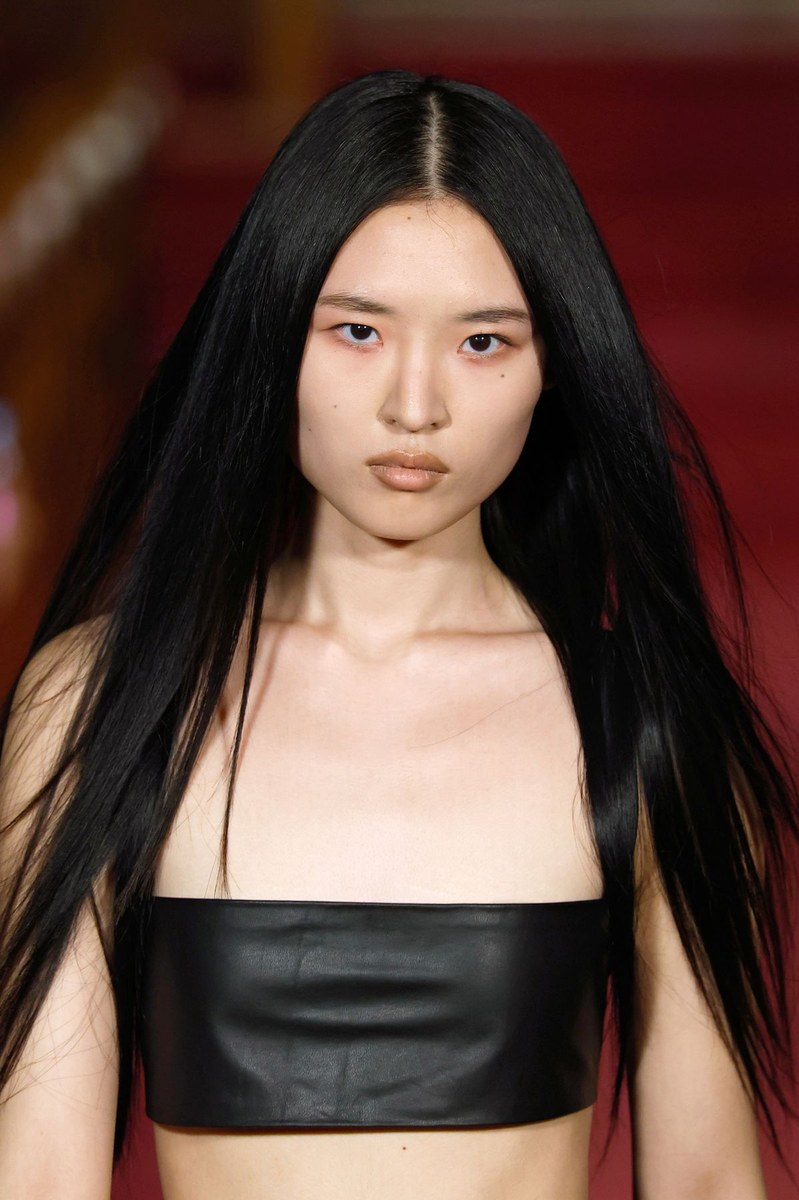
Christian Siriano FW26 Women Looks Report

Christian Siriano FW26 Women Looks Report
Did you know? Christian Siriano was the youngest designer to win Project Runway at age 25 in 2008, and he subsequently built his brand on a made-to-order manufacturing model that allows for rapid customization and small-batch production rather than traditional seasonal collections. His atelier-based approach has enabled him to serve both high-profile clients and direct-to-consumer customers while maintaining control over quality and design integrity across his product lines.

Christian Siriano FW26 Women Looks Report

New York Fashion Week

Christian Siriano FW26 builds a collection around controlled extremes, moving between body-conscious cutouts and voluminous sculptural forms within a single, coherent vision rooted in black with deliberate chromatic breaks. For buyers, this range signals strong commercial versatility across eveningwear, red carpet, and contemporary categories without sacrificing a clear point of view.

Silhouette and Volume

Two opposing poles structure the collection. Sharply structured shoulders anchor the power-dressing half, visible in Looks 1, 9, 10, and 15, while Look 19 swings to the opposite extreme with a strapless iridescent ball gown whose sculptural bubble skirt reads almost architectural. Mid-length draped skirts with asymmetric hems appear repeatedly, keeping the floor-length and cropped options in constant dialogue. Look 5 demonstrates how a simple column silhouette, cut close to the body in matte jersey, lets a feather hem explosion do all the volumetric work at the base.
Look 19
Look 19

Color Palette

Black dominates unconditionally across roughly two thirds of the collection, ranging from flat matte crepe to high-gloss patent finishes that read almost brown-black under the runway lights. A saturated yellow-green with golden undertones, the acid-chartreuse metallic brocade in Looks 16 and 17 lands between bioluminescent and old Hollywood, representing the single most commercially significant color move. Off-white appears in Look 6 as a cool porcelain tone and in Looks 7 and 8 as a salt-and-pepper marled fur, preventing the palette from reading as a simple black-and-white contrast story. Look 19's iridescent fabric cycles through deep emerald, electric blue, and near-black depending on the angle, making it the collection's most attention-demanding color moment.

Look 6
Look 6

Materials and Textures

An unusually wide material range runs throughout. Heavy matte crepe and structured wool-blend suiting in Looks 1, 4, 5, and 6 provide clean, press-ready surfaces with strong drape and good structural memory. Looks 7 and 8 use a shaggy marled faux fur with a deliberately rough, almost animal-coat texture, while Looks 9 and 10 shift into a high-gloss crinkled patent fabric that catches light like liquid metal and reads strikingly different at every viewing angle. Look 11 pairs a silver sequin knit top with a dense black ostrich-feather skirt and matching cape collar, stacking three distinct surface treatments into one look. Look 14 uses a burnout velvet on sheer mesh, placing large-scale floral motifs over a transparent ground that reveals the body selectively.

Look 11
Look 11

Styling and Layering

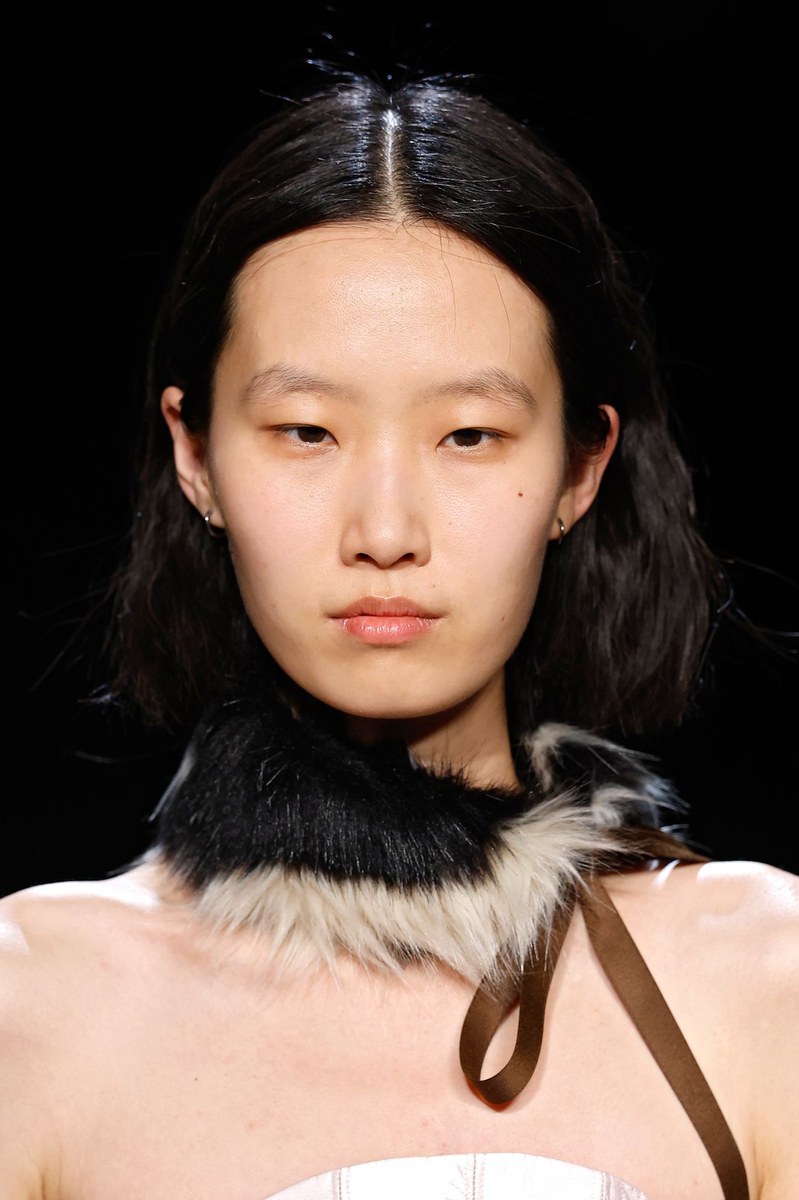
A fabric strip choker in black functions as a recurring styling device across Looks 2, 3, 4, 15, 16, 17, and 19, providing visual continuity across very different silhouettes and materials. Footwear splits cleanly between pointed-toe pumps in black or coordinating fabric and strappy lace-up heeled boots, with the green brocade pumps in Looks 15 and 16 serving as a precise color-match accessory strategy that product managers should note for coordinated selling. Layering logic is minimal and intentional. Look 18 is the exception, stacking a cropped shaggy black jacket over a bare midriff, high-waist briefs, and a floor-length black lace skirt, building texture through juxtaposition rather than volume. Long black mesh gloves appear only in Look 14, keeping the overall styling vocabulary lean.

Look 18
Look 18

Look by Look Highlights

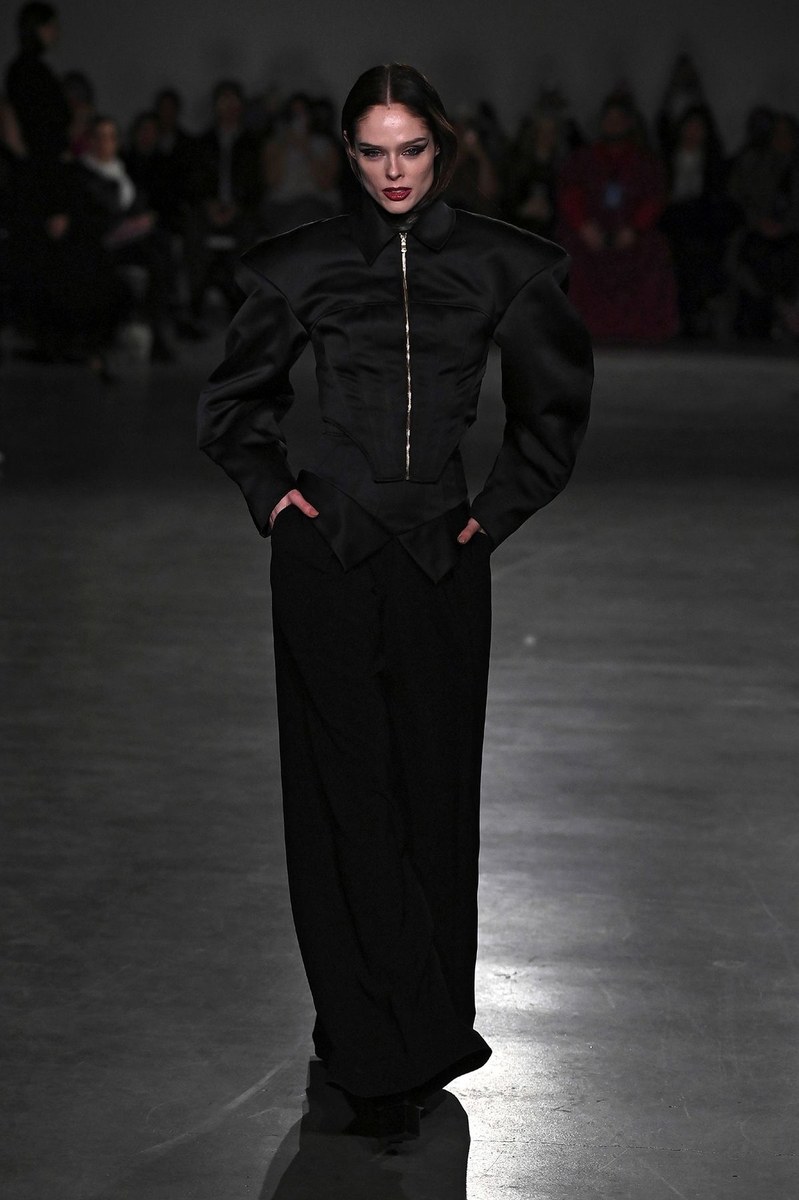
Look 1 The structured black satin jacket with exaggerated shoulder caps and a center-front gold zipper is a direct commercial proposition for eveningwear separates buyers who need a strong statement top.

Look 1
Look 1

Look 3 The bralette-and-tie construction in black, paired with a lace-up draped skirt, gives contemporary buyers a two-piece formula that photographs well and can be split across two SKUs.

Look 3
Look 3

Look 5 The floor-length black column jersey dress with a dense white feather hem creates a strong editorial moment on a construction that is relatively simple to produce and style for red carpet clients.

Look 5
Look 5

Look 10 The full-length high-gloss patent column dress with structured shoulders is the most architectural single-fabric statement in the collection and will photograph as a hero look across all digital channels.

Look 10
Look 10

Look 11 Pairing a silver sequin long-sleeve top with a voluminous black ostrich-feather skirt and oversized feather collar gives luxury specialty buyers a high-drama feather story they can break apart for top and bottom separates selling.

Look 17 The chartreuse gold metallic brocade halter gown with deep waist cutouts is the strongest evening color statement in the collection and will drive red carpet placement for buyers in the awards-season market.

Look 17
Look 17

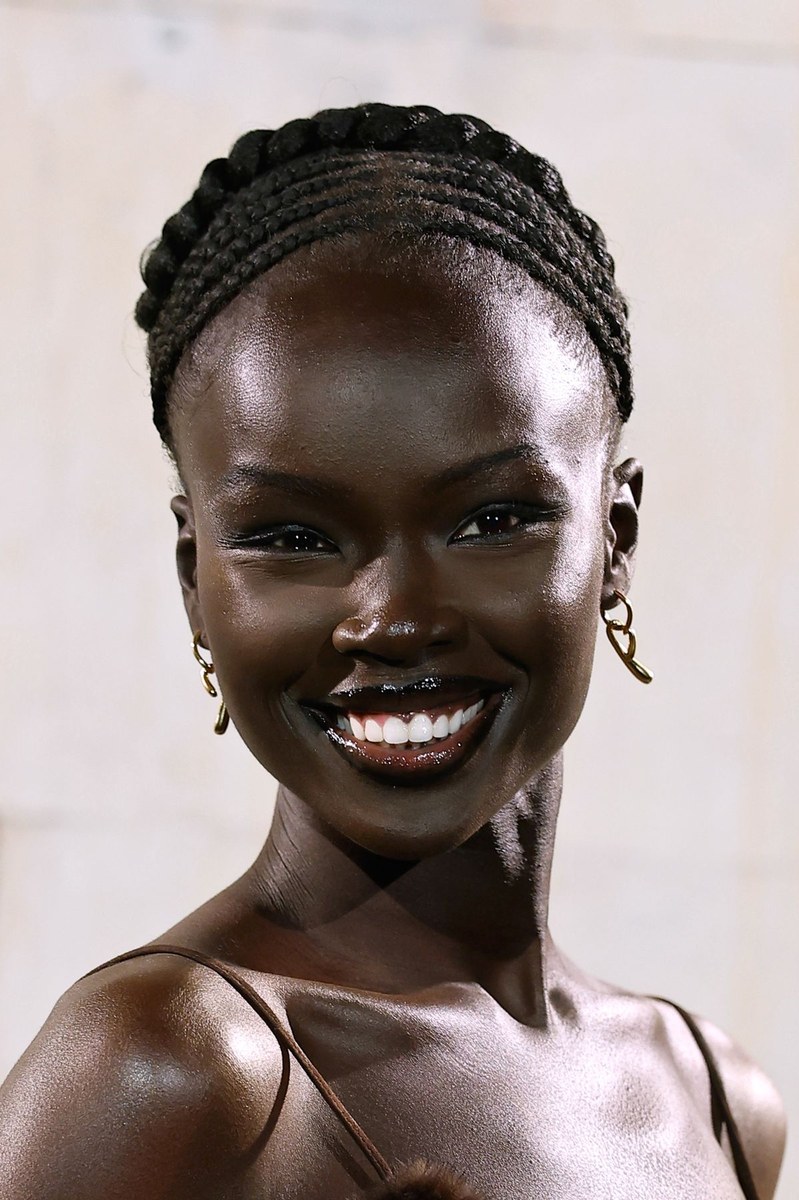
Look 19 The iridescent strapless ball gown with a structured bubble skirt closing the collection is a clear couture-adjacent statement that justifies a premium price point and serves as the brand's primary editorial and advertising image for the season.

Look 12 The tuxedo-cut black blazer worn as a dress over a bralette bodysuit on a curvy model is a direct signal that Siriano is building inclusive sizing into commercial hero pieces, a buying consideration for retailers with extended-size programs.

Look 12
Look 12

Operational Insights

Black SKU depth: Black accounts for the majority of the collection and spans at least four distinct fabric categories, including matte crepe, sheer chiffon, patent, and faux fur. Buyers can build a coherent all-black assortment with strong material contrast without introducing additional color risk.

Feather cost planning: Feather trims appear in Looks 2, 4, 5, 8, and 11 across both black and white colorways, representing a significant material cost variable. Product managers should lock in feather supplier pricing early, as ostrich and marabou trims remain subject to seasonal availability constraints.

Two-piece strategy: Looks 3, 16, 18, and the cropped jacket pairings throughout the collection confirm that Siriano is building separates business deliberately. Style directors should evaluate these as top-and-bottom buys rather than full-look buys to maximize floor flexibility and hit multiple price points.

Color extension window: The chartreuse metallic brocade in Looks 16 and 17 is specific enough to be a signature color for the season and commercial enough to sustain a small capsule. Buyers with access to fabric-matching vendors should move quickly on this tone, as it will appear in competitive collections within two to three months of market.

Size inclusivity as a stocking signal: Look 12 places a curvy model in a hero commercial silhouette, not a specialty plus look, signaling that Siriano expects extended sizing to function at the same sell-through rate as core sizing. Retailers should plan size runs accordingly rather than treating extended sizes as a markdown category.

Complete Collection

Look 2
Look 2
Look 4
Look 4
Look 7
Look 7
Look 8
Look 8
Look 9
Look 9
Look 13
Look 13
Look 14
Look 14
Look 15
Look 15
Look 16
Look 16
Look 20
Look 20
Look 21
Look 21
Look 22
Look 22
Look 23
Look 23
Look 24
Look 24
Look 25
Look 25
Look 26
Look 26
Look 27
Look 27
Look 28
Look 28
Look 29
Look 29
Look 30
Look 30
Look 31
Look 31
Look 32
Look 32
Look 33
Look 33
Look 34
Look 34
Look 35
Look 35
Look 36
Look 36
Look 37
Look 37
Look 38
Look 38
Look 39
Look 39
Look 40
Look 40
Look 41
Look 41
Look 42
Look 42
Look 43
Look 43
Look 44
Look 44
Look 45
Look 45
Look 46
Look 46
Look 47
Look 47
Look 48
Look 48
Look 49
Look 49
Look 50
Look 50
Look 51
Look 51
Look 52
Look 52
Look 53
Look 53
Look 54
Look 54
Look 55
Christian Siriano

About the Designer

Christian Siriano was born in 1985 in Annapolis, Maryland, where his parents were both schoolteachers and his older sister Shannon danced with the Ballet Theatre of Annapolis. He was five or six years old the first time his mother brought him to the theater with paper and pencils to keep him occupied, and he sat there sketching the Sugar Plum Fairy's costume from a performance of The Nutcracker. The costumes were the point from the beginning: ballet, musical theater, and the specific transformation that happens when a person puts on something made to be looked at. He started designing at thirteen, working as a hair washer and styling assistant at Bubbles Salon in Annapolis, eventually creating the costumes for the salon's annual hair shows. After a year at Broadneck Senior High School, he transferred to the Baltimore School for the Arts, where he was allowed to concentrate on fashion design and to be, as he later described it, thrown in with creative people and given real responsibility. FIT rejected his application after graduation, so he went to London instead, enrolling at the American InterContinental University and interning first at Vivienne Westwood and then at Alexander McQueen, two houses with nothing in common except a total commitment to the proposition that clothes can be transformative objects.

He returned to New York and worked as a freelance makeup artist for Stila Cosmetics, sewed custom wedding gowns for private clients, and took a brief internship at Marc Jacobs. A friend's mother suggested he audition for Project Runway. He won Season 4 in 2008 at twenty-one, becoming the youngest winner in the show's history, with Victoria Beckham calling his twelve-piece finale collection a breath of fresh air. The prize included a hundred thousand dollars to launch his own label and a slot at New York Fashion Week. He showed his first collection in September 2008. The business reached an estimated five million dollars in revenue by 2012 and his client list expanded to include Michelle Obama, Lady Gaga, Oprah Winfrey, Rihanna, and Angelina Jolie, among many others. He was named to Time magazine's 100 Most Influential People in 2018.

The terms on which Siriano built his brand diverged sharply from industry convention from the start: his runway shows have consistently featured models across a genuinely wide range of sizes, ages, and body types, not as a stated policy but as a baseline condition of how he works. When the pandemic arrived in 2020, he converted his atelier into a mask production operation, turning out roughly two thousand a day for frontline workers. The reference pool for his collections runs through Pop Art, theatrical costume, Baroque excess, and the visual culture of spectacle broadly — the connection to his sister's ballet costumes never fully left. He designs, produces, and sells from New York, remains founder and creative director of his label, and returns regularly to Project Runway as a mentor.

"She would be in dazzling ballet costumes with her hair and make-up all done up and then she and the other dancers would turn into these amazing creatures. That was my first real experience of what fashion could do."

"Growing up, I knew I wasn't meant to stay in one place. I knew nothing — but I was always good at pretending like I knew more than I did."

✦ This report was generated with AI — combining human editorial vision with Claude by Anthropic. Because the future of fashion intelligence is already here.