Coach FW26 Women Looks Report

Coach FW26 Women Looks Report
Coach FW26 Women Looks Report

New York Fashion Week

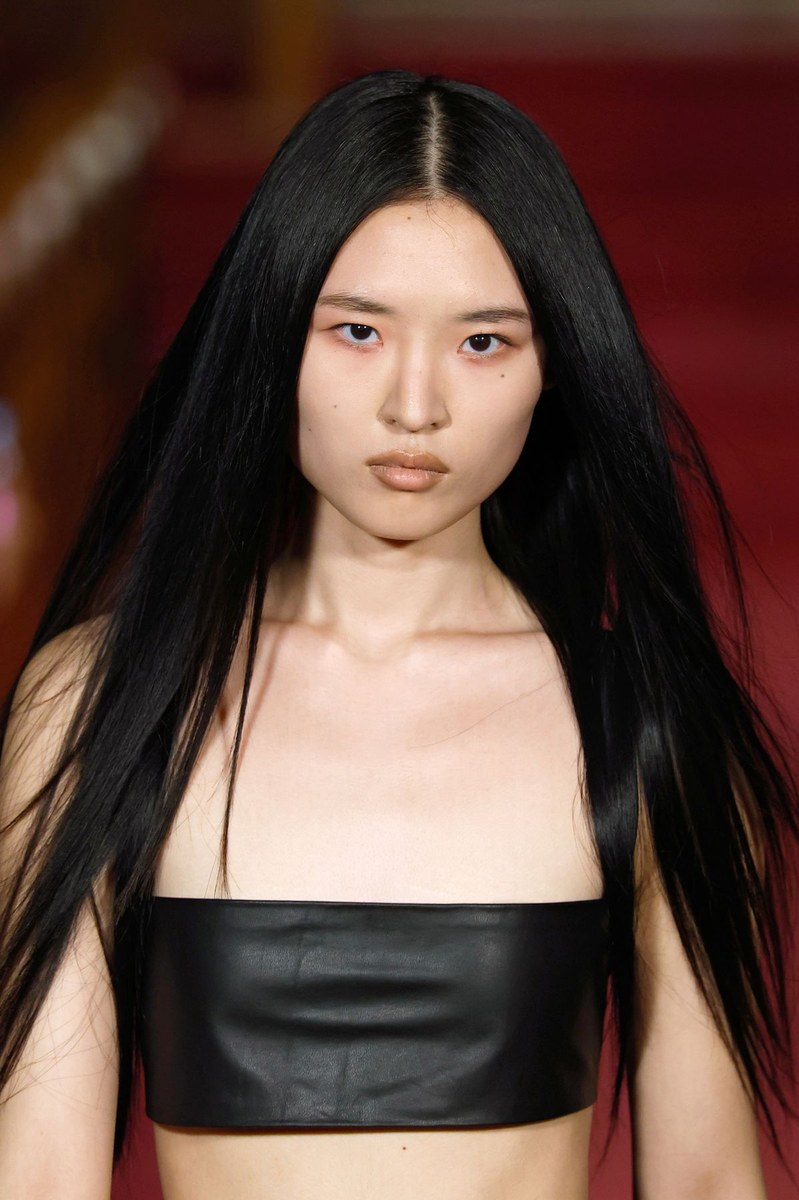
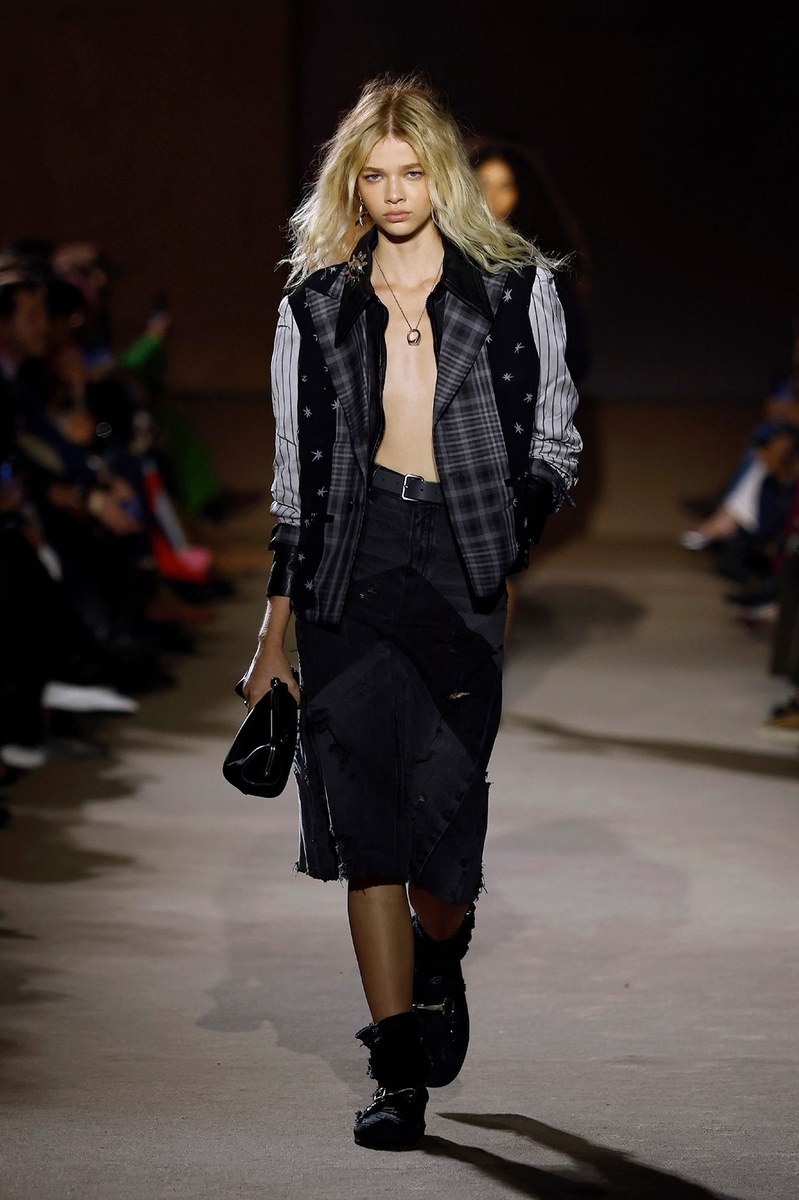
Coach FW26 builds its identity around a deliberate collision of punk-era deconstruction and Americana sportswear codes, funneled through gender-fluid casting and heavily distressed denim as the connective tissue of the entire lineup. For buyers and style directors navigating a market hungry for cross-category product that reads both street-credible and brand-legible, this delivers a commercially viable template with clear entry points across outerwear, bottoms and bags.

Silhouette and Volume

Two dominant shapes emerge here: a cropped, broad-shouldered jacket worn open over the bare torso, and a midi-length skirt with a relaxed, slightly fluted hem. Wide-leg trousers recur across Looks 15, 16, 17 and 18, cut long enough to break heavily at the ankle and graze the floor. Bermuda-length shorts in distressed black denim appear in Looks 7, 8, 9 and 10, offering a mid-season proposition that bridges the jacket weight above with chunky boot footwear below. Proportion here is intentionally unresolved, mixing oversized tops with neither fitted nor fully voluminous bottoms, creating a deliberately suspended silhouette.
Color Palette

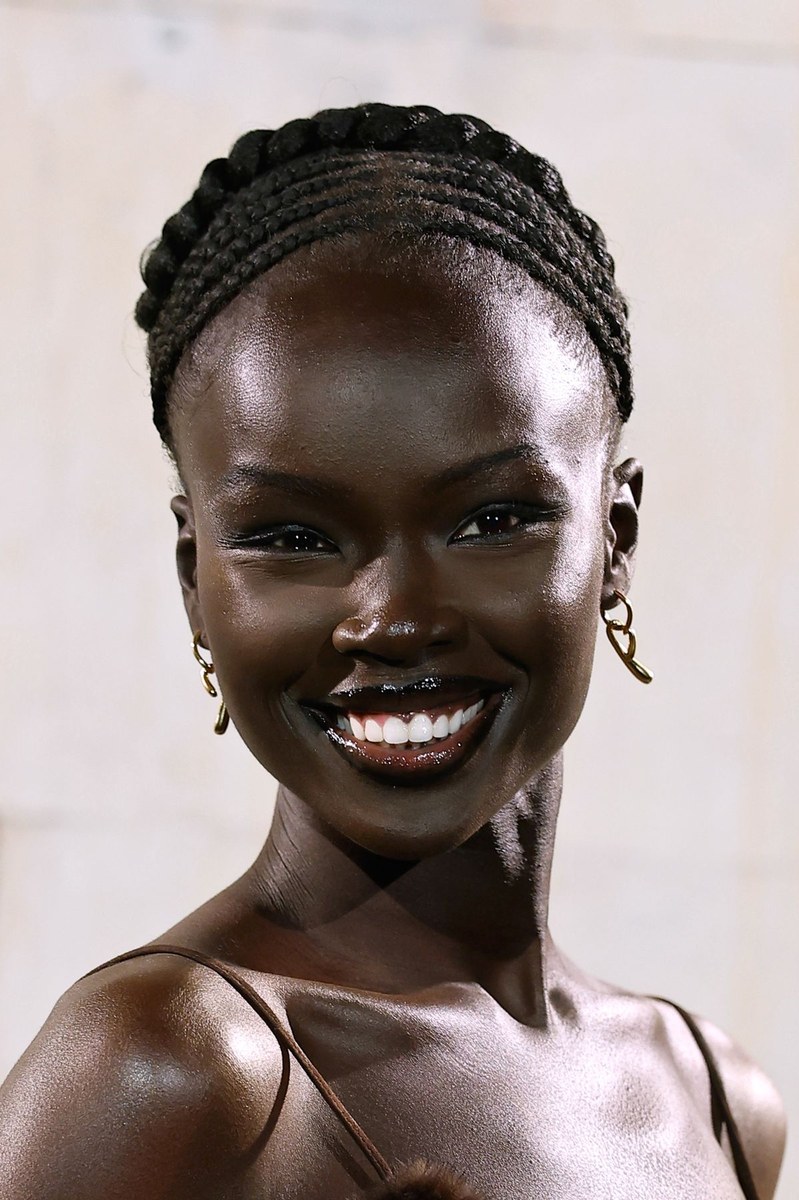
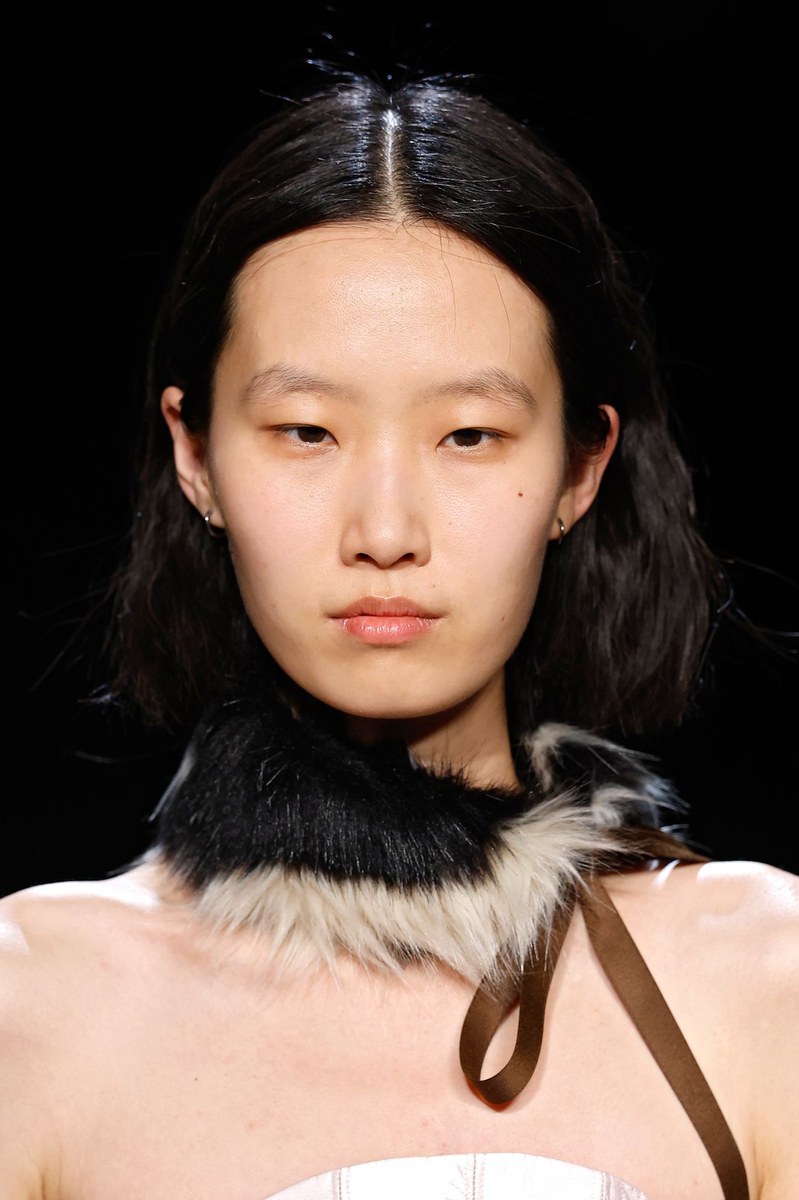
Charcoal, washed black and deep navy anchor the first half, with grey plaid and pinstripe patterns providing surface variation within that near-monochromatic register. Looks 1 through 11 sustain a cooled-down, nocturnal mood with consistent discipline. Sharp pivot arrives at Look 12, introducing saturated red, cobalt blue and warm caramel brown, colors that reappear in Looks 13 through 18 and push the energy toward a 1970s collegiate warmth. These two palette chapters read like two distinct delivery drops rather than a single blended range, which is a practical advantage for phased buying.

Look 12
Look 12

Materials and Textures

Distressed denim dominates, appearing in rigid washed-black Bermuda shorts, wide-leg jeans with tonal patchwork panels (Look 17), and midi skirts with raw, fraying hems throughout Looks 1, 2 and 11. Plaid wool or wool-blend fabric in a grey and black windowpane pattern covers the double-breasted blazers in Looks 3 and 4, and recurs as a midi skirt in Look 6 and wide-leg trousers in Look 15. Look 5 introduces a pinstriped satin or silk-weight fabric with substantial drape and a large ruffled collar, reading significantly lighter and more fluid than the rest of the lineup. Velvet-textured black fabric, likely a cotton velvet or velveteen, anchors Looks 2 and 19, giving those pieces a matte, light-absorbing surface against the sheen of the large leather totes carried alongside them.

Look 17
Look 17

Styling and Layering

The open, no-shirt layering convention runs through the majority of looks, treating the jacket or shirt as an outer layer worn directly against skin. This is a deliberate brand gesture rather than a practicality, and buyers should read it as a styling directive for editorial and visual merchandising rather than a literal wear prescription. Footwear divides cleanly into two categories: a chunky buckled ankle boot with shearling or sock trim, worn across the darker first chapter, and a chunky platform sneaker in white, yellow, blue or pink, worn across the brighter second chapter. Small structured top-handle bags appear in nearly every look, confirming this silhouette as the hero accessory of the season.

Look by Look Highlights

Look 1 The patchwork layering of grey plaid, pinstripe and star-print fabrics across a single sleeveless vest silhouette makes this a strong editorial opener and a reference point for cut-and-sew mixed-fabrication development.

Look 1
Look 1

Look 5 High-ruffled collar pinstripe midi dress in slate grey is the collection's most directional womenswear piece, with the raw lace hem and chunky black sneaker grounding what could otherwise read as purely archival.

Look 5
Look 5

Look 6 A black floral-print knit layered over a grey plaid midi skirt is the most straightforward commercial styling formula in the lineup and the easiest look to translate into a retail buy without styling risk.

Look 6
Look 6

Look 11 All-black pinstripe shirt with a grey leather tie-detail at the collar, belted over a distressed denim midi skirt, is a complete and self-contained outfit with strong sell-through potential across multiple consumer age brackets.

Look 11
Look 11

Look 12 Saturated red pinstripe shirt, blue denim distressed Bermuda shorts and cobalt platform sneakers mark the collection's tonal pivot and read as the clearest signal for color direction in the spring transitional floor set.

Look 17 Patchwork wide-leg jeans in contrasting blue denim washes, paired with a double-breasted navy velvet jacket and a red leather belt, deliver the collection's most fully resolved 1970s reference and a strong candidate for a hero display look.

Look 18 Mixed-fabric vest in brown plaid, navy and ivory pinstripe with a purple leather collar layered over heavily distressed ultra-wide blue denim jeans is the highest-risk, highest-reward look for specialty or concept-store buyers targeting a younger, trend-forward customer.

Look 18
Look 18

Look 19 Navy midi dress with scattered metallic star and crescent moon embroidery, worn with grey shearling-trim buckle boots and a large black leather tote, translates the punk-celestial mood into a single wearable, lower-barrier commercial piece.

Look 19
Look 19

Operational Insights

Hero bag repeat: Small structured top-handle bags appear in virtually every look across both chapters, confirming this as the season's primary leather goods driver. Buyers should treat it as a carry-over investment piece and negotiate depth, not breadth, of SKU count.

Two-chapter buying strategy: Two distinct sections emerge here, a dark chapter (Looks 1 to 11) and a color chapter (Looks 12 to 19) with near-zero overlap in palette. Product managers should plan floor transitions and delivery windows separately for each chapter to avoid visual dilution on the sales floor.

Denim fabrication priority: Distressed black and blue denim appears across shorts, skirts, jeans and patchwork constructions. Sourcing and production teams should secure fabric early, as the tonal wash variation and distressing level will require significant lead time to execute consistently across SKUs.

Footwear segmentation: Buckled shearling ankle boots and platform sneakers serve two distinct consumer moods and should be treated as separate category buys. Conflating them in a single footwear order risks muddying the brand story at point of sale.

Celestial embellishment signal: Star and moon motifs appear on Look 1 (as fabric print), Look 7 (as hardware stud on outerwear) and Look 19 (as metallic embroidery on a dress). This recurring motif is strong enough to anchor a capsule or a marketing moment and should be tracked as a potential licensed or exclusive-print opportunity for key wholesale accounts.

Complete Collection

Look 2
Look 2
Look 3
Look 3
Look 4
Look 4
Look 7
Look 7
Look 8
Look 8
Look 9
Look 9
Look 10
Look 10
Look 13
Look 13
Look 14
Look 14
Look 15
Look 15
Look 16
Look 16
Look 20
Look 20
Look 21
Look 21
Look 22
Look 22
Look 23
Look 23
Look 24
Look 24
Look 25
Look 25
Look 26
Look 26
Look 27
Look 27
Look 28
Look 28
Look 29
Look 29
Look 30
Look 30
Look 31
Look 31
Look 32
Look 32
Look 33
Look 33
Look 34
Look 34
Look 35
Look 35
Look 36
Look 36
Look 37
Look 37
Look 38
Look 38
Look 39
Look 39
Look 40
Look 40
Look 41
Look 41
Look 42
Look 42
Look 43
Look 43
Look 44
Look 44
Look 45
Look 45

About the Designer

Stuart Vevers was born in 1973 in Doncaster, South Yorkshire, in the industrial north of England. Both his parents left school at fifteen, and the house he grew up in had no obvious pathway into the arts or fashion. What it had was a grandmother who made costumes for the local amateur dramatics society, who owned a sewing machine and didn't ask too many questions when her teenage grandson turned up with two meters of PVC fabric wanting to make trousers for a Saturday night out. Vevers was tall for his age and could get into nightclubs from around fifteen; his education in clothes happened entirely through the experience of dressing for them, cutting images from magazines, working out what he wanted to wear, and occasionally making it. He had a poster for Gus Van Sant's My Own Private Idaho on his bedroom wall and a deep, largely self-taught obsession with American music — the Beastie Boys, Bruce Springsteen, Janet Jackson — absorbed from a place where America existed only through film and record sleeves. He completed a foundation course at art school in Carlisle and, at eighteen, moved to London alone to study womenswear at the University of Westminster, working five nights a week at a bar to fund it.

He graduated in 1996 and almost immediately landed a job at Calvin Klein in New York, arriving in the city at one of the more electrically charged moments in its recent cultural history. After two years he returned to Europe: Bottega Veneta headhunted him to Milan, where he worked as accessories designer and first met Luella Bartley, with whom he would collaborate for eight years. Stints at Givenchy and then Louis Vuitton under Marc Jacobs followed, giving him a decade inside some of the most technically rigorous design operations in the industry. In 2004 he became creative director of Mulberry, won Accessory Designer of the Year at the British Fashion Design Awards in 2006, and then moved to Madrid in 2007 to run Loewe for LVMH. He spent six years there, transforming it from a well-regarded Spanish leather house into a brand with genuine international momentum.

In 2013 Coach brought him to New York as executive creative director, replacing Reed Krakoff after a sixteen-year tenure. The brief was a reset — and the ambition, which Vevers had pitched at his initial interviews, was to introduce ready-to-wear and stage runway shows at New York Fashion Week, repositioning a leather-goods company as a full fashion house with a distinct attitude. The first show came in September 2015. His references at Coach have been consistently, almost devotionally American: road-trip films, Springsteen, NASA logos, Little House on the Prairie, hip-hop, downtown New York in the nineties. The Tabby bag, revived and re-proportioned, became one of the defining accessories of the early 2020s. The brand has ranked among the five hottest fashion houses globally on the Lyst Index. Vevers was awarded the OBE in 2024 and continues as creative director, a role he has held for over twelve years. He lives in New York with his husband and their twins.

"I come from a working-class family. Both my parents left school at 15. I think I brought that working-class fear. It drives me and gets me up in the morning."

"Things that an American would find everyday, I still find exotic, and I'm excited by the everyday. A lot of American references I grew up with, I saw on films or through music. I'm still very inspired by America when I travel and experience it."

✦ This report was generated with AI — combining human editorial vision with Claude by Anthropic. Because the future of fashion intelligence is already here.