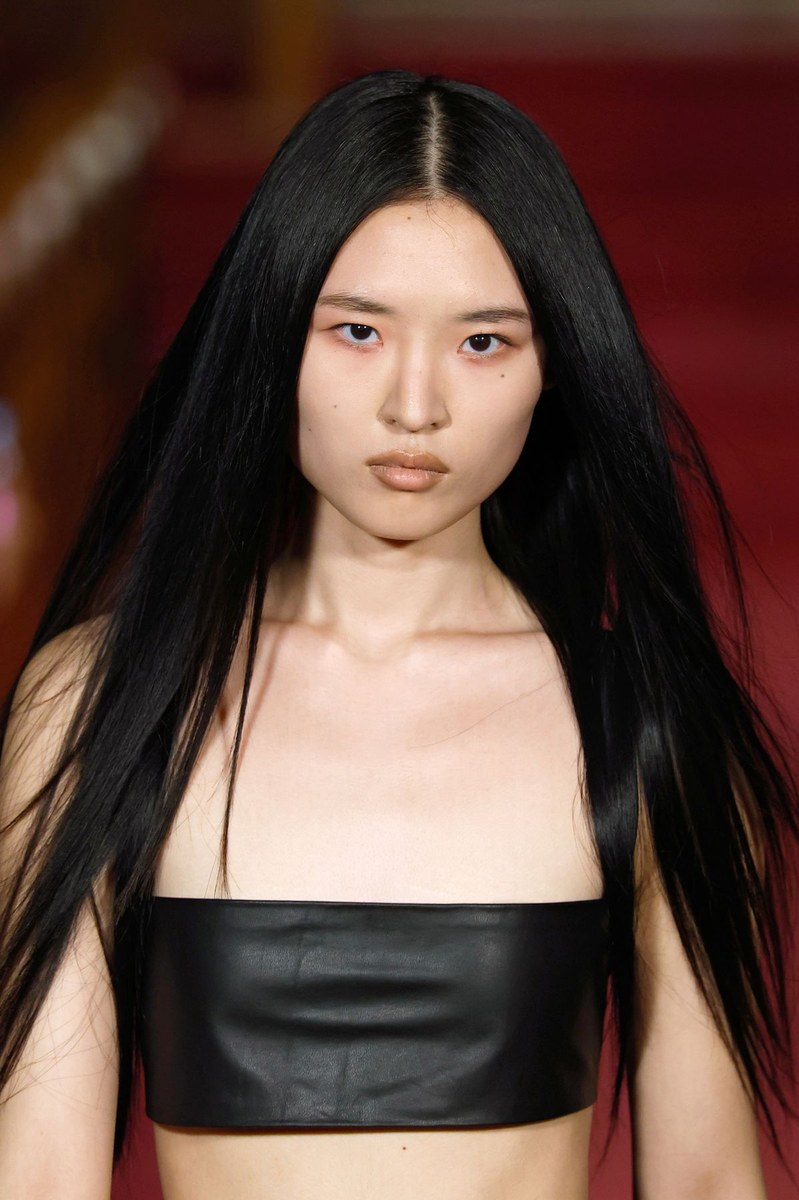
Collina Strada FW26 Women Looks Report
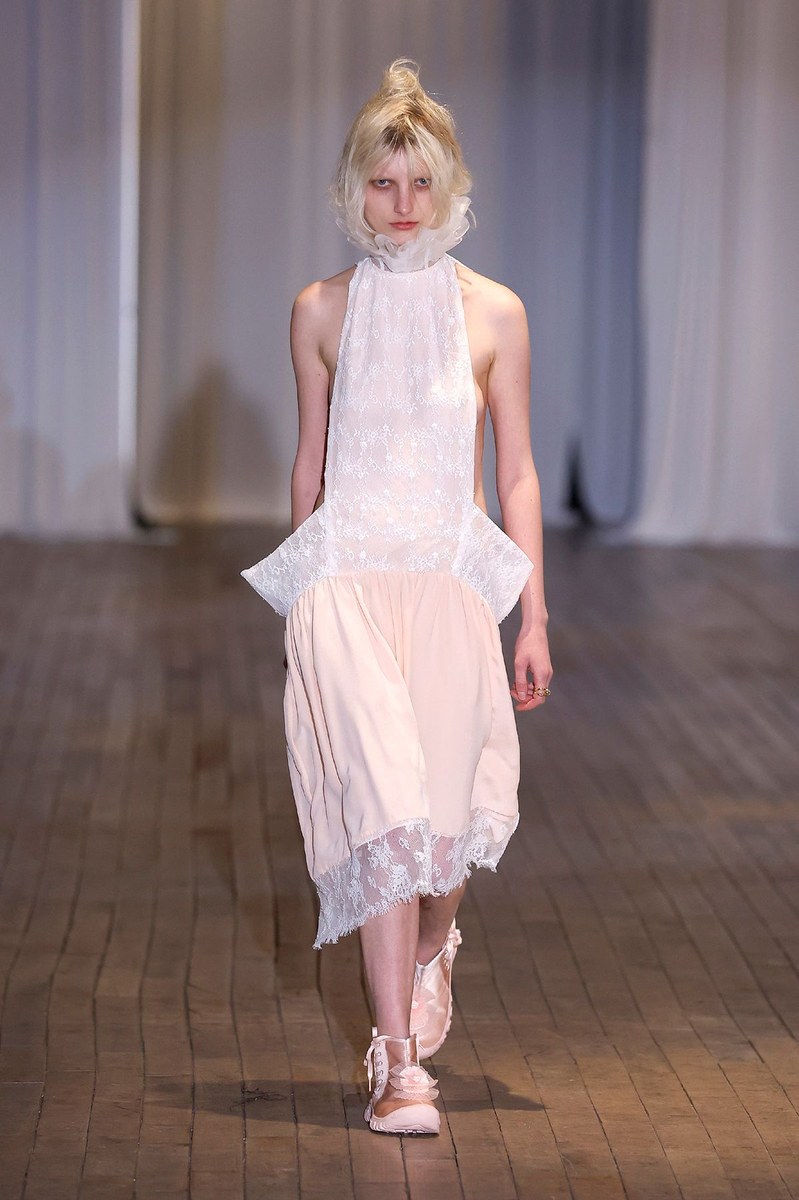
New York Fashion Week
Collina Strada FW26 builds a wardrobe from deliberate contradiction, placing lace against cargo denim, leopard print against pixelated plaid, and ball gown volume against combat boots. For buyers navigating a market fatigued by clean minimalism, maximalist layering and inclusive casting emerge here as a commercial direction, not just a runway statement.
Silhouette and Volume
Two dominant shapes anchor the collection: a collapsed, blouson-hemmed drop-waist dress (Look 1, Look 10) and a floor-grazing, asymmetrically draped column (Look 2, Look 16, Look 19). Wide-leg trousers with exaggerated cargo pockets ground the more voluminous tops in both denim and suiting weights (Look 9, Look 20). Ruffled and tiered midis appear throughout the middle of the range (Look 4, Look 11), while Look 18's oversized topcoat reads as the strongest outerwear statement. Nothing sits close to the body except the slip silhouettes, and even those carry ruching and surface distortion.
Color Palette
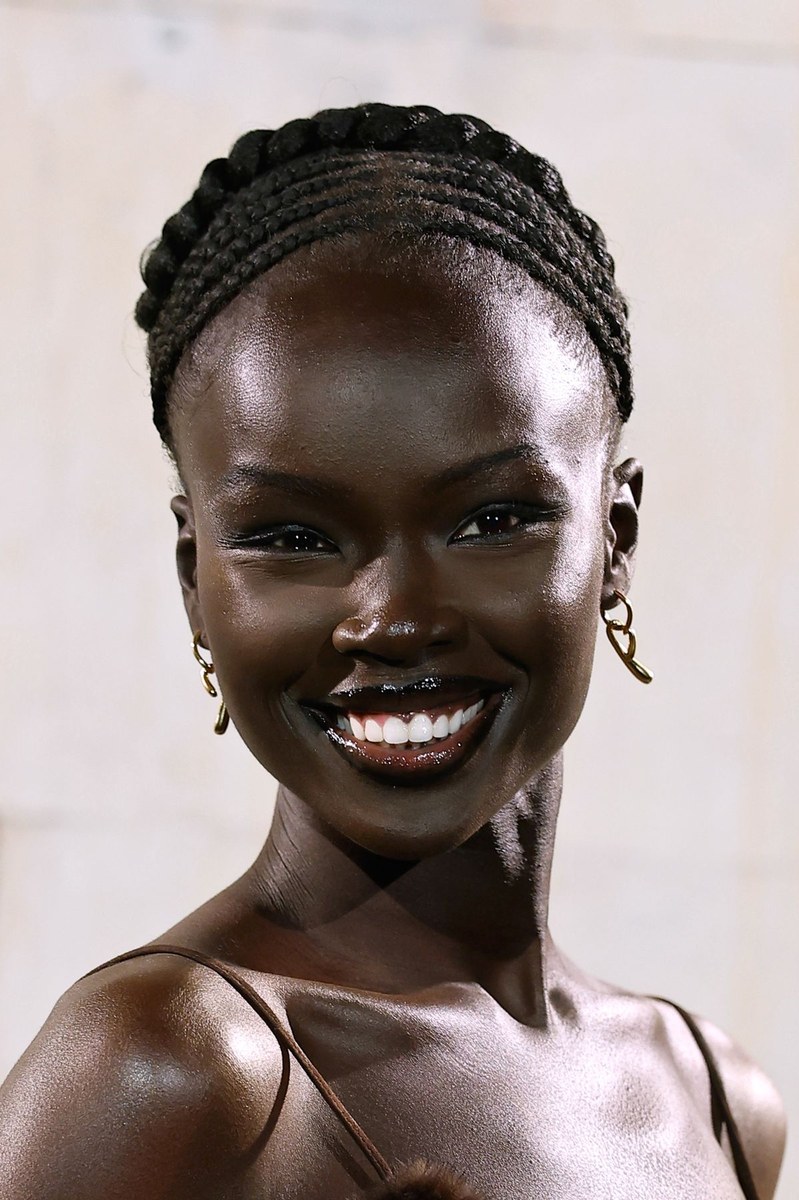
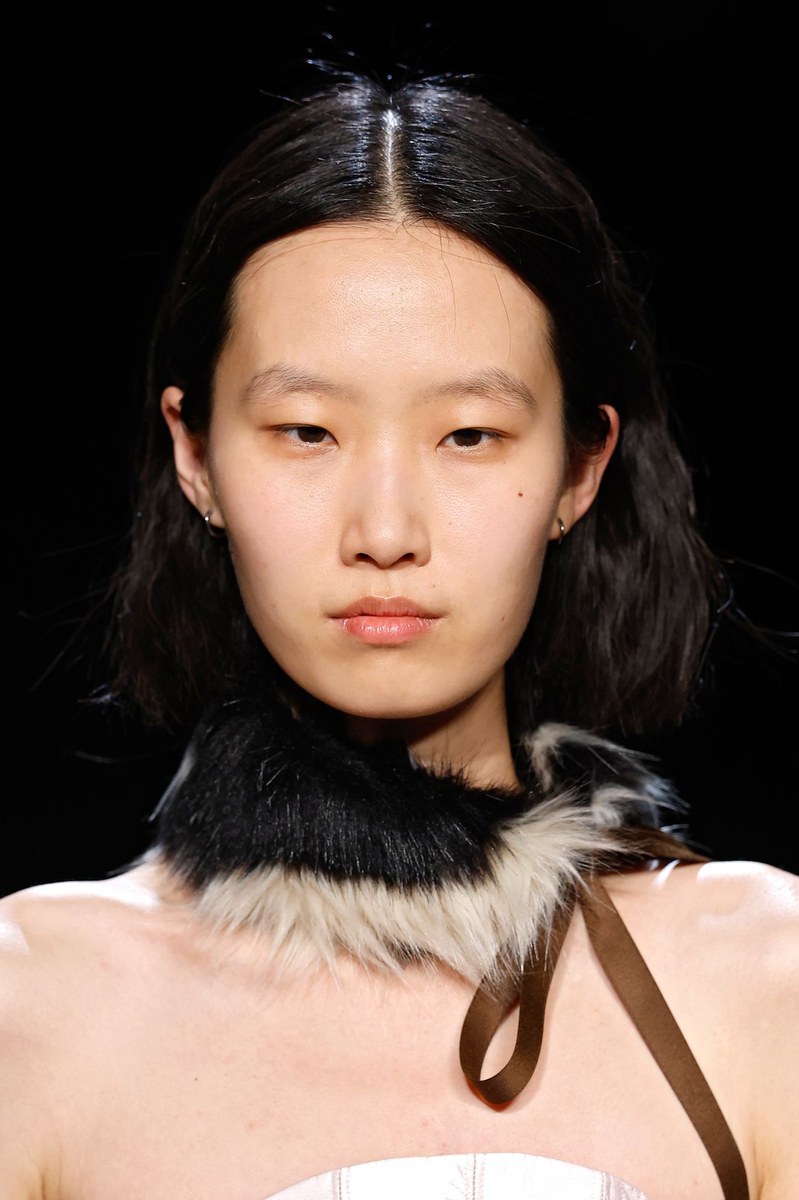
Opening looks operate in a pale blush, warm white and lavender register that reads as deliberately fragile (Look 1, Look 2). From there, the collection shifts hard into bruised earth tones: dark chocolate brown, charcoal, slate blue and near-black satin (Look 7, Look 12, Look 15, Look 16). A recurring pixelated plaid in dusty mauve, rust, pale lilac and deep brown stitches the two halves together (Look 13, Look 14, Look 17, Look 18). Tortoiseshell amber, used in Look 6 and echoed in Look 8 and Look 20 as a leopard-adjacent print, adds the only true warmth to an otherwise cool, low-saturation story.
Materials and Textures
Liquid satin dominates the eveningwear, used in both a matte-faced purple (Look 7) and a high-shine black (Look 16), with enough body to hold the draped constructions without collapsing. A pixelated woven plaid appears across at least four distinct fabrications, from sheer georgette (Look 14 top) to dense velvet (Look 17 slip dress) to what reads as a bonded organza for Look 18's coat. Curly Persian lamb or a convincing faux equivalent reappears as jacket (Look 12), bag (Look 7, Look 9), belt trim (Look 14) and hood (Look 14 neck piece), functioning as a recurring textural signature rather than a single hero piece. Lace borders, visible at the hem of Look 1 and Look 10 and throughout Look 19, pull the collection toward a lingerie reference that runs quietly under the heavier outerwear fabrics.

Styling and Layering
A sheer, split-sleeve top in pale grey or olive layered over slip dresses and camisoles appears as a consistent base formula (Look 3, Look 13, Look 17). This three-part structure of sheer shell plus cami plus bottom is the clearest repeatable commercial unit in the range. Footwear splits into two camps: chunky black lace-up boots worn with both formal and casual looks (Look 10, Look 13, Look 15), and embellished sneakers or satin ballet-adjacent shoes (Look 1, Look 9) that reframe occasion dressing. Crystal and rhinestone collar necklaces appear on nearly a third of the looks, functioning as the primary jewelry logic and an accessible entry-price accessory for wholesale. The fluffy, sculptural black tote in Look 7 and the large curly-fur bag in Look 9 read as the most commercially viable bag shapes shown.

Look by Look Highlights
Look 1 The white lace halter-neck drop-waist dress with blush silk bloomers reads as a direct bridal or resort buy, while the embellished satin sneaker adds a youth-market price point to an otherwise occasion-driven garment.
Look 4 Blue and cream plaid with extreme puff sleeves and cascading asymmetric ruffles. This is the single strongest volume piece for a specialty retailer looking for a statement dress that photographs well.

Look 6 A model using a power wheelchair wearing the tortoiseshell jersey draped set confirms the brand's commitment to adaptive-adjacent design and gives buyers a clear signal about the sizing and fit range intended here.

Look 10 The brown and white airbrushed halter-neck drop-waist dress in silk charmeuse with a white lace petticoat hem is a cleaner, more wearable rework of Look 1 and likely the stronger commercial performer at full-price.

Look 15 An oversized black organza-faced topcoat worn over a pixelated plaid top and wide navy trousers. This is the most gender-neutral look in the collection and represents a direct opportunity for a unisex coat buy.

Look 17 The pixelated velvet slip dress in deep brown, dusty lilac and rust layered over the olive split-sleeve shell best communicates the collection's print direction to a product manager sourcing wovens and cut-and-sew knits together.

Look 18 The double-breasted oversized coat in leopard-and-plaid hybrid print on a semi-sheer base is technically complex and commercially risky, but for a retailer with a strong outerwear business, it functions as a halo piece with genuine sell-through potential.

Look 19 The black lace halter-neck jumpsuit with sheer wide-leg trousers is a direct carry-forward from Look 1 in evening weight, and matching black-on-black palette removes the styling risk that keeps buyers away from sheer categories.

Operational Insights
Print development: The pixelated plaid in dusty mauve, rust and lilac is the collection's most transferable print asset. Buyers should request strike-offs across velvet, chiffon and woven suiting to evaluate cross-category breadth.
Layering system: The split-sleeve sheer shell in grey and olive functions as a modular layering piece across at least four looks. A standalone SKU for this style, sized broadly, would extend the collection's commercial reach without additional pattern investment.
Outerwear priority: Look 15 and Look 18 represent the two ends of the outerwear offer, from a clean unisex topper to a print-heavy statement coat. Evaluate Look 15 first for breadth and Look 18 for depth at key accounts with a print-forward customer.
Accessory entry price: Crystal collar necklaces appear with enough frequency to position them as a branded accessory category. Style directors sourcing add-on items should flag these for exclusive or limited wholesale arrangements given their low production complexity.
Sizing and fit signal: Casting across the show includes models in a wide range of body types and one model using a power wheelchair, which signals that the brand is building patterns with real fit range in mind. Buyers should ask for the full size run before placing orders to confirm grading consistency across the wider silhouettes.
Complete Collection


About the Designer
Hillary Taymour grew up in Palos Verdes, a coastal enclave south of Los Angeles where the main activities were surfing and riding horses. She was the kid who threw tantrums because her dolls didn't have the right clothes for where she was taking them. She enrolled at college to study finance, dropped out, and went to fashion school in Los Angeles instead — beginning to make handbags in between classes, eventually producing over three hundred of them before she had any formal brand infrastructure in place. In 2008 she started Collina Strada, naming it after herself in oblique translation: a classmate had called her Collina because it means "hill" in Italian, and Strada followed as a sound she liked. She moved to New York in 2010 and shortly after found photographer and art director Charlie Engman through a Craigslist post, beginning a collaboration that would shape the visual identity of the brand for the next decade and eventually result in a monograph published by Rizzoli.
The leather handbag phase ended the day she looked around the studio and saw, in her own description, too much death. She stopped using animal-derived materials entirely, went fully vegan around 2017, and rebuilt the brand's material base around deadstock sourced from Los Angeles warehouses and Kantamanto Market in Accra, Ghana, alongside alternative fibers like rose silk, a cellulose derived from rose stems. Everything is manufactured in New York, in limited runs rarely exceeding five hundred units per style. The runway shows have been the brand's most visible expression of this thinking: a street closed near Stuyvesant Square Park with produce stacked around the set and show notes listing composting instructions; models carrying fruit and infants and flowerpots; a live performance by Hayley Williams; a sound bath played by children with chimes. The shows function as events with specific arguments to make, not backdrops for clothes.
Her references are wide and run through the body rather than the library: nature, animals, childhood, the streets of Chinatown where her studio has long been based. She has cited Ciccolina, Sigourney Weaver, and Tilda Swinton as design icons, and keeps her process material-first, building collections piece by piece, trying everything on her own body, working on the show concept with her pattern director after six in the evening when the studio empties. The brand has been a CFDA/Vogue Fashion Fund finalist, is carried at Ssense, Browns, and Assembly, among others, and continues to show at New York Fashion Week. Taymour remains its sole creative director, founder, and, effectively, its main working employee.
"I've learned not to design for other people. I've learned to trust myself. It's all instinct, or feeling."
"The best part about Collina is the freedom. We aren't locked into a certain idea of how anything has to be. The more you go off the deep end the better."
✦ This report was generated with AI — combining human editorial vision with Claude by Anthropic. Because the future of fashion intelligence is already here.