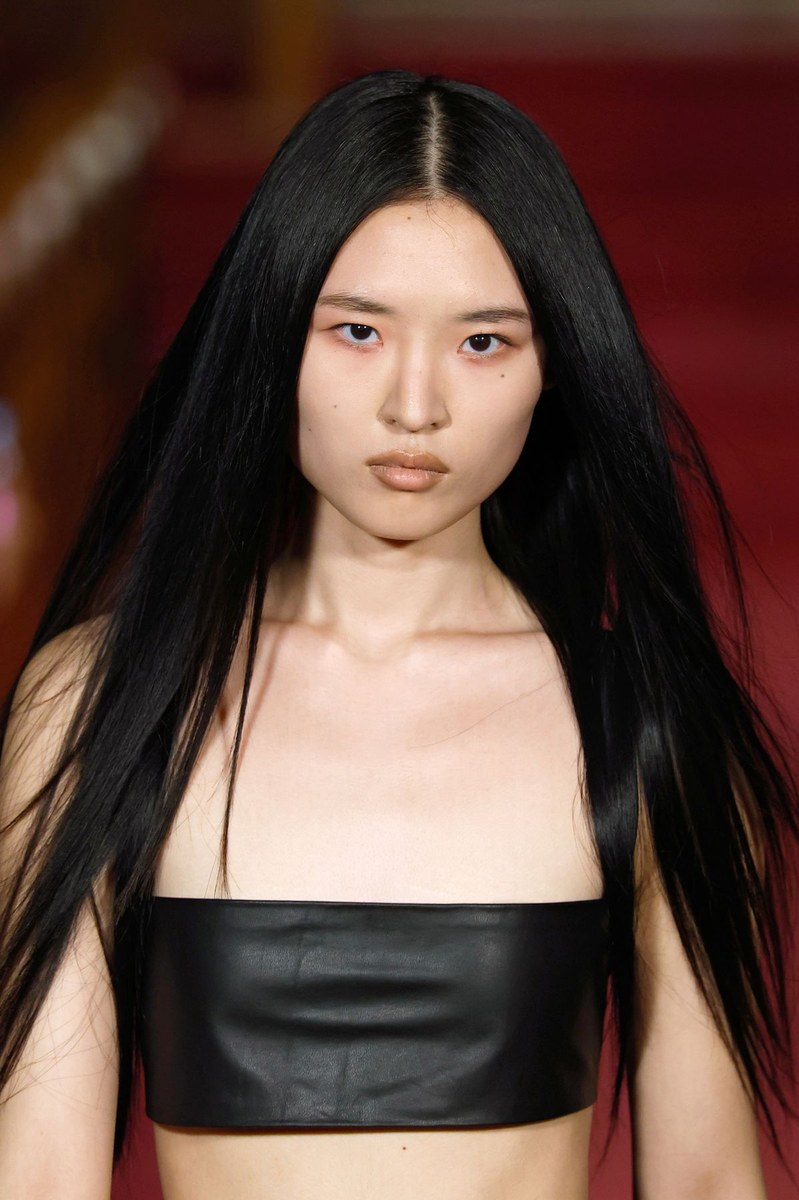
Cult Gaia FW26 Women Looks Report
New York Fashion Week
Cult Gaia FW26 builds its identity on pleating, fringe, and drape as structural languages rather than decorative afterthoughts, pulling the collection between sharp tailoring and fluid eveningwear with a dual-gender casting that broadens its commercial reach. For buyers targeting the premium contemporary and accessible luxury segments, this collection arrives at a moment when customers are actively trading up on fabrication and texture while still demanding versatility across day and occasion dressing.
Silhouette and Volume
The collection moves between two clear poles: body-skimming floor-length drape and voluminous outerwear with dropped shoulders and generous cuts. Look 4 and Look 13 anchor the tailored end, with double-breasted suiting cut wide through the chest and long through the hem. Crop-to-maxi pairings recur across Looks 3, 7, and 18, creating a midriff-revealing proportion that drives the eveningwear narrative. By Look 19, the bridal finale uses pleated fabrication to sculpt a structured mermaid silhouette, signaling that the label's signature textile work now extends fully into occasion categories.
Color Palette
The palette runs almost entirely on two axes: matte black and a range of chartreuse-to-olive greens. Within the green story, the electric yellow-green of Look 2 and Look 12 shifts gradually toward the deeper moss and army tones of Looks 5, 9, and 14, creating internal range without leaving the single family. Black carries the tailored and evening pieces, from the deep charcoal pleats of Look 1 to the feather-trimmed skirts of Look 3 and Look 20. White appears only once, in Look 19, which gives the bridal gown a clear standalone visual weight on the runway.

Materials and Textures
Pleated fabric is the dominant material across both the black and green stories, deployed with varying weights from the lightweight accordion pleats of Look 1 and Look 16 to the denser crinkle texture of Look 14. Fringe operates in three distinct applications: the floor-grazing green fringe of Look 12, the sculptural knotted fringe of Look 7, and the leather-trimmed fringe dress of Look 11, each reading differently in terms of market positioning. Feathers, used in Look 3 and Look 20, carry a matte, tightly packed quality that reads more architectural than costume. Leather surfaces in gloves (Looks 5, 6, 8, 13), trousers (Look 8), and boots (Look 5) add a cross-category material thread that supports accessory and leather goods expansion.

Styling and Layering
Footwear splits cleanly between platform sandals in green (Look 2), strappy gold sandals (Look 16), patent kitten heels (Looks 4, 8, 11), and knee-high leather boots (Looks 5, 7). Long leather gloves appear on both womenswear and menswear looks, functioning as a consistent styling signature rather than a one-off accent. Bags remain minimal and architectural, including a boxy green clutch in Look 2 and a dark structured doctor bag in Look 8. Look 15 layers a maximalist gold chain top under an oversized black blazer, the one moment where jewelry functions as a garment layer and signals a strong wholesale accessory story.
Look by Look Highlights
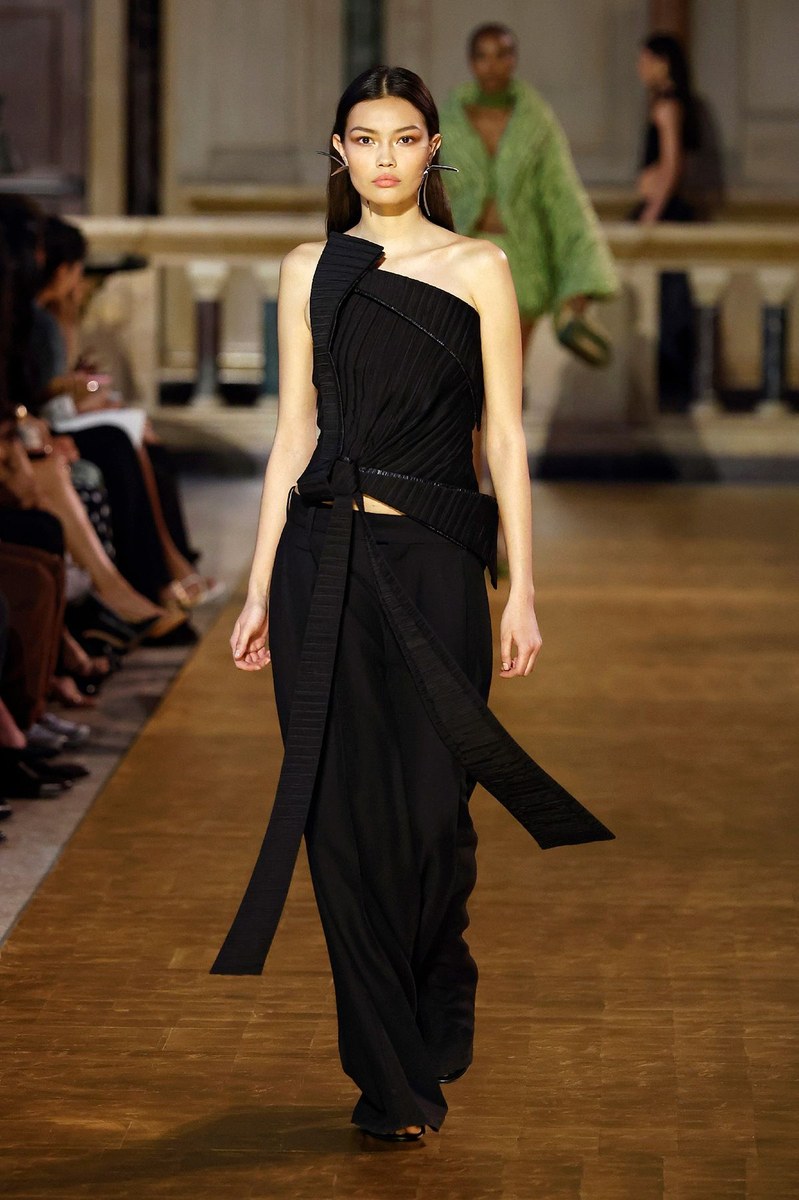
Look 1 The one-shoulder black pleated top with a wrapped sash skirt establishes the pleating technique as a construction device capable of building both volume and structure at the same time.
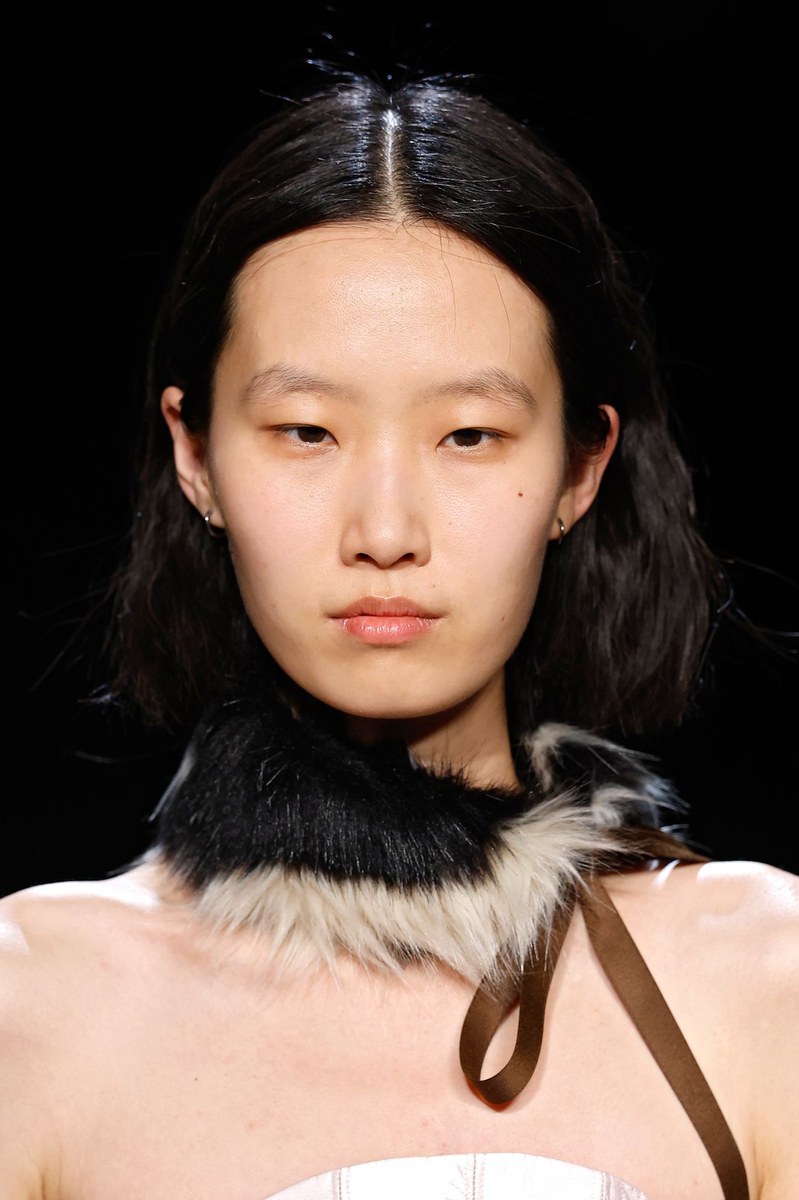
Look 2 The chartreuse crinkle-textured oversized jacket worn open over a matching micro skirt with a ruched neck scarf creates a head-to-toe tonal green statement that will perform well as a set purchase.
Look 7 The black knotted fringe crop top and low-slung skirt paired with over-the-knee leather boots is the collection's strongest editorial piece and the look most likely to drive press placement.

Look 12 The floor-length green fringe dress with a high neckline reads as a direct red-carpet proposition and should be prioritized for special occasion buyers and rental platforms.

Look 15 Stacking multiple gold chain necklaces as a top layer over a black turtleneck under an oversized blazer converts a jewelry piece into a commercial outfit driver with strong cross-sell potential.

Look 16 The olive pleated gown with cut-out waist and radiating fan pleats at the shoulder is the most technically complex piece in the lineup and speaks directly to buyers seeking fabrication-forward eveningwear with a point of difference.

Look 17 A black silk slip with baroque lace appliqué panels running asymmetrically across the body brings a luxury lingerie sensibility into eveningwear and targets a customer currently spending on elevated slip dressing.

Look 19 The white strapless mermaid gown constructed entirely in accordion pleat fabric with sculptural bow detail at the hip positions Cult Gaia as a credible bridal player, a category the brand has not previously pushed this explicitly.

Operational Insights
Pleating as a production priority: The volume and variety of pleated fabric treatments across at least eight looks signals that pleating is the brand's core technical investment this season. Buyers should expect longer lead times and higher per-unit costs on these pieces and plan margins accordingly.
Green as a commercial color story: The chartreuse-to-olive green range runs across separates, outerwear, gowns, and accessories, which means buyers can build cohesive green floor sets without relying on black for contrast. This is a strong capsule-building opportunity for specialty retailers.
Fringe in three price tiers: Fringe appears as a knotted craft texture in Look 7, a fluid floor-grazing treatment in Look 12, and a leather-integrated detail in Look 11, which gives buyers the ability to select fringe at different price points and for different customer occasions without cannibalizing across the assortment.
Dual-gender casting as a buying signal: Looks 6, 13, and 14 are worn by male models but the silhouettes and fabrications read as gender-open. Style directors at multi-brand retailers should flag these for gender-neutral floor placements or at minimum coordinate menswear and womenswear buys from the same delivery.
Bridal entry point requires early commitment: Look 19 is a single bridal look but its technical construction and the presence of a veil suggest the label intends to develop this category. Buyers with bridal or occasion floors should initiate conversations with the brand now to understand production minimums and exclusivity windows before the broader market moves.
Complete Collection


About the Designer
Jasmin Larian Hekmat was born and raised in Los Angeles, inside a household where making things was the baseline condition. Her father, Isaac Larian, ran MGA Entertainment and created the Bratz dolls; she grew up designing miniature outfits for the figures and spending time in his workshop, absorbing the logic of products built to become cultural objects. Her mother was a fashion designer turned sculptor who had studied at FIDM, and the family linen closet was packed with remnants of fabric and trim from those years. Larian Hekmat learned to sew on paper before she could do much else. The lesson her mother preferred was one of self-sufficiency: when she gave her daughter a Barbie, she refused to buy the house, insisting she build it herself. That disposition — make it yourself, make it recognizable, make it worth looking at — runs through everything that followed.
She moved to New York to study fashion design and international marketing at FIT, where she interned at Narciso Rodriguez and Jason Wu and worked simultaneously on an evening-wear line that never quite went anywhere. The thing that did go somewhere was the flower crowns she was making on the side and wearing out with friends to clubs in Manhattan. Bouncers started recognizing the group as the girls with the flowers in their hair. A friend told her to stop trying to launch a clothing line and just sell the crowns. She listened, named the brand after Gaia — the Greek goddess of the earth and the daughter of Chaos — and launched Cult Gaia in Los Angeles in 2012. Two years later she designed the Ark bag: a half-moon structured carry made of bamboo slats, which sat unnoticed for another two years before it flooded Instagram in 2016 and landed in the hands of Beyoncé and Rosie Huntington-Whiteley. She watched, as she later described it, the anatomy of a trend.
The Ark was the proof of concept and the permission slip. Ready-to-wear came because she needed clothes to style alongside the bags in lookbooks without borrowing from elsewhere; shoes followed when Net-A-Porter approached her for an exclusive collaboration. The brand's design logic has stayed consistent throughout the expansion: architecture and nature as opposing forces, a preference for things that look like objects before they look like clothes, a stated belief that the slight asymmetry and imperfection found in natural forms is what makes them worth studying. Destinations like Saint-Tropez and Saint-Barths feed her eye as much as her studio does; she has described gathering ideas less through formal sketching and more through accumulating fragments of texture and shape while moving through unfamiliar places. She was named to Forbes 30 Under 30 in 2017 and remains founder, creative director, and CEO of the brand, which is headquartered in Los Angeles and sells globally.
"When we're designing things, we think: if it sits alone on a coffee table, does it look like a piece of art? When you walk down the street, is someone going to be like, 'Oh my god, what is that?' I want people to think about whether or not they can pull it off, otherwise it's a little too basic."
"When a piece captures a feeling rather than a trend, it becomes larger than fashion. Cultural iconography happens when design becomes a symbol of a moment or mindset."
✦ This report was generated with AI — combining human editorial vision with Claude by Anthropic. Because the future of fashion intelligence is already here.