Diotima FW26 Women Looks Report

Diotima FW26 Women Looks Report
Diotima FW26 Women Looks Report

New York Fashion Week

Diotima FW26 builds a wardrobe around the tension between structural tailoring and tactile, almost sculptural textile work, routing that tension through a color story anchored in earth, charcoal and warm neutrals. For buyers navigating a market that wants considered luxury without obvious logomania, this delivers clear commercial entry points alongside statement pieces with strong editorial pull.

Silhouette and Volume

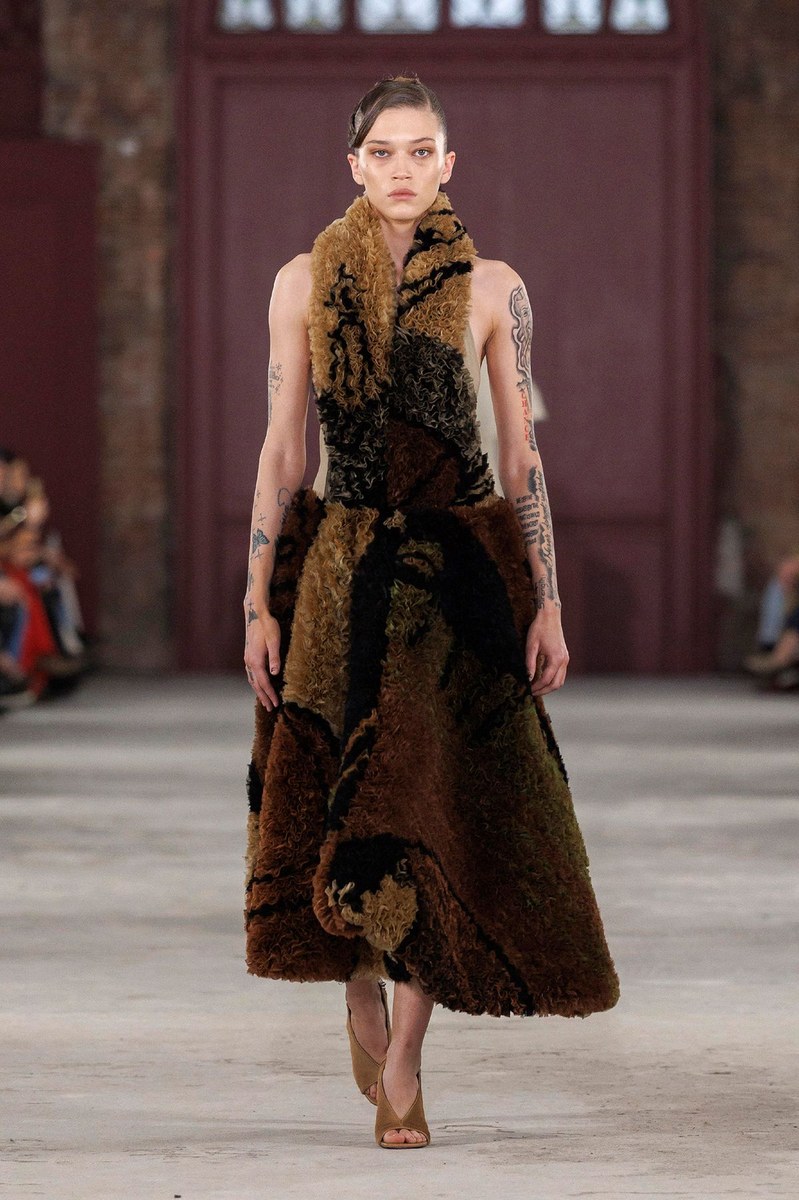
A flared, midi-to-floor-length silhouette that widens from the hip appears repeatedly throughout, in both fluid tailoring (Look 3, Look 8) and heavily textured shearling constructions (Look 1). Pronounced shoulder and collar architecture defines the coats, with oversized wrapping collars in Look 2 and Look 7 adding volume at the top rather than the hem. Trouser cuts run wide and long, pooling slightly at the ankle in Looks 11, 14 and 18. The overall effect reads tall, weighty and deliberate.
Look 3
Look 3

Color Palette

Tawny brown, dense black and warm stone dominate the opening sequences, creating an autumnal palette without rusticity. Looks 9, 10 and 16 pull camel and tobacco together, reinforcing a burnished warmth that runs through the collection's center. Forest green arrives with authority in Look 11 and Look 18, and the olive-tinged khaki net dress of Look 13 bridges the warm neutrals with something cooler and more mineral. Black remains the backbone, appearing across at least half the looks either as a primary or as a grounding contrast.

Look 11
Look 11

Materials and Textures

Shearling cut in graphic, patchwork-style tonal panels anchors Looks 1 and 9, with dense, curled pile set against close-cropped areas to create surface contrast within a single garment. Tightly pleated and pin-tucked cotton or poplin constructions appear on the shirts of Looks 9 and 10, giving rigidity and surface interest simultaneously. Macramé or knotted-net column dresses in Looks 12 and 13 carry structural weight despite their open construction, reading more like armor than drape. Fluid silk-weight fabric in Look 5 and the printed silk charmeuse of Look 6 introduce lightness and movement that counterbalance the heavier textile moments.

Look 5
Look 5

Styling and Layering

A structured or textured outer piece consistently pairs over a restrained base, as seen in Look 7 where a boxy shearling jacket lands over a laddered-knit turtleneck and layered grey suiting. Footwear trends toward open-toe block-heeled mules in warm tan leather (Looks 1, 9, 13) and square-toed low heels, keeping the foot visible without feminizing the silhouette in an obvious way. Fringe gloves carried in Looks 2 and 8 function as accessories that extend the textile story of the garments rather than accessorizing in a conventional sense. Green beaded fringe gloves in turquoise appear in Look 15, the one moment of color punctuation that reads as a deliberate buying signal for accessory departments.

Look 7
Look 7

Look by Look Highlights

Look 1 The sleeveless shearling coat in tonal brown and black patchwork makes the strongest single-garment case for an investment outerwear buy, with a silhouette wide enough to style over volume.

Look 1
Look 1

Look 2 Stone-colored shearling with its collapsed wrap collar reads as an accessible commercial anchor that can move across multiple customer profiles without heavy styling.

Look 2
Look 2

Look 3 Black Mandarin-collar wool in a clean A-line cut is the most immediately wearable tailoring piece and the safest reorder candidate in the collection.

Look 9 Pairing a precision pin-tucked camel shirt with a floor-length shearling skirt in black and brown demonstrates a separates strategy that allows buyers to retail top and bottom independently at different price points.

Look 9
Look 9

Look 11 A floor-length green and black houndstooth trench coat worn over wide black trousers is a strong hero outerwear piece with enough classical reference to carry a broad retail audience.

Look 12 Black crystal-embellished knotted column dress with shoulder cutouts and attached long sleeves is the clearest eveningwear hero and the most likely look to generate press pickup at retail launch.

Look 12
Look 12

Look 18 Double-breasted olive wool with a dramatically flared and dipped back hem worn over wide trousers is structurally complex and positions as a designer-level statement coat with real production investment.

Look 18
Look 18

Look 19 Oversized printed jacket with botanical engraving pattern and contrast khaki ribbed collar is the strongest print statement in the collection and the most forward-facing piece for buyers targeting trend-driven editorial clients.

Look 19
Look 19

Operational Insights

Shearling investment: A recurring shearling language appears across Looks 1, 2, 7 and 9, meaning buyers can justify sourcing commitments for this material across outerwear and skirts rather than treating it as a one-off piece.

Separates architecture: Several looks are structured to sell as separates (Look 9, Look 10, Looks 16 and 17), giving product managers a unit flexibility that supports both full-look and individual SKU buying strategies.

Accessory signal: Fringe gloves appearing in Looks 2, 8 and 15 represent a deliberate accessory category push. Style directors should flag these for accessory edits as standalone items, particularly the turquoise beaded version from Look 15.

Look 15
Look 15

Print strategy: Looks 6 and 19 carry distinct print identities, one figurative silk and one graphically engraved, that allow print-focused buyers to edit into the collection without committing to the heavier textile investment pieces.

Eveningwear entry: Looks 12 and 13 form a two-piece eveningwear chapter that gives formal buyers a clear assortment option. Both dresses rely on textile construction rather than embellishment volume, which supports a higher perceived value at a potentially more competitive production cost.

Complete Collection

Look 4
Look 4
Look 6
Look 6
Look 8
Look 8
Look 10
Look 10
Look 13
Look 13
Look 14
Look 14
Look 16
Look 16
Look 17
Look 17
Look 20
Look 20
Look 21
Look 21
Look 22
Look 22
Look 23
Look 23
Look 24
Look 24
Look 25
Look 25
Look 26
Look 26
Look 27
Look 27
Look 28
Look 28
Look 29
Look 29
Look 30
Look 30
Look 31
Look 31
Look 32
Look 32
Look 33
Look 33
Look 34
Look 34
Look 35
Rachel Scott

About the Designer

Rachel Scott was born in Kingston in 1984, into a household that ran on making things. Her father was a furniture-maker; her mother owned a clothing boutique and once bought her a Barbie doll but refused to buy the house, insisting she build it herself. Scott grew up between the city and the Jamaican countryside, her mother pulling her out of school to travel, sitting her in the jump seat of Air Jamaica planes. The doilies crocheted by every auntie and grandmother on the island, the G-string swimsuit covers sold to tourists at the beach, the men in Kingston still wearing organza shirts and sweeping lace-trimmed trousers: all of it went in, though she wouldn't understand how much until years later. She left for Colgate University in upstate New York in 2002, where she studied fine art, art history, and French, and spent summers interning at Vogue and taking classes at Central Saint Martins. She already knew she was heading toward fashion; she just wanted the widest possible intellectual foundation first.

After Colgate, she enrolled at Istituto Marangoni in Milan and interned at Costume National, where the technical standards were exacting and the embellishment obsessive — sequins stood on their ends to simulate astrakhan, a level of artifice that she found genuinely astonishing. She stayed in Milan four and a half years before visa complications ended that chapter. She interviewed for roles with Phoebe Philo at Céline and Sarah Burton at Alexander McQueen, didn't land either, and flew home to her parents' house in Jamaica feeling the defeat of it. A college friend called from New York, and she went. She spent time at J.Mendel, then at Elizabeth and James, then joined Rachel Comey in 2015, working her way up to vice president of design for ready-to-wear and footwear. Those were the years that built the technical architecture. When the pandemic arrived and she was finally still enough to act on what had been quietly accumulating for a decade, she bootstrapped Diotima with thirty thousand dollars of personal savings and launched it in 2021 at the age of thirty-seven.

The brand is named after Diotima of Mantinea, the ambiguous female philosopher in Plato's Symposium who teaches Socrates about desire — though Scott arrived at the name through Herbert Marcuse's Eros and Civilization first, not through the original Greek. The clothes work along similar lines of tension: hand-crocheted doilies sourced from women's cooperatives across Jamaica, starched and distorted into harnesses and ruffled skirts; sharply tailored suiting set against transparent mesh; structure placed directly against skin. Scott's mother now manages the network of artisan crochet partners spread across the island, women who work from home as farmers and nurses and makers. Diotima won the CFDA Emerging Designer of the Year award in 2023 and the Womenswear Designer of the Year in 2024. In September 2025, Scott was named creative director of Proenza Schouler, where her debut collection showed during New York Fashion Week in February 2026. She continues to run Diotima alongside that role.

"I've always been obsessed with language, and that's really how I even view fashion. The clothes that we wear are like our vocabulary."

"Working with artisans is a deeply political act. I've always been political. It's very important to me to share our cultural heritage and make sure the artisans receive the recognition they deserve."

✦ This report was generated with AI — combining human editorial vision with Claude by Anthropic. Because the future of fashion intelligence is already here.