Eckhaus Latta FW26 Women Looks Report

Eckhaus Latta FW26 Women Looks Report
Eckhaus Latta FW26 Women Looks Report

New York Fashion Week

Eckhaus Latta FW26 builds a wardrobe around body inclusivity and gender fluidity, running both womenswear and menswear silhouettes through the same collection without hierarchy or apology. For buyers navigating a market where size range and gender-neutral product are no longer niche propositions, this reads as a direct commercial signal.

Silhouette and Volume

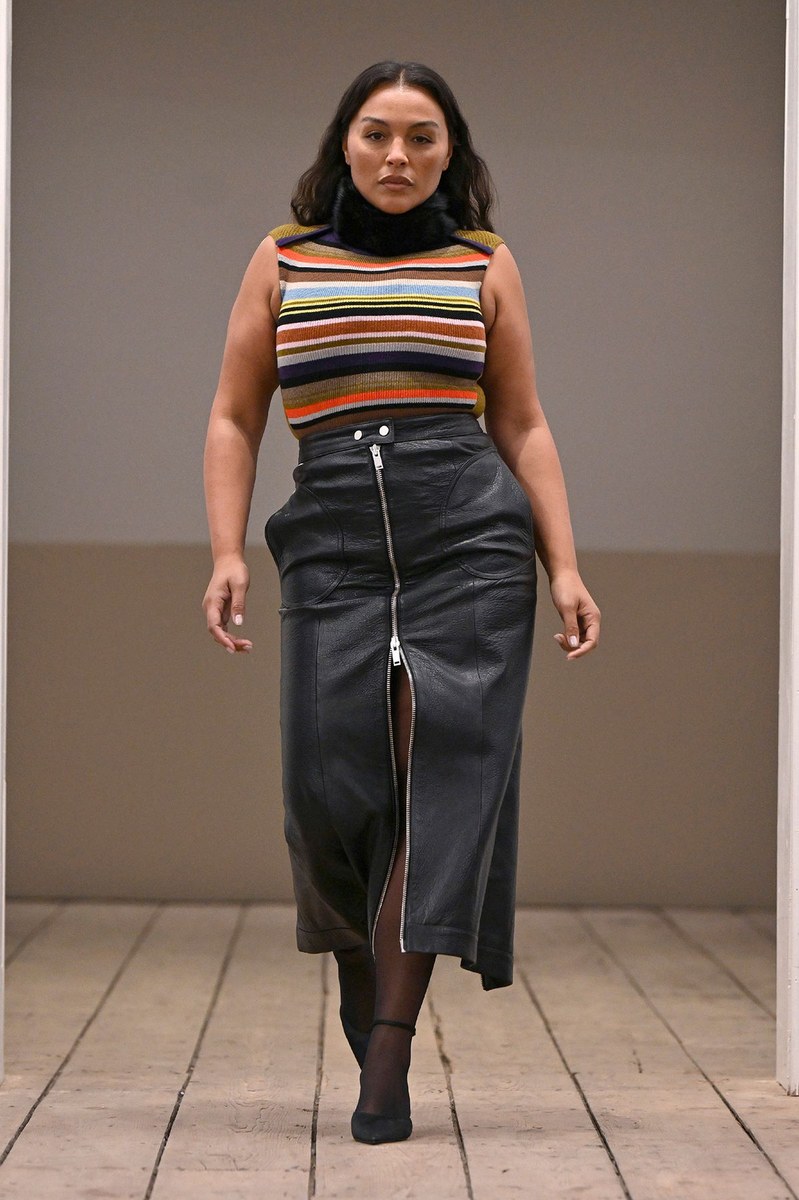
Two distinct volume registers split the collection: close-fit ribbed knits and draped jersey dresses on one side, and ballooned wide-leg trousers, oversized outerwear and dropped-crotch denim on the other. Look 8 anchors the wide-leg story with exaggerated barrel-leg dark denim paired with a cropped plaid jacket. Look 12 and Look 19 collapse volume entirely into the outerwear layer, leaving the bottom half deliberately slim. A high-waisted leather midi skirt with a center-front zipper introduces Look 1, creating a sharp pencil line from hip to hem, one of the stronger commercial shapes in the lineup. Midi and mini coexist without tension, skirt length varying by fabrication rather than following a single seasonal directive.
Look 8
Look 8

Color Palette

A multicolor stripe opens the collection, running across mustard, rust, sky blue, coral, navy, black and cream. It repeats across Look 1, Look 2 and Look 3 with enough variation in cut and weight to read as a coherent family rather than a uniform. From there, the palette migrates into earth tones: warm camel, olive, tobacco brown and golden mustard dominate Looks 8 through 14, grounding the mid-collection in autumnal warmth. The final third pulls sharply toward charcoal, slate grey, ink navy and black. Look 17 delivers a silver-grey shimmer as the sole metallic accent. Energy moves from retro graphic at the open to heavy, urban cool at the close.

Look 1
Look 1

Materials and Textures

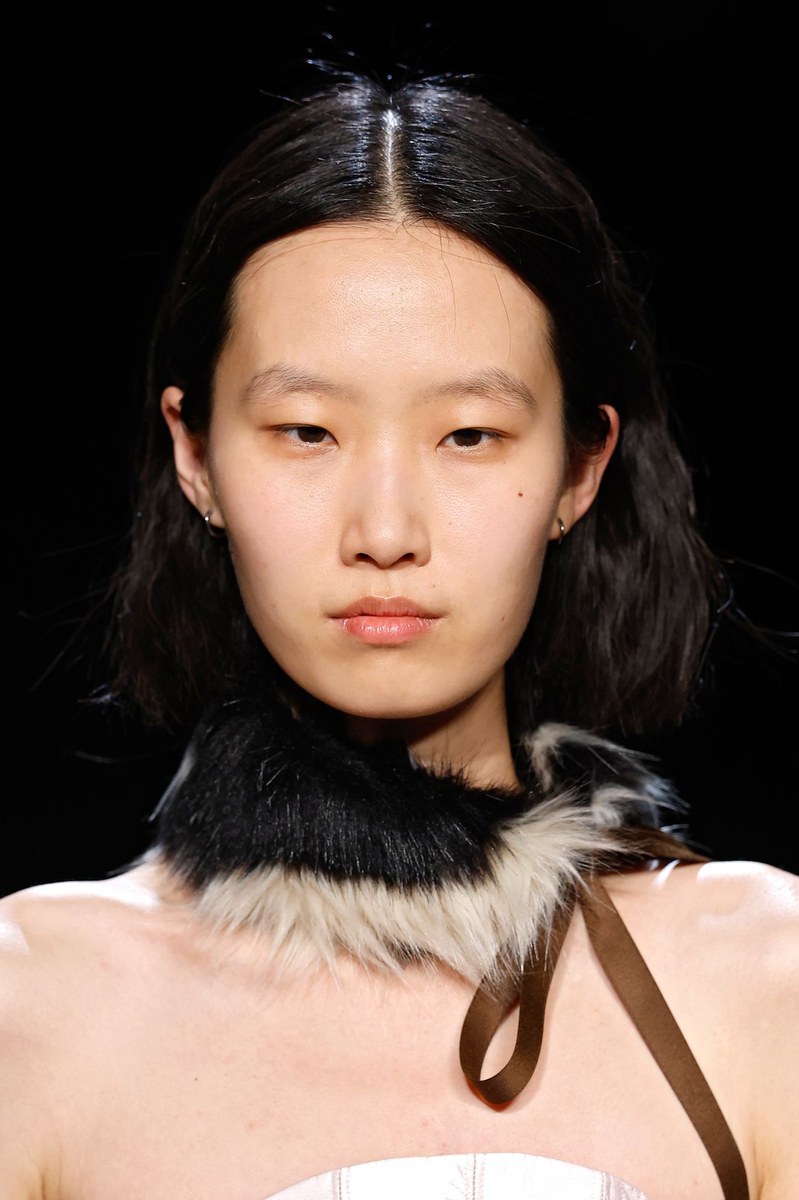
Rib-knit jersey carries significant weight here, appearing in both the sleeveless stripe top of Look 1 and the long-sleeve olive green dress of Look 13, where the fabric clings and moves with enough stretch to read body-conscious without being restrictive. Leather appears in two forms: a matte black midi skirt in Look 1 with a substantial, structured drape, and black leather trousers on the male designer at the bow in Look 20, confirming leather as a house material with real production continuity. Fur, whether real or faux, drives the outerwear statement in Looks 11, 12, 13, 14, 15, 16 and 19, ranging from a full golden fox-tone jacket in Look 12 to fur trim used as a scarf or collar accent in Look 16. Suede reappears as a consistent bag material in mustard gold across Looks 2, 3, 9, 10 and 13, giving the accessories a unified surface story.

Styling and Layering

Layering logic here is additive but casual. Shirts wear over visible inner tops in Looks 6 and 7, outerwear drops over knitwear and fur scarves in Looks 11, 14 and 18, and dresses get weighted by fur thrown over one shoulder in Look 13 rather than worn as a structured coat. Footwear stays minimal and low throughout: sheer sock boots with a square heel appear on women repeatedly, from Look 1 through Look 17, while men wear chunky lug-sole boots in black. A mustard suede bag with metal snap hardware and a wristlet handle functions as a recurring prop across multiple looks and represents the clearest standalone accessory buy in the collection.

Look 13
Look 13

Look by Look Highlights

Look 1 The matte black leather zip-front midi skirt paired with a sleeveless multicolor stripe rib-knit turtleneck is the collection's most immediately commercial silhouette, combining two strong fabrication stories in one outfit.

Look 3 A striped rib cardigan cropped above the natural waist over a black wool mini skirt with raw lace hem delivers a 1960s mod reference that translates directly into a separates buy with broad appeal.

Look 3
Look 3

Look 5 Ultra-high-waisted grey button-fly wide-leg denim with a strong center-front construction detail and a striped sheer bow-collar blouse signals a serious denim investment piece with a distinct waist treatment worth tracking for production.

Look 5
Look 5

Look 8 An oversized camel and black plaid cropped collarless jacket over barrel-leg dark denim with a sheer mauve slip underneath is the strongest outerwear plus bottom combination in the lineup for buyers developing a coordinated casual category.

Look 10 A geometric diamond-stripe polo top in warm blush and camel paired with a fuzzy plaid mini skirt in the same tone family demonstrates the collection's pattern-mixing confidence and offers a cohesive two-piece buy.

Look 10
Look 10

Look 13 An olive jersey cutout dress with a ruffle hem, worn with a curly camel fur stole draped loosely over one shoulder and the mustard suede bag, is the collection's most editorial look with the strongest potential for runway-to-editorial placement.

Look 17 A sleeveless silver-grey shimmer draped top worn with a matching bias-cut asymmetric skirt delivers a minimalist eveningwear option that contrasts the collection's dominant casualwear register and fills a gap in the Eckhaus Latta commercial range.

Look 17
Look 17

Look 19 An all-black oversized fox-fur jacket over a black satin slip skirt consolidates the fur outerwear story into its most wearable and market-ready form, with clear potential across luxury contemporary retail.

Look 19
Look 19

Operational Insights

Size inclusivity: Models across a wide body range cast the collection, including in Looks 1 and 13. Core silhouettes, stretch rib-knit dresses, high-waisted denim and oversized outerwear are all technically compatible with extended size grading without significant pattern reconstruction.

Stripe program: The multicolor horizontal stripe in Looks 1, 2 and 3 functions as a ready-made capsule. Buyers can treat the turtleneck, the pullover sweater and the button-front cardigan as a three-piece knit story that shares the same yarn palette and justifies a coordinated floor placement.

Fur outerwear risk: Looks 12 and 19 present full fur jackets with no visible labeling clarification in available images. Buyers operating in markets with fur sales restrictions, particularly California and several EU jurisdictions, should confirm material sourcing as real or faux before committing to orders.

Accessories entry point: A mustard suede snap-hardware bag appearing in Looks 2, 3, 9, 10 and 13 is the collection's most accessible price-point accessory and benefits from repeated placement across both the men's and women's looks, giving it genuine gender-neutral retail positioning.

Denim construction: Looks 5, 6, 7 and 8 each present denim with elevated waist construction, including visible button plackets, high rises and structural seaming, pointing toward a denim category strategy that differentiates on hardware and waist engineering rather than wash or distressing alone.

Complete Collection

Look 2
Look 2
Look 4
Look 4
Look 6
Look 6
Look 7
Look 7
Look 9
Look 9
Look 11
Look 11
Look 12
Look 12
Look 14
Look 14
Look 15
Look 15
Look 16
Look 16
Look 18
Look 18
Look 20
Look 20
Look 21
Look 21
Look 22
Look 22
Look 23
Look 23
Look 24
Look 24
Look 25
Look 25
Look 26
Look 26
Look 27
Look 27
Look 28
Look 28
Look 29
Look 29
Look 30
Look 30
Look 31
Zoe Latta and Mike Eckhau

About the Designer

Mike Eckhaus grew up in New York; Zoe Latta in Santa Cruz, California. Both were born in 1987, and both ended up at the Rhode Island School of Design, where they circled each other for a while before actually meeting. They are known to have initially intimidated each other. At RISD, Latta studied textiles and Eckhaus chose sculpture after considering and rejecting the apparel department — the conversational register of the fine art program interested him more. That decision, born more from intellectual curiosity than from any deliberate career strategy, turned out to define the way Eckhaus Latta would eventually work: learning construction by doing it, figuring out pattern-cutting from the inside, taking a single night class at FIT and otherwise teaching themselves everything. After graduating in 2010, Eckhaus designed accessories at Marc by Marc Jacobs, worked in the studio of artist Matthew Barney, and spent time with the fashion collective Three As Four. Latta designed knitwear at Opening Ceremony, ran a textile company called Prince Ruth whose prints and fabrics supplied Calvin Klein and Proenza Schouler, and held a fellowship at the Ratti Textile Center at the Metropolitan Museum.

By 2011 they had both hit a wall with work shaped by other people's market instincts, and Eckhaus Latta came out of that frustration. The first collection showed in New York for Spring 2013. The label arrived without Instagram, without SSENSE, without the infrastructure that would come to define how young brands build themselves in the years after — and that absence of scaffolding, they've since suggested, gave them a kind of freedom that would have been harder to find later. They were genuinely working it out: fishing line, plastic, transparent leather that changes with the weather, deadstock sourced before European mills became part of the equation. The clothes were material-led from the start; silhouette followed texture, not the other way around. Casting followed the same logic, filling runway shows with artists, friends, musicians, and people who had never modeled and didn't look like they were supposed to.

The art world took notice early and persistently. Group shows at MoMA PS1 and the Hammer Museum gave way to a full exhibition at the Whitney in 2018 — the first fashion-related show there in over two decades — and work has since appeared at the 55th Venice Biennale. The brand was an LVMH Prize finalist the same year as the Whitney show. They now operate bicoastally, with studios and stores in both New York and Los Angeles, maintaining the split across cities without formally dividing their roles or their titles. For their Spring 2025 presentation at New York Fashion Week they ditched the runway entirely, hosting a dinner instead and collaborating with Depop to put guests in archival pieces from earlier collections. The label has been running for well over a decade and still operates as its own thing.

"Sculpture gave me space and a different sense of critical thinking. It allowed me to come to the foundational elements of making clothing through less traditional means. When we started Eckhaus Latta, we were teaching ourselves everything." (Mike Eckhaus)

"The majority of the time the design is material-led. Even if we haven't found the material — sometimes we'll only have a texture first, or the idea of a texture, and then the silhouette comes." (Zoe Latta)

✦ This report was generated with AI — combining human editorial vision with Claude by Anthropic. Because the future of fashion intelligence is already here.