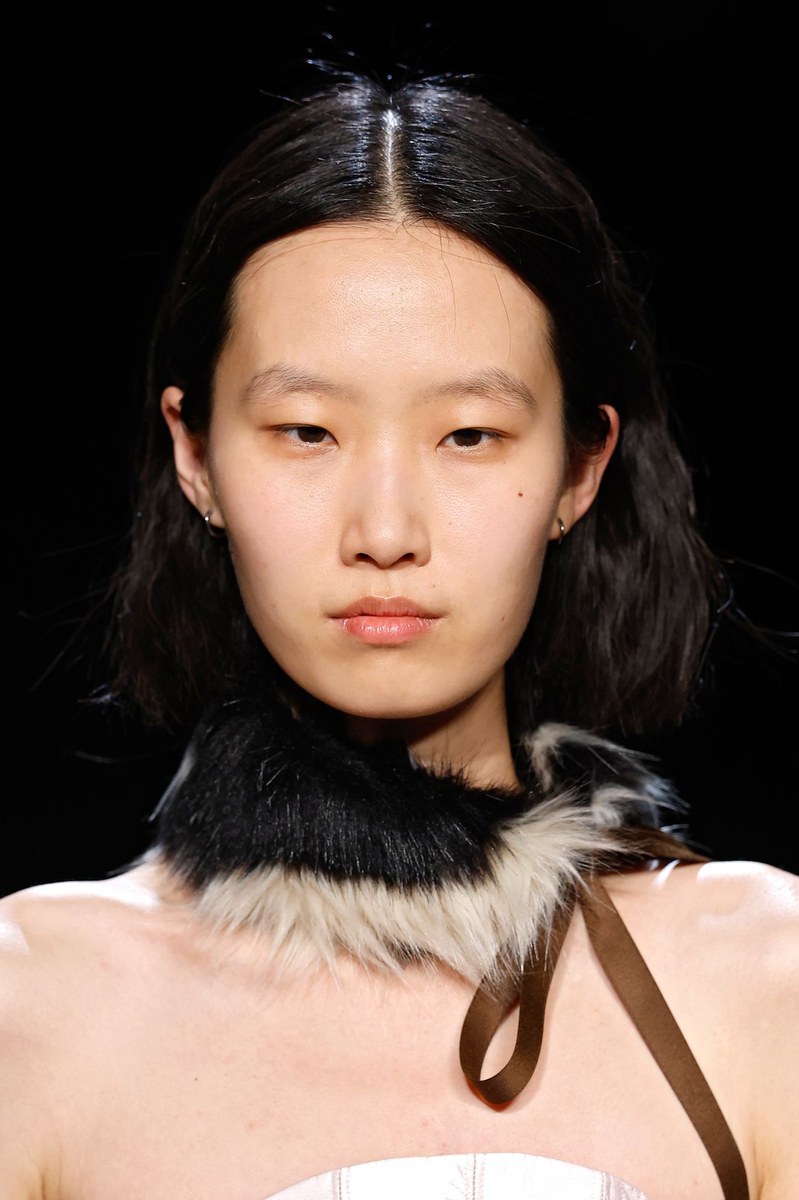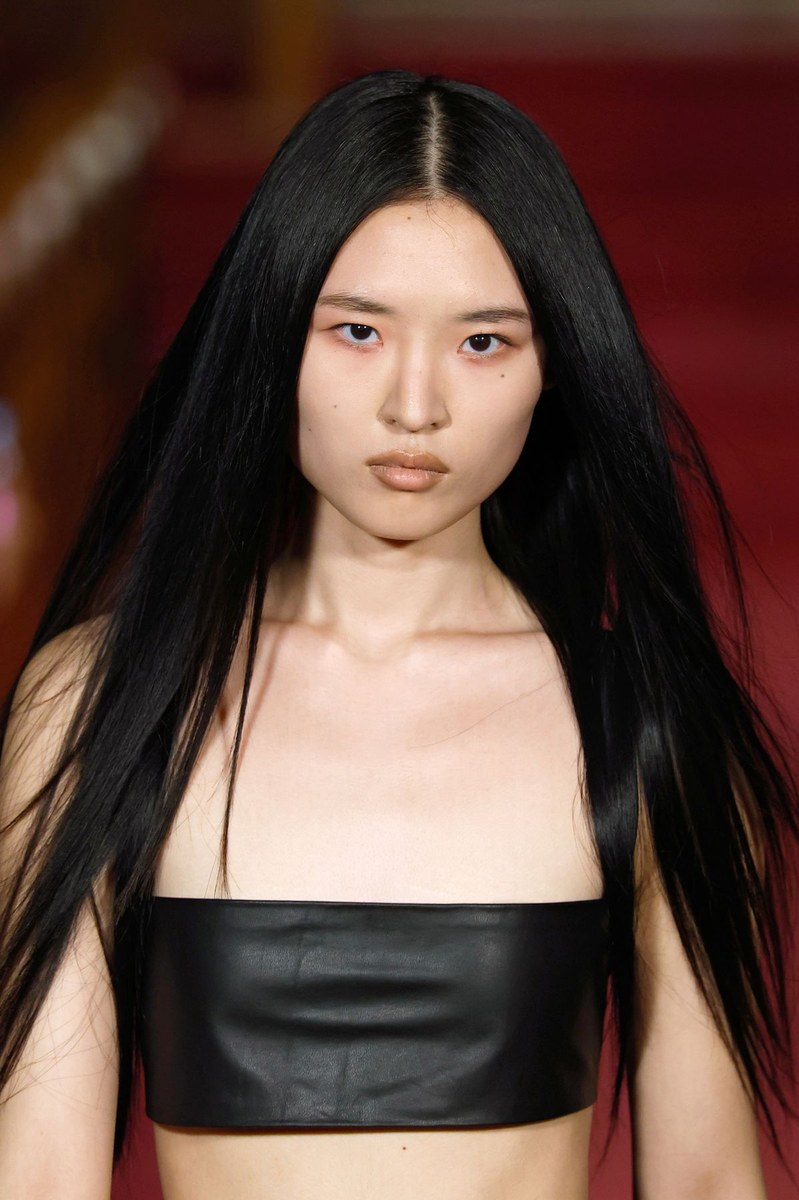
FForme FW26 Women Looks Report
New York Fashion Week
FForme FW26 builds a complete cold-weather wardrobe around three tonal registers, black, warm grey, and camel-to-gold, treating volume and texture as the primary design tools rather than decoration. For buyers navigating a market fatigued by maximalist prints, this collection delivers high-conviction wardrobe staples with enough material richness and silhouette drama to justify full-price positioning.
Silhouette and Volume
Two distinct approaches anchor the collection. Columnar floor-length dressing appears in Looks 1, 3, 9, and 11, while enveloping cocoon or cape volumes define Looks 2, 4, and 17. Structured width at the shoulder and torso dominates the midpoint, particularly in the fur-yoke constructions of Looks 13 and 15, where the upper body reads almost architectural. Shorter hemlines appear only in Looks 14, 16, 17, and 18, anchored by opaque hosiery that extends the leg line and keeps proportions deliberate rather than casual.
Color Palette
Black carries the first nine looks, creating an extended monochromatic run that reads as a strong, singular buy bloc. From Look 10 forward, champagne satin, ochre gold velvet, and a consistent warm camel tone running through knitwear, leather, and fur shift the mood. Grey bridges both halves, present in Looks 3, 4, and 18. Look 19 closes on an ivory fringe column, functioning as the collection's only true neutral contrast.

Materials and Textures
Crushed and panne velvet carry the most visual weight. Look 9's strapless black gown and Look 11's deeply textured ochre dress showcase pile compressed and wrinkled to read almost like burnished metal. Pony-effect and shearling-adjacent fur appear as full coats (Look 12) or as wide rectangular yoke panels (Looks 13, 15), providing the tactile anchor across both color groups. Fluid satin in Looks 10 and 8 sits at the lighter end of the material range, with liquid drape contrasting against ribbed-knit constructions in Looks 16 and 18. Look 19's ivory fringe dress introduces raw-edge textile that reads handcraft without veering into craft-market territory.

Styling and Layering
A single footwear formula anchors every look: a flat or very low sock boot in a tone-on-tone match that disciplines the silhouette from hem to floor. Fur hats with trappers-style ear coverage appear across Looks 2, 4, 5, 8, 10, 16, and 18, functioning less as accessories and more as structural extensions of the outerwear logic. Layering remains spare. A sheer turtleneck under the grey strapless dress in Look 3 and a white fringed knit turtleneck visible under the black fur jacket in Look 14 are the primary instances where underlayers read as a deliberate second piece rather than just a base.

Look by Look Highlights
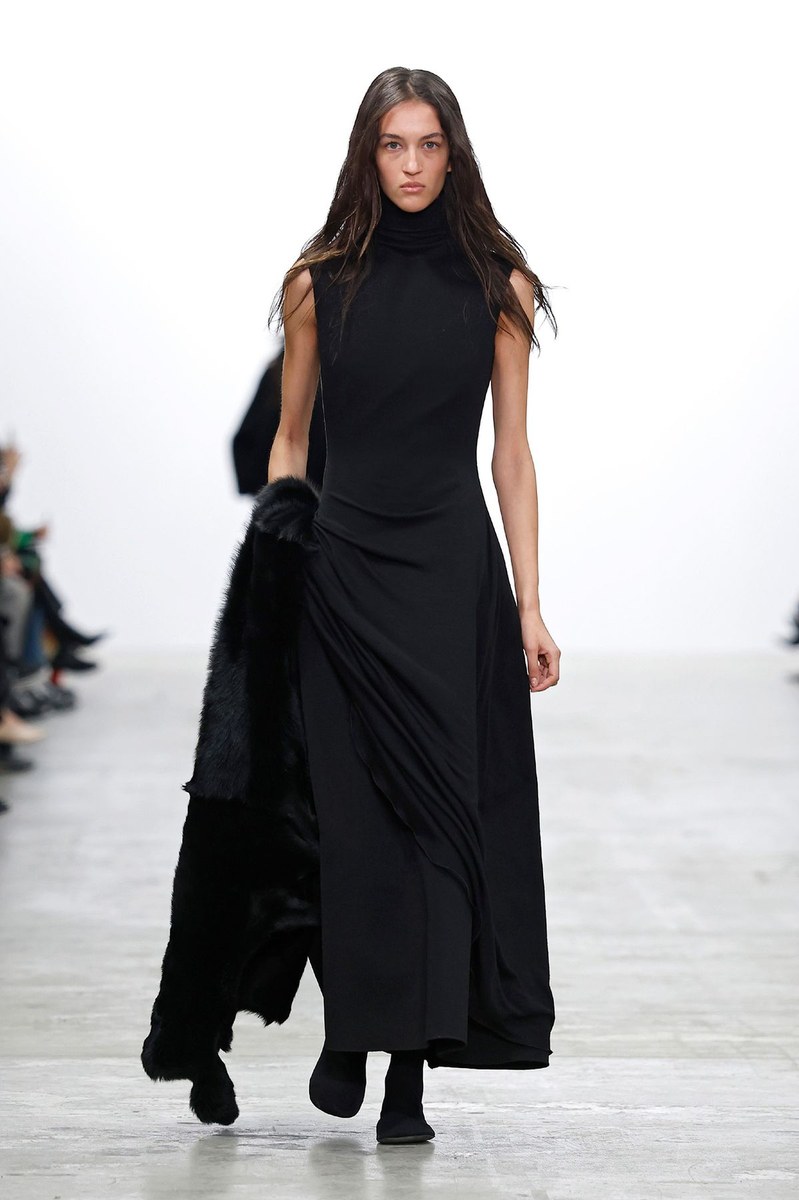
Look 1 A sleeveless black turtleneck column dress carried with a draped black fur coat in hand establishes the collection's core commercial proposition, a single strong dress with an outerwear add-on that sells as a set.

Look 3 The grey strapless dress worn over a sheer long-sleeve turtleneck is the collection's most layerable and size-inclusive silhouette, making it a strong candidate for broad-door retail.
Look 9 A black velvet strapless gown with ruched waist compression is the clearest evening entry point and the look most likely to translate directly into formal occasion buying.
Look 11 The ochre crushed velvet off-shoulder gown with a boned or seamed bodice reads as a hero dress, with enough sculptural construction at the waist to differentiate it from category-standard velvet gowns.

Look 13 The wide fur yoke worn as a separate piece over a camel ribbed knit and leather wide-leg trousers is the collection's most modular and reorderable item, as the yoke reads as a distinct SKU with strong gifting and layering appeal.

Look 16 The sleeveless camel ribbed turtleneck mini dress with oversized detached knit sleeves is the collection's strongest social-media-facing piece, built around an exaggerated proportion that photographs at a scale disproportionate to its production complexity.

Look 17 The A-line black technical coat with a rigid bell silhouette and leather collar trim is the cleanest outerwear buy in the lineup, with broad demographic reach and a shape that works across multiple body types.

Look 19 The ivory strapless column dress with horizontal fringe panels at hem and bust closes the collection with a bridal-adjacent offering that functions equally well as a resort or occasion dress without requiring a separate category designation.

Operational Insights
Capsule structure: The black-only opening sequence (Looks 1 through 9) buys and floors as a self-contained capsule, reducing the visual noise of mixed colorways on a rack and supporting a focused hero-black seasonal campaign.
Fur yoke as separate SKU: The rectangular fur yoke panels in Looks 13 and 15 are architecturally distinct enough to produce and sell as standalone layering accessories, which allows buyers to enter the fur category at a lower unit cost and higher turn velocity than a full fur coat.
Velvet depth: Both the black velvet (Look 9) and ochre velvet (Look 11) rely on a crushed or distressed pile finish rather than standard even-pile velvet, which requires sourcing confirmation on minimum yardage and finish consistency before committing to production volume.
Hosiery dependency: At least six looks read correctly only when paired with the tone-matched sock boot or opaque tight shown on the runway. Style directors should plan coordinated hosiery and footwear fixtures at point of sale to protect the intended proportional read.
Size range consideration: The cocoon and cape silhouettes (Looks 2, 4) and the knit yoke constructions (Looks 13, 15) carry inherently wide size tolerance and should be prioritized for extended size range inclusion, as the design logic does not degrade at larger cuts the way a fitted seamed bodice would.
Complete Collection


About the Designer
Frances Howie grew up in New Zealand, a long way from the Paris ateliers and London studio rooms where she would eventually spend most of her working life. She arrived at Central Saint Martins in London during a period when the fashion department was still shaped by Louise Wilson, the famously demanding course director whose forensic approach to construction and concept left a permanent mark on nearly every designer who passed through her hands. Howie graduated in 2006 with the kind of training that prioritizes what happens inside a garment as much as what shows on the outside. She didn't linger in London. Within a short time she was in Paris, working directly alongside Alber Elbaz at Lanvin, a posting that placed her at the centre of one of the most emotionally intelligent labels operating at that moment in French fashion.
She spent nearly four years with Elbaz — long enough to absorb both his working method and his particular belief that clothes should meet a woman rather than challenge her. The habit of cutting and draping half a garment before sketching the result, building shapes through touch rather than image, stayed with her when she moved to London in 2009 to join Stella McCartney. Over more than a decade there, she climbed to design director for womenswear, developing a fluency in tailoring that critics would later describe as Savile Row in its precision. The masculine-feminine negotiation that defines tailored dressing, the intelligence embedded in a seam, the way a jacket can be both authoritative and yielding: these are the problems she worked on for twelve years before stepping away in August 2021.
Three years later, in the summer of 2024, she was named creative director of Fforme, the direct-to-consumer New York label that had already earned an unusual degree of critical respect in just two years of existence. Founded in 2022 by Silicon Valley product designer Nina Khosla and fashion executive Laura Vazquez, Fforme had been built around a quiet-luxury proposition and a rigorous approach to construction. Howie's debut runway show, presented at the Chelsea Factory in February 2025, was received as a decisive step forward: bias-cut dresses that drew comparisons to Madame Grès and Madeleine Vionnet, mohair blazers contoured to the body, trouser seams hand-frayed into a stripe of texture at the side. She presented the spring 2026 collection during NYFW in September 2025, where blues and greens began to surface among the brand's characteristic black and white. She works out of a studio in SoHo.
"Fforme — the name already suggests something sculptural, but to me the primary form is the female form. That's where I started."
"Fabric development and this unique level of textile is going to be an ongoing thing for us. We don't want to offer an idea that's inaccessible."
✦ This report was generated with AI — combining human editorial vision with Claude by Anthropic. Because the future of fashion intelligence is already here.