Gabe Gordon FW26 Women Looks Report
New York Fashion Week
Gabe Gordon's FW26 collection builds a world where early-2000s athletic casualwear collides with figure skating pageantry, flannel shirting, and deliberately undone knitwear. For buyers, this tension between cozy utility and performance drama answers a clear market appetite for nostalgic Y2K references with enough wearable weight to justify full-price positioning.
Silhouette and Volume
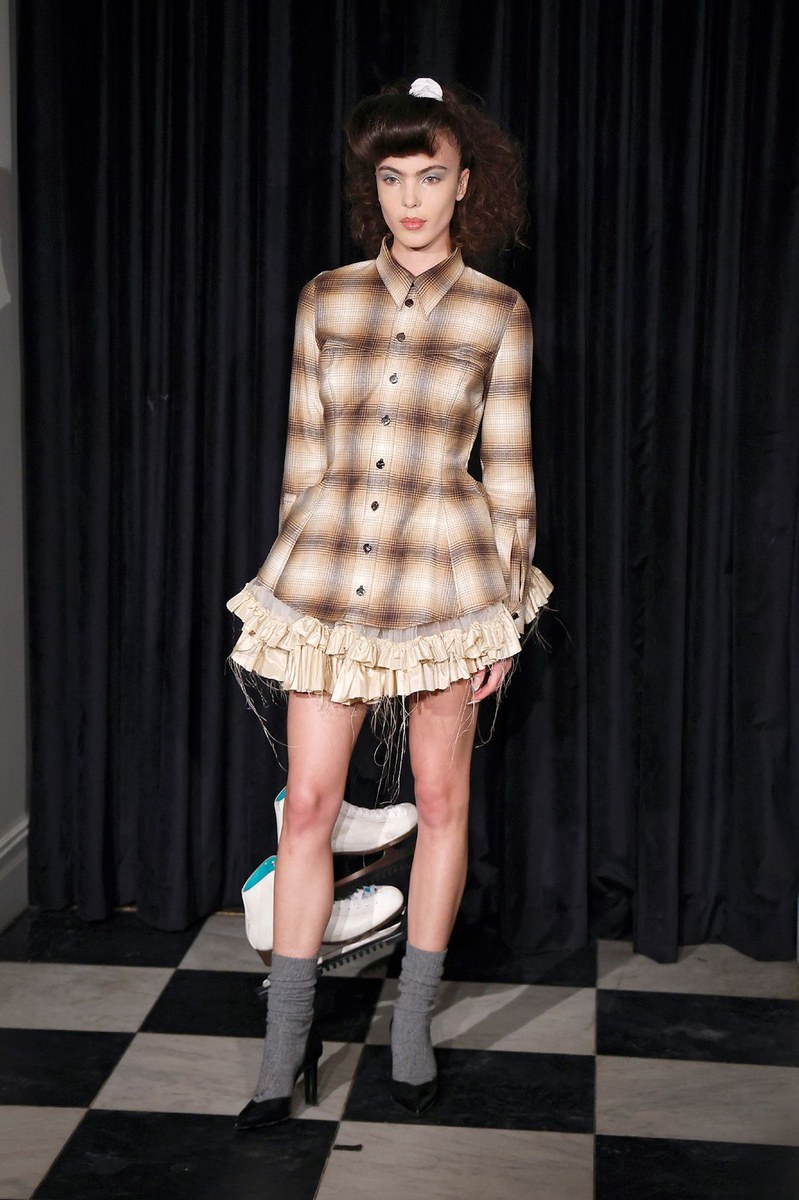
The lineup splits cleanly between two poles: body-skimming knit tubes and cropped tops paired with low-slung or drawstring bottoms, and structured peplum-flared mini silhouettes that nod directly to competitive figure skating costumes. Ruffled hem layers appear repeatedly, most visibly in Looks 1 and 11, where flannel shirting meets raw-edged pleated underskirts to create a peplum effect that reads as deconstructed rather than precious. In Look 3, trouser cuts sit wide at the hip with a clean pleat break, anchoring the more exposed top half. Midi-length lace-up skirts in Look 14 and the knit two-piece in Look 16 push volume lower and wider, introducing a slower, more deliberate proportion into an otherwise short-dominant lineup.
Color Palette
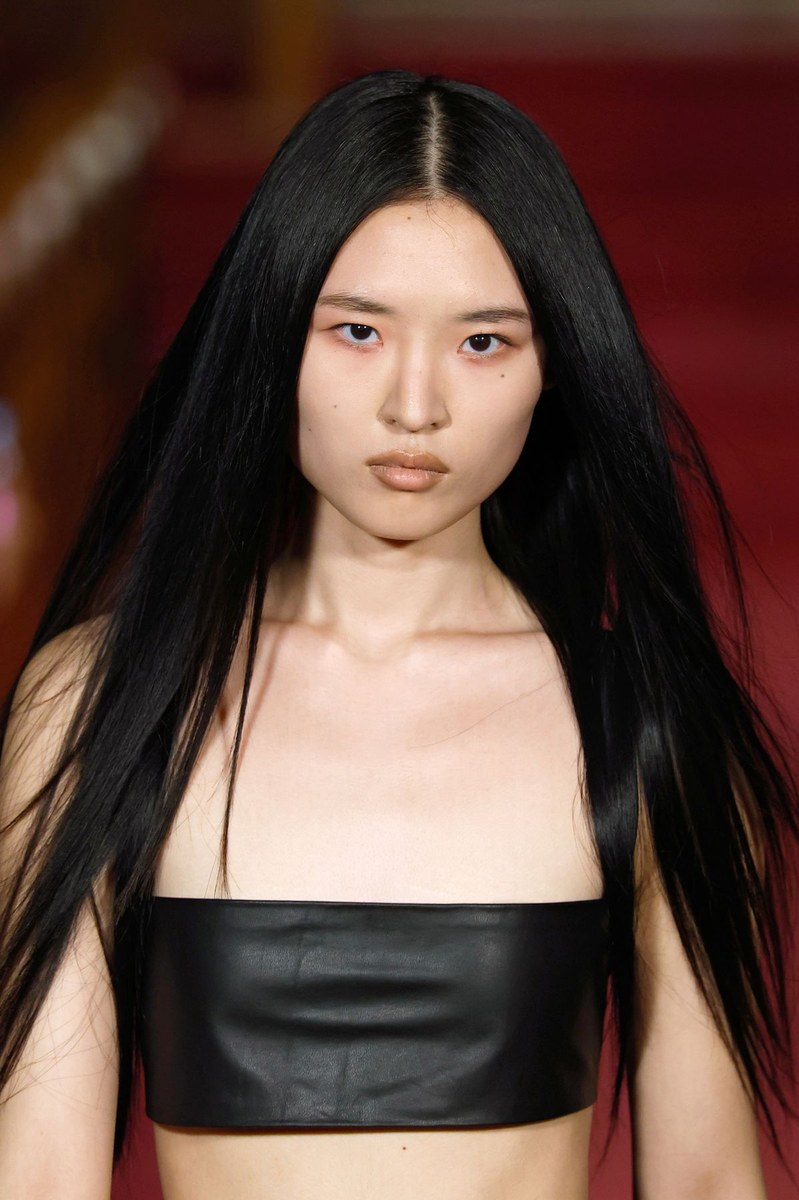
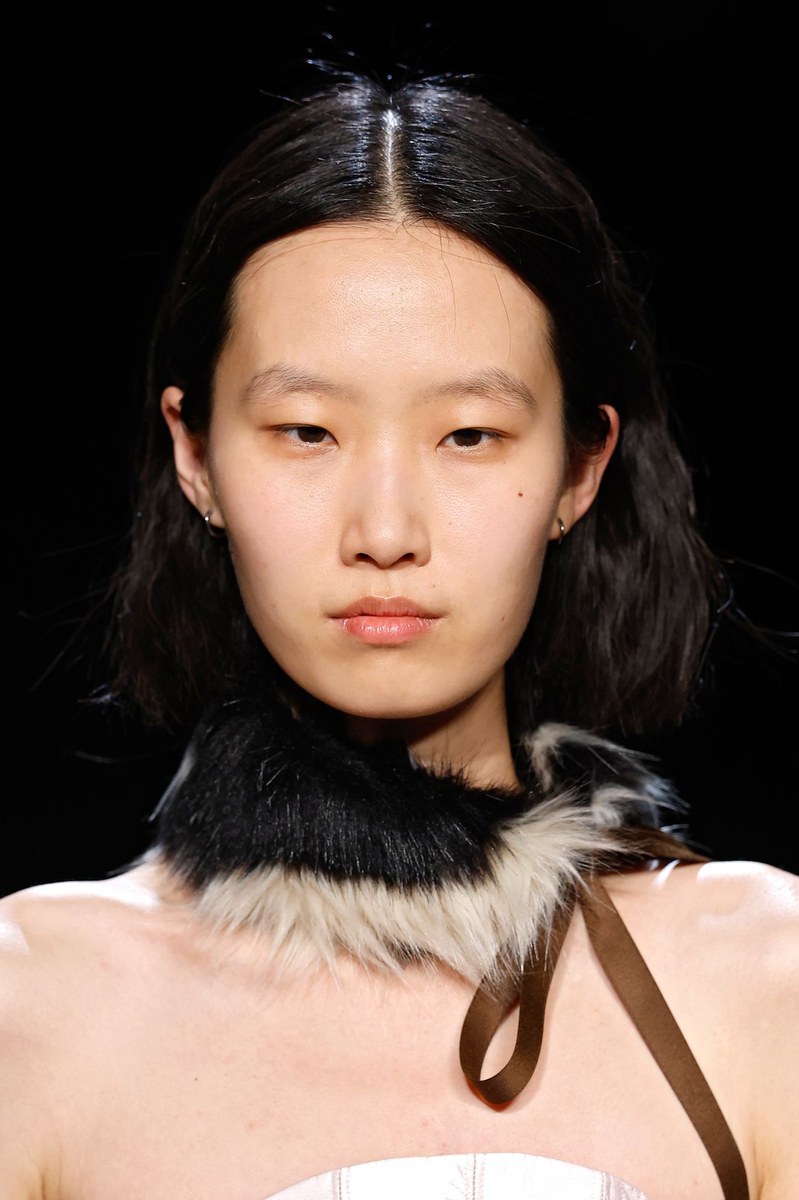
Warm beige, oatmeal, and taupe dominate the knitwear and flannel groups, forming a cohesive neutral spine across Looks 1, 4, 7, 13, 14, and 15. Mint green recurs as a deliberate accent, pairing with grey wool in Look 2 and crossing-wrap cotton in Look 10, a combination that reads simultaneously retro and clean. All-white in Look 5 and all-red in Look 19 function as punctuation marks, bracketing the warmer neutrals with high-contrast drama. Dusty grey appears across knitwear, shorts, trousers, and socks, threading everything together at a tonal level without flattening it.

Materials and Textures
Fuzzy mohair-blend striped knit carries the most commercial weight, appearing in coordinated sweater and wide-leg trouser sets in Look 4 and wide-leg pants in Look 18. The soft, slightly hazy surface photographs well and reads as luxurious at a mid-market price point. Ombre-dyed plaid flannel in Looks 1 and 11 is structured enough to hold the fitted button-through shape without interfacing, suggesting a medium-weight brushed cotton or cotton-poly blend. Grey marled knit in Looks 6, 3, and the separates throughout feels dense and ribbed with visible body, neither slouchy nor stiff. Red patchwork jacquard or appliquéd silk organza panels in Look 19 introduce the most technically ambitious surface here, with overlapping geometric tile-like pieces creating optical depth that would require careful sourcing and construction.

Styling and Layering
UGG classic boots, both tall and short, appear on at least seven looks, worn over grey tube socks or shearling-trimmed cuffs, and the repetition is clearly intentional rather than default. White pointed-toe stilettos and white kitten heels counter the UGG frequency and appear mostly on the more tailored or skate-inspired looks, creating a deliberate tension between softness and precision. Accessories stay tightly edited: white nylon backpacks with charm attachments in Looks 7 and 13, white ice skates carried by hand in Looks 5 and 19, and roller skates in Look 9 reinforce the ice-rink and schoolgirl references without overloading any single look. Appliquéd or embroidered red heart or skull brooches appear across Looks 2, 4, 7, and 9, functioning as a repeatable signature hardware detail with direct product development potential.

Look by Look Highlights
Look 1 The ombre beige plaid flannel shirt dress with cream ruffled raw-edge underskirt and grey ribbed sock-boot combination is the collection's most immediately shoppable silhouette for specialty retail buyers seeking a statement casual dress with clear styling direction.

Look 3 Grey wool bandeau bra paired with matching wide-leg pleated trousers and black pumps represents the strongest tailoring moment in the collection and carries real potential as a coordinated suiting alternative for contemporary buyers.
Look 4 The full mohair ombre stripe set with cold-shoulder sweater, drawstring wide-leg pants, and tan UGGs is a ready-made cozy luxury set that requires minimal styling investment from the consumer, making it a high-velocity candidate for e-commerce.
Look 9 Dusty pink waffle-knit button-embellished crop top and matching pleated asymmetric skirt with tall UGG boots and roller skates as a prop distills the collection's nostalgia thesis into a single wearable moment with a distinct pink category story.
Look 11 Grey-and-black ombre flannel fitted shirt over a red pleated ruffle mini with tall UGG boots delivers the most editorial contrast in the collection, pairing masculine shirting with overtly feminine skirt volume in a way that has strong street-styling potential.

Look 14 Chunky off-white marled stripe pullover layered over a taupe knit lace-up midi skirt with tall UGG boots and burgundy socks builds a full outfit story in a muted palette that would translate directly into a wholesale buy without heavy editing.

Look 19 All-red geometric patchwork structured mini dress with tiered peplum hem, white tights, and white pointed-toe ankle boots is the collection's closest thing to a hero look and carries the construction complexity and visual drama that supports a higher price bracket.

Look 16 Marled grey-beige rib-knit open-front long-sleeve crop paired with a matching drawstring midi skirt and worn with black lace-up boots introduces the most mature silhouette proportion and would perform in a market segment older than the primary Y2K target.

Operational Insights
Footwear co-branding: The UGG boot appears on roughly half the lineup with enough visual intentionality to suggest a formal collaboration agreement. Buyers should confirm exclusivity terms before committing to adjacent product adjacency.
Knit coordinate sets: Looks 4, 9, and 16 each present top-and-bottom knit coordinates in matching fabric and color, a category that consistently outperforms separates in unit volume for contemporary mid-market retailers. These three sets warrant priority sampling.
Brooch hardware: Repeated red heart and skull brooches across Looks 2, 4, 7, and 9 function as a collectible signature accessory that could be developed as a standalone SKU or bundled with knit tops to drive average order value.
Ice and roller skate prop references: Looks 5, 9, and 19 use skates as carried accessories, a visual cue that aligns the collection with an active lifestyle and nostalgia narrative that social and content teams can leverage without additional concept development.
Ruffled underskirt construction: The raw-edge pleated ruffle underlayer in Looks 1 and 11 is a replicable construction detail that adds visual interest without significant material cost increase, making it a strong candidate for a house signature detail across future seasons if adopted now.
Complete Collection


About the Designer
Gabe Gordon grew up in Ridgefield, a small Connecticut town where winter arrived hard and stayed. The lake behind his mother's house, the kind of storms that buried the yard under two or three feet of snow overnight, the specific stillness of a frozen landscape — these images didn't leave him. They became, eventually, the raw material for a body of work that pulls personal history into textile with unusual directness. Gordon went on to study Textiles at the Rhode Island School of Design in Providence, where the isolation of a small college city turned out to be a productive constraint. Working out of a home studio shared with classmates, he learned to hand-loom and hand-dye, sourcing discarded yarns from a local mill and beginning to develop the body-hugging, distressed knits that would become his signature.
He interned at Gauntlett Cheng while still a sophomore, and it was around that time that Café Forgot, the New York retailer with a sharp eye for emerging talent, first encountered his work. What landed wasn't a concept but a technique: Gordon had begun experimenting with intentional eyelets knitted into his garments, a method he named the "moth hole." The point was to simulate decay without faking it, to build imperfection into the structure itself. His fabrics also drew on a space-dyeing process that creates a slow moiré drift of color around the form. By 2021, when his Vortex cardigans launched and quickly appeared on Kim Kardashian and Dua Lipa, the brand had found an audience that responded to the particular mix of vulnerability and craft.
Gordon's references are specific and tend toward American romanticism filtered through grief and queerness. He is, by his own admission, a devoted follower of Lana Del Rey — deeply enough to have her tattooed on his body — and the sixties pop culture she obsesses over: Roy Orbison, the Lewis Sisters, ice skating, prom night, horror movies. His Fall 2022 collection used prom as a vehicle to process personal trauma; his AW23 work, shot partly at his childhood home in Ridgefield, channeled snow globes and the idea of things suspended in time. More recently, his husband Timothy Gibbons, who brings a background in costume design and tailoring, has entered the work as a creative partner, pushing the label toward structured silhouettes that sit alongside the knits without displacing them. The brand's debut runway show, held in late 2024, confirmed a shift in scale. At New York Fashion Week in February 2026, their collection "Frostbite" placed figure skaters in cinched waists and voluminous hair under spotlights that mimicked moonlight on snow.
"I thought about the moth holes as a way to make the garment impure, as if decaying and tattering, but also as a form of ornamentation."
"When developing the garments, I was really inspired by horror movies and the prom as a vehicle of highlighting my own trauma from experiences of grief and queerness."
✦ This report was generated with AI — combining human editorial vision with Claude by Anthropic. Because the future of fashion intelligence is already here.