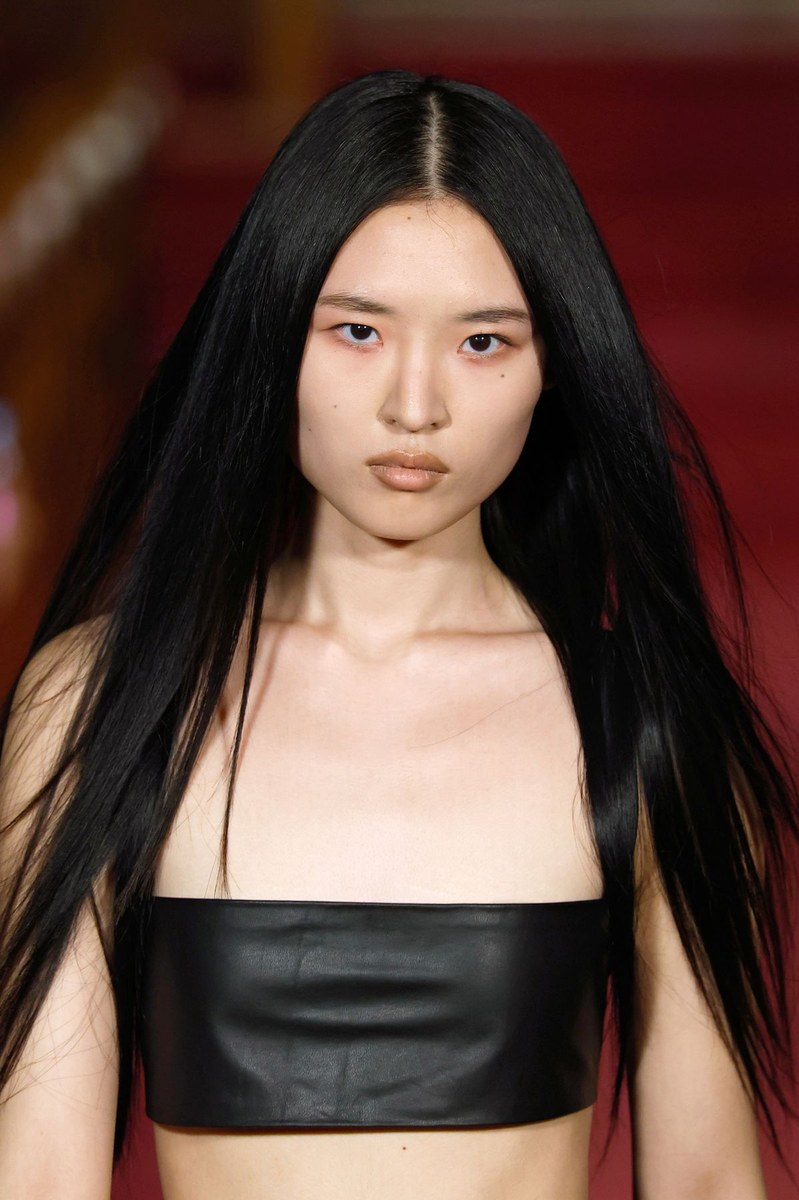
Kim Shui FW26 Women Looks Report

Kim Shui FW26 Women Looks Report
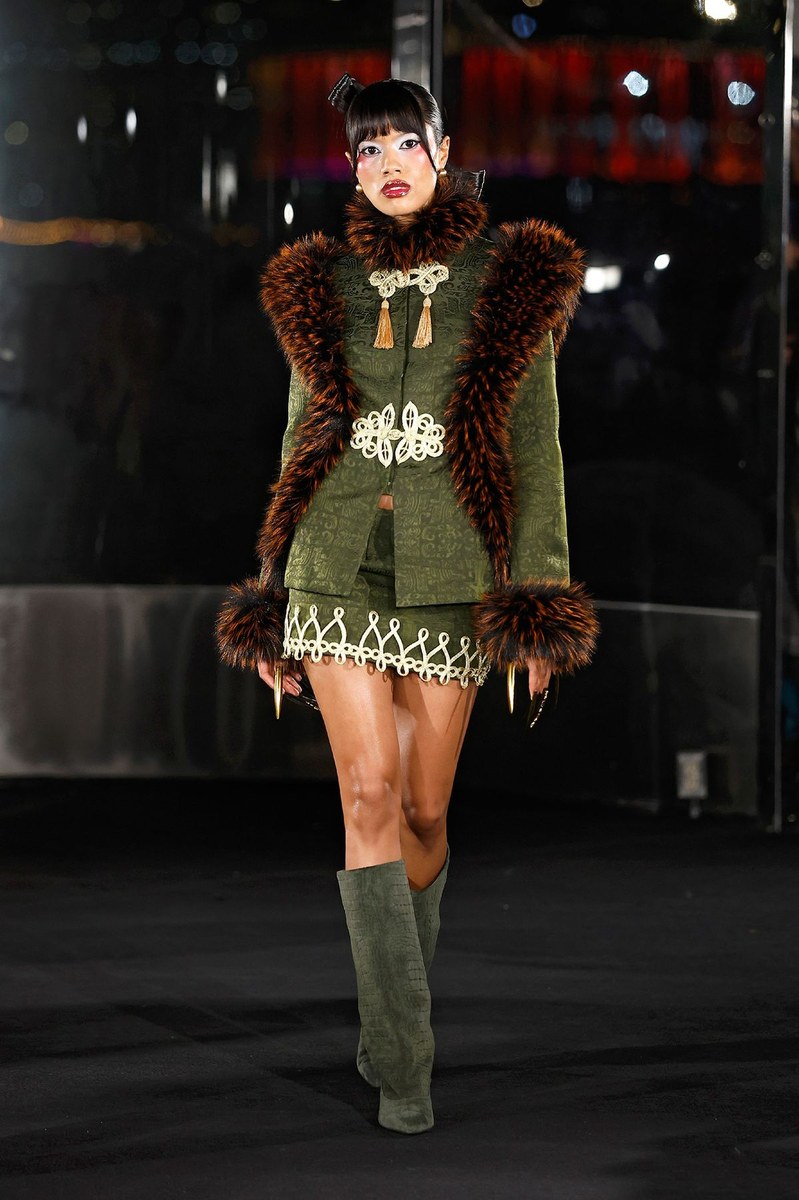
Kim Shui FW26 Women Looks Report

New York Fashion Week

Kim Shui FW26 pulls Chinese cultural codes, specifically frog closures, mandarin collars, qipao silhouettes and soutache knotwork, directly into the vocabulary of contemporary Western luxury streetwear and nightlife dressing. Consumers are actively seeking cultural specificity over generic globalism right now, making these references a commercial differentiator rather than a styling footnote.

Silhouette and Volume

Two dominant shapes rotate constantly throughout: the micro-mini with exposed leg and the long, fluid column. Structured outerwear, from the wide-shouldered fur-trimmed jacket in Look 1 to the hooded shearling coat in Look 10, adds volume at the top to offset the abbreviated hemlines below. Floor-length wide-leg trousers appear in Looks 3, 6 and 12, anchoring the collection's more relaxed, suit-driven chapter. Bodycon and cutout constructions in Looks 2, 8 and 19 strip volume entirely, reducing the silhouette to its barest architectural frame.
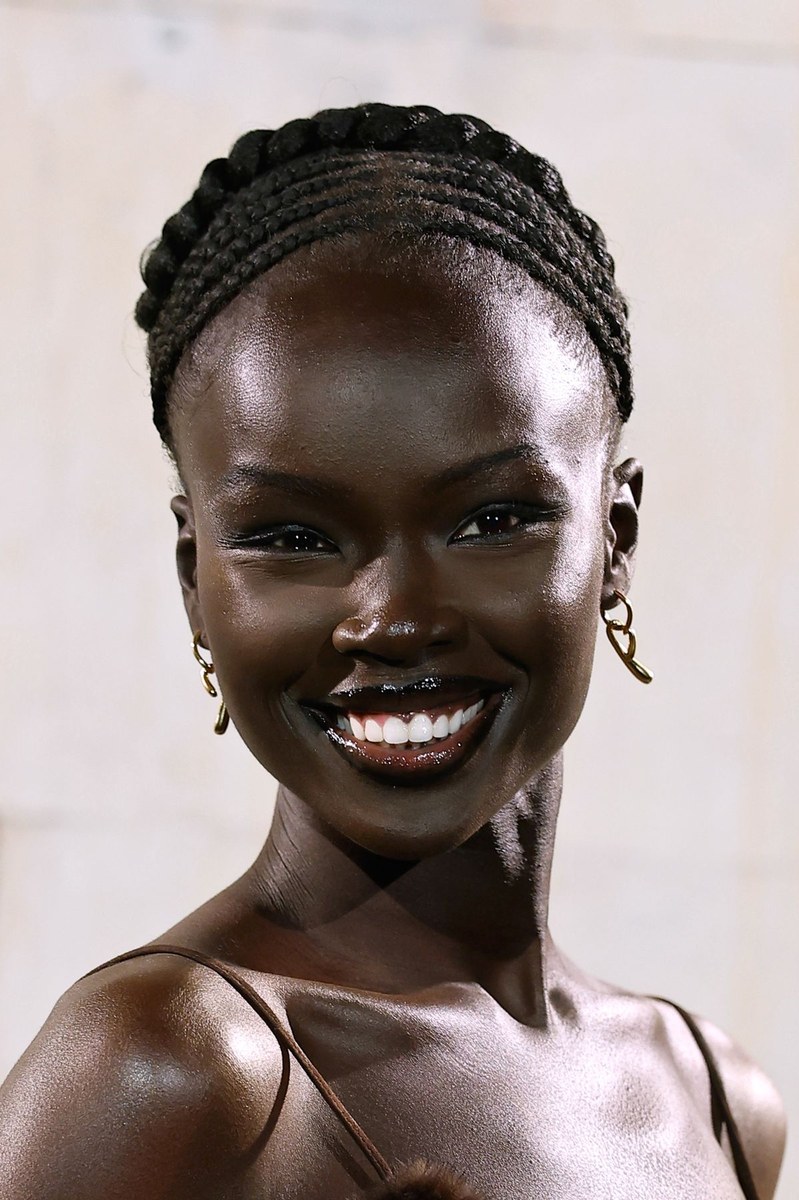
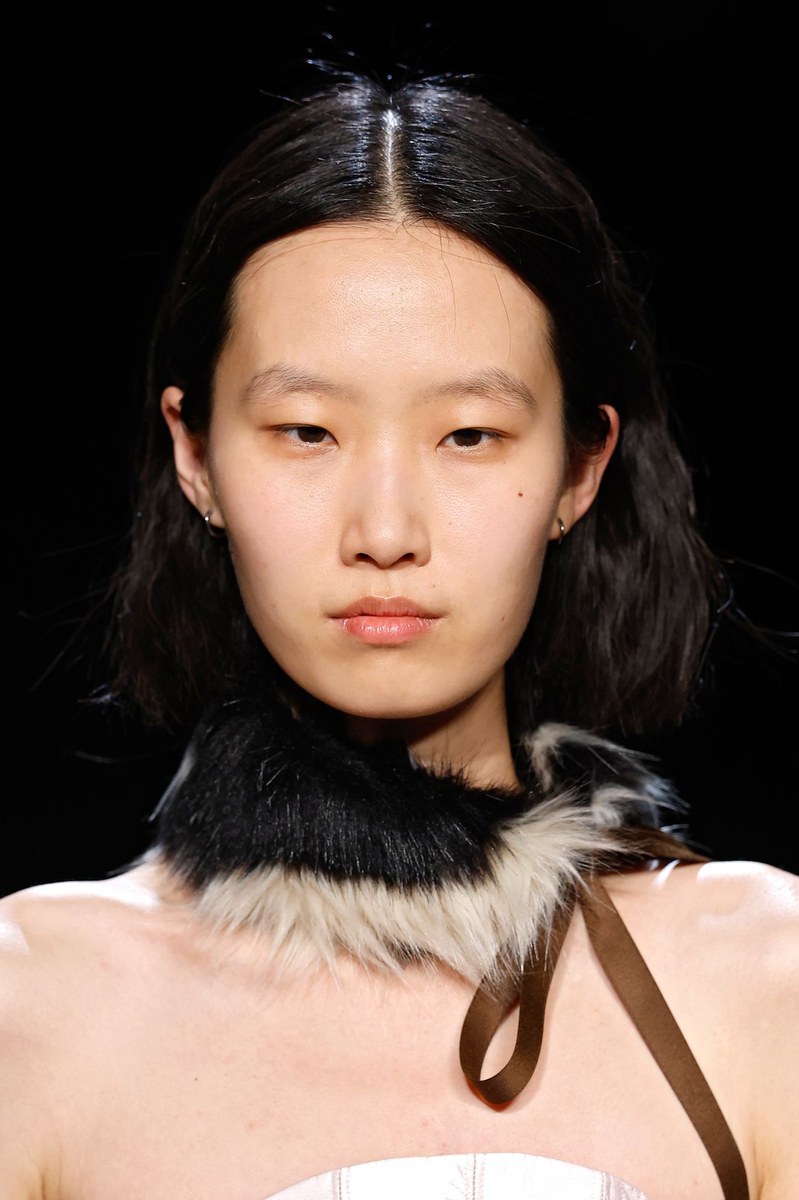
Look 1
Look 1

Color Palette

Three dominant colors drive the collection: arterial red, olive green and burnt orange. Red recurs across Looks 2, 3, 5, 11, 15 and 18, shifting in finish from matte sequin to satin brocade to sheer chiffon. Olive green anchors Looks 1, 4 and 16, pairing consistently with warm brown fur and cream knotwork details to create an earthy, almost military-luxe tension. Orange dominates Looks 6, 10 and 12, escalating from velvet to satin brocade to high-voltage shearling, and reads as the collection's most commercially charged statement grouping.

Materials and Textures

Brocade carries the heaviest weight in the collection, appearing in the red toile-style jacquard of Look 11 and the botanical satin of Look 12, both with a stiff, self-supporting drape that holds the garment's shape independent of the body. Faux fur trims every outerwear piece, in brown fox-style pelts on Looks 1 and 4, tiger-stripe on Look 3, olive-toned on Look 7 and blazing tangerine on Look 10, moving from accent to full surface material as the collection progresses. Knotwork panels in Looks 2, 8 and 13 use dense cream soutache braid as both structural surface and decorative system. Distressed, shredded and burnout textures appear in Looks 9, 17 and 19, introducing a raw, degraded finish that contrasts directly with the lacquered surfaces elsewhere.

Look 11
Look 11

Styling and Layering

Layering logic is deliberately incomplete. Outerwear opens or falls away to reveal abbreviated underlayers, as seen in Looks 7, 13 and 16, where coats expose bare midriffs, lingerie-cut briefs or bra constructions. Footwear splits into two camps: knee-high suede boots in olive and tan anchor the structured looks, while gold strappy heels and patent pumps finish the more body-forward evening pieces. Beaded choker necklaces in red, yellow and green appear across multiple looks and function as the collection's primary connective accessory, pulling disparate color groups into a single tonal system.

Look by Look Highlights

Look 1 The olive brocade cape-jacket with brown fur trim and matching micro-skirt, finished with knee-high suede boots and tassel frog closures, is the collection's most complete commercial package and the strongest candidate for wholesale adoption.

Look 2 The crimson halter bodysuit with cream soutache lattice panels worn over burgundy tights and gold platform heels reads as a directional eveningwear proposition with clear licensing potential for the bridal and red carpet market.

Look 2
Look 2

Look 8 The strapless cream knotwork cage dress worn with red beaded jewelry and gold sandals is the collection's most editorial statement and will drive press placement and visual merchandising impact disproportionate to its production complexity.

Look 8
Look 8

Look 10 The all-orange shearling-trimmed hooded coat over a matching bodycon mini is the single loudest color moment in the collection and the piece most likely to perform as a hero SKU in directional retail environments.

Look 10
Look 10

Look 12 The burnt orange botanical brocade trouser suit with deep-V blazer, worn open with no underlayer, is the easiest entry point for buyers who need cultural narrative without maximal body exposure.

Look 12
Look 12

Look 16 The olive satin brocade duster coat worn open over a black soutache bra and high-cut briefs with sheer tights and knee-high suede boots packages the collection's lingerie-as-outerwear thesis in its most wearable and retail-ready configuration.

Look 16
Look 16

Look 17 The rust and brown burnout maxi dress with bell sleeves, cutout lace-up front and green beaded choker pulls the collection's distressed-textile thread into formal-length dressing, opening a distinct product category with no direct repetition elsewhere in the range.

Look 17
Look 17

Look 18 The teal blue ruched mini dress with mandarin zip collar and asymmetric trailing panel is the most restrained and silhouette-focused look in the collection, and its singular color makes it the clearest choice for size-range expansion in contemporary sportswear-adjacent retail.

Look 18
Look 18

Operational Insights

Frog closure hardware: Soutache frog and knotwork details appear across at least eight looks in different scales and colorways. Buyers and product managers should treat this as a standalone trim category with potential for cross-category application in accessories, footwear and outerwear lines beyond this collection.

Faux fur sourcing: All fur trims read as faux and are deployed in five distinct colorways including tiger-stripe, olive, brown, tan and orange. Sourcing teams should confirm fiber content and MOQ with the brand directly, as color consistency across these shades will be critical to maintaining the collection's visual coherence at retail.

Color blocking by category: Red, olive and orange map cleanly onto three distinct retail categories: red for evening and occasion, olive for outerwear and transitional dressing, orange for statement and novelty. Style directors can use this structure to place looks into separate department buys without cannibalizing adjacencies.

Size and body range: Looks 13 and 14 confirm that the collection was designed and presented across a visible range of body types. Buyers pursuing inclusive sizing strategies have direct runway precedent to cite in range planning conversations and can present this collection with confidence to size-inclusive retail partners.

Brocade fabric lead times: Heavy reliance on jacquard and brocade constructions in multiple colorways means extended timelines will be necessary. Given current supply chain pressures on woven jacquard production, particularly for custom colorways in red and orange, buyers should build extended lead time into order schedules and confirm fabric availability before committing to depth buys on Looks 11 and 12.

Complete Collection

Look 3
Look 3
Look 4
Look 4
Look 5
Look 5
Look 6
Look 6
Look 7
Look 7
Look 9
Look 9
Look 13
Look 13
Look 14
Look 14
Look 15
Look 15
Look 19
Look 19
Look 20
Look 20
Look 21
Look 21
Look 22
Look 22
Look 23
Look 23
Look 24
Look 24
Look 25
Look 25
Look 26
Look 26
Look 27
Look 27
Look 28
Look 28
Look 29
Look 29
Look 30
Look 30
Look 31
Look 31
Look 32
Look 32
Look 33
Look 33
Look 34
Look 34
Look 35
Look 35
Look 36
Look 36
Look 37
Look 37
Look 38
Look 38
Look 39
Look 39
Look 40
Look 40
Look 41
Look 41
Look 42
Kim Shui

About the Designer

Kim Shui was born in the United States to two Chinese immigrants and moved to Rome at age three, growing up in a city saturated with Renaissance architecture, Catholic pageantry, and a street culture that had no reflection of her face or heritage in it. The visibility she lacked as a child became, over time, a design problem worth solving. She wanted to be a fashion designer from the beginning: in her sixth-grade yearbook she drew herself at a drafting table. But her parents steered her toward stability, and she followed their direction, enrolling at Duke University, where she graduated with a double major in economics and French in 2011. Her dissertation for the French literature requirement explored the connections between fashion, film, and the representation of women on screen, which suggests the detour was not entirely wasted.

After Duke, she studied fashion design at Parsons and then at Central Saint Martins in London, where she graduated with Distinction. At Saint Martins she arrived with a fixation on Rick Owens and an almost compulsive attachment to black, dressing entirely in draping and shadow. London sharpened her technical sense but not yet her color. Moving to New York did that. The city's openness unlocked something, and the work started accumulating chromatic heat. In 2016, she was selected as a VFiles Runway winner and debuted her first collection at New York Fashion Week. The breakthrough image from that season was Kylie Jenner, then nineteen, sitting front row in one of Shui's sheer lace bodysuits. The phone did not stop.

The references she pulls from are as layered as her biography: Kandinsky's abstract color theory, traditional Chinese qipao construction filtered through a European club-going sensibility, and what she has described without irony as "Ming Dynasty meets Eurotrash." She has spoken about her collections as social commentary as much as clothing, addressing the double standards placed on women in public versus private spaces, and the politics of who gets to wear what. Her clients have expanded from Kylie Jenner and Solange to Dua Lipa, Cardi B, Megan Thee Stallion, Bella Hadid, and K-pop groups including BLACKPINK and Twice, for whom she designed bespoke tour looks. She has collaborated with Nike, Jordan Brand, and Afterpay, and has been named a Time Next Generation Leader and a Tory Burch Foundation Fellow. The brand is based in New York City, where she continues to design and produce it.

"I think it comes from how I grew up and me as a person. I'm Chinese, but I was born in the States, and then I grew up in Italy. I was always around diverse cultures and different things. It was kind of a mishmash of cultures, and I think my design developed that way too; it's bringing together all of these different aesthetics and places subconsciously."

"I grew up in Rome, surrounded by art and history — but rarely saw people who looked like me, especially reflected in beauty or fashion. That contrast made me sensitive to whose stories get told and whose don't."

✦ This report was generated with AI — combining human editorial vision with Claude by Anthropic. Because the future of fashion intelligence is already here.