Nardos FW26 Women Looks Report
New York Fashion Week
Nardos FW26 builds a wardrobe around ceremony, treating every occasion from cocktail hour to black-tie finale as a reason for considered construction and material drama. For buyers and style directors working in the elevated occasion and bridal-adjacent market, this delivers a commercially legible range that spans wearable event dressing and high-impact statement pieces within a single coherent vision.
Silhouette and Volume
Two poles define the collection: fitted columns and sculptural volume. Mini dresses with full skirts anchor Looks 5, 6, and 10, while floor-length gowns in Looks 13, 15, 16, and 19 command the opposite end of the spectrum. Peplum and balloon constructions, particularly in Looks 1 and 17, introduce a mid-range drama that sits between those extremes. Trouser pairings in Looks 1 and 14 push a non-gown option that occasion separates buyers should note.
Color Palette
Black anchors the entire offering, appearing across Looks 1, 3, 5, 10, and 14 with enough variation in fabric and construction to read as distinct commercial propositions rather than repetition. Gold and champagne occupy a warm metallic tier across Looks 6, 7, 12, and 13, creating a festive evening cluster. Soft sage green in Looks 16 and 17 and blush pink in Looks 4, 9, and 11 supply the quieter, ceremony-appropriate register that bridal buyers will recognize immediately. Look 18 stands apart as the collection's most approachable daytime-to-evening crossover piece, featuring a single one-shoulder silver-grey floral print.

Materials and Textures
Silk taffeta, velvet, and structured brocade carry the volume-dependent looks, with Look 15 deploying a heavyweight metallic jacquard that holds a full ballgown skirt without visible underlining. Sheer organza and tulle function as layering elements rather than primary fabrics, appearing as sleeves in Looks 4 and 9 and as a full transparent overskirt in Look 2. Looks 11, 13, and 19 showcase embroidery and crystal beadwork applied with genuine density, which will affect cost-per-unit calculations significantly. Deep-pile emerald velvet in Look 14 is cut strapless with wide-set architectural bow detail, a combination that reads luxe without relying on embellishment.

Styling and Layering
Coats and capes serve as primary layering instruments throughout. Look 12 pairs a black satin opera coat over a gold-beaded bustier and sparkle-knit skirt. A matching structured cape extends into a full train in Look 16, anchoring a sage column gown beneath it. Footwear stays restrained throughout, with silver or nude pumps and strappy heeled sandals keeping the focus on the garments. Statement chokers and chandelier earrings, scaled to complement necklines rather than compete with embellishment, dominate jewelry choices.

Look by Look Highlights
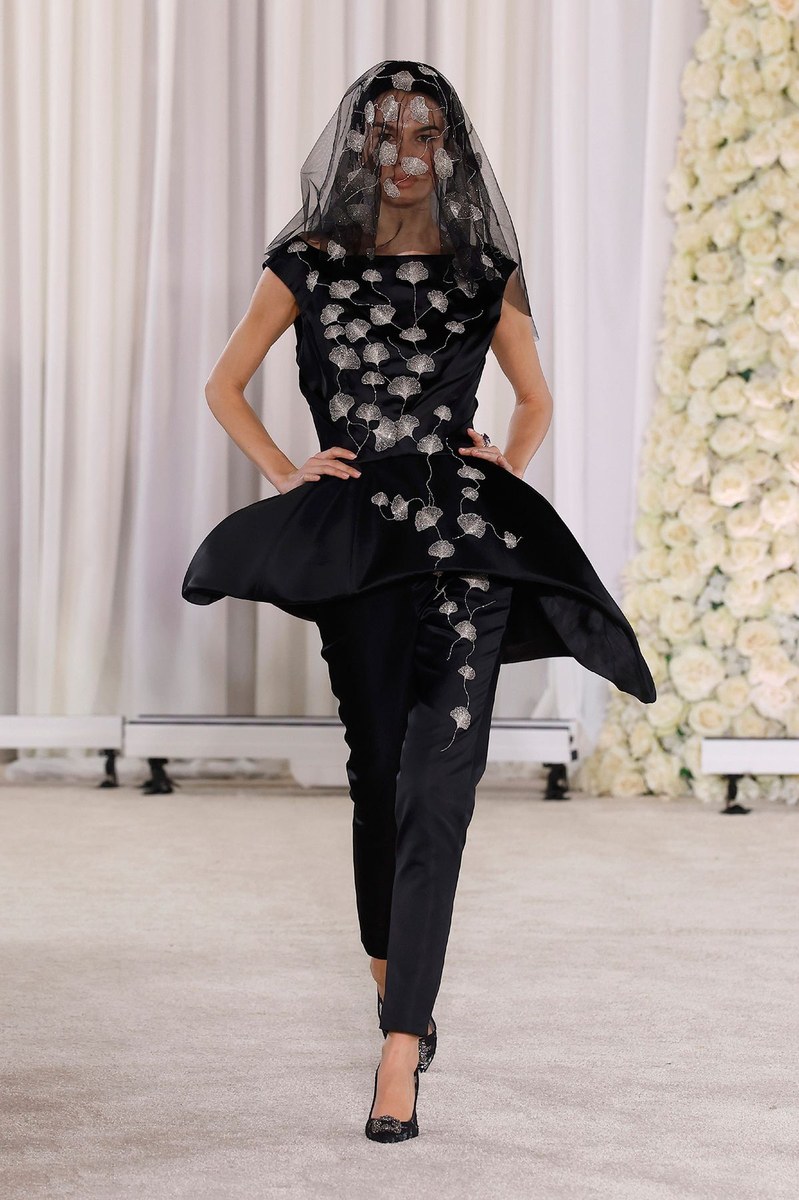
Look 1 opens with black satin wide-flared peplum tunic over slim trousers under a crystal ginkgo-leaf embroidered black tulle veil, a complete exit look that translates directly to mother-of-the-bride or formal guest dressing.

Look 7 pairs a gold 3D appliqué cropped jacket, open at the center front, against a full-length black and gold floral brocade ballgown skirt, and the separates structure makes it a strong candidate for dual SKU buying.

Look 13 delivers a floor-length gold lurex column gown with tonal floral embroidery and a matching floor-sweeping cape attached at the shoulders, and the all-gold uniformity makes this a red-carpet-ready unit with high editorial placement potential.

Look 14 uses deep emerald velvet in a strapless jumpsuit with an oversized front bow at the waist, and the format positions it as the collection's strongest non-gown formal option for retailers with younger luxury customers.

Look 15 puts a metallic green and silver abstract floral jacquard ballgown with sheer organza puff-sleeved inset against a precise square neckline, and the volume and surface complexity justify a premium price tier.
Look 16 grounds a white and sage embroidered column gown in a structured sage satin floor-length cape, and the subdued palette combined with strong silhouette makes this the most commercially transferable look for upscale department store buying.

Look 18 prints large-scale purple roses on a silver-grey silk one-shoulder draped gown, and the painterly quality of the print differentiates it from digitally produced florals at the same price point.
Look 19 closes with a white crystal-lattice embroidered sheath gown inside a full tulle overskirt with a cathedral-length veil, functioning as the bridal finale and signaling that Nardos is actively competing in the luxury bridal segment beyond the occasion category.

Operational Insights
Separates potential: Looks 7 and 12 both present as strong candidates for separates buying, with tops and skirts or coats that can be retailed individually at lower entry price points without losing the collection's aesthetic identity.
Embellishment cost tier: Looks 11, 13, and 19 carry bead and crystal work at a density that will push landed costs above most mid-market occasion thresholds, so buyers should pre-qualify these for luxury wholesale or made-to-order channel placement only.
Color capsule strategy: The sage green grouping across Looks 16 and 17, the blush cluster across Looks 4, 9, and 11, and the all-black tier across Looks 1, 3, 5, 10, and 14 each form self-contained color stories that can be bought and presented as mini capsules rather than a full buy.
Bridal adjacency: Looks 2, 9, and 19 use white and ivory with structural detail that positions them directly in the non-traditional bridal or civil ceremony market, and style directors building bridal edits should pull these three as a standalone presentation group.
Trouser and jumpsuit crossover: Looks 1 and 14 both pair formal embellished tops with tailored leg constructions, and this format addresses a documented gap in the occasion market for clients who resist full skirts, giving buyers a functional reason to include non-gown options in their order.
Complete Collection


About the Designer
Nardos Imam grew up in Eritrea with almost no access to the fashion world as an industry or profession. What she had instead was her mother's workroom, where she spent hours as a child cutting scraps with borrowed scissors and paging through old Vogue pattern books, studying the geometry of sleeves and the logic of a bodice. In 1997, at seventeen, her parents sent her to Dallas to study nursing. She was homesick and miserable for most of that first year. Medicine lasted a few semesters before she made the pivot her family had not planned for: she enrolled at El Centro College to study costume design, drawn specifically to the courses on theatrical costume and the historical arc of Western dress.
She could not afford to transfer to a school in New York, so she built her apprenticeship where she was. Her first job was selling fabric at Richard Brooks, a luxury fabric store in Dallas where she learned the material side of the craft, what different textiles do under a cut, how weight and drape behave on a body. Then she applied to Stanley Korshak, the high-end Dallas retailer. She was turned away as a designer because she had no clients and no connections. She came back and asked for a job in tailoring, brought a dress she had sewn herself, and told them to look at it. They gave her the alterations department. She ran it, then redesigned its custom offering, and eventually became Korshak's in-house designer and their top vendor. By 2009, clients were commissioning piece after piece, traveling from New York and New Jersey to her Dallas atelier.
She launched NARDOS Couture formally in 2012. The aesthetic she had been building since those fabric-store years drew from multiple, specific sources: the silhouette discipline of Gilded Age American dress, the ceremonial weight of 1950s African American church attire, the organic curves she finds in nature, and the dramatic pacing of Shakespearean structure. Her Spring/Summer 2026 collection, shown in the Grand Ballroom of The Pierre Hotel during New York Fashion Week, was built entirely around that last reference, and the idea that a well-constructed garment should move through a room the way language moves through a scene. Today NARDOS operates salons in Dallas and New York, producing bespoke couture, bridal, and ready-to-wear.
"Everything I know about sketching, fitting, fabric selection, and sewing I learned first in Eritrea, with my mother as my teacher. When I came to this country I had no idea what it meant to be a fashion designer. I just knew that I wanted to make beautiful things, and to make a career of that if I could."
"My inspiration can best be articulated through the fusion of American fashion from the Gilded Age with a contemporary twist. During that time, women used fashion also as a form of expression but also as a reflection of their beliefs."
✦ This report was generated with AI — combining human editorial vision with Claude by Anthropic. Because the future of fashion intelligence is already here.