Patbo FW26 Women Looks Report
New York Fashion Week
Brazilian craft traditions shape Patbo FW26 through hand crochet, fringe construction and vivid textile printing, creating a wardrobe that moves between resort and evening with deliberate commercial intent. For buyers operating in the luxury contemporary and resort segments, the collection arrives at exactly the moment when clients are spending on handcraft-forward pieces that read as both artisanal and globally relevant.
Silhouette and Volume
Two distinct silhouettes anchor the lineup: fluid, floor-length gowns with ruffle or fringe tiers (Looks 1, 5, 7, 8, 9, 15) and abbreviated, high-impact minis that expose the leg entirely (Looks 2, 6, 10, 12, 14, 16). Midlength is almost entirely absent, a deliberate commercial bet on drama at both ends of the length spectrum. Early looks feature structured, bra-shaped bodices or cut-outs. Moving through the show, the silhouettes shift to relaxed, wide-sleeve tunic shapes and slip-style strappy tops. Volume never derives from tailoring. It comes from movement, from swinging fringe, cascading ruffles and billowing chiffon panels.
Color Palette
Black and cream open the collection, a disciplined, high-contrast pairing anchored by gold chain and beadwork details across Looks 1 and 2. Warm amber and marigold carry Looks 4 and 5, the former in a single burnt-orange crochet, the latter mixing rust, cobalt blue, cream and black fringe tiers into the most multicolor moment of the show. A reddish brown, terracotta-adjacent burgundy dominates the middle section through Looks 7, 9, 14 and 15, paired consistently with dusty pink, soft blue and gold, creating a palette that reads earthy and opulent simultaneously. Sky blue appears twice, in the crochet mini of Look 6 and the printed trousers of Look 13, functioning as a recurring accent that prevents the warm tones from feeling heavy.

Materials and Textures
Crochet is the technical signature of the collection. Looks 4 and 6 present it in full-body form, a scalloped fan pattern worked in amber and sky blue respectively, with enough open negative space to make the fabric entirely sheer. Dense, thread-weight fringe in alternating color bands appears across Looks 1, 2, 5 and 16, creating a weighted hem that moves with the body rather than standing away from it. Printed chiffon and georgette carry a large-scale baroque floral and paisley print with enough transparency to layer over skin or lining in Looks 7, 8, 9 and 15. Ruffled, Victorian-cut lace construction enters in Looks 3, 10 and 11, used as outerwear-weight tops rather than underlayers.
Styling and Layering
Chain harnesses worn over lace or sheer blouses are the collection's most repeatable styling device, appearing in Looks 3 and 11 and reading as an immediately transferable accessory story for buyers sourcing separates. Feather-trimmed scarves draped off one shoulder recur in Looks 13, 14 and 15, adding color and movement without a formal outerwear layer. Footwear divides into two clear categories: chunky wood-sole platform sandals with jeweled or woven straps for the warmer-toned looks, and strappy black lace-up heeled sandals for the black and cream opening section. Both choices read as functional for outdoor resort settings while maintaining the elevated bohemian identity the brand is building season over season.
Look by Look Highlights
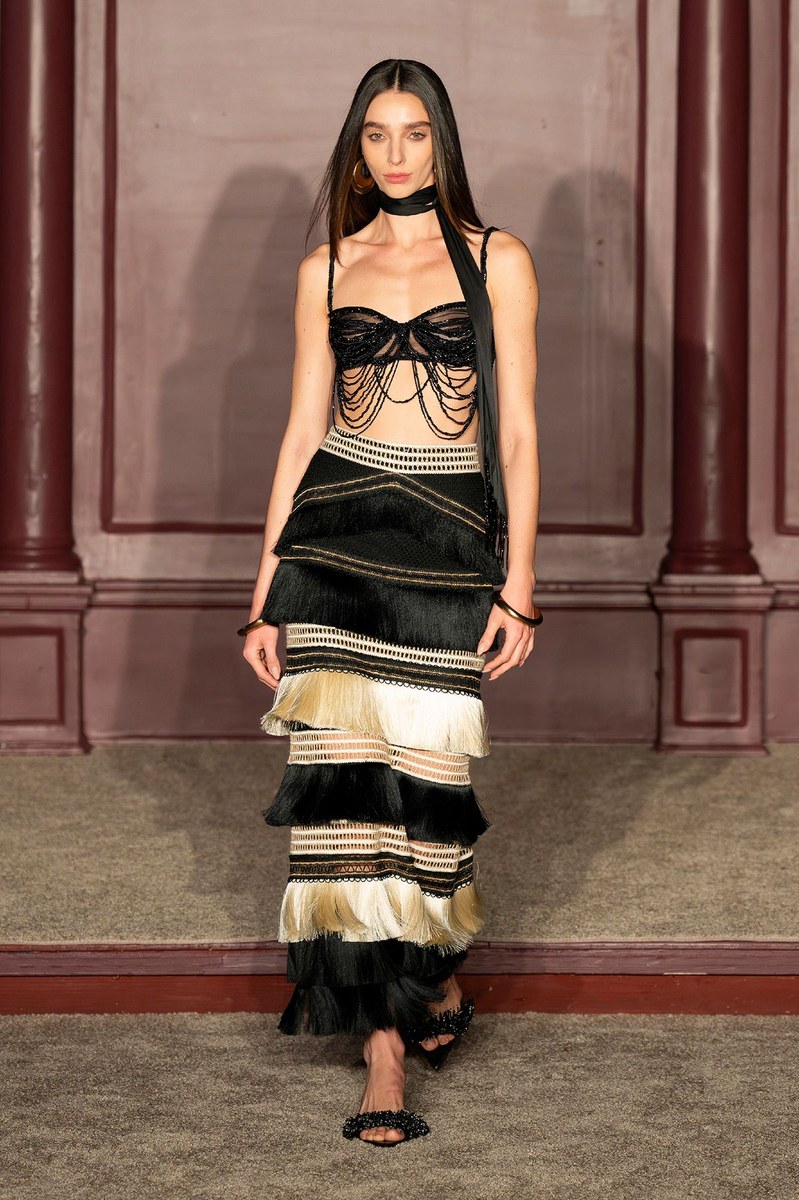
Look 1 Black hand-crochet fringe with a beaded bra top and draped black neck scarf anchors the collection as the most editorial piece in the lineup and a strong candidate for press-facing buys.

Look 4 A full-length amber scalloped crochet dress cinched with a gemstone-embellished belt establishes the brand's handcraft credibility in a single, no-compromise piece.

Look 5 Multicolor fringe tiers in rust, blue, cream and black on a black knit bodice produce the collection's most wearable long dress for resort hotel and cruise clientele.

Look 7 A reddish brown large-scale floral printed chiffon set with flared sleeves, gold fringe trim at the hip and a high-slit skirt worn over a sheer underlayer delivers maximum drama with straightforward construction.

Look 10 A sheer chocolate brown lace ruffled blouse with gold floral embroidery paired with a blush pink ostrich feather micro skirt and pearl-detailed waistband is the sharpest cocktail option for buyers in the luxury occasion market.

Look 12 A blush floral printed wide-sleeve kaftan mini with a deep V neckline framed in champagne fringe and gold beading presents a strong resort top-selling silhouette with proven sell-through logic in warm-weather markets.

Look 14 A richly embroidered and crochet-paneled brown slip mini with feather-trimmed scarf accessory is the collection's clearest translation of the handcraft story into a commercially accessible, high-margin evening piece.

Look 16 A fringe two-piece halter set in printed brown and mauve, worn with a jeweled platform slide, reads as a premium beach and resort destination buy with strong potential for wholesale in specialty boutiques.

Operational Insights
Handcraft MOQ risk: Pieces with significant crochet and fringe work (Looks 1, 4, 5, 6) carry substantial handwork labor content. Buyers should confirm production minimums and lead times directly with Patbo before placing orders, as artisanal output caps can constrain reorder capacity mid-season.
Length polarization: Strong inventory exists at floor length and micro length with almost nothing in between. Style directors building a range should plan assortments accordingly, filling the midlength gap with pieces from other vendors or requesting a midseason capsule from the brand.
Print exclusivity windows: Baroque floral and paisley prints appearing across Looks 7, 8, 9, 13, 14 and 15 are likely fabric-exclusive to Patbo for a defined window. Buyers sourcing competing prints from other brands risk direct visual overlap if they miss the exclusivity period.
Crochet colorway optionality: Looks 4 and 6 demonstrate that the scalloped crochet construction works across warm amber and cool sky blue. Additional colorways, particularly cream, black or red, may be available for order to broaden the commercial range without new product development costs. Buyers should inquire directly.
Accessories as incremental revenue: Chain harnesses (Looks 3 and 11), feather scarves (Looks 13, 14, 15) and jeweled platform sandals represent low-complexity, high-margin add-on categories. Style directors should evaluate these accessories as standalone SKUs capable of driving basket size alongside the ready-to-wear core.
Complete Collection


About the Designer
Patricia Bonaldi was born and grew up in Uberlândia, a city in the interior of the Brazilian state of Minas Gerais, far from São Paulo's fashion circuits and further still from New York. Her family didn't shop for clothes. Her mother took her to the fabric store instead, and what Bonaldi has described as the Disneyland of her childhood was not a mall but a room full of bolts of cloth, where the women who worked there watched her grow up and still recognize her when she walks in. Her mother taught her to sew, and the combination of material access and necessity became a form of play that would stay with her longer than anything else she tried. Uberlândia is, not coincidentally, Brazil's embroidery capital, a fact that shaped what she would later build there.
She enrolled in law school, and was good at it. On the side she opened a small store and began receiving requests for custom gowns, hand-sewn, one at a time, in silk organza, tulle, and taffeta weighted with sequins and pearls. The requests multiplied. In the final year of law school, the choice made itself. She graduated in fashion design separately, building technical knowledge onto what was already an instinct honed by years of making things by hand. She established herself first through bespoke couture eveningwear, becoming the first Brazilian designer to be carried at Harrods, and then in 2002 she launched PatBO as a ready-to-wear and swimwear line, extending the same craft sensibility into a broader commercial vocabulary. In 2015 she opened Costurando Sonhos, a free school in Uberlândia teaching embroidery, sewing, and hand-beading to local women, and it now employs over 500 artisans whose work goes directly into every PatBO collection.
The brand made its New York Fashion Week debut in 2021, opened a SoHo flagship on the same street as Louis Vuitton and Tiffany, and is currently stocked at Saks Fifth Avenue, Bergdorf Goodman, Neiman Marcus, Harrods, and Net-A-Porter across more than 150 distribution points in 15 countries. Bonaldi has never taken outside investment and has no intention of doing so. She produces everything in Uberlândia, with over 99 percent of her employees women.
"That fabric store was like Disneyland for me. They watched me grow up. That store was a big part of my life."
"I'm super bold. I love colors, prints, all of what we do. But because I started with something as detail-oriented as haute couture, I still want people to recognize the exceptional talent here in Brazil. We're not just resort wear. Our artisans have amazing capabilities too."
✦ This report was generated with AI — combining human editorial vision with Claude by Anthropic. Because the future of fashion intelligence is already here.