Public School FW26 Women Looks Report
Public School FW26 Men's Looks Report
New York Fashion Week
Public School FW26 builds its identity around a compressed archive of Black American style codes, pulling from workwear, suiting, outerwear and streetwear without treating any single category as dominant. For buyers, this matters because it positions the brand squarely at the intersection of cultural authority and commercial wearability, two things the men's market is actively chasing right now.
Silhouette and Volume
Width dominates the lower half while structured or softly inflated volume sits on top. Trousers across nearly every look are wide-leg cuts with generous pleating or drape, anchoring the body low and heavy. Jackets and outerwear shift between cropped and oversized proportions, never mid-length, which creates a deliberate visual break at the waist. Look 15 and Look 4 both use deconstructed suiting with dangling fabric strips to push that sense of interrupted silhouette further.
Color Palette
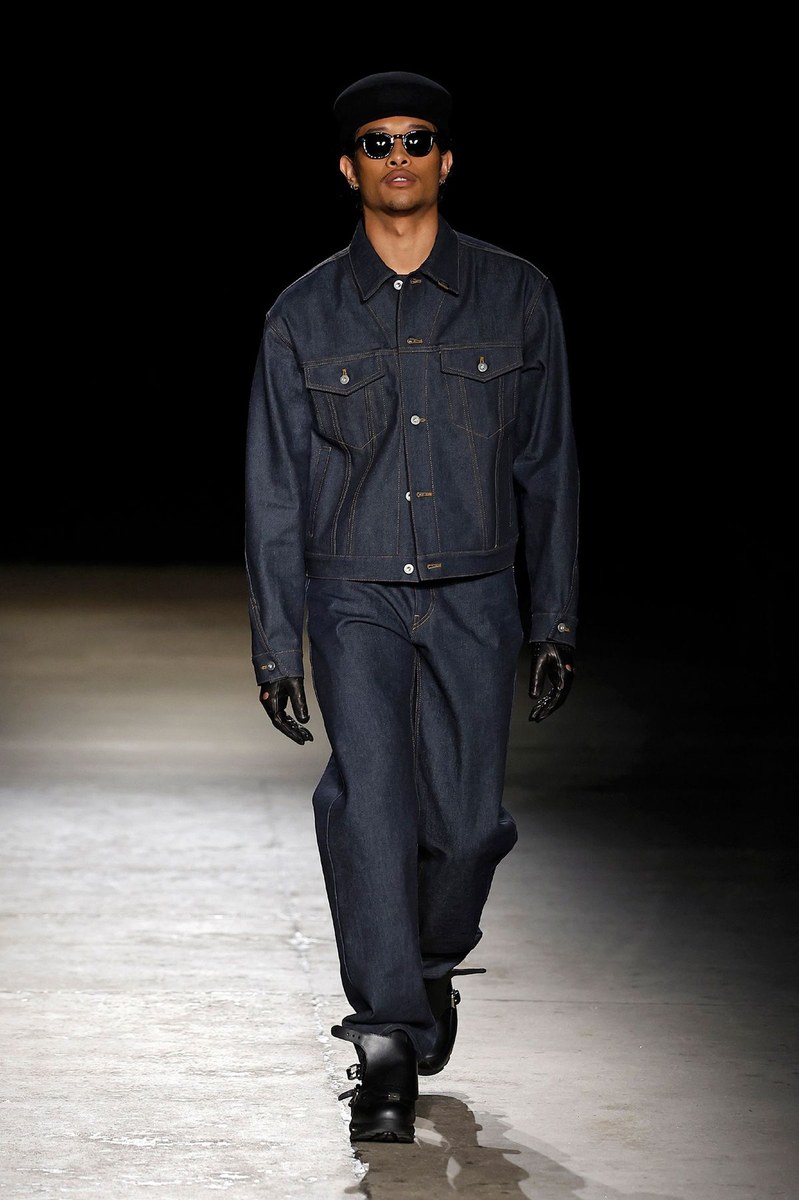
Raw indigo denim, charcoal grey wool, flat black and navy dominate the floor and give it a serious, almost utilitarian gravity. Red enters as the primary disruptor, appearing as a full jacket in Look 10, a satin bomber in Look 19 and a printed shirt beneath layers in Looks 7 and 8. Controlled noise comes from the white-and-black printed shirt in Look 6 and the graphic print shirt in Look 16, both functioning within an otherwise restrained palette. Tan camel in Look 14 and the distressed khaki of Look 11 read as the warmest departures, lending those looks a worn, archival credibility.

Materials and Textures
Raw selvedge-weight denim carries significant visual mass in Looks 1, 10, 11 and 18, and the stiff, unwashed surface reads as deliberate rather than unfinished. Leather appears in multiple weights: a supple navy anorak construction in Look 3, a heavier black shearling-lined jacket in Look 5, glossy navy trousers in Look 13 and black wide-leg trousers in Look 6. Satin-finish nylon in Look 18 and Look 19 adds a high-sheen surface that reads luxurious against the matte wool suiting pieces. Wool suiting in charcoal and grey glen plaid runs through the tailoring looks with a mid-weight drape that holds structure without stiffness.

Styling and Layering
Leather driving gloves with open-finger cutouts appear in nearly every look and function as the collection's most consistent styling signature, threading a coded coolness through both tailored and casual builds. Berets in black, navy and khaki recur as headwear, grounding looks in a Pan-African and jazz-era visual register that reads intentional rather than nostalgic. Chunky black buckle boots alternate with sleek black derbies for footwear, while black athletic sneakers appear selectively in the shorter-hemmed looks like Look 3 and Look 12. Layering logic depends on density rather than contrast, stacking turtlenecks under blazers, hoodies under leather jackets and open shirts over knit tops.
Look by Look Highlights
Look 1 delivers a complete raw indigo denim set with contrast orange stitching that reads as a direct commercial anchor for the collection, the kind of head-to-toe denim build that translates cleanly into wholesale.

Look 3 pairs a navy leather anorak with a ruched nylon cap and tailored charcoal shorts, a technically demanding construction that justifies a premium price point for outerwear buyers.
Look 5 stacks a black leather bomber with visible shearling lining over a black zip hoodie and wide-leg technical trousers, producing a total-black layered build with strong outerwear sell-through potential.

Look 9 contrasts a floor-length black double-breasted overcoat with black leather shorts and a trailing satin hem panel beneath, a complex multi-material build that style directors will read as an editorial statement piece.

Look 11 uses a distressed khaki leather trench coat over a graphic-print shirt and wide black denim trousers, with the coat's worn surface suggesting an aged, found-object quality that aligns with the current appetite for vintage-referencing outerwear.

Look 14 wraps a camel double-breasted overcoat with clean peaked lapels over black shorts and a loose white shirt, and the coat's cut is precise enough to carry a tailoring-focused buying conversation on its own.

Look 15 presents a full grey wool suit with multiple fabric strips hanging from the jacket front, a deconstructed detail that signals creative direction without sacrificing the suit's underlying wearability.
Look 19 layers an oversized red satin bomber over a black tailored vest and grey suiting trousers, combining a high-impact outerwear piece with structured underneath components that give the look commercial range across multiple retail contexts.

Operational Insights
Denim as anchor: Raw indigo denim in Looks 1, 10 and 18 forms the most accessible commercial tier. Buyers should plan depth in the denim category, particularly the wide-leg jean silhouette which appears consistently enough to signal core status rather than seasonal experiment.
Outerwear as margin driver: At least six distinct outerwear silhouettes span leather, nylon, wool and technical fabrications. Product managers should treat outerwear as the highest-margin category here, with the camel overcoat in Look 14 and the black leather bomber in Look 5 as the strongest candidates for full-price sell-through.
Glove as accessory opportunity: Open-finger leather driving gloves appear across more than fifteen looks and represent a low-cost, high-visibility accessory that buyers can use to complete shop-the-look presentations or build accessory margin into curated bundles.
Color blocking for red: Red functions as a deliberate accent across Looks 7, 8, 10 and 19. Style directors should build fixture presentations around the red-to-indigo and red-to-black pairings rather than treating red pieces as standalone, since the collection consistently shows red in contrast to darker grounds.
Shorts as year-round proposition: Bermuda-length and above-knee shorts appear in Looks 3, 9, 12 and 14, consistently paired with long outerwear. Buyers considering the shorts category should plan them alongside overcoats and trench silhouettes rather than positioning them as warm-weather exclusives, following the collection's own internal logic.
Complete Collection


About the Designer
Dao-Yi Chow grew up in Jackson Heights, Queens, the dense, polyglot neighborhood known as Little India, where South Asian, Latin American, and Caribbean cultures overlap on the same block. Maxwell Osborne was raised in Kensington, Brooklyn, a working-class neighborhood with its own relationship to the city's underground currents. Eight years apart, they came up through different parts of the same machine, but the machine was always New York: music, sport, and the precise social codes that clothes carry in public school hallways. Neither attended design school. Chow studied communications at NYU and built his early career in the business infrastructure of hip-hop culture, working at Mecca, Ecko, and the magazine Blaze before becoming VP of marketing at Sean John. Osborne joined Sean John as an intern, was hired as a designer, and the two met there around 2001.
What Sean John gave them was less about construction than about how clothes function as identity in specific communities. What you wore to school in Queens or Brooklyn announced who you were before you spoke. That observation became the foundation of everything they later built. They launched Public School in 2008, starting with menswear at Barneys, and spent several years developing quietly before the industry paid attention. In 2010 the CFDA selected them as the only menswear brand for its inaugural Fashion Incubator program. By 2013 they had won both the CFDA Swarovski Award for Menswear and the CFDA/Vogue Fashion Fund's top prize in the same year. In 2014 came the CFDA Menswear Designer of the Year and the first International Woolmark Prize for Menswear. Every piece of production runs through the New York Garment District.
In 2015 they were appointed Creative Directors of DKNY but departed eighteen months later when the brand changed hands. In the years that followed, the two worked separately, with Osborne launching AnOnlyChild from deadstock materials, and Chow serving as creative director at Brand New Era and Sergio Tacchini. In February 2026, Public School returned to the NYFW schedule with a Fall 2026 collection titled "Everything Is Now," the show framed as a direct response to the current political and cultural moment in America, and to a sense of renewed energy in New York specifically.
"The title of the show is 'Everything Is Now.' That's how we feel, the urgency of everything that's happening around our country and a bubbling renaissance in New York City. Now we have something to say."
"At public school here, you could tell who groups of students were by what they wore."
✦ This report was generated with AI — combining human editorial vision with Claude by Anthropic. Because the future of fashion intelligence is already here.