Ralph Lauren FW26 Women Looks Report
New York Fashion Week
Ralph Lauren FW26 builds its identity around the collision of English country tailoring, frontier utility, and velvet-weight evening glamour, all anchored in a near-monochromatic palette of chocolate, khaki, and forest. For buyers, this arrives at a moment when the market is actively consolidating around investment dressing and layered, season-spanning wardrobing rather than trend-driven capsules.
Silhouette and Volume
The offering splits cleanly between two poles: a long, columnar silhouette that grazes the ankle and a voluminous, draped upper body that reads oversized but structured. Wide-leg trousers with deep pleats appear across Looks 12, 13, and 17, always cinched by a thick leather belt that reintroduces waist definition without sacrificing ease. Outerwear dominates the middle section, with shearling, fur, and quilted coats adding mass to the top half while skirts and trousers remain relatively narrow below. Look 5 is the clearest statement of the house's tailoring ambition, a floor-length double-breasted herringbone coat with squared shoulders that reads as near-architectural.
Color Palette
Chocolate brown is the undisputed lead, appearing in wool, velvet, leather, and faux fur across at least twelve looks. Warm khaki and olive join in, absorbing enough green to read earthy rather than military, while near-black anchors Looks 9 and 19. Silver and gold lamé make targeted appearances in Looks 11 and 14, cutting through the earth tones with metallic brightness that positions evening separates as commercially distinct from the daywear core. Rich and sediment-layered, the mood across the full lineup deliberately resists minimalism.
Materials and Textures
Herringbone and flecked tweed carry the tailoring story, used in blazers, coats, and skirts in mid-to-heavy weights with a dry, nubby surface that photographs with strong texture. Velvet appears in three distinct weights, from the fluid slip-dress construction of Look 9 to the dense, crush-resistant pile of the olive blazer in Look 4. Cropped and voluminous faux or real fur in Look 3 becomes floor-length with a shaggy curl in Look 10, providing the collection's most commercially charged material moment. Crinkled metallic fabric in the wide-leg skirt of Look 14 and the palazzo trousers of Look 11 adds a pleated, light-catching surface that bridges the daywear and eveningwear categories.

Styling and Layering
Layering is the collection's primary styling argument. Turtlenecks anchor almost every day look, worn beneath corset tops, blazers, shawls, and draped wraps, creating a base-layer logic that buyers can translate directly into coordinated selling strategies. Wide leather belts function as structural elements, not decorative ones, cinching coats, knitwear, and blazers alike, as seen in Looks 3, 10, and 12. Silver chain details at the waist recur in Looks 1, 4, and 16, functioning as both accessory and belt alternative. Brown or black knee-high riding boots, ankle boots with a pointed toe, and occasional flat loafers with animal print dominate the footwear story, reinforcing a coherent country-luxe ground level.
Look by Look Highlights
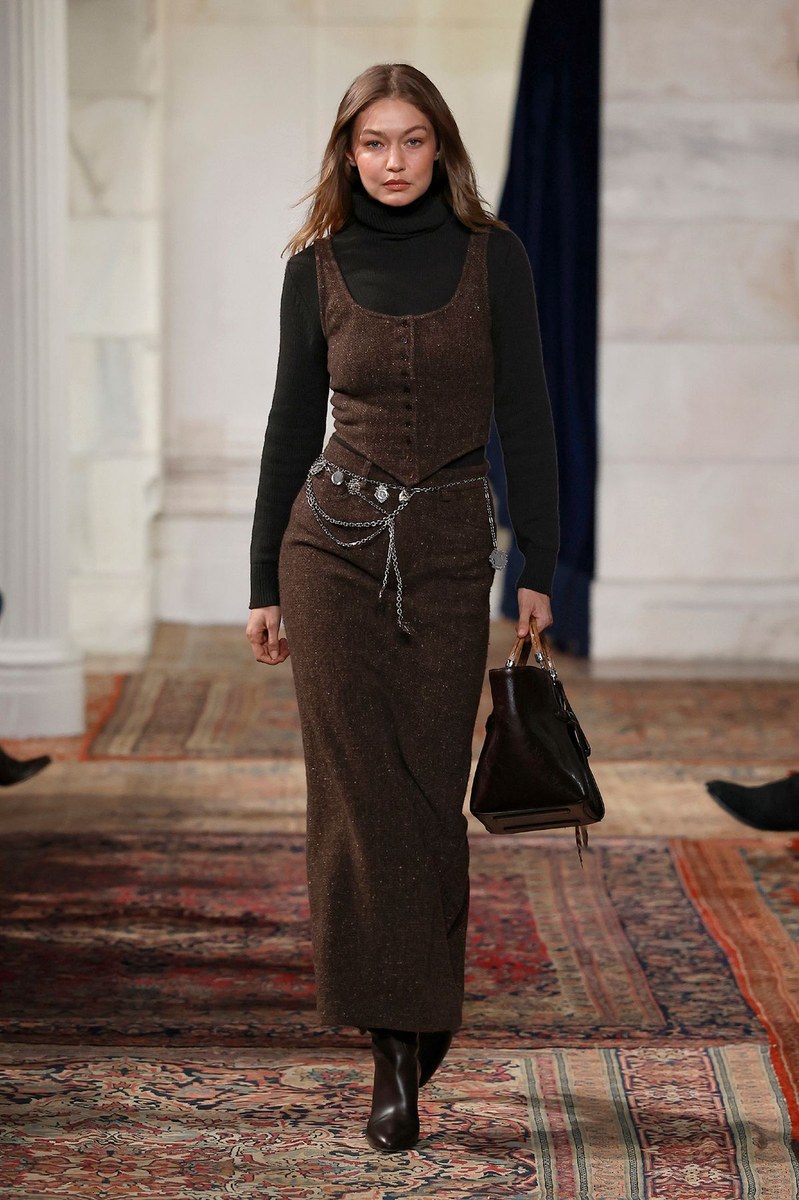
Look 1 Sets the collection's commercial template immediately: a brown tweed corset layer over a black turtleneck, a column skirt in the same fabric, and a silver coin chain belt that gives buyers a clear accessories attachment point.

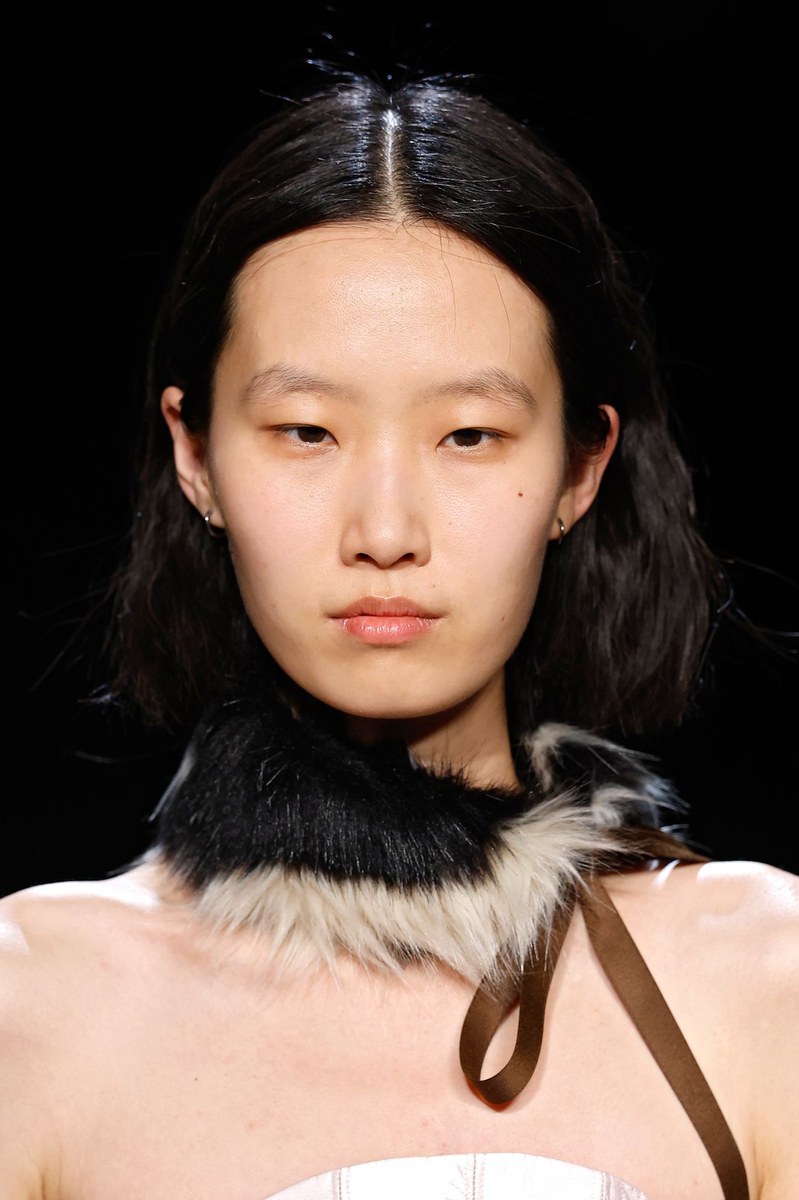
Look 3 The cropped black faux fur jacket over olive cargo-style trousers and distressed suede knee boots is the most directional outerwear entry and the strongest candidate for early pre-order.

Look 5 A floor-length double-breasted herringbone coat with structured shoulders and a sequined shirt underneath positions the house squarely at the intersection of heritage and eveningwear, a combination with strong department store viability.
Look 10 A floor-length shearling coat with a curly lamb trim worn open over a grey belted suit is the collection's most volume-forward statement and the clearest signal of where Ralph Lauren places its top-tier coat price point.

Look 13 Sharp tailoring defines this double-breasted khaki wool suit with a lace blouse underneath, structured enough for formal retail floors but loose enough in the trouser leg to attract a contemporary customer.

Look 14 An olive caped field jacket belted over a floor-length metallic pleated skirt is the collection's most disruptive mix, and its modular logic makes it easy to break into separates for multi-unit buying.

Look 17 An all-chocolate leather look, belted military jacket over slim leather-paneled trousers and chain detail, with a lace turtleneck underneath, delivers the most cohesive head-to-toe leather proposition and a strong gifting or outerwear hero.

Look 19 Deep khaki-brown velvet gown with a deep V-neck, flutter sleeves, and ruched waist serves as the clearest evening anchor in the lineup and requires minimal styling investment from retail partners to perform on the floor.

Operational Insights
Color concentration: Brown in all its tonal variants, from milk chocolate to near-black espresso, dominates roughly 70 percent of the offering. Buyers should plan depth in this colorway and treat the olive and grey groupings as secondary stories rather than standalone capsules.
Layering separates strategy: Turtleneck underlayers, belted midlayers, and draped outerlayers recur throughout, meaning nearly every look can be de-constructed into three sellable SKUs. Style directors should plan coordinated wall sets rather than isolated hero pieces to drive average transaction value.
Outerwear as lead category: Coats and jackets appear in at least eight distinct looks across faux fur, shearling, herringbone, quilted, caped, and leather constructions. This breadth signals that outerwear is Ralph Lauren's margin driver for FW26 and warrants the deepest open-to-buy allocation.
Accessories attachment rate: Chain belts, wide leather belts, baker-boy caps, long gloves, and structured handbags appear consistently enough across the lineup to support a full accessories sell-through strategy. Product managers should negotiate accessory inclusions in look-based buy programs.
Evening entry point: Looks 9, 19, and elements of Look 6 confirm that velvet evening dressing is commercially viable as a standalone category within this offering. Retailers with strong occasion-wear floors should pull these three looks into a dedicated evening assortment rather than integrating them into the broader daywear floor set.

Complete Collection


About the Designer
Ralph Lauren was born Ralph Lifshitz on October 14, 1939, the youngest of four children in a Jewish immigrant family from Belarus, living in a neighborhood in the Bronx that was nothing like anything he would later build his reputation on. His father Frank was a house painter who considered himself an artist and wrote for the Yiddish theater; his mother kept the household strictly kosher and hoped Ralph would become a rabbi. He attended DeWitt Clinton High School, where he reportedly listed his future career in the yearbook as "millionaire," and worked part-time at Alexander's department store to save money for clothes. By his mid-teens he was already spending his earnings on suits, dressing in a way that was conspicuously out of step with his surroundings, fascinated by Fred Astaire and Cary Grant in the way a teenager in the Bronx in the 1950s could be fascinated by men who seemed to inhabit a different world entirely.
He studied business at City College of New York for two years before dropping out, served in the Army from 1962 to 1964, and then worked his way through the garment district, landing at Brooks Brothers and later at the tie manufacturer A. Rivetz, traveling New England as a salesman. The job taught him what the market looked like from the outside, but the ties being made bored him: narrow, dark, and safe. In 1967 he joined Beau Brummell as a designer specifically for neckwear, and from a drawer in a showroom in the Empire State Building he began selling wide, colorful, European-cut ties under the name Polo, making deliveries himself and pitching stores directly. A $50,000 loan from his backer Norman Hilton in 1968 allowed him to launch Polo Ralph Lauren as a full menswear house. Three years later he opened the first freestanding American designer boutique, on Rodeo Drive in Beverly Hills.
What he was selling from the beginning was never really clothing in any narrow sense. It was the composite image of the American ruling class as imagined by someone who had grown up at a careful distance from it: English tweed suits, New England prep school sportswear, the dry luxury of the Hamptons, the rugged romance of the American West. The Great Gatsby costumes he designed for the 1974 film adaptation crystallized exactly what he was doing, and the decade that followed made Polo into a national institution. He stepped down as CEO in 2015, remaining as Executive Chairman and Chief Creative Officer of the company he founded. In 2025 he became the first fashion designer awarded the Presidential Medal of Freedom.
"People ask how can a Jewish kid from the Bronx do preppy clothes? Does it have to do with class and money? It has to do with dreams."
"I'm interested in longevity, timelessness, style, not fashion."
✦ This report was generated with AI — combining human editorial vision with Claude by Anthropic. Because the future of fashion intelligence is already here.