Showpony FW26 Women Looks Report
New York Fashion Week
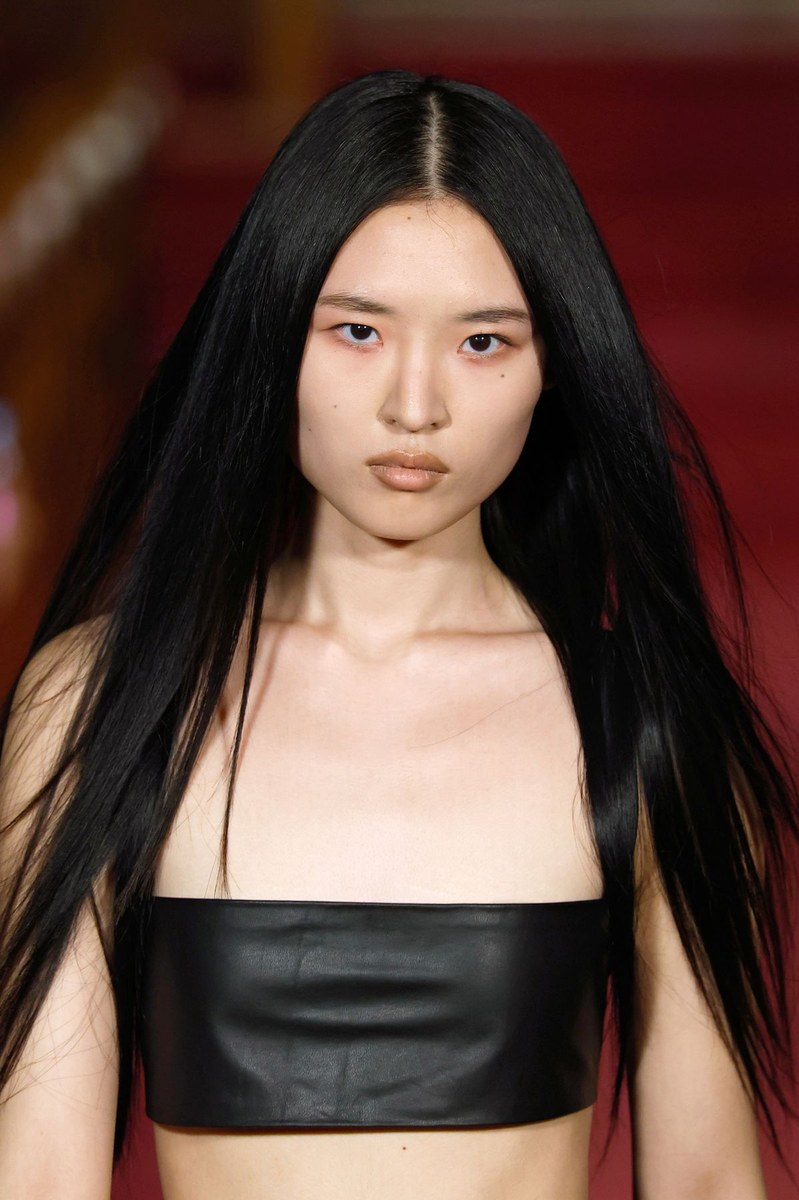
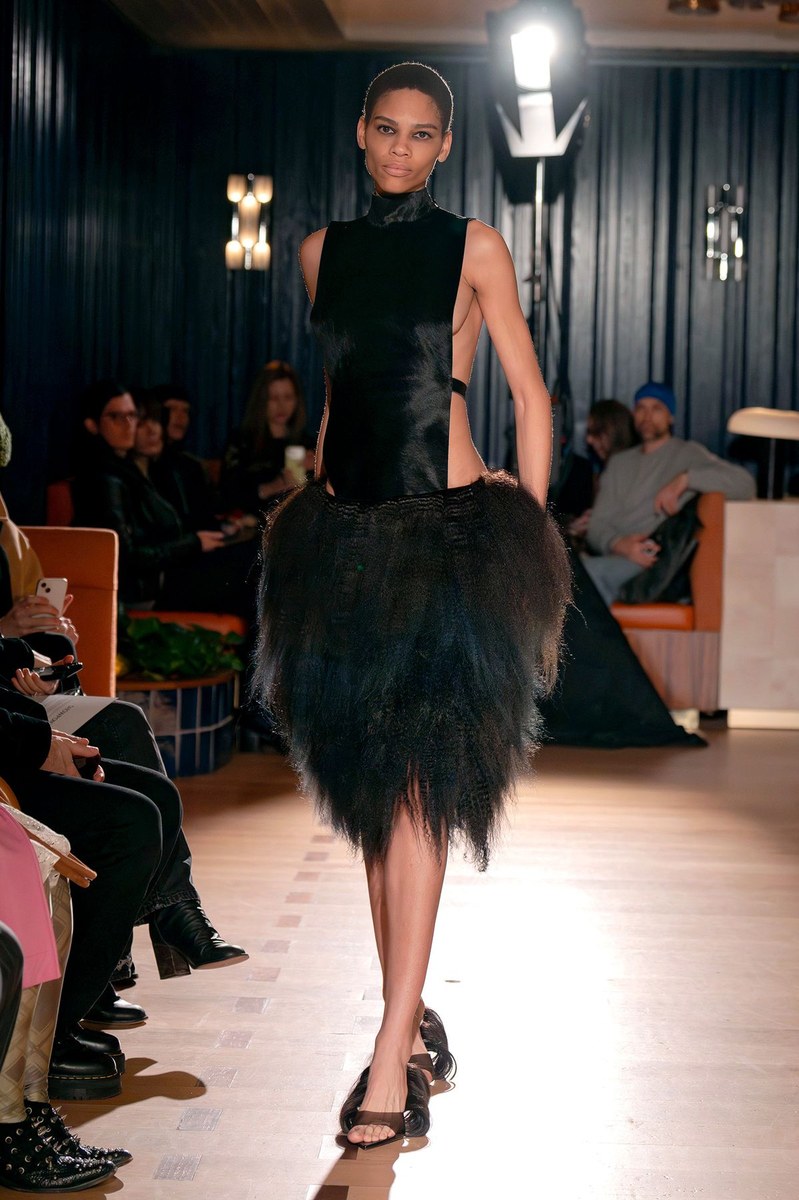
Showpony FW26 constructs garments almost entirely from human hair extensions, treating the material as both fabric and concept. Every silhouette pushes toward craft-labor-intensive construction and body-conscious, skin-baring proportions that challenge conventional ready-to-wear category logic. Buyers and product directors should take note.
Silhouette and Volume
Two clear shapes emerge across the lineup: a cropped-and-exposed torso paired with a micro bottom, and a full-length enveloping form that reads as wearable sculpture. Look 8 demonstrates the latter most literally, with bundled hair compressed into barrel-shaped sections by three stacked leather belts, creating structured volume without any traditional garment architecture underneath. Look 5 swings to the opposite extreme, wrapping the body in a floor-grazing curly hair cape that eliminates silhouette almost entirely. Fitted latex and leather bodysuits in Looks 7, 9, and 11 anchor the body beneath the hair, making the exposed skin an intentional structural element rather than a gap in coverage.
Color Palette
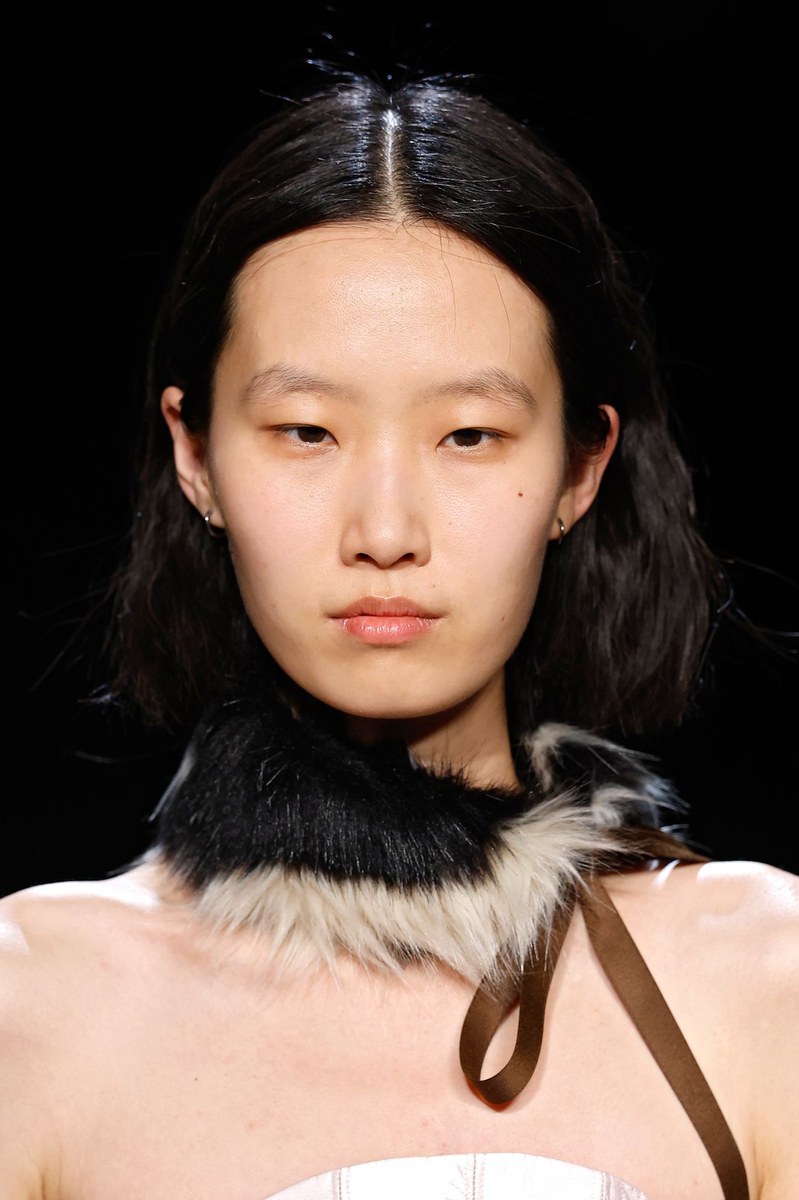
Black dominates the first half, appearing in Looks 1, 2, 3, 4, 5, 14, 15, 16, and 18 with a cold, near-matte depth that reads as deliberate and consistent rather than default. The palette then shifts into a warm caramel-to-cognac range in Looks 7, 8, 9, 10, and 11, using honey blonde, chestnut brown, and burnished tan latex in close tonal groupings that evoke natural hair gradients. A dusty rose-blush appears in Looks 12 and 13, softening the mood before the finale grey in Look 17 closes on a cool, silvered note. Without print or pattern to rely on, the tonal variation within each hair texture carries the full visual weight of color.

Materials and Textures
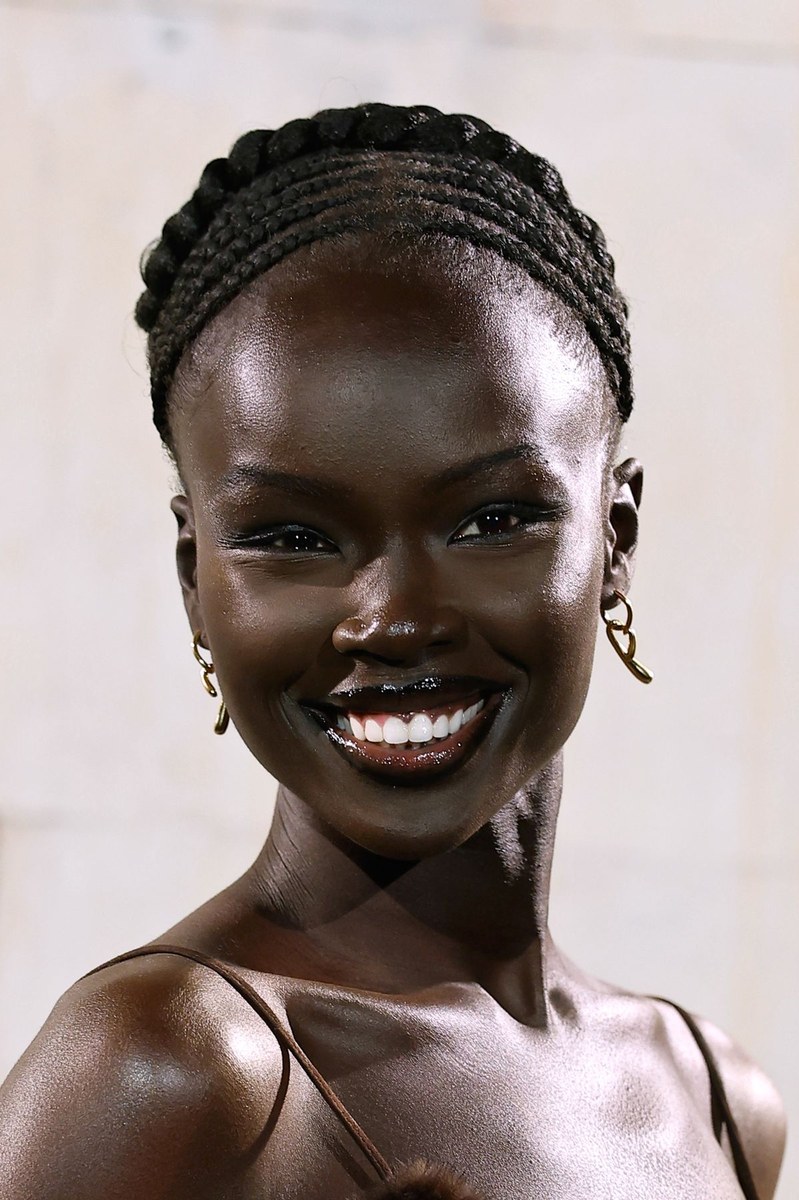
Human hair extensions, both raw and processed, serve as the primary textile throughout. Straight, wavy, crimped, and tightly coiled textures are used separately and in combination, and the difference in surface behavior between each type creates what amounts to a full material vocabulary within a single source. Bone-straight extensions drape stiffly while kinky-coiled hair springs into volume. Leather and latex appear as structural counterpoints in Looks 7, 9, 11, and 14, with cognac leather belts in Look 8 functioning as the only visible non-hair construction element in that garment. A white structured corset bodice in Look 17 and a blush satin corset in Look 13 introduce smooth surfaces that make the surrounding hair textures read even more dramatically by contrast.
Styling and Layering
Footwear runs on a narrow track: open-toe strappy sandals in black or cognac leather appear in the majority of looks, with several pairs carrying fringe or hair extensions along the toe strap, most visibly in Looks 2, 4, 5, 9, and 11. The hair-covered knee-to-floor boot in Look 2 functions as both footwear and textile, collapsing the boundary between accessory and garment. Leather belts serve as structural devices rather than accessories, segmenting and compressing the hair in Looks 6 and 8 to create form where there would otherwise be mass. Almost no jewelry appears across the collection, and bags are absent entirely, placing all visual and commercial focus on the body-and-hair system itself.

Look by Look Highlights
Look 3 makes the most radical statement in the collection, using only hair extensions and a black underwire brief as the complete garment, with straight extensions reaching the floor from a hairpiece crown, a production choice that collapses clothing and body adornment into a single object.

Look 8 presents the strongest commercial case study in the collection, using three wide cognac leather belts to compress layers of blonde-to-brunette ombre hair extensions into a strapless barrel-shaped dress that holds structure without any internal boning or lining.
Look 9 pairs a voluminous straight-hair shoulder cape in warm chestnut ombre with gold-tan latex flared trousers, a combination that grounds the hair material in a wearable, production-legible silhouette more than most other looks manage.

Look 14 introduces a dark chocolate leather corset as a standalone structural piece above a black kinky-hair maxi skirt with a deep center-front slit, making this the look with the clearest path toward a separated, sell-able corset SKU.

Look 17 closes the show with a white structured leather bodice over a floor-length grey wavy hair skirt, worn with animal ear headpiece and prosthetic muzzle makeup, a deliberate rupture in tone that functions as a signature finale rather than a commercial proposition.
Look 6 presents a burgundy-to-black ombre shaggy hair mini dress framed by a wide dark chocolate leather harness collar, one of the few looks where the leather construction reads as a jacket-weight layering piece with standalone retail potential.

Look 13 offers the most accessible entry point in the collection, pairing a blush pink wavy hair crop top with a wide blush satin underbust corset and a matching wavy hair micro skirt, a three-piece system where the corset could be extracted and merchandised independently.

Look 15 translates the hair textile into a fitted strapless mini dress with a straight-hair body and a kinky-coiled hem border, the tightest and most dress-coded silhouette in the collection and the look most likely to generate direct wearability conversation with buyers.

Operational Insights
Material sourcing: Production viability depends entirely on establishing reliable, ethically audited supply chains with hair extension manufacturers rather than traditional fabric mills. Buyers should pressure-test sourcing capacity before placing orders.
Construction labor: Building garments from hair extensions requires specialized hand-construction techniques not present in standard CMT factories. Style directors and production managers should expect significantly elevated cost-per-unit and extended lead times, making small-batch or made-to-order models more operationally realistic than mass production runs.
Category placement: Most looks resist standard ready-to-wear categorization, sitting closer to costume, performance wear, or art-adjacent fashion. Specialty and concept retailers will find the most natural fit, while department store buyers should focus narrowly on the corset pieces from Looks 6, 13, and 14, which carry the clearest standalone product logic.
Corset opportunity: The leather and satin corset forms appearing in Looks 6, 13, 14, and 17 represent the most extractable commercial product in the collection. Sourcing the corset silhouettes as independent pieces, separate from the hair skirts and capes, would allow product managers to enter the corset-as-outerwear market with a designer reference point and a more manageable cost structure.
Trend signal for texture: Extreme material texture and tactile surface continue to replace print or embellishment across FW26. Style directors building assortments around the feather, fringe, and shaggy-fur trend already active in the market should read this collection as confirmation that consumer appetite for high-drama surface texture continues to accelerate, and plan buy quantities in textured categories accordingly.
Complete Collection


About the Designer
Evanie Frausto was born in Orange County, California, to Mexican immigrant parents, and grew up in a conservative community where he learned early to find his own edges. As a child he stole his sister's Barbies, cut their hair, and recolored it with markers, hiding the evidence under the bathroom sink. As a teenager he was styling and dyeing his friends' hair, and as a young queer kid in Orange County, the MySpace emo scene gave him a community that the world around him did not. He completed cosmetology school and, when the graduation trip to New York arrived, decided not to go home. He was 18. He crashed in a hostel in the city, broke and certain there was something there for him, and eventually met a hairstylist who needed an assistant and a roommate. He moved out of the hostel the same week.
The years that followed were a methodical apprenticeship through the editorial and celebrity tiers of the industry. He trained under Jimmy Paul, then Laurent Philippon, then Guido Palau, absorbing the particular discipline of people who had built careers out of knowing exactly what a photograph needs from a person's head. Once working independently, he developed a reputation for taking a client's reference and pressing it to an extreme, constructing wigs ten feet tall, or engineering hair that dragged on the floor behind a model. He noticed that the most spectacular things he made were making the people wearing them physically uncomfortable, and that observation led him toward a different question: what if the hair came off the body entirely and became the garment itself? He began accumulating the clippings, offcuts, and leftover material from years of editorial work, storing it all in his Brooklyn studio. His clients by this point included Bella Hadid, Sabrina Carpenter, Rosalía, Addison Rae, and Alexa Demie.
Two years of development produced Showpony, which debuted at New York Fashion Week in February 2026 at a seafood restaurant in SoHo, 14 looks of gowns, jackets, boots, and corsets constructed almost entirely from styled and dyed human hair. The name came from two places simultaneously: the snatched ponytails he famously created for Hadid, and the theatrical, performative energy of a show horse. The collection closed with German DJ and singer Horsegiirl420 wearing a full equine-faced prosthetic, which captured the project's tone precisely. Stars including Rosalía and Tate McRae have since worn pieces from the line. Frausto remains based in Brooklyn, where Showpony continues as a parallel project alongside his hair career.
"I wanted to disrupt my system and do something crazy that felt authentic to myself and my art."
"I've been a hairstylist for so long, hair has become normalized to me. But I get reminded of it whenever I pull out a wig, because there's always a gasp. There's something about that feeling that I love and want to lean into."
✦ This report was generated with AI — combining human editorial vision with Claude by Anthropic. Because the future of fashion intelligence is already here.