Tory Burch FW26 Women Looks Report
New York Fashion Week
Tory Burch FW26 builds a wardrobe around the tension between prep-school restraint and quietly subversive material choices, pairing collegiate knitwear with patent leather, liquid satin, and braided leather belts that read as both archival and current. Aspirational American sportswear emerges at a higher craft register without abandoning its commercial core, positioning itself strategically for buyers navigating a market fatigued by overtly logo-driven product.
Silhouette and Volume
Two distinct volume propositions anchor the collection. A relaxed, slightly boxy torso appears consistently in the pulled-over knitwear of Looks 1 through 7, while a more architectural outerwear shell in Looks 4, 10, 12, and 19 carries structured shoulders without exaggerating the armhole. Long, unhurried falls characterize both skirts and trousers, which land at midi or below. Wide-leg corduroy trousers in Looks 2 and 5 pool softly at the ankle, while cropped leather culottes in Looks 7 and 15 introduce a sharper mid-calf break that reads well as a separates buy. Nothing feels aggressively avant-garde, which is commercially strategic.
Color Palette
Two distinct registers organize the palette. Cream, pale butter yellow, camel, and khaki run through Looks 2, 5, 10, and 17, producing an autumnal tone that photographs beautifully in catalogue and editorial contexts. Against that ground, Burch drops high-saturation punctuation: a pillar-box red in Looks 1 and 9, a sharp chartreuse yellow in Look 3, and an olive-meets-moss green in Look 8. Navy functions as a true neutral anchor in Looks 6, 12, and 18, while the silver satin of Look 14 and the steel blue of Look 18 move the closing section toward evening without abandoning the collection's structural logic.

Materials and Textures
Patent leather delivers a high-sheen, slightly stiff drape on both the dark brown midi skirt in Look 1 and the culottes of Look 15, contrasting directly against the matte, pilled surface of the wool knitwear layered above it. Wide-wale corduroy in a butter-yellow colorway (Look 5) and a warm camel (Look 2) carries the kind of tactile weight that translates into strong cold-weather sell-through. Heavy, duchess-weight satin in Looks 14 and 18 holds the pleated ruffle construction at the waist without collapsing, a detail that matters for production quality assessment. Embellished outerwear in Looks 11 and 13 applies sequin-and-bead embroidery onto a bouclé-adjacent ground, mixing a rough textile base with reflective surface decoration.

Styling and Layering
A single repeated formula organizes layering throughout: a collared shirt or turtleneck as the visible base layer, a wool crewneck or oversized sweater pulled over it with the collar deliberately exposed, and a woven or braided leather belt cinching the ensemble at the high hip. Footwear skews toward square-toe ballet flats, low block-heel pumps in olive or nude, and patent loafers with a gilt hardware bar, all sitting at a commercial price point relative to the collection's positioning. Braided leather belts recur across at least six looks in varying colorways, brown and tan in Look 1, blue and gold in Look 7, and black and yellow in Look 8, making them a clear accessories hero with strong repeat-buy potential. Bags range from structured mini top-handles in croc-embossed leather to relaxed net and woven totes, covering both the formal and casual ends of the buyer spectrum.
Look by Look Highlights
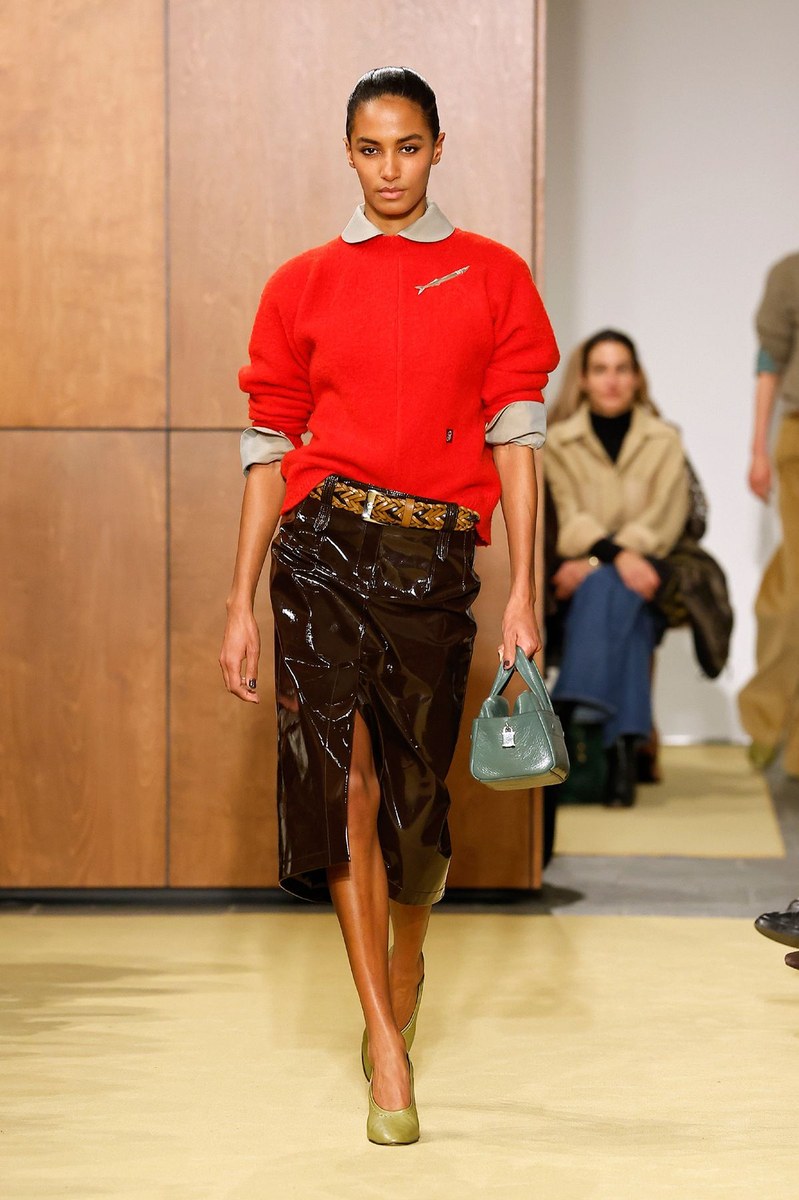
Look 1 Red wool crewneck over a beige Peter Pan collar shirt, belted above a dark brown patent leather midi skirt with a center front split, anchored by olive block-heel pumps and a mint croc mini bag. This look functions as the collection's clearest commercial entry point and strongest editorial pull.
Look 3 A chartreuse yellow crewneck paired with a matching yellow-green patent leather midi skirt and a gold-and-brown braided belt operates as a tonal dressing reference that contemporary buyers can position as a color-story capsule.
Look 4 A classic beige trench with a high throat-latch collar worn over a red knit and dark grey wide-leg trousers with a leather-trimmed seam at the outseam, this look layers outerwear over color in a way that rewards in-store discovery when the coat is opened.

Look 9 A voluminous red cotton twill dress with structural seaming, patch pockets, a pintucked waistband, and two long self-belt streamers hanging from the back creates the collection's most photographable single piece. A statement-dress entry point emerges here, one that will perform strongly in resort-adjacent retail environments.

Look 12 A full-length double-breasted navy wool overcoat with gold military buttons, worn with black leather knee boots and black leather gloves folded into the welt pockets, delivers a complete outerwear look with near-zero styling complexity and strong sell-through probability in colder-climate markets.

Look 14 A silver duchess satin two-piece, with a ruched long-sleeve top, a tiered pleated ruffle peplum, and matching palazzo trousers, represents the collection's clearest evening proposition and the look most likely to drive press placement and influencer pickup around the holiday season.

Look 17 A charcoal grey double-breasted power suit with a brown velvet collar, worn with a matching grey sweater underneath, a dark leather belt, and two-tone loafers, reads as the strongest suiting buy for style directors building a corporate-adjacent but fashion-forward wardrobe edit.

Look 11 A jewel-embellished black bouclé cape coat worn open over a sheer black ribbed turtleneck, black satin culottes, and patent loafers with gold hardware signals a gala-adjacent outerwear narrative that sits between occasionwear and outerwear. A genuine gap in most buyers' winter floor plans becomes addressable here.

Operational Insights
Belts as a standalone buy: Braided leather belts appear in at least six distinct colorways across the collection and function as an independent accessories hero. Negotiate a belt assortment separate from garment buys to capture the accessory customer.
Patent leather fabric story: Patent leather appears on skirts and culottes in multiple colorways including near-black, dark brown, and yellow-green. Assess whether the supplier can deliver this finish at the correct MOQ for a coordinated separates launch, since the fabric is central to the collection's material identity.
Corduroy trousers as a volume driver: Wide-wale corduroy in butter yellow (Look 5) and camel (Look 2) carries immediate commercial legibility. Prioritize these SKUs for floor placement in October delivery windows when corduroy demand traditionally peaks.

Outerwear depth: Five distinct outerwear silhouettes appear throughout: the trench (Look 4), the navy peacoat (Look 6), the charcoal single-breasted coat (Look 10), the navy military coat (Look 12), and the black cocoon coat (Look 19). Build a tiered outerwear wall at different retail price points rather than selecting a single silhouette.
Evening capsule potential: Looks 14 and 18 in silver and steel-blue satin respectively, alongside the embellished outerwear of Looks 11 and 13, constitute a self-contained evening capsule. Consider pulling these four looks as a dedicated drop timed to November delivery rather than integrating them into the broader fall floor set.
Complete Collection


About the Designer
Tory Burch grew up on a 250-year-old farm on Philadelphia's Main Line, the kind of setting that quietly instills a very specific relationship with quality, tradition, and the rituals of getting dressed. Her mother Reva was a former actress with a wardrobe built from Moroccan tunics, Valentino, and stops at vintage markets in Europe; her father Buddy, an investor and natural dandy, had his dinner jackets lined with Hermès scarves and every shirt monogrammed. Neither career was fashion, but the house ran on aesthetic intelligence. Burch rode horses, captained the tennis team, and attended the Agnes Irwin School before going to the University of Pennsylvania, where she studied art history and graduated in 1988 without any particular plan to work in fashion.
She moved to New York and built her industry knowledge from the outside in, taking positions in public relations and advertising rather than on the design floor. She worked at Zoran, then at Harper's Bazaar, then held roles at Vera Wang, Ralph Lauren, and Loewe. None of it was design work in the technical sense, but it trained her eye for what a brand looks like from the consumer's side of the transaction. After 9/11, she started cutting pages from magazines and assembling image books, photographs of her parents as the nucleus of a visual language she wanted to make commercial. She launched her first collection from her Manhattan apartment in 2004, opening a boutique on Elizabeth Street in Nolita the same year with a 1,900-square-foot space she insisted on designing herself, warm and layered when the industry default was minimal and cold.
The brand's early pivot point arrived in 2005 when Oprah Winfrey called it the next big thing on national television, collapsing a decade of brand-building into a single broadcast. Sales went vertical overnight. The Reva ballet flat, named for her mother, became one of the most recognized shoes in American fashion. By 2008 the CFDA had named her Accessory Designer of the Year. In 2009 she founded the Tory Burch Foundation, which provides capital, education, and community to women entrepreneurs in the United States. In 2024 she was included in TIME's 100 most influential people. She remains the brand's founder and Executive Chairman, with her designs produced across more than 300 stores worldwide and carried at Bergdorf Goodman, Neiman Marcus, and retailers across Europe and Asia.
"I always watch my mother, Reva, get dressed at night, and just look incredibly stylish. And my father had his own innate sense of style. He was one of my biggest, biggest inspirations."
"Luxury as I see it is not exclusionary. It's about having personal style and living your life based on your individual aesthetic. It is about having taste, developing it over time and understanding how to apply it to every aspect of your life."
✦ This report was generated with AI — combining human editorial vision with Claude by Anthropic. Because the future of fashion intelligence is already here.