TWP FW26 Women Looks Report
New York Fashion Week
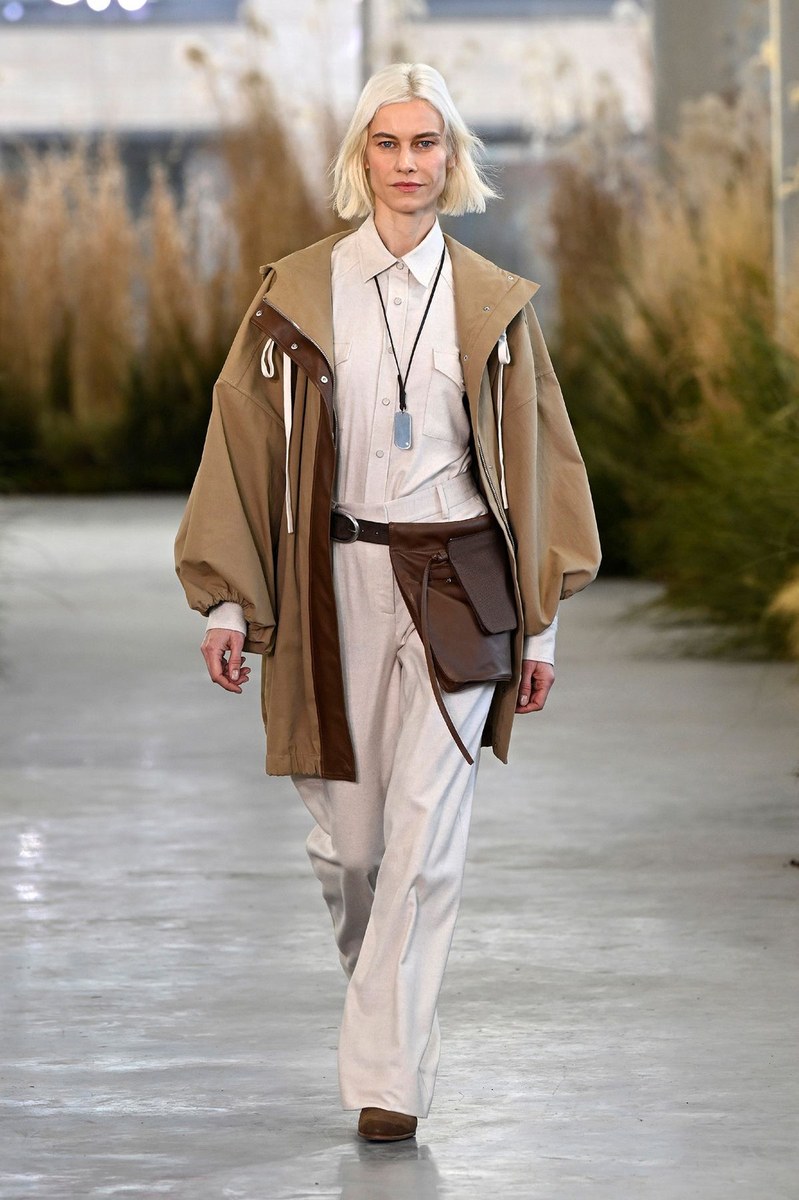
TWP FW26 builds a wardrobe around the working woman who moves between practical outdoor life and polished urban context, using earth-toned outerwear, leather accessories and wide-leg trousers as the load-bearing pillars of every look. For buyers, this collection arrives at a moment when the market is actively seeking investment-grade separates that resist trend fatigue, and TWP delivers exactly that kind of durable commercial logic.
Silhouette and Volume
Wide-leg trousers in relaxed, floor-grazing cuts anchor the collection from Look 1 through Look 19, pairing consistently with oversized or belted outerwear that adds volume at the shoulder without widening the hip. Skirts appear in Looks 12, 13, 15 and 16 at midi length with A-line or wrap construction, maintaining the same unhurried ease as the trouser looks. The silhouette reads generous but never shapeless. Belts in Looks 1, 4, 5, 6, 10, 12 and 14 reintroduce a waist without abandoning the relaxed framework.
Color Palette
Khaki, raw linen, warm camel and dark chocolate brown form the core, cycling across outerwear, trousers and knits in a palette that reads as coherent terrain across the full lineup. Look 10 introduces a muted teal in the wide-leg trousers, the single coolest deviation in an otherwise entirely warm-spectrum edit. Looks 5, 6, 17 and 19 push into near-black and charcoal, giving the collection a darker anchor that reads commercially strong for fall replenishment. Northern latitude and utilitarian define the mood here, closer to Patagonian field wear than to urban minimalism.

Materials and Textures
Heavy wool coats in Looks 2 and 19 carry a dense, matte hand that signals genuine weight and warmth rather than fashion-weight suiting. Shearling and faux fur appear in Looks 4 and 6, both in chocolate brown with visible panel construction that reads as intentionally artisanal. Cotton canvas in safari jacket weights powers Looks 1, 3 and 8. Leather pieces in Looks 7, 9 and 10 use a supple, slightly matte finish rather than high-gloss, keeping the texture register consistent with the rest of the collection. Chunky marled knit in Look 15 and an open-stitch sweater in Look 14 add tactile contrast without breaking the earthy material story.

Styling and Layering
Layering happens with a cumulative logic: shirt under knit under outerwear, with each layer visible at the collar or cuff. Look 3 adds a dark navy sweater between a collared shirt and a khaki field jacket. Look 18 stacks a white dress shirt, a brown suede blazer and a dark textured overcoat as three distinct panels. Footwear divides into two camps: olive rubber riding boots appear across Looks 7, 12, 13, 15 and 16, grounding the collection in utility, while suede ankle boots in tan and chocolate carry the dressier looks. Accessories stay purposeful, with fringed totes in Look 3, a western belt buckle in Look 4, and stone pendant necklaces in Looks 1 and 3 reading as personal objects rather than fashion additions.

Look by Look Highlights
Look 1 Combines a sand linen wide-leg suit with a khaki cotton field jacket worn open and a large chocolate leather belt bag that sits at the hip, making it the collection's clearest argument for outerwear as a layering piece rather than a closing layer.
Look 4 Pairs a long paneled brown faux fur coat with striped leather wide-leg trousers and a western oval belt buckle, the most commercially charged look in the lineup for buyers serving a western-influenced contemporary market.

Look 5 Delivers a head-to-toe washed charcoal denim look, western shirt tucked into wide straight jeans with a black belt and oval buckle, that functions as a direct production candidate for denim-focused private label programs.

Look 9 Builds on a brown leather oversized bomber, a gray scarf worn loose at the neck and a caramel wrap midi skirt with a high front slit, creating the collection's strongest argument for leather outerwear at a mid-market price architecture.

Look 10 Introduces the only teal-blue element in the collection, a fluid wide-leg trouser worn with a camel belted blazer and a leather glove bag, making it the standout styling risk and the look most likely to drive editorial placement.
Look 16 Puts a cropped double-breasted gray herringbone blazer over a navy pinstripe midi dress, adds olive riding boots and a structured oxblood box bag, and lands as the collection's most direct play for a professional workwear customer.

Look 19 Closes the main runway sequence with a floor-length black wool wrap coat over a navy satin slip dress, worn with tan suede ankle boots, pairing two opposing material registers in a way that reads as a strong evening-to-transit proposition.

Look 14 Layers a floor-length heather gray bouclé coat over a taupe sweater, brown wide-leg trousers, a mauve ribbed scarf and shearling platform slides, making it the most volume-forward look in the collection and the most relevant for cold-climate luxury outerwear buyers.

Operational Insights
Outerwear depth: At least eight distinct outerwear silhouettes run through the collection, from the belted cotton jacket in Look 8 to the long faux fur in Look 4, giving buyers the option to build a tightly edited outerwear capsule from a single vendor source with strong material variety.

Leather accessories as margin drivers: Belt bags, glove bags, fringed totes and structured box bags appear across more than half the looks, all in consistent chocolate and oxblood leathers that could translate into a high-margin accessories tier without requiring new material sourcing.
Western hardware recurrence: Oval and rectangle belt buckles appear in Looks 4, 5, 6 and 10, signaling a sustained western hardware direction that product managers should flag for belt and hardware procurement well ahead of the fall floor set.
Rubber boot positioning: Olive rubber riding boots styled across six looks represent a deliberate push to reframe utilitarian footwear as a wardrobe anchor rather than a weather contingency, a signal that buyers in the footwear category should evaluate stock depth on this silhouette for fall.
Color range for assortment planning: Raw linen and camel through chocolate and charcoal to near-black provide a natural assortment ladder that allows style directors to plan colorway rollouts across key and fill deliveries without introducing palette breaks that would disrupt the floor story.
Complete Collection


About the Designer
Trish Wescoat Pound grew up in a small town on the border of Kansas and Oklahoma, raised by a young mother with limited resources and very little about her circumstances that pointed toward New York or fashion. She has said the work ethic that still drives her came entirely from that place and that time, from growing up where you worked or you didn't eat, without any ambient encouragement toward ambition in the arts. She did not come to the city with a plan. She came, as many do, because she needed to go somewhere, and New York is where she landed. Her first job was as a receptionist at Calvin Klein. Then she worked the door at Nell's nightclub. Neither was a conventional route into design, but both taught her something the design schools don't: how a room reads, who walks in wearing what, what a woman reaches for when she wants to feel a specific thing.
Her real education began at Theory, where Andrew Rosen, who had co-founded the brand, became her first boss and first serious mentor. She rose through the company from Vice President of Sales to President and Creative Director, learning fabrication, fit, and the commercial logic of building clothes women actually buy. From there she moved to Liz Claiborne before, in 2008, betting everything on her own idea. Haute Hippie was a bohemian-rock sensibility anchored in quality fabric and a very specific California-via-Manhattan attitude. It grew to $40 million in revenue and 300 specialty stores across 40 countries. In 2015, internal financial misconduct by employees forced a sale she never wanted, and she lost the brand, her money, and, as she has put it plainly, her marriage and her sense of identity.
She retreated to her pattern room. Instead of trying to rebuild what she had lost, she started from a single question: what makes a perfect shirt? For two years she worked quietly, developing tailored button-downs that reworked men's shirting architecture for a woman's body, and sold them at trunk shows in Miami to women she trusted. One of those women ran into Andrew Rosen and mentioned the shirts without knowing their origin. Rosen traced them back to Wescoat Pound, called her for lunch, and by the time the check arrived had offered to invest. TWP launched for Spring 2022, with Rosen backing the business and Wescoat Pound's daughter Jillian, now Director of Styling, working alongside her. The brand has since shown at New York Fashion Week, opened boutiques in the Hamptons, and launched at Selfridges London in November 2024. The name is her initials.
"Sometimes it's the things that don't work out in your life, the things that break your heart, that lead to the most amazing experiences."
"I saw a big void in the market between contemporary and designer. I felt like there have to be other people that feel like I do."
✦ This report was generated with AI — combining human editorial vision with Claude by Anthropic. Because the future of fashion intelligence is already here.