Vivetta FW26 Bags
Vivetta FW26 Bags Report
Vivetta FW26 commits to miniaturization as a deliberate design thesis, pairing drawstring pouches and rigid minaudieres with sculptural gold hardware that functions almost as jewelry in its own right. For buyers and product managers, this signals a clear opening in the gifting and evening accessories market, where price-per-square-inch logic favors high-margin small formats with strong visual identity.
Silhouettes and Shapes
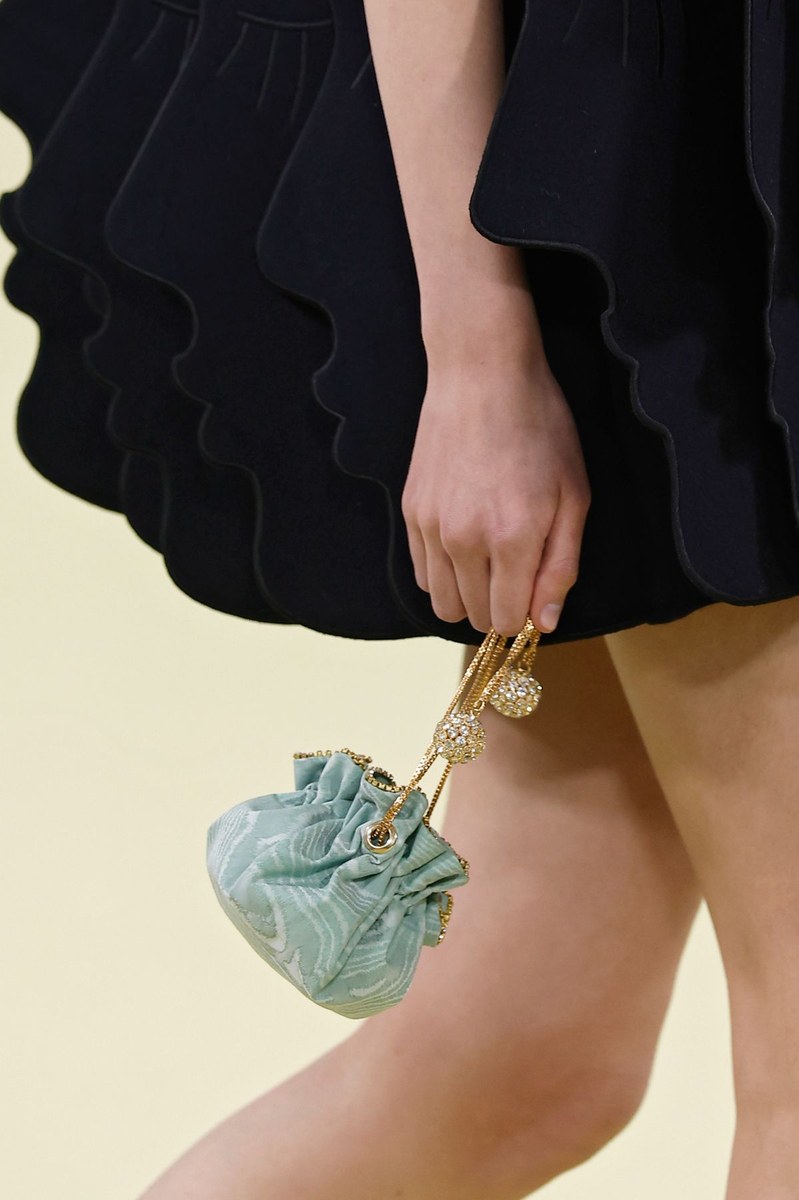
Two opposing structures define the collection: soft, gathered drawstring pouches and hard-shell circular or spherical minaudieres. Bags 1 and 2 occupy the slouchy pouch category, both carried via finger-loop ring handles rather than conventional straps, which dramatically changes the carry posture and the visual relationship between hand and bag. Bags 3 and 4 move into rigid territory, with a flat disc and a sphere respectively, each small enough to nest in one palm. Proportion stays firmly in micro and minaudiere territory across all four looks, with nothing exceeding a 20 cm footprint.
Materials and Hardware
Bag 1 uses a pale celadon moire fabric with a watered-silk finish, giving it a surface pattern that reads as both archival and editorial. Bag 2 is executed in matte navy nylon or satin, a more commercial and seasonless proposition. Bags 3 and 4 abandon textile entirely and go fully metallic, with Bag 3 constructed from polished yellow gold-tone pleated metal panels and Bag 4 from a pyramidal gold-tone quilted metal sphere. Ring handles on Bags 1 and 2 are pavé-set crystal and rope-twist gold respectively, functioning as statement jewellery hardware rather than utilitarian closures.

Color Direction
The palette runs narrow and deliberately restrained. Celadon, navy, and two registers of gold cover the entire group. Soft bags anchor wearable, wardrobe-compatible tones while hard bags push into full ornament mode with yellow gold finishes that read more Cartier than contemporary accessories. There is no black, no neutral tan, and no red, which signals Vivetta is targeting a specific evening and occasion customer rather than building an everyday carry programme.
Key Models and Details
The finger-ring handle emerges as the signature construction detail of the season, appearing across Bags 1 and 2 and connecting a delicate chain to a pavé or rope-twist knuckle ring. This transforms the carrying gesture into a deliberate pose, relevant to runway styling and social content. Bag 3 closes as a clamshell and appears to lock at a central diamond or crystal point, making the closure the focal decorative element. Bag 4 pairs its quilted sphere body with a mixed-metal clasp that combines silver and gold tones, suggesting an intentional tension in hardware finish rather than a matched set approach.

Bag by Bag Highlights
Bag 1 Pale celadon moire pouch with pavé crystal ring handle. The highest fabric interest in the group and the strongest candidate for a limited-edition or capsule SKU targeting the bridal and cocktail dresser.
Bag 2 Matte navy pouch in the same ring-handle format as Bag 1. More commercially scalable given its neutral color and clean material read.

Bag 3 Polished yellow gold pleated disc minaudiere on a fine link chain. A direct evening accessory play with strong jewellery-adjacency that supports premium price positioning at retail.
Bag 4 Pyramidal quilted gold sphere clutch with a mixed silver and gold clasp. The most architecturally complex piece in the group and the one most likely to generate press placement and editorial pick-up.

Bag 1 vs Bag 2 The shared silhouette across these two creates a natural two-SKU entry point for wholesale buyers who want to present the house's core handle concept without committing to the full range.
Bags 3 and 4 as a pair Both rigid minaudieres read as collectible objects rather than functional bags, positioning them for trunk show environments, prestige multi-brand retailers, and occasion-wear floor sets rather than standard bag walls.
Operational Insights
MOQ strategy: The two-variant pouch format (Bag 1 and Bag 2) in shared construction allows buyers to negotiate a combined minimum order quantity across colorways, reducing inventory risk on an unfamiliar silhouette.
Margin architecture: Hard minaudieres in metal construction (Bags 3 and 4) carry strong keystone or above margin potential given raw material cost relative to perceived luxury value. Buyers should prioritize these for gifting and holiday floor sets.
Category placement: All four bags sit in evening and occasion rather than daywear, which means floor placement, visual merchandising, and sell-through cadence should align with cocktail apparel adjacencies rather than the main bag floor.
Hardware as hero: Ring handles on Bags 1 and 2 are the primary visual sell. Product managers should ensure e-commerce imagery captures the hand-carry gesture directly, as flat lay photography will not communicate the concept.
Reorder risk: Moire fabric and pleated metal panel construction both carry long lead times and supplier constraints. Buyers committing to Bags 1 and 3 should confirm fabric and component availability before placing initial orders for a season with a narrow delivery window.
✦ This report was generated with AI — combining human editorial vision with Claude by Anthropic. Because the future of fashion intelligence is already here.