Zankov FW26 Women Looks Report
New York Fashion Week
Knit construction forms the beating heart of Zankov FW26, pushing well beyond the basics into sculptural, pattern-dense, emotionally charged territory. For buyers seeking craft-forward product with clear visual identity, this collection offers a coherent and commercially legible point of view.
Silhouette and Volume
Two distinct body registers anchor the collection. Oversized, cocoon-shaped sweaters and cardigans dominate the top half, as seen in Looks 15, 16, and 17, while skirts and trousers below read either long and lean or sharply cropped at the knee. Look 4 breaks the pattern with a floor-length double-breasted wool coat cut in a straight, almost architectural column that gives the range a formal anchor. Volume is concentrated and controlled throughout rather than diffused across the entire silhouette.
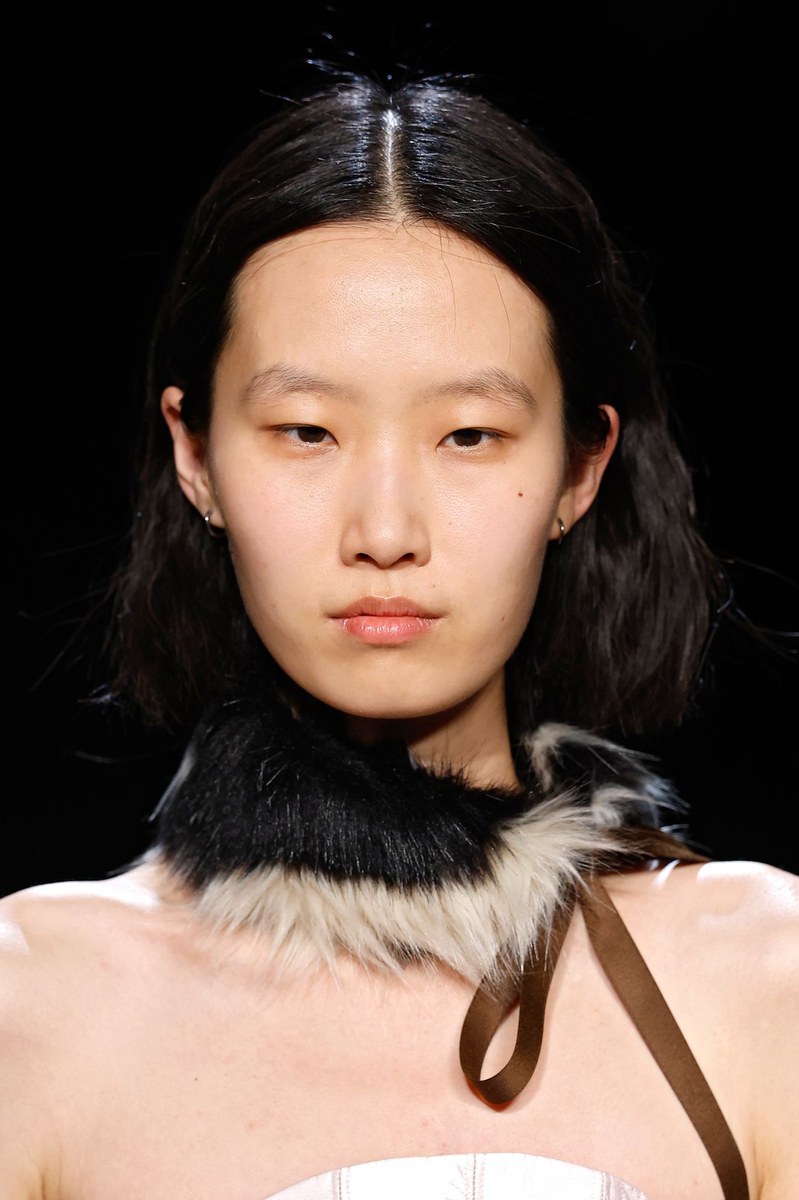
Color Palette
Tobacco brown, ochre, and olive form the warmest thread running through the collection, appearing together most visibly in Looks 15, 18, and 19. Black and grey recur as structural neutrals, grounding the more complex pattern work in Looks 1, 7, and 16. Look 8 makes one bold chromatic break, pairing electric cerulean satin against a burnt orange knot and khaki skirt. Look 9 echoes this energy with a red turtleneck and cobalt sequin band sitting above a teal silk skirt. These pops read as deliberate commercial relief within an otherwise autumnal, earthy ground.

Materials and Textures
Mohair is the dominant material story, carrying a dense, high-pile surface through multiple looks including 1, 7, and 16, and giving the knitwear a blurred, almost impressionistic edge. Sheer organza appears in Looks 1 and 5, adding weightless underpinning that contrasts the heaviness of the knit layers above. Silk satin in cerulean and teal, used in Looks 8 and 9, introduces fluid, light-catching weight that pulls the collection briefly into eveningwear proximity. Lurex and sequin appliqué in Looks 7 and 9 add surface tension without departing from the knitwear framework.
Styling and Layering
Layering is the collection's primary construction logic. Sweaters sit over sheer slips, cardigans open over striped pullovers, and knit tops are bundled over printed blouses as in Look 14 where an argyle vest, a floral shirt, and wide grey trousers coexist without any single piece surrendering its identity. Footwear moves with deliberate inconsistency, from fringed heeled sandals in Look 1 to white knee-high socks with square-toe ankle boots in Look 2, to pom-pom flats in Look 6 and yellow pointed pumps in Look 9. Accessories stay tightly edited. The striped fringe tote in Look 11, the red polka-dot clutch in Look 19, and the ostrich feather headpiece in Look 5 function as singular editorial punctuation rather than a recurring accessory system.

Look by Look Highlights
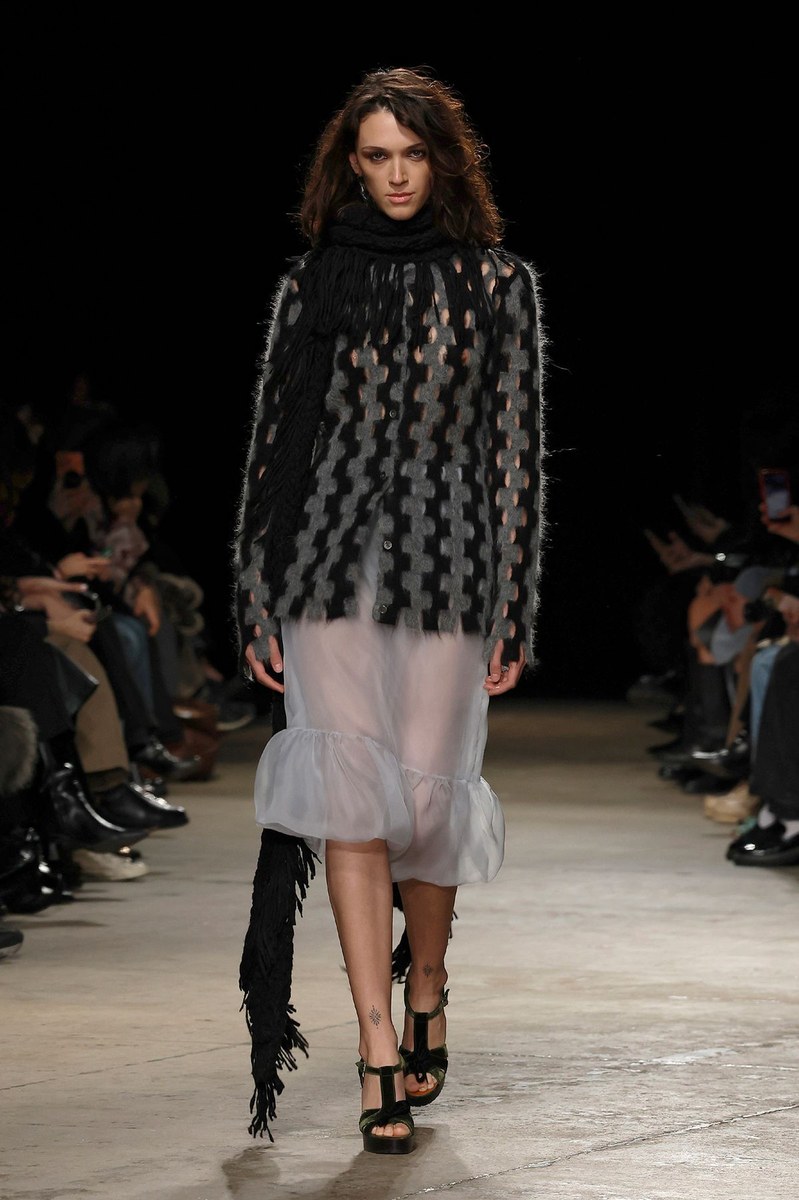
Look 1 The black mohair sweater with cut-through geometric openings over a white organza ruffle slip and single fringed leg warmer signals the brand's willingness to combine knitwear construction with extreme styling for press traction. It's the collection's most editorial opening move.

Look 3 A matched geometric-print knit set in red, white, blue, and black with contrast cuff detail and brown studded platform boots reads as the most immediately retail-ready, pattern-complete outfit in the range.

Look 4 The long tobacco wool coat with asymmetric lapels and a diamond-grid lurex skirt visible beneath represents the collection's strongest outerwear proposition for department store and specialty buyers.
Look 7 A yellow and black dot-embellished bomber jacket layered over a mohair checkerboard maxi dress combines two of the collection's core pattern languages in a single look. It's a strong candidate for editorial placement and trunk show pull.

Look 11 A dark chocolate turtleneck knit column with square-link embellishment running the full length of the front, worn with a striped fringe bag, gives buyers a quieter, more wearable long-form knit option with a clear styling hook.

Look 13 A bold red short-sleeve knit over a gold diamond-mesh maxi skirt with a rope necklace tied in a sailor knot delivers the collection's strongest volume-to-simplicity ratio and translates cleanly to gift and special occasion buying.

Look 17 Three pattern scales stacked together, a striped cardigan over a diamond-print pullover over a green pixel-check skirt, make this look the collection's definitive statement on pattern mixing and a natural fit for style director editorial picks.

Look 19 The draped gold lurex asymmetric top and matching skirt with a red floral sequin clutch closes the collection on an eveningwear note that competes directly with occasion-dressing categories, broadening the brand's buying relevance beyond knitwear specialists.

Operational Insights
Mohair investment: Mohair carries full looks across silhouette and pattern here, not a secondary texture. Buyers building orders need to plan for higher per-unit cost and confirm care labeling compliance for their key markets.
Pattern mixing as a system: At least two distinct geometric or stripe patterns pair together in the majority of looks, meaning visual merchandising teams will need to build display logic around pattern adjacency rather than color blocking to avoid floor confusion.
Knitwear as eveningwear: Looks 7, 11, and 19 push knit construction into occasion and eveningwear territory, which opens a cross-category buying conversation for floors that currently silo knitwear separately from occasion assortments.
Accessory amplification: Footwear and bags carry outsized editorial weight in this collection, particularly the fringed leg warmer in Look 1 and the striped fringe tote in Look 11. Product managers should evaluate whether accessory co-buys are viable to support full look integrity on the floor.
Size and fit range planning: The oversized silhouette in pullovers and cardigans, especially Looks 15, 16, and 17, gives this collection natural size range flexibility. Buyers should discuss with the brand whether this proportional logic is intentional across the size run or calibrated only for sample sizing.
Complete Collection


About the Designer
Henry Zankov grew up in Saint Petersburg, Russia, in a city whose relationship with pattern, geometry, and the applied arts runs so deep it operates almost subconsciously on anyone who spent their childhood there. He immigrated to New York, and before he was old enough to study fashion formally, he was already setting up imaginary clothing stores in his bedroom, sketching designs and printing catalogs for his younger brother to browse. That instinct to organize beauty into a system, to make it browsable and shareable, never went away. In high school he took sewing classes at the Fashion Institute of Technology, enrolled there afterward to study women's design, and found his way to knitwear through a combination of temperament and material logic: he was drawn to softness, to the idea of building something structural from something pliant, and a professor pushed him toward an internship at the cashmere label TSE that fixed the direction permanently.
After FIT he joined Donna Karna as an assistant menswear designer, an early lesson in the commercial architecture of a collection. The decisive shift came at Diane von Furstenberg, where working alongside someone for whom color was a non-negotiable language rather than a finishing touch trained his eye in a way that his earlier education in black and neutrals had not. He went on to hold design positions at several LVMH brands and took on consulting work for emerging and established designers in New York and Europe, building a CV that was wide rather than deep at any single house. In February 2020, with a first capsule of six sweaters, he launched ZANKOV from his Brooklyn apartment, where the studio, showroom, and living quarters still share the same square footage.
The brand's visual references are graphic before they are fashion historical. Piet Mondrian's color-block compositions, the geometry of modernist architecture, the accidental pattern-making of street life, all feed into intarsia and horizontal knitting executed in alpaca, high-twist viscose, and compact merino. When the pandemic arrived weeks after launch, Zankov turned his sweater patterns into pillows and blankets and kept the business moving. The collections since have grown in technical ambition: a wool developed with an Italian mill that weaves metal into the thread, crochet panels hung with paillettes, zig-zag intarsia as a recurring graphic signature. In 2023 the CFDA and Vogue awarded him second prize in their annual competition. He shows during New York Fashion Week and is stocked at Bergdorf Goodman. In 2025, DVF tapped him for a capsule collaboration exclusive to Bergdorf's, a full-circle moment given what Diane von Furstenberg had done for his understanding of color two decades earlier.
"I very much try to avoid a traditional sense of what knitwear is. It's really about pushing the boundaries of what's possible within the stitch and the technique."
"When I first started in the industry, I was really into black and neutrals. It wasn't until I worked with Diane von Furstenberg that I was really able to get into color, because she's such a color person."
✦ This report was generated with AI — combining human editorial vision with Claude by Anthropic. Because the future of fashion intelligence is already here.