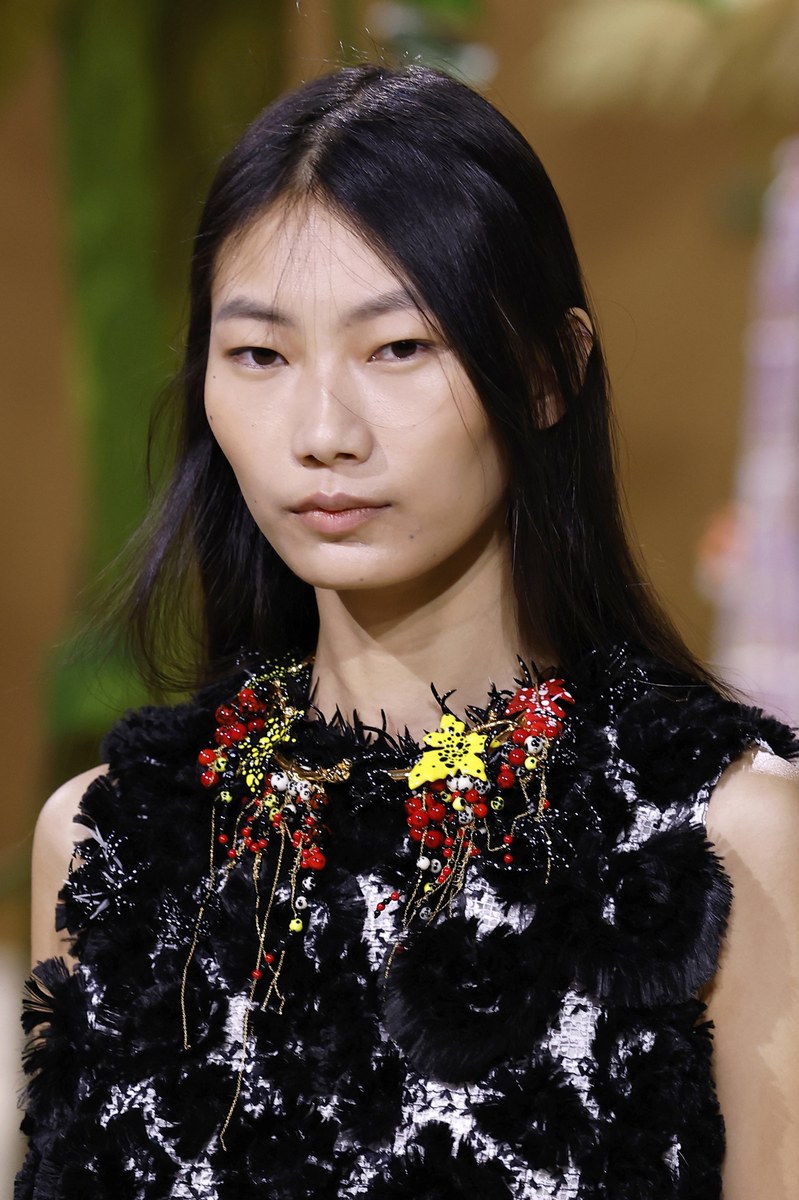
7 For All Mankind FW26 Women Looks Report
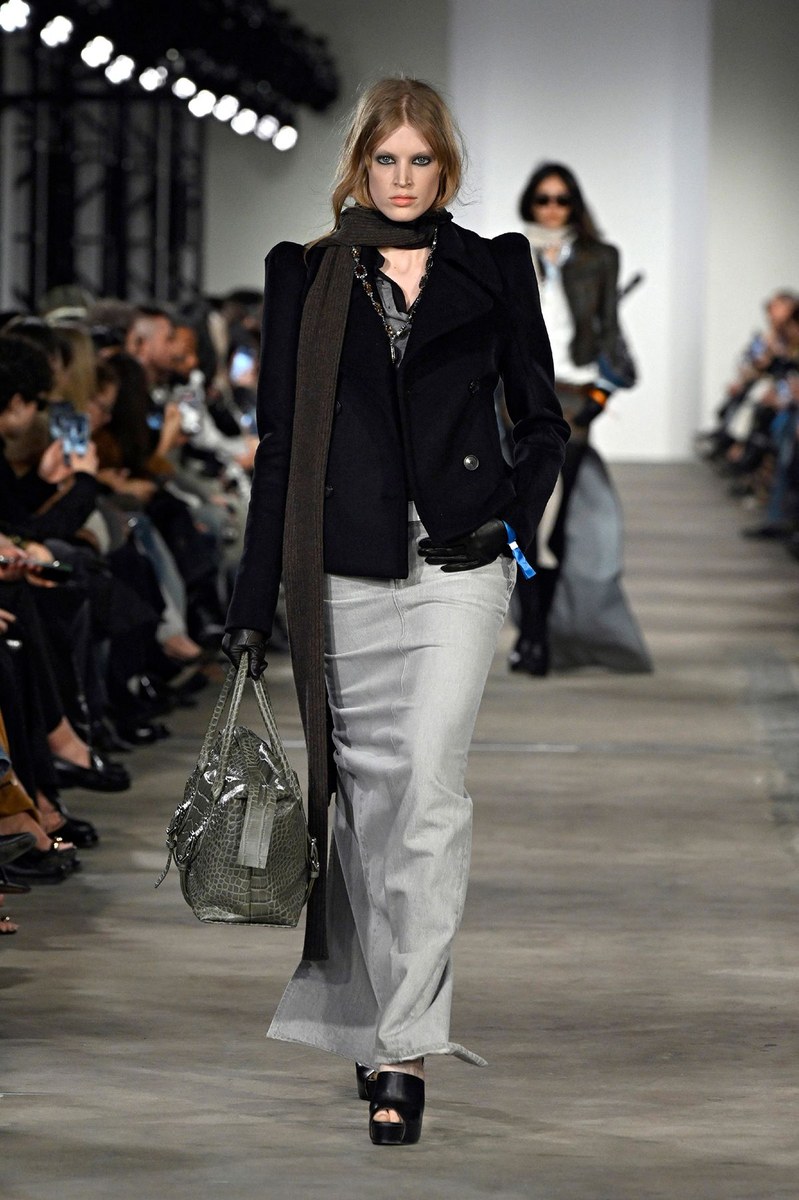
New York Fashion Week
7 For All Mankind is repositioning itself as a full wardrobe brand, not just a denim label. Every look builds from a denim core and expands outward into tailoring, leather, knitwear and sheer fabrications. For buyers, that pivot creates a clear argument for expanding floor space beyond bottoms and into category-adjacent pieces that can anchor whole outfits.
Silhouette and Volume
Two parallel silhouette tracks run through the collection. Lean and elongated shapes dominate the first track, built on slim or straight-leg denim worn with structured blazers and long coats, visible in Looks 1, 5, 7, 10 and 12. A deliberately abbreviated second track pairs micro skirts and knit shift dresses with opaque black tights to create high-contrast proportions that read as edgy but remain commercial. Look 18 pushes this furthest, with an off-shoulder bow mini dress that stands as the collection's most directional silhouette statement.
Color Palette
Grey forms the backbone, ranging from pale silver denim in Looks 1 and 10 to mid charcoal wool in Looks 3 and 4 and deep gunmetal in Look 11. Black anchors the darker half of the range, appearing in total looks like Look 8 and Look 19 as well as in coats, tights, gloves and bags throughout. Cognac and tobacco brown punctuate the grey-and-black ground repeatedly, showing up in bag leather, platform heels and burgundy gloves across Looks 9, 10, 14 and 16. That warm accent against a cool grey base emerges as the collection's most repeatable color formula for retail styling.

Materials and Textures
Denim appears in multiple finishes as the through-line: pale wash straight-leg trousers, dark overdyed mini skirts, and jackets covered in tonal stud embellishments across Looks 2, 6, 13 and 15. Wool flannel and boiled wool function as the premium outerwear anchors, used in the oversized cape coat of Look 10 and the structured double-breasted jackets of Looks 1 and 4. Patent croc-embossed leather on the recurring tote bag silhouette adds a high-gloss, high-contrast surface element that threads across nearly every look. Look 19 introduces a black shearling-trimmed leather coat that carries the heaviest weight and most tactile contrast in the entire collection.

Styling and Layering
Deliberate and dense layering consistently stacks three to four pieces: a base layer, a denim or knit mid-layer, a tailored or leather outer, and a long scarf worn loose or wrapped. Function matters here. The scarf is not decorative but rather a structural element that adds length and visual weight, appearing in grey ribbed knit, dark brown ribbed knit and textured tweed versions across more than half the looks. Platform mules and block-heel pumps in black patent and cognac patent run consistently through the footwear, reinforcing a retro-inflected but grounded sensibility. Leather gloves, worn in black and burgundy throughout, read as both a styling signature and a category opportunity for accessories buyers.
Look by Look Highlights
Look 3 carries two matching croc-embossed black totes, one per hand, which signals a deliberate editorial push on the bag silhouette as a statement piece rather than a functional afterthought.

Look 5 pairs studded skinny denim in a washed charcoal tone with a layered black turtleneck, dark knit and long navy coat, making it the most immediately commercial look in the collection for a contemporary denim buyer.

Look 7 presents the collection's most accessible styling argument: a grey oversized wool coat over a blue Oxford shirt, camel V-neck sweater, and studded light-wash skinny jeans with a red leather belt as the single accent.

Look 9 builds the strongest case for the scarf as a hero product, wrapping a heavy tweed scarf over a layered grey top and denim mini with burgundy gloves and cognac platform pumps, creating a look that a styling director can reconstruct with existing stock.

Look 11 demonstrates how a grey denim jacket in light wash reads entirely differently when layered over a studded grey knit mini dress with black tights and a dark scarf, offering the collection's clearest argument for a denim jacket in the outerwear mix.
Look 17 represents the collection's strongest leather moment, combining an oversized black leather belted jacket with slim houndstooth-check coated trousers, burgundy gloves and a white scarf, pointing directly at a leather goods expansion opportunity.

Look 18 is the commercial outlier and the one look most likely to generate press traction, using a single oversized grey flannel bow as the entire bodice of a strapless mini dress, paired with a black turtleneck underneath and long black gloves.
Look 19 closes the womenswear sequence with a full-volume black leather A-line dress under a black shearling-trimmed coat, the single look where the brand moves closest to luxury outerwear territory and the strongest signal of where the line's price ceiling could go.

Operational Insights
Scarf as hero SKU: At least ten looks feature a long scarf across two colorways and two fabric weights. Buyers should treat it as a standalone product launch, not just a styling prop, and plan for it to carry its own floor placement.
Bag architecture: The croc-embossed patent tote recurs in black, dark brown and olive green. A consistent silhouette across all colorways makes it a strong candidate for a capsule accessories push with a clear replenishment path.
Studded denim as the premium tier: Studded or crystal-embellished denim appears on both slim and relaxed silhouettes across Looks 5, 7, 9, 13 and 15. Product managers should position this as a limited premium tier within the denim assortment rather than a full-depth style, with tight SKU counts and higher opening price points.
Leather gloves as a category entry: Burgundy and black leather gloves appear in nearly every look and function as the collection's most consistent accessory. Style directors building a brand story around this collection should source or co-brand a glove option, as the styling logic falls apart without them.
Colour formula for buy planning: The grey plus cognac plus black combination is repeatable and low-risk for regional markets. Buyers building a tight edit should prioritize these three color anchors across categories rather than chasing the full palette, which includes olive and white that appear sparingly and carry higher markdown risk in a denim-driven retail context.
Complete Collection


About the Designer
Nicola Brognano was born in 1990 in Calabria, the southernmost tip of mainland Italy, a region whose cultural history runs through Greek colonization, Byzantine influence, and the kind of dense, layered baroque that Gianni Versace, another Calabrian, absorbed into his work before him. His mother owned a wedding dress shop, and that early proximity to dressed femininity, to the ceremony and construction of garments intended for maximum occasion, shaped the instincts he would later develop professionally. The impulse to move north was decisive: Milan meant fashion school, and he enrolled at Istituto Marangoni, where he graduated in fashion design. His first industry posts placed him inside two very different versions of extravagance: the Parisian preciousness of Giambattista Valli's couture-adjacent world, and the Sicilian baroque grandeur of Dolce & Gabbana's Alta Moda collections, where Domenico Dolce and Stefano Gabbana noticed his talent and brought him into that specific orbit of ornament and excess.
In 2015 he launched his own label, Brognano, which immediately established a sensibility built around crinkled silks, macramé, embroidery, and a studied tension between menswear construction and theatrical femininity. In 2016 he won the Who Is On Next? competition, organized by AltaRoma and supported by Vogue Italia, which gave the brand its first significant institutional visibility. His debut runway in Milan followed in 2017, and a menswear line launched in 2019. That same year, Italian entrepreneur Marco Marchi acquired the Blumarine parent company and appointed Brognano as creative director, a position that would become the defining episode of his first decade. His debut Blumarine show in autumn 2020, styled by Lotta Volkova, applied a deliberately early-2000s logic to the Italian house's archive of butterfly motifs, roses, and sex appeal, arriving precisely ahead of the Y2K wave that would consume the industry over the following two years. Dua Lipa, Kim Kardashian, and Bella Hadid became regular wearers. He parted ways with Blumarine in October 2023 after four years.
In December 2025 he was appointed creative director of 7 For All Mankind, the Los Angeles-born denim label founded in 2000 that had defined premium jeans culture for a generation before gradually losing momentum. His mandate is to extend the brand beyond its denim heritage into a full fashion proposition, with a debut runway show at New York Fashion Week in February 2026, the first in the brand's history on that calendar.
"I wanted to show a collection that talks about happiness, sexiness, freedom. Something that breaks the rules. I feel very close to the early 2000s because I grew up in these years and it was natural for me to present them."
"My goal is to create collections that honour the 7 For All Mankind DNA, while infusing a confident ease and an of-the-moment attitude, one that complements the brand's heritage in denim."
✦ This report was generated with AI — combining human editorial vision with Claude by Anthropic. Because the future of fashion intelligence is already here.