Abra FW26 Women Looks Report
Paris Fashion Week
Abra FW26 pulls between utility and ceremony, building a wardrobe that treats military outerwear, sculptural knitwear, and laser-cut embellishment as equally valid entry points into a single coherent language. For buyers navigating a market where customers want clothes that read as considered rather than costumed, here are layerable, conceptually anchored pieces across multiple price tiers.
Silhouette and Volume
The collection moves between two poles: collapsed, draped volumes that pool and gather at the waist or hem, and structured boxy outerwear that holds its shape away from the body. Looks 2, 4, and 6 demonstrate a recurring preference for cropped, double-breasted jackets worn over wide, below-knee skirts, creating a compressed-top, expanded-bottom proportion that reads as deliberate rather than oversized. Look 15 pushes this furthest with a stiff khaki tabard that fans outward at the hip over matching wide-leg shorts, producing a silhouette closer to architectural textile sculpture than ready-to-wear. At the other end of the spectrum, the floor-length navy wool coat in Look 23 anchors everything in pure, uninterrupted length, its cascading lapels and asymmetric hem panels delivering maximum drama.
Color Palette
Navy, black, and chocolate brown carry the core of the collection, functioning as neutral anchors across the utilitarian looks in the first half. Against these foundations, the designer deploys specific chromatic accents with precision: deep teal in Look 24, baby pink across Looks 10 and 25, and a warm golden yellow in Look 19. Most visible in Looks 1 and 5 is a patchwork approach to color where bold floral prints in hot pink and mint are spliced directly onto plain ground pieces, creating a visual logic where color is structural rather than decorative. The result feels commercial enough for multi-brand retail but differentiated enough to stand apart on any shop floor.

Materials and Textures
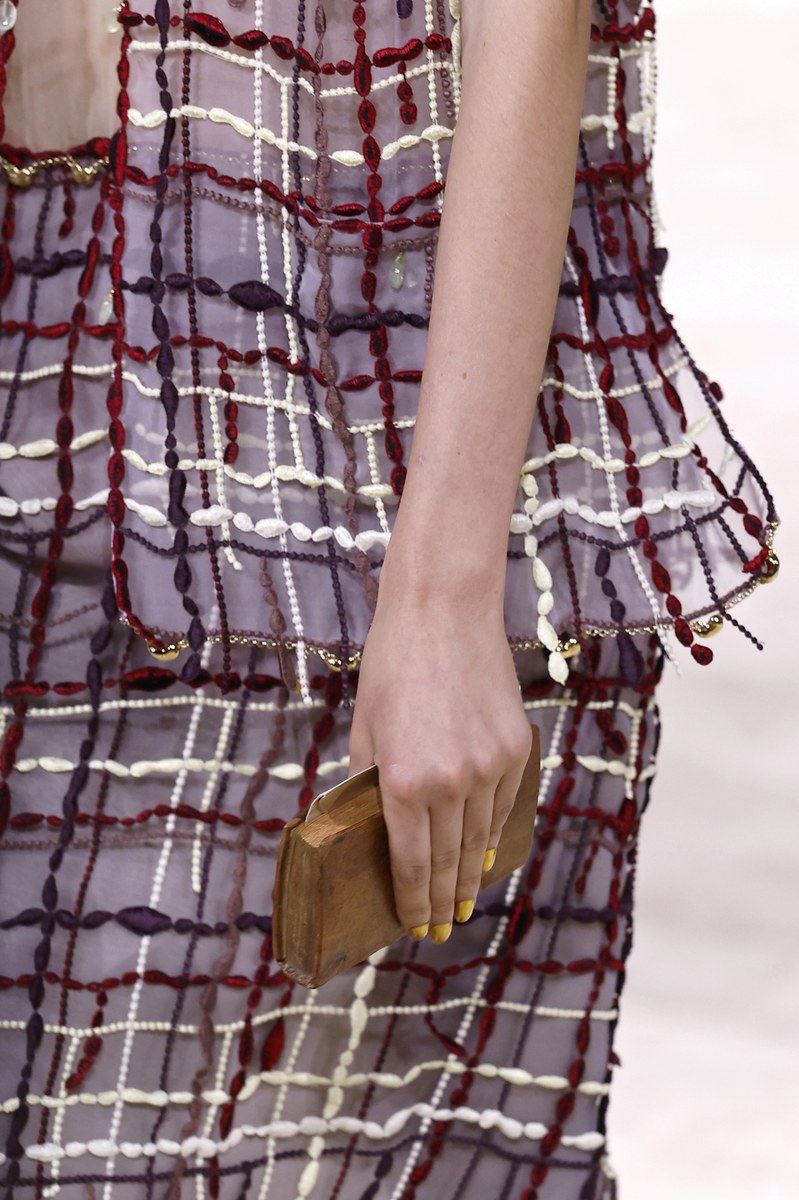
Velvet, shearling, leather, and dense felted wool form the material backbone, all selected for surface richness and physical weight. Looks 8 and 9 use a mid-weight silk-blend velvet with enough body to hold sculptural pleated bands at the midriff without collapsing. Shearling appears in two registers: the rough, distressed suede face in Look 5 worn with the fleece collar turned out, and the cleaner, sand-toned version in Look 7 with prominent contrast stitching at the patch pockets. Most technically demanding are Looks 19 and 20, which deploy layered metallic ribbon fringe and dimensional cut-strip construction respectively, achieving surface texture through material accumulation rather than weave or print.

Styling and Layering
Layering here functions as both an aesthetic and a commercial strategy, because nearly every look can be read as two or three separable SKUs. Plaid shirting appears under shearling in Look 7, under the white leather bomber in Look 12, and visible at the cuff in Look 6, establishing a recurring base layer that connects across outerwear silhouettes. Footwear swings between chunky lug-sole brogues and hiking boots in the utilitarian looks and fringe-trimmed kitten heels or sculptural white ankle boots in the ceremonial ones, making the footwear program essential to reading the tonal split within the collection. Bags appear sparingly but specifically: the quilted chain bag in Look 14, the fringed black chain bag in Look 15, and the structured tote in Look 13 all read as internal accessories designed to reinforce the collection's own language rather than act as standalone commercial drivers.

Look by Look Highlights
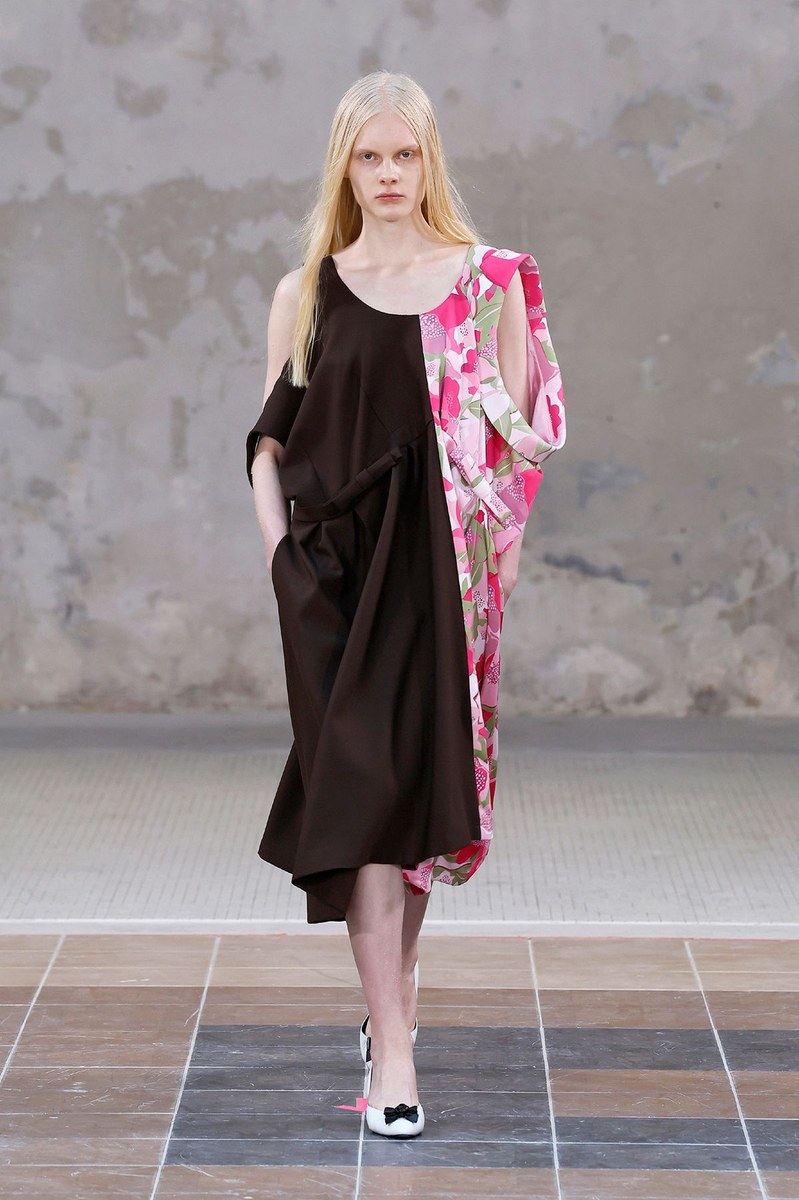
Look 1 pairs a loose chocolate-brown satin slip dress with a voluminous hot pink and olive floral oversized jacket draped off one shoulder. Strong commercial image and a clear candidate for editorial buys.

Look 4 combines a fitted khaki trench coat with epaulettes and a tortoiseshell buckle belt over an asymmetric two-panel skirt split between black cargo fabric and brown suiting. Most immediately wearable piece for buyers targeting the tailoring-adjacent customer.

Look 8 uses a single color, pale steel blue velvet, across a cape-shoulder top with horizontal pintuck pleating and an asymmetric high-low skirt. Monochromatic approach with enough surface complexity to justify a premium price point.

Look 15 constructs a full look from a single khaki cotton canvas, cutting a structured tabard top with wide side wings over matching wide-leg shorts, with a leather rosette brooch and fringe chain bag completing the composition. Reads as ready to produce and strong on the floor.
Look 19 is the collection's technical centerpiece, a midi dress built entirely from layered gold metallic ribbon fringe on the bodice and tiered cut-strip panels on the skirt. Weight and construction suggest couture atelier involvement and justify positioning at the top of the price architecture.

Look 24 delivers a teal wool fringed cape with long, dense yarn tassels falling over a matching knit body and a floral silk printed skirt peeking out at the hem. Strong buy for stores needing a statement knitwear piece with clear gift or occasion utility.
Look 26 builds a near-identical structure to Look 25 in all-black pleated leather fringe with a sheer underlayer, worn with black leather boots trimmed in matching fringe. Demonstrates the collection's capacity to translate the same construction into both a daytime and a dark eveningwear version.

Look 16 positions a structured navy wool blazer over an exaggerated ruffled cravat in white and gray tattersall check with matching cuffs, above a blush pink satin skirt and gray suede fringe thigh boots. Strongest look in the collection for buyers seeking a directly runway-referencing statement piece with actual wearability.

Operational Insights
Modular buying strategy: Consistent separation of jacket, base layer, and skirt or trouser across Looks 2, 4, 6, and 7 means buyers can build assortments around separates rather than committing to full looks, reducing inventory risk while maintaining visual coherence on the floor.
Two-tier price architecture: The collection splits cleanly between accessible utility pieces, the trench coats, shearling jackets, and plaid shirts, and high-investment statement constructions like the gold fringe dress in Look 19 and the velvet sculptural looks in Looks 8 and 9. Multi-brand retailers can range across multiple spend brackets.
Fringe as a recurring construction motif: Fringe appears in at least six looks across yarn, leather, metallic ribbon, and silk, meaning a buyer can build a tight fringe-driven capsule from a single collection without the pieces feeling repetitive. This strengthens the story at point of sale.
Footwear program coherence: The lug-sole brogues in brown and olive, the fringe kitten heels, and the sculptural white ankle boots each appear across multiple looks, indicating a footwear line with enough internal logic to wholesale independently or be used by style directors to anchor in-store presentations.
Fabric and sustainability signaling: Patchwork construction in Looks 1, 3, 5, and 22 combines disparate fabrics and panels within single garments, aligning with current buyer interest in material-conscious production narratives. Product managers should confirm with the atelier whether any panels derive from deadstock or reclaimed sources before marketing the collection on that basis.
Complete Collection


Fashion Designer

Abraham Ortuño Perez was born in 1987 in a small village in Alicante, Spain, where the main local industry was shoemaking. His parents ran a restaurant, and he grew up equally obsessed with Barbies and the shoes being made around the corner. At 17, he dropped out of high school and moved to Barcelona, where he began assisting Elena Cardona, one of Martin Margiela's accessory designers. That early mentorship shaped everything: instead of looking at other shoes for inspiration, Cardona taught him to start from whatever was sitting in the kitchen.
He eventually moved to Paris to study at the Institut Français de la Mode, but the real education came on the job. Before finishing his degree he was already working with Jacquemus, designing shoes and accessories. From there he moved through Givenchy, Kenzo and Paco Rabanne, then shifted into consulting for Jonathan Anderson, Loewe and Coperni. Quietly, he became the person behind some of the most coveted accessories of the early 2020s, without most people knowing his name.
He launched ABRA in 2019, initially out of a very personal frustration: growing up he couldn't find luxury shoes in his size. The brand started with heels available up to size 45, an act of inclusion that was also completely autobiographical. His muses are not celebrities or archetypes but specific people: his sister, who was masculine where he was feminine, his mother in her electric blue 1980s wedding dress, his old Barbies, his best friend Lois. Collections are built from family photographs and shared memories, not mood boards assembled from runway archives.
The factory is back in Alicante, run with siblings and cousins. On production days he wakes at six, flies from Paris, works until afternoon, has lunch with his parents, naps, then flies back. It is an unusual rhythm for Paris fashion, and that is exactly the point.
"I never learned the right way, and maybe that's why I've never been afraid to do things the wrong way. A lot of my work sits on that line: it works, but it's also a bit off. And I like that."
"Martin is probably the smartest designer in creating something so pure but so strong. I want to make something you've never seen before, something where you're not sure if it's a joke or kind of genius."
✦ This report was generated with AI — combining human editorial vision with Claude by Anthropic. Because the future of fashion intelligence is already here.