Act Nº1 FW26 Details
Act Nº1 FW26 Details Report
Accumulation is the language here. Act Nº1 FW26 deliberately piles materials, objects, and layering techniques into a single frame across its accessories and garment details. For buyers and product managers, this signals a fundamental shift away from minimal add-on accessories toward integrated, concept-driven pieces that carry narrative weight and command full-price positioning.
Category Overview
Two categories drive the detail strategy: belts and dress details. A tight, coherent belt category centers on one core leather style worn in radically different contexts. By contrast, the dress detail category is expansive and deliberately chaotic, pulling in knitwear tied as body adornment (Detail 8), sweatshirt sleeves bundled at the waist (Detail 9), buttons used as surface textile (Details 10 and 16), and body-altering padded forms (Detail 11). Together, these argue that accessories and garment construction are no longer separate conversations for this label.
Material and Construction
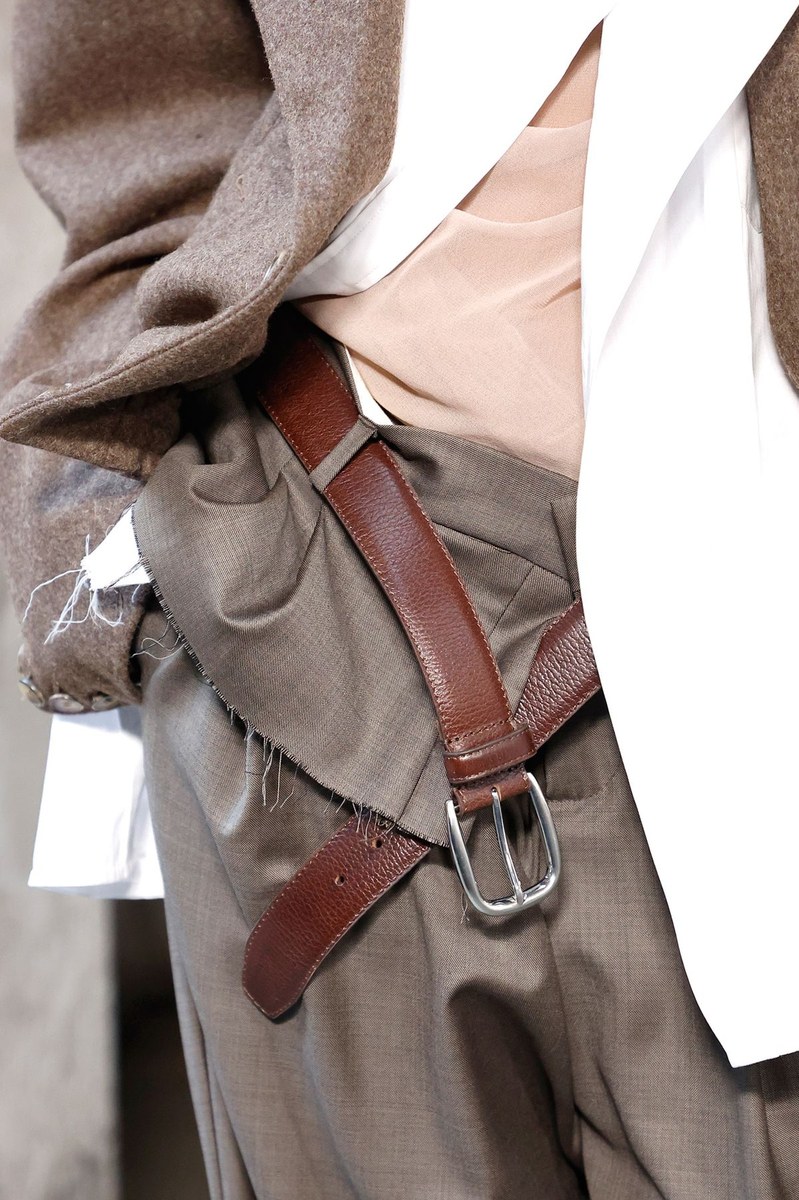
Details 1, 2, and 3 share a single pebble-grain brown leather belt, medium width, with a silver-tone rectangular buckle and visible contrast stitching along the edges. The leather reads mid-tan chestnut brown with a matte, slightly tumbled surface rather than a high-polish finish. Dress details move through wool knit, sheer silk organza, cotton poplin, jersey cotton in multiple weights, and what appears to be a paper or stiffened muslin shell in Detail 11. Details 10 and 16 use hundreds of sewn-on buttons in ivory, horn, and pearl tones as a fabric substitute, each button individually secured to create a dense, sculptural textile surface.

Color and Finish Direction
A warm earth axis dominates across all 16 details: chestnut brown, taupe, greige, oatmeal, and ivory. Cool blue-grey and dusty navy enter through the organza layers in Details 4 and 14, and through the abstract watercolor print in Detail 7. Grey-green wool from the coat cuff in Detail 13 pairs with the marigold-orange silk slip visible beneath it, introducing the only genuinely warm accent color in the group. Hardware finishes stay consistently silver-tone brushed metal across the belt buckles, avoiding any gold presence entirely.

Key Pieces and Details
The pebble-grain chestnut belt deserves particular attention here. Worn across the waist in Detail 3, looped at the neck in Detail 2, and styled diagonally with raw-edge trousers in Detail 1, it's the single most commercially transferable piece in this report. Its versatility across three entirely different body placements makes it a strong candidate for broad-range buying. Detail 10's button-encrusted jacket ranks as the highest-concept piece, but Detail 16's close-up reveals that the button application is dense enough to function as a standalone fabric panel, which opens production conversations around cut-and-apply yardage. Detail 12, a heavily crinkled white cotton poplin shirt twisted and gathered at the center front, points directly toward a permanently crinkled or resin-set finish that a product manager could spec into a core shirt program.

Detail by Detail Highlights
Detail 1 (Belt) The chestnut pebble-grain belt threads diagonally across the front of wide-leg taupe trousers with raw, fraying hems, creating an asymmetric diagonal line that reads as intentional styling rather than functional closure.

Detail 2 (Belt) Wrapped twice around the neck of a ribbed blue-grey knit cowl scarf, the same belt functions as a standalone collar. Zero hardware modification reframes a waist accessory as a choker-scale neck piece.

Detail 3 (Belt) At the waist over a white poplin shirt and brown suede jacket, the belt performs its traditional function with visible silver buckle center-front placement and open shirttails confirming an undone, displaced dressing approach.
Detail 8 (Dress Detail) A chunky charcoal cable-knit is knotted and bunched at the waist of a khaki trench over a sage silk blouse, functioning as a textile belt and volume-builder simultaneously.
Detail 9 (Dress Detail) Three sweatshirt sleeves in white, grey marl, and olive green hang from the waistband of navy wide-leg trousers, the ribbed cuffs dangling at hem level as a deliberate accumulation of undone wardrobe gestures.

Detail 10 (Dress Detail) A collarless jacket is covered entirely in individually sewn buttons ranging from small ivory to large horn-toned discs, the combined weight and texture creating a surface with the visual density of beaded embroidery but the material vocabulary of haberdashery.

Detail 11 (Dress Detail) A torso-shaped padded shell in off-white stiffened muslin or paper material sits over a white cotton shirt, sculpting exaggerated bust and abdominal volume that directly references Venus figurine proportions.
Detail 12 (Dress Detail) A white cotton shirt is twisted and gathered aggressively at the center front, the permanent-press crinkle running from collar to hem suggesting either resin-set construction or a washed and compressed finishing technique ready for production scaling.

Operational Insights
Belt versatility: Styling the single chestnut pebble-grain belt in three positions across Details 1, 2, and 3 demonstrates that a well-constructed core leather style can sustain a full seasonal narrative without SKU multiplication. Buyers should prioritize depth of stock over range width for this category.
Button surface material: Details 10 and 16 point to buttons as a primary surface material rather than a functional closure. Product managers should evaluate button-covered fabric panels as a separate textile category for coats and vests, assessing unit cost per square inch against embroidery or beading alternatives.
Layering-as-accessory strategy: Details 8 and 9 use knitwear and jersey sleeves as waist-level accessories, suggesting that cross-category bundling between accessories and ready-to-wear could drive higher basket values at retail.
Crinkle and texture finishes: Detail 12 and Detail 5 both show heavily textured and worked surface finishes on cotton and semi-sheer fabrics. Accessories directors should push development on pre-crinkled or resin-finished leather and coated fabric goods to align with this texture direction for FW26.
Color palette alignment: Silver-tone metal is the preferred finish across all 16 details, with brushed silver dominating belt buckles and zero gold hardware present. Buyers should align bag hardware, shoe hardware, and jewelry metal specifications accordingly to avoid tonal conflict across the shop floor.
More Details


✦ This report was generated with AI — combining human editorial vision with Claude by Anthropic. Because the future of fashion intelligence is already here.