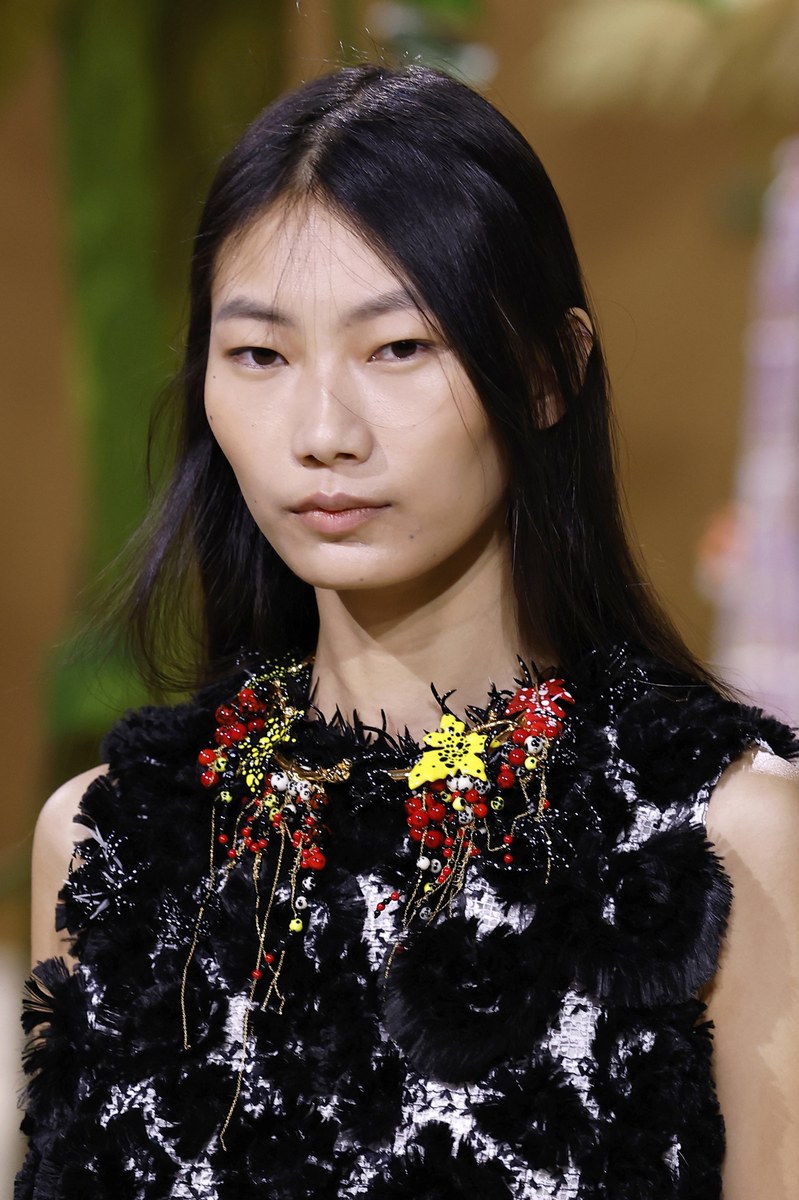
Agnes B FW26 Women Looks Report
Paris Fashion Week
Agnes b. FW26 rebuilds the brand's foundational codes, the Parisian workwear jacket, the snap-button cardigan, the tailored suit, and runs them through a rigorous seasonal update that spans denim, tartan, photographic print, and evening satin without ever abandoning a democratic, wearable logic. Buyers will find this collection arriving at exactly the moment when customers are pulling back from logo-driven streetwear and looking for clothes that carry meaning through cut and craft rather than branding.
Silhouette and Volume
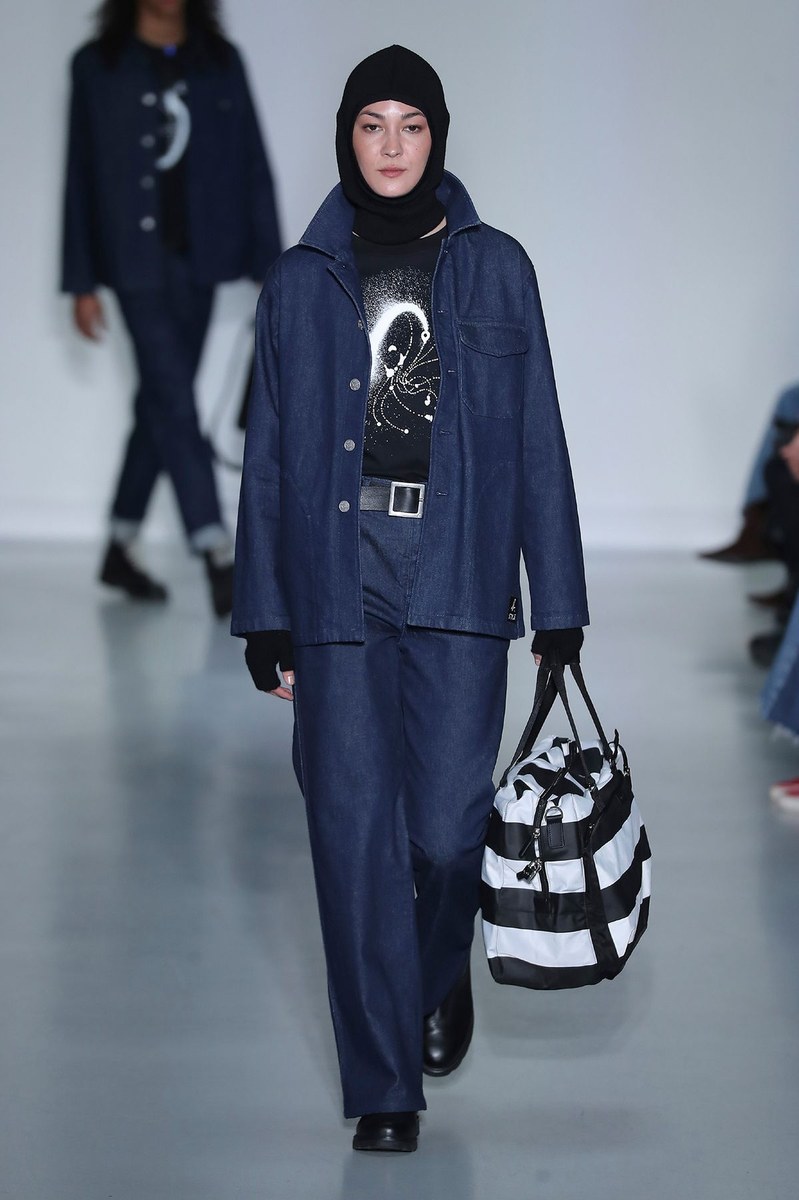
Relaxed without being oversized, the dominant silhouette grounds the collection. Trousers throughout read wide-leg or straight with a high waist, anchoring the body cleanly from hip to ankle, as seen in the denim coordinates of Looks 1 and 2 and the corduroy neutrals of Look 20. Jackets sit boxy and hip-length, a consistent proportion that works against both the wide-leg trousers below and the midi skirts paired with them in Looks 33, 41, and 56. Evening looks pivot toward body-conscious pencil silhouettes in Look 52 and Look 50, creating a clear day-to-evening arc across the collection.
Color Palette
Indigo denim and black open the collection, establishing a baseline of utilitarian cool that carries through to the teal boilersuits of Look 9. A concentrated burgundy and deep oxblood range emerges mid-collection across Look 10, Look 12, and Look 14, layering velvet, tweed, and leather in tones that feel rich without formality. Royal Stewart tartan in Look 22, Look 23, and Look 24 delivers the collection's sharpest visual statement, a saturated red-and-black plaid that anchors the most commercially legible group in the show. Pale lavender shimmer in Look 54, cream sequin in Look 55, and a single saturated red satin in Look 50 close the final third on a note of restrained occasion dressing.

Materials and Textures
Denim anchors the opening group with a medium-weight, dark-rinse fabric that reads structured and polished rather than casual. Wool coatings in burgundy and charcoal dominate mid-collection, joined by a shearling-trim aviator jacket in Look 11, corduroy in camel and grey, and a notable burgundy velvet jacket in Look 10 paired with high-gloss faux leather trousers. Photographic silk print appears across several key pieces including Looks 32, 34, 36, and 38, where tree canopies, urban architecture, and winter landscapes are transferred directly onto fluid satin or stiff taffeta, giving the print program a fine-art credibility. Metallic lamé in lavender and ivory alongside a heavily embroidered sequin jacket in Look 55 signals a considered eveningwear push in the closing group.

Styling and Layering
Agnes b. layers in a distinctly Parisian way, with the base garment always legible on its own. A graphic tee, a white poplin shirt, a snap-button cardigan reads clearly before the jacket or coat goes over it. Scarves and bandanas worn as neck ties recur in Looks 11, 12, 14, 38, and 39, functioning as a consistent house signature that translates easily to accessories buying. Footwear splits between flat lace-up boots and chunky-soled loafers in daywear looks and low platform heels or Mary Janes in evening pieces, a practical split that gives retailers clear floor placement logic. Baker boy hats in Look 12 and Look 13, a velour bucket in Look 22, and a wide-brim felt in Look 40 run through the collection as a headline accessories category.

Look by Look Highlights
Look 9 A matching teal cotton boilersuit worn by both a male and female model establishes a genuine gender-neutral entry point that opens up dual-floor or unisex buy options.
Look 11 An oversized dark-brown shearling aviator jacket over a photographic-print midi dress in amber and black creates the collection's strongest outerwear hero, a commercially grounded piece with clear full-price sell-through potential.
Look 22 Head-to-toe Royal Stewart tartan pairs a bomber jacket with a pleated kilt skirt, black knee-high socks, and a velour bucket hat, reading as a complete, immediately shoppable set for buyers building coordinated capsule programs.

Look 23 The same Stewart tartan appears in a full three-piece pantsuit on a model in her sixties, a direct statement about age-agnostic dressing that aligns with current market demand for non-youth-targeted product.

Look 35 A Mondrian-grid dress with photographic panels worn over black leggings with fur-trimmed tall boots is the collection's most directional single piece, one that tests the market for art-print statement dressing at a mid-tier price architecture.

Look 44 A black pajama-cut suit covered in an all-over text print reading what appears to be the brand name in a stacked repeat pattern positions the logo product within a sophisticated, non-aggressive format that works for customers resistant to overt branding.

Look 55 The cream lamé wide-leg trouser suit with a leaf-sequin embroidered collarless jacket is the collection's clear eveningwear investment piece, structured enough for event dressing and relaxed enough for dressed-up casual occasions.

Look 57 A black tuxedo on the man and a bias-cut ivory satin gown with a lace veil on the woman close the show as a bridal couple, signaling that Agnes b. is formally entering the occasion and bridal-adjacent market, a category extension worth tracking for potential wholesale or made-to-order programs.

Operational Insights
Gender-neutral potential: Look 9 and the denim coordinates in Looks 1 and 2 are cut and styled to work across binary shopping contexts, making them viable candidates for unisex floor placements or dual-gender buying allocations without requiring separate SKUs.
Print program complexity: Looks 32, 34, 36, 38, and 48 feature photographic prints that require careful production planning because image placement relative to seam lines and drape direction will vary significantly between bodies, adding sampling and grading cost that buyers should factor into margin calculations.
Accessories depth: Hats, bandana-scarves, and structured bags appear in sufficient volume and variety to support a standalone accessories buy, particularly the bucket hat in Look 22 and the stripe-print bandana neck tie, which function as low-cost entry products for new customers.
Tartan capsule buy: Looks 22, 23, and 24 form a self-contained Stewart tartan capsule covering a bomber, a three-piece suit, a pleated kilt, and a tailored coat, allowing buyers to commit to a focused group buy that carries its own internal visual logic without needing other collection pieces to support it on the floor.
Eveningwear expansion signal: Strapless occasion dresses in Looks 46, 50, and 52 alongside the bridal closing of Look 57 indicate Agnes b. is deliberately widening its occasion offer, creating an opening for accounts that currently carry the brand only in daywear to add a small evening buy and test incremental category performance.
Complete Collection


Fashion Designer

Agnès Troublé was born in 1941 in Versailles, a few steps from the palace, into a household of lawyers and military men where culture was taken seriously and bohemianism was not. Her father took her to Florence at twelve to see the Italian masters. She started drawing at the École des Beaux-Arts shortly after. None of this pointed obviously toward fashion.
At seventeen she married a publisher, had twins at nineteen, and was broke and alone by twenty. She sold her wedding dress and furniture to make rent. What saved her was the way she dressed: picked-up pieces from flea markets and discount stores worn with a confidence that stopped people in the street. An editor from Elle noticed her at a Paris market and offered her a job. She took it, left quickly, passed through Dorothée Bis as a stylist and buyer, freelanced for a handful of labels, and in 1975 opened her first boutique in a former butcher shop in Les Halles. She dyed the first collection in her bathtub. Some pieces were still wet on opening day.
Her references were never the runway. They were the street, American crime films, rock and roll, and a deep, lifelong obsession with contemporary art. She dressed David Bowie, advised him to burn the brown pleated suits, and gave him a pair of leather trousers. She was buying Basquiat before the market knew his name, and owned six of his works by the time the institutions caught up. Keith Haring was a friend. So were David Lynch, Patti Smith and Jonas Mekas. The snap cardigan, launched in 1979, became her most enduring design: cotton fleece, press-stud buttons, nothing to explain.
She has never advertised, never sold the brand, and still runs everything independently in her eighties. La Fab., her cultural space in the 13th arrondissement of Paris, houses five thousand works of art, a bookshop, and a gallery. Nearly half her clothes are still made in France.
"I don't like fashion. I like clothes you can keep and still wear after ten or twenty years."
"The idea was to show people it's OK to have your own style and not be influenced by other fashion people."
✦ This report was generated with AI — combining human editorial vision with Claude by Anthropic. Because the future of fashion intelligence is already here.