Akris FW26 Bags
Akris FW26 Bags Report
Akris FW26 plants its accessories strategy firmly in architectural minimalism, with structured box silhouettes, sculptural clutches, and a recurring gold-hardware knuckle handle threading through the collection as a signature device. For buyers and product managers, this collection signals a shift away from logo-driven status toward material integrity and form-led differentiation, a positioning that plays well into the contemporary luxury consumer's current preference for quiet authority.
Silhouettes and Shapes
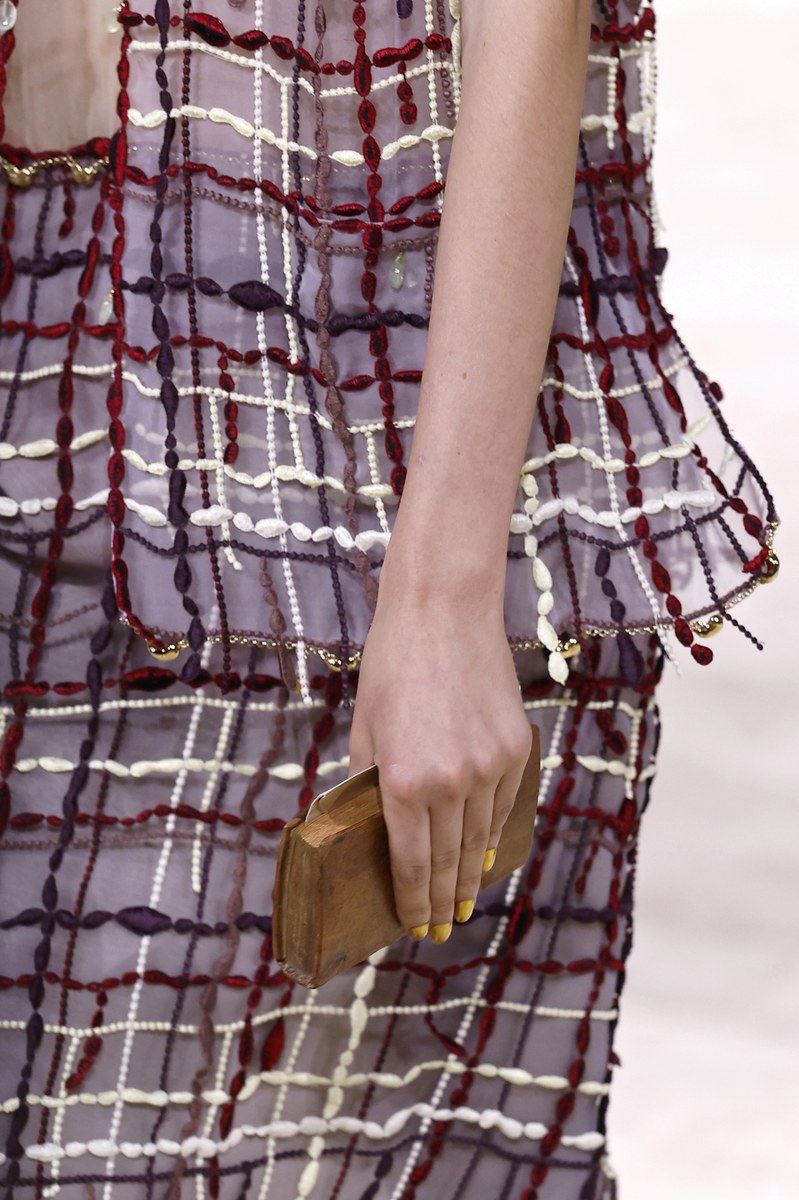
Two distinct registers emerge here. Rigid, boxy top-handle bags in the small-to-medium range (Bags 1, 4, 7, 16) anchor one side, while oversized, soft draped fold-over clutches and saddlebag hybrids with trailing strap systems (Bags 5, 9, 13, 17) inhabit the other. The box bags read as the commercial anchor, compact enough for evening but proportioned for daytime crossover use. Bag 8 stands apart: a large structured tote with applied rectangular frames that addresses the market for statement workbag alternatives. Bag 11 pushes into conceptual territory. A fringe-wrapped flat pouch worn at the hip, it functions more as a runway editorial piece than a production-ready SKU.
Materials and Hardware
Smooth vegetable-tanned calfskin dominates the structured bags, with Bags 1 and 4 presenting in burnished tan and deep burgundy respectively, both featuring tight, clean edge-painted seams. Suede appears in Bags 6, 9, 13, and 17, used for the softer, draped silhouettes where the nap adds tactile contrast to the otherwise restrained palette. Mirror-finish patent leather enters via Bag 3 and Bag 20 in tortoise-effect amber and gradient navy-to-black, both executed with precise heat-set color transitions. Hardware threads through in two directions: polished 24-karat gold in the knuckle handle format (Bags 12 and 19) and matte brushed silver on the strap buckle closures of the saddle variants (Bags 5, 13, 17).
Color Direction
Black dominates, appearing across at least ten of the twenty looks and spanning patent, suede, grained leather, and embellished fabric constructions. Warm neutrals in camel (Bag 1) and burgundy (Bag 4) read as the primary non-black commercial offering and align directly with the broader FW26 runway palette of cognac and oxblood across categories. Gold (Bags 2, 18, and 19) functions as a metallic accent tier rather than a core color story. Tortoise amber in Bag 3 and the gradient finish of Bag 20 introduce a covetable editorial note that could support a limited-edition or capsule production strategy.
Key Models and Details
The knuckle-handle box bag appears most prominently in dark croc-embossed leather with polished gold bar handles in Bags 12 and 19. It's the most production-ready signature model of the collection. Both feature a push-lock mechanism, and the compact footprint, roughly 18 by 12 centimeters based on visual proportion, positions them squarely in the evening minaudière-to-day crossover bracket. A second key model family emerges with the fold-over saddle bag featuring silver tongue-and-keeper buckles (Bags 5, 13, 17), with Bag 13 appearing in the largest iteration in grained black leather and Bag 17 in midnight navy suede. Bag 7 presents a sleek black patent top-handle with a stepped, multi-layer front panel construction and a subtle channel closure, the most directional of the structured daytime options.
Bag by Bag Highlights
Bag 1 A camel smooth calfskin box bag with a single rolled top handle and a rectangular gold push-lock closure, positioned as the most accessible and commercially transferable design in the lineup.

Bag 2 A fully embossed gold metallic clutch with a concentric wave texture across the entire body. This is the highest-drama piece in the collection and the strongest candidate for a holiday capsule.

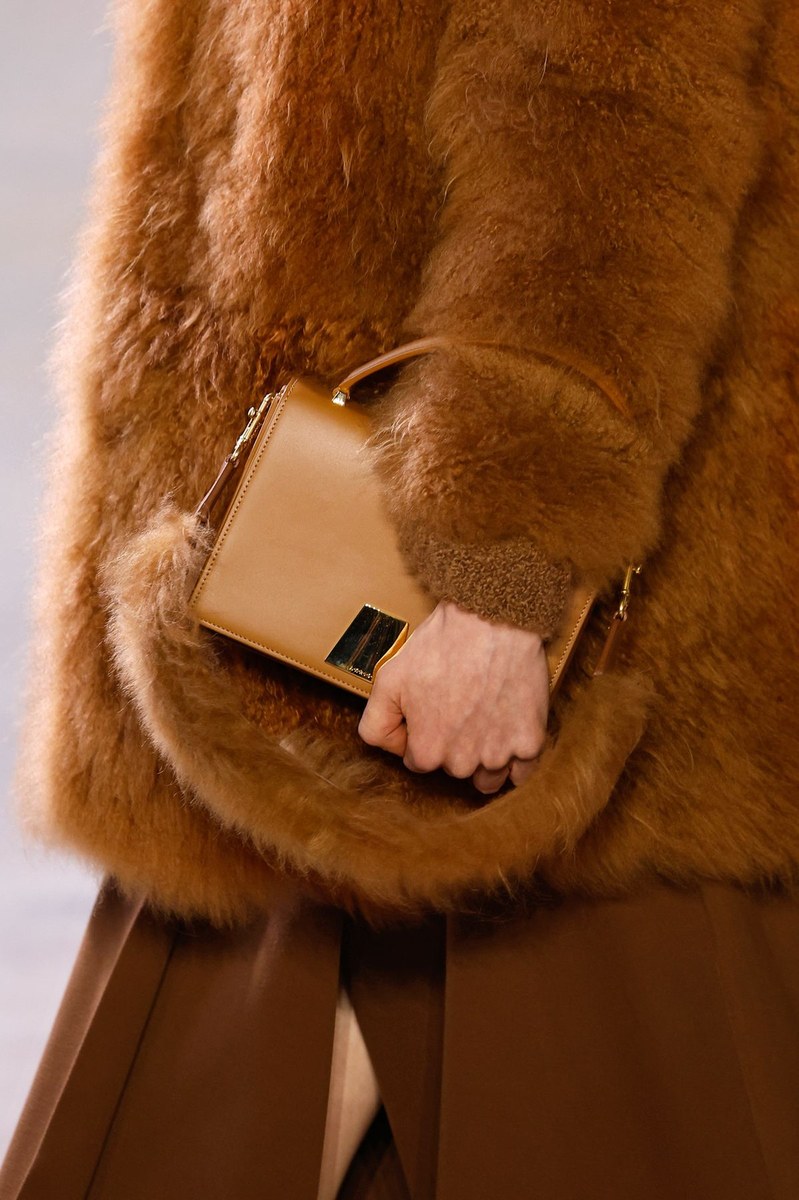
Bag 4 The burgundy ribbed-fabric box bag with a triangular matte hardware closure mirrors the tone of the fur coat it accompanies, making it the clearest proof of concept for a color-coordinated accessories sell-in strategy.

Bag 7 A structured black patent top-handle with a stacked, tiered front panel and navy-tipped handle. The detail-forward construction justifies a higher price tier and targets the investment-bag customer.

Bag 8 A large grained black leather tote with applied gold rectangular frames in a mosaic layout, the only bag in the collection that addresses volume-forward carrying needs while maintaining a strong visual identity.

Bag 13 A large grained black leather fold-over saddle bag with silver buckle hardware and extended trailing straps. This is the most practical of the draped silhouettes and the one most likely to translate into retail with minor construction refinements.

Bag 18 A gold crinkle-patent fold-over clutch with a top-loop handle, the most wearable of the metallic options and a strong pairing candidate for the season's bold outerwear colors.

Bag 20 A gradient navy-to-black smooth leather cylindrical clutch worn against a red and violet printed gown. This material and color pairing opens the bag up to formal and occasion market placement.

Operational Insights
Signature hardware The polished gold knuckle handle used on Bags 12 and 19 functions as the clearest proprietary hardware opportunity in this collection. Buyers should pressure-test exclusivity with Akris production before committing to wholesale volumes, as the knuckle handle format is gaining traction across multiple luxury labels this season.
Core SKU prioritization Bags 1, 4, 7, and 16 form a four-way box-bag family with consistent proportions and a clear closure system. Product managers should evaluate whether these can be sold as a coordinated color-group set to drive multi-unit purchasing from key accounts.
Suede risk management Bags 6, 9, 13, and 17 rely on dark suede for their visual impact. Buyers in markets with high humidity or heavy rainfall should request water-resistant treatment specifications before order confirmation, or negotiate suede alternates in the same silhouette.
Limited-edition levers Bag 2 in embossed gold wave leather and Bag 3 in tortoise mirror patent are too editorially specific for broad replenishment but carry strong sell-through potential in limited runs of 50 to 100 units per colorway for flagship and online-exclusive channels.
Saddle bag development timeline The fold-over saddle family (Bags 5, 9, 13, 17) involves complex strap routing and buckle placement that will require extended pre-production sampling. Accessories directors should build a minimum 14-week lead time buffer into the calendar to avoid late-delivery penalties at wholesale.
Complete Collection
More Bags
More Bags


✦ This report was generated with AI — combining human editorial vision with Claude by Anthropic. Because the future of fashion intelligence is already here.