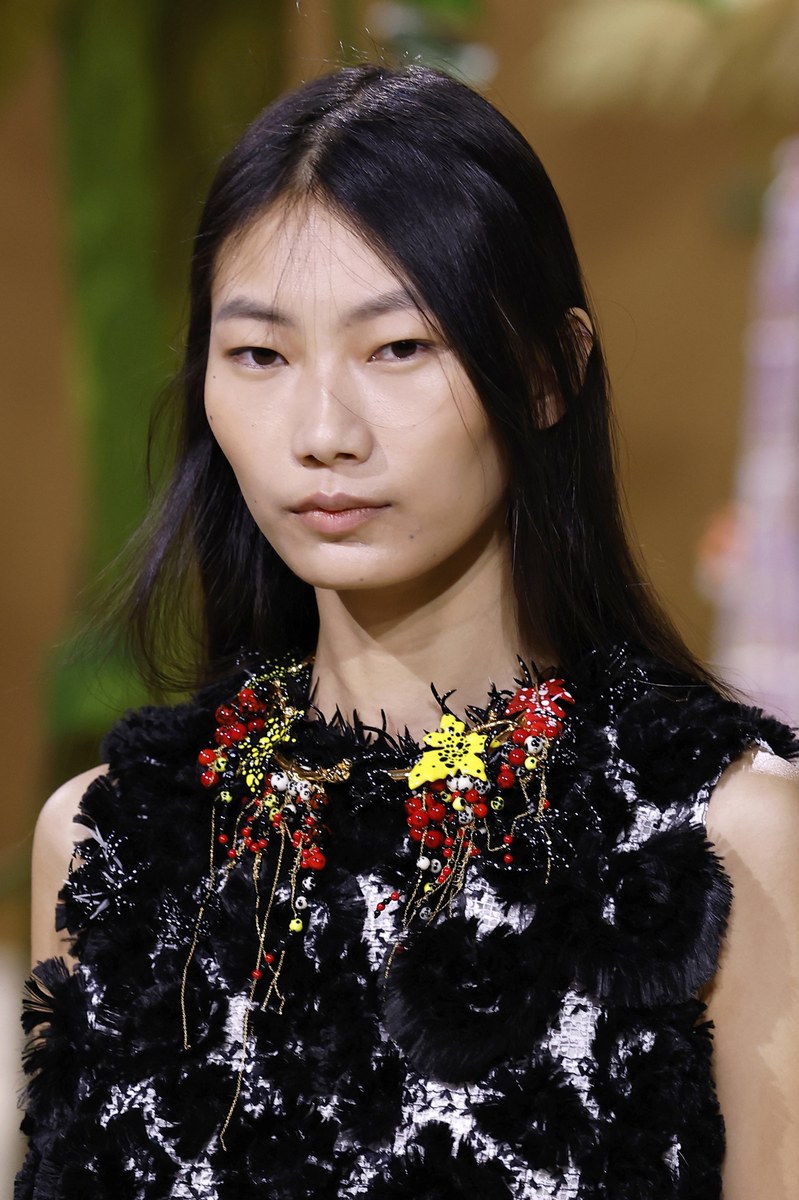
Akris FW26 Women Looks Report

Akris FW26 Women Looks Report
Akris FW26 Women Looks Report

Paris Fashion Week

Akris FW26 builds a collection around the tension between weight and luminosity, moving from gold-heavy metallic volumes through deep earth tones and into saturated brights that close the show with deliberate velocity. For buyers and style directors, this speaks directly to a client who wants occasion dressing with daywear logic baked in.

Silhouette and Volume

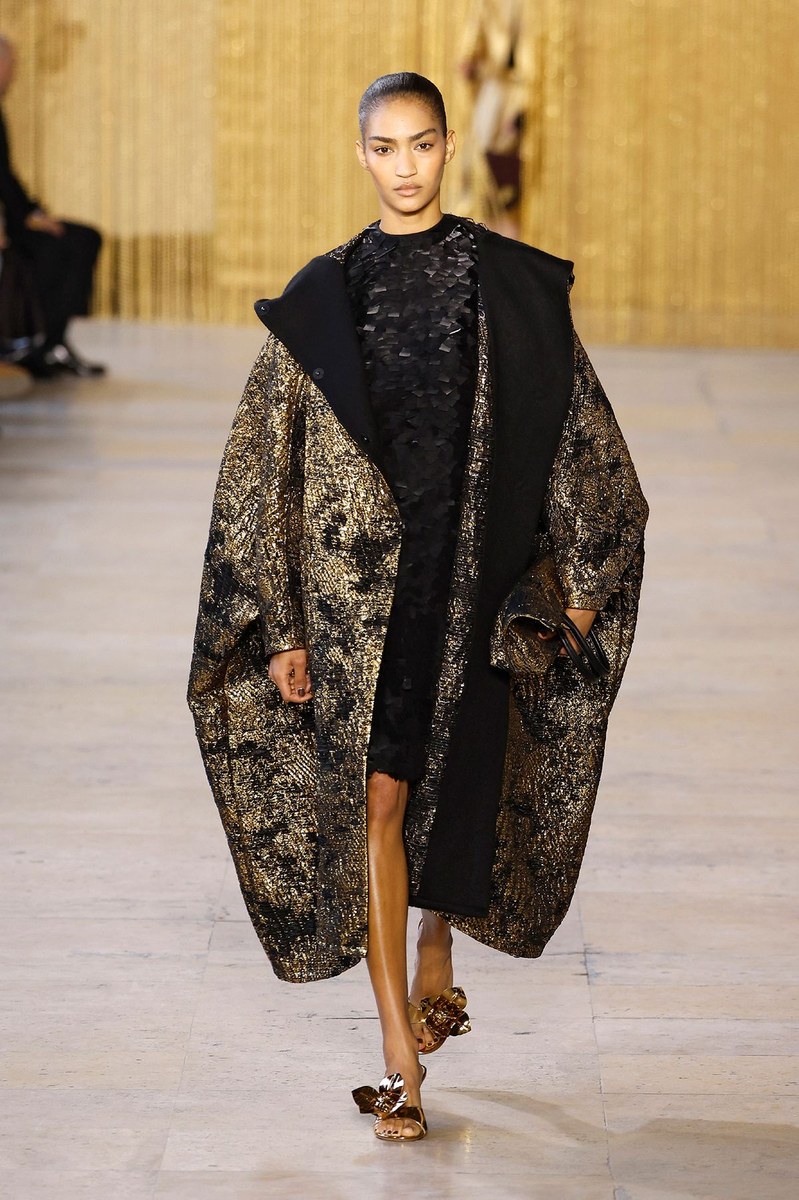
Dramatically cocoon-shaped outerwear opens the collection, particularly Look 1's sweeping gold-and-black brocade cape coat, before settling into a recurring midi-length that dominates across day and evening categories. Cropped jackets paired with fluid skirts appear repeatedly in Look 2 and Look 24, establishing a proportional signature that reads as both structured and unhurried. Evening anchors arrive in the form of column gowns, with Look 44's floor-grazing black velvet turtleneck dress and Look 48's long-sleeve lamé tube providing the most commercially direct shapes in the lineup.
Look 1
Look 1

Color Palette

Black and antique gold open the collection in sustained conversation, a pairing that runs from Look 1 through Look 10 and returns again in the finale evening looks. Tobacco and burgundy occupy the middle section, grounded in Look 8's caramel fox-effect coat, Look 9's camel-and-dark-plum layering, and Look 11's patchwork of brown knit and magenta fur. Forest green and emerald appear in Looks 32 through 37, before the collection pivots into a high-voltage closing sequence of cobalt blue, magenta, and tomato red in Looks 38 through 43, making this the most commercially disruptive segment. Look 40's pairing of fuchsia and orange-red and Look 42's red blazer over a magenta skirt push the color logic furthest from the house's typical restraint.

Materials and Textures

Metallic lamé, both bonded leather-effect in Look 2 and fluid jersey in Look 48, carries the most commercial weight in the collection and translates most easily into retail. Fringe functions as a structural device rather than decorative trim, used to dissolve hemlines in Looks 5, 7, 29, 50, and 53 and creating movement that photographs well and reads as artisanal on the floor. Textural knits, including chunky bouclé in Look 35, looped velvet in Look 13, and shaggy loop-pile in Look 32, provide the heaviest hand in the lineup and signal a clear commitment to cold-weather fabrication with a craft dimension. Sheer chiffon, deployed in Looks 12, 37, and 52 as ombré-printed or layered over opaque bases, introduces lightness that offsets the otherwise high-weight narrative.

Look 2
Look 2

Styling and Layering

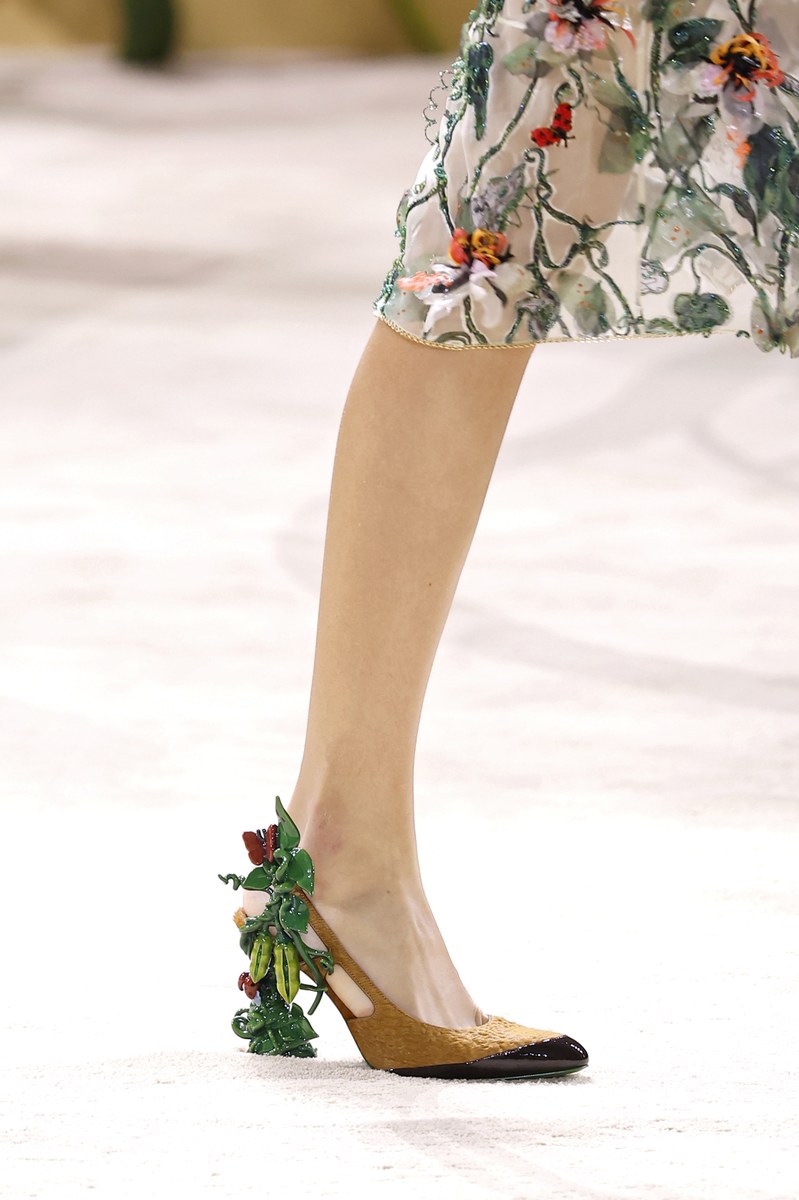
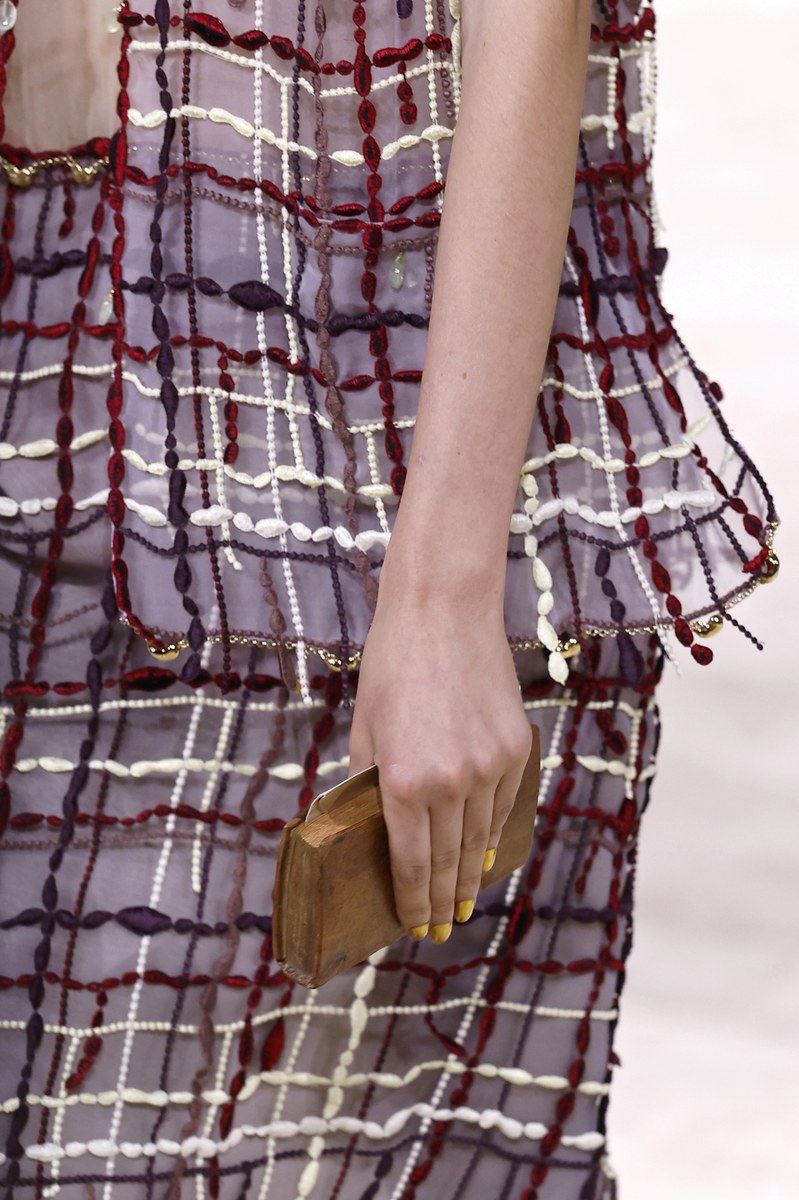
A cropped knit or jacket over a longer skirt with an exposed turtleneck underneath emerges as the dominant layering move, seen in Looks 4, 7, 9, and 25 and creating a tiered silhouette that allows each piece to function independently at retail. Footwear runs almost entirely on a single sculptural mule style with floral resin or metallic ornament at the toe strap, present across more than thirty looks and operating as a unifying visual signal rather than a secondary consideration. Bags remain restrained and compact, mostly structured top-handle styles in black, burgundy, or gold, with a rolled cylindrical clutch in Look 10 standing out as the most editorial accessory in the lineup. Black woven bucket hat in Look 21 and an oversized green knit beret in Look 35 are the only head pieces, used sparingly enough to read as intentional character moments rather than styling filler.

Look 10
Look 10

Look by Look Highlights

Look 3 delivers the collection's most transferable evening piece, a strapless gold lamé column dress with a pleated panel at the hip that creates sculptural interest without construction complexity.

Look 3
Look 3

Look 7 pairs a chunky black hand-knit turtleneck with a gold metallic fringe skirt and demonstrates exactly how the collection bridges knitwear and occasion categories within one outfit.

Look 7
Look 7

Look 10 combines a dark mink-effect coat with gold wave-embossed leather separates underneath and a roll clutch in the same embossed fabric, making it the most coordinated head-to-toe proposition in the lineup.

Look 16 puts a violet shaggy Tibet-lamb-effect coat over a plum leather midi skirt and matching turtleneck, and the monochromatic intensity makes it one of the most shelf-ready statement coat moments in the show.

Look 16
Look 16

Look 33 commits entirely to kelly green velvet, layering a faux-fur oversized coat over a velvet blazer and wide-leg trousers, a tonal head-to-toe that will perform strongly in markets where color confidence is growing.

Look 33
Look 33

Look 47 presents a floor-length column dress covered entirely in black and gold geometric paillette tiles that catch light differently at each angle, and the construction density places it firmly in the made-to-order or trunk-show category.

Look 47
Look 47

Look 52 uses an ombré printed chiffon in purple-to-red degradé, shaped as a draped cape dress, and the color gradient reads as digitally engineered yet retains the hand of couture-adjacent fabrication.

Look 52
Look 52

Look 53 closes the show with a strapless red fringe mini that graduates from scarlet at the bodice to magenta at the fringe tips, and the brevity of the silhouette against the preceding volume makes it a strong closing punctuation for the brand's eveningwear message.

Look 53
Look 53

Operational Insights

Fringe as a construction category: Fringe appears in at least eight looks across day and evening, and buyers should treat it as a key fabrication investment rather than a trend accent. Sourcing fringe in multiple colorways, including black, gold, red, and magenta, will be essential for full assortment coverage.

Metallic lamé versatility: Multiple distinct silhouettes use metallic fabric, from structured skirt suits to fluid jersey columns, which means a single fabric development can support multiple SKUs. Product managers should prioritize lamé in antique gold and bright gold as two separate colorway investments.

The turtleneck as a system anchor: Black or brown sheer knit turtlenecks function as foundational layering pieces across nearly every category, and style directors should build them into the assortment as core basics that activate outerwear, skirts, and evening pieces alike.

Outerwear volume and wearability: Most volumetric coats, including the cocoon brocade in Look 1, the chocolate bouclé cape in Look 4, and the velvet bubble coat in Look 13, require significant floor space and strong editorial support to convert. Buyers should assess sell-through risk for extreme volume against their client base before committing at depth.

Color blocking as a closing strategy: The final ten looks escalate from forest green through cobalt, fuchsia, and red, and this chromatic escalation maps directly onto a separate color story that could be merchandised as a distinct floor moment or dedicated trunk show rather than folded into the broader neutral-anchored range.

Complete Collection

Look 4
Look 4
Look 5
Look 5
Look 6
Look 6
Look 8
Look 8
Look 9
Look 9
Look 11
Look 11
Look 12
Look 12
Look 13
Look 13
Look 14
Look 14
Look 15
Look 15
Look 17
Look 17
Look 18
Look 18
Look 19
Look 19
Look 20
Look 20
Look 21
Look 21
Look 22
Look 22
Look 23
Look 23
Look 24
Look 24
Look 25
Look 25
Look 26
Look 26
Look 27
Look 27
Look 28
Look 28
Look 29
Look 29
Look 30
Look 30
Look 31
Look 31
Look 32
Look 32
Look 34
Look 34
Look 35
Look 35
Look 36
Look 36
Look 37
Look 37
Look 38
Look 38
Look 39
Look 39
Look 40
Look 40
Look 41
Look 41
Look 42
Look 42
Look 43
Look 43
Look 44
Look 44
Look 45
Look 45
Look 46
Look 46
Look 48
Look 48
Look 49
Look 49
Look 50
Look 50
Look 51
Look 51

Fashion Designer

Albert Kriemler was born in 1960 in St. Gallen, a small city in eastern Switzerland whose main industry was textiles and embroidery. He grew up in a multigenerational household: his grandmother Alice had founded Akris in 1922 on a single sewing machine, making polka-dot aprons. His parents expanded the business into ready-to-wear, producing for Givenchy and Ted Lapidus. Hubert de Givenchy became a family friend. At fifteen, Kriemler was already accompanying his parents to fabric fairs. At sixteen, his father brought him to Paris, where he attended his first Yves Saint Laurent show.

The plan after school was to move to Paris, enroll at the École de la Chambre Syndicale de la Couture, and apprentice at Givenchy's atelier. It never happened. A key collaborator in his father's studio died suddenly, and in 1980, at twenty years old, Kriemler was asked to step in as creative director. He has been there ever since, with no other employer, no gap year, no detour through another house.

What he built over the following decades is quietly unusual. His references are not other designers but artists and architects: Thomas Ruff, whose galaxy photographs became a Fall collection; Carmen Herrera, whom he visited on her 101st birthday in her wheelchair on 19th Street in New York; Ellsworth Kelly, Agnes Martin, Imi Knoebel. The process is always the same: he encounters a body of work, feels a genuine pull, reaches out personally, and builds a dialogue. The clothes are the result, not the starting point.

The word he returns to most often is selbstverständlich, a German term with no clean English translation, somewhere between natural, self-evident, and effortless. It describes what he wants a woman to feel when she puts on an Akris coat: that it was always supposed to be there. The brand remains family-owned, based in St. Gallen, with fabrics developed in specialized mills in northern Italy and production in Swiss ateliers.

"You should notice the woman first, then her dress."

"A hundred years ago, my grandmother Alice set out to define a woman's presence and enhance her charisma. That very much remains my mission today."

✦ This report was generated with AI — combining human editorial vision with Claude by Anthropic. Because the future of fashion intelligence is already here.