Alainpaul FW26 Details
Alainpaul FW26 Details Report
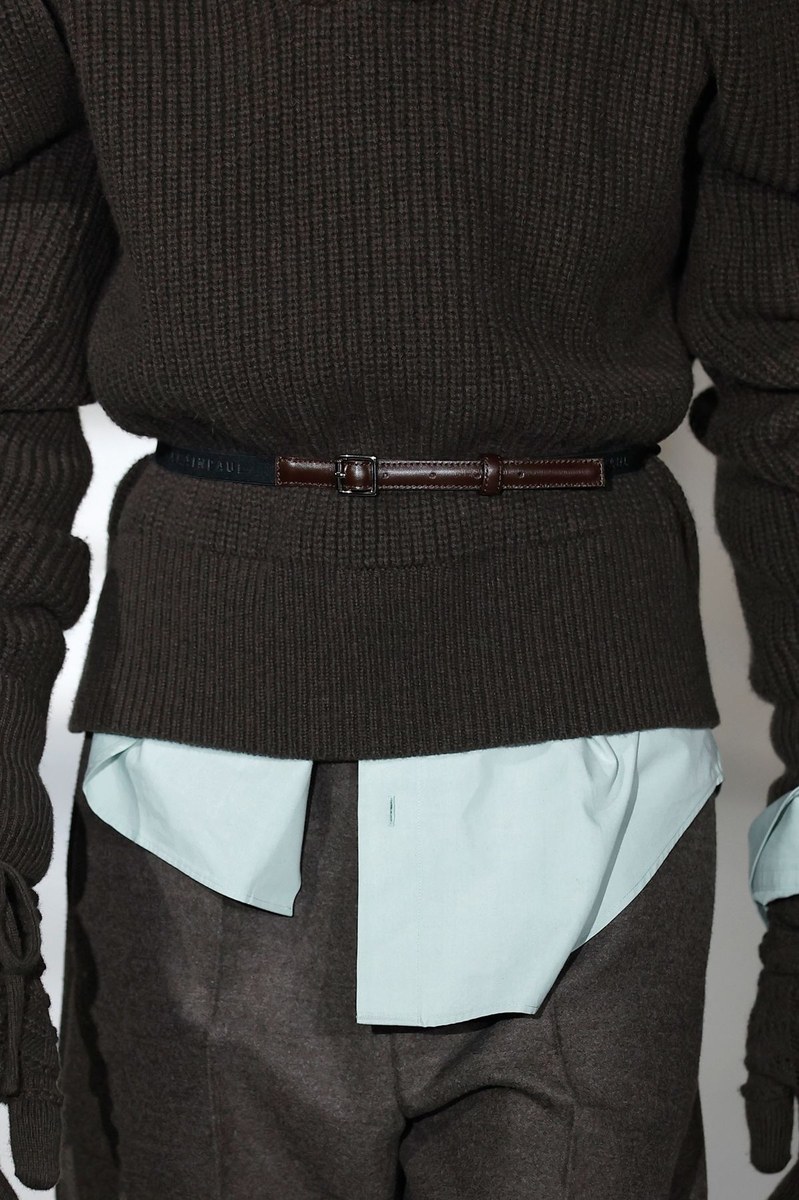
Knitwear-integrated gloves, self-tie waist treatments, and slim leather belts form the backbone of Alainpaul FW26. Rather than functioning as decorative afterthoughts, these accessories work as structural anchors that complete garment silhouettes. For buyers and product managers, this signals a commercial shift toward pieces that belong inside a look, not outside it.
Category Overview
Three categories define the accessory strategy: belts, gloves, and dress construction details. Gloves dominate numerically and conceptually, appearing in five colorways and functioning as the collection's most commercially deployable unit. Belts play a precise tonal role, pinning oversized knitwear to the body with minimal hardware and maximum restraint. The dress details, particularly the felted appliqués and satin self-ties, read as in-house manufacturing signatures that buyers should track for private-label or collaborative development.
Material and Construction
Details 8 through 13 showcase fine-gauge cashmere or cashmere-blend knit with ribbed cuffs and deliberately raw or open-lacework bodies, finished with a single cord tie at the wrist that loops into a bow. Detail 13 pushes construction complexity higher with its ruched, scrunched outer texture, implying either a separate fabric layer or a gathered knit panel. Smooth leather dominates the belts in Details 1 and 2, each with stitched edges and small, brushed-metal single-prong buckles measuring roughly 1.5 to 2 centimeters in width. The dress appliqués in Details 5 and 6 appear needle-felted or thermally bonded, sitting proud of the base fabric with soft, blurred edges rather than clean appliqué lines.

Color and Finish Direction
Dusty blush pink dominates the accent story across the gloves in Detail 11, dress details in Details 3, 4, and 7, and belt-adjacent styling. Charcoal grey anchors the entire collection, appearing in gloves (Details 9, 10, 12), the belt in Detail 2, and base knitwear throughout. Off-white and ivory carry the lighter register in Details 5 and 8, while deep olive-black in Detail 13 grounds the darker looks. Hardware finishes are uniformly warm antique brass or brushed silver, with no high-polish metal visible anywhere in the lineup.

Key Pieces and Details
Detail 11, the cord-tie glove in blush pink, stands out as the single most commercially transferable piece in this collection. Its pointelle knit body, ribbed cuff, and wrist bow translate directly into a mid-tier retail price point and require no complex hardware sourcing. The slim white leather belt in Detail 2, worn over a grey ribbed sweater above a brocade skirt, demonstrates exactly how a sub-2cm belt can shift a knitwear-based look into a tailored register, making it a practical reorder candidate. Detail 6, the felted patch dress, presents the strongest production question: whether the appliqués are hand-applied or machine-bonded will determine MOQ viability and cost-per-unit significantly.
Detail by Detail Highlights
Detail 1 (Belt) A narrow, dark brown leather belt with contrast stitching and a brushed-gold single-prong buckle sits mid-sweater over a ribbed hem, visually cinching volume without compressing the layered mint shirt beneath.

Detail 2 (Belt) White leather, roughly 1.5 centimeters wide with a silver buckle, sits at the natural waist over charcoal knitwear and acts as the only hard-material element in an otherwise all-soft look.

Detail 6 (Dress Detail) A grey flannel or felted wool strapless dress carries needle-felted or bonded abstract patches in dusty pink and charcoal, distributed asymmetrically across the torso and skirt front with visible fiber texture at each patch edge.

Detail 7 (Dress Detail) Pale blush satin uses a wide self-fabric panel at the waistband that releases into two long hanging ties, creating drape and movement without any external hardware or closure.

Detail 10 (Glove) Charcoal grey short gloves transition from ribbed cuff into a bouclé or looped-texture body, finished with a cord bow at the wrist and worn against a crinkled white top and black gathered skirt for maximum tonal contrast.

Detail 11 (Glove) Blush pink pointelle-knit extends past the wrist in a fitted silhouette, with the cord tie sitting precisely at the pulse point and the open-lace pattern running the length of the hand to the fingertips.
Detail 12 (Glove) The elongated charcoal style reaches nearly elbow length with a ribbed top edge, a chunky cord bow at mid-forearm, and a textured body that sits against a blush satin skirt, making the color tension between grey and pink the primary visual statement.

Detail 13 (Glove) Olive-black in this iteration is the most construction-intensive variant, with heavily ruched or gathered panels creating a sculptural, bubbled surface from cuff to finger, finished with the same cord-tie closure used across the range.
Operational Insights
Glove MOQ planning: The cord-tie glove exists in at least four colorways (off-white, blush pink, charcoal, olive-black) and two texture variants (pointelle and bouclé or ruched), so buyers should negotiate colorway minimums independently rather than locking into a single-SKU run.
Belt sourcing: Both belt styles are narrow-width (under 2 centimeters) smooth leather with single-prong buckles, which allows for a shared hardware program across colorways and reduces tooling costs if a private-label version is pursued.
Felted appliqué production risk: Details 5 and 6 carry appliqué-heavy construction that requires early supplier confirmation on whether the technique is hand-worked or machine-bonded, as lead times and per-unit costs differ by a factor of three or more between the two methods.
Knitwear-accessory crossover: Gloves in Details 3, 4, and 8 appear to share the same pointelle stitch and cord-tie construction as the knitwear garments, suggesting a single knit supplier produces both, which product managers should treat as a co-development opportunity to consolidate vendor relationships.
Colorway hierarchy for buying: Blush pink and charcoal grey are the two safe commercial bets across all three categories, appearing in belts, gloves, and dress details simultaneously, while off-white and olive-black function as depth SKUs for buyers with broader open-to-buy.
More Details


✦ This report was generated with AI — combining human editorial vision with Claude by Anthropic. Because the future of fashion intelligence is already here.