Alainpaul FW26 Women Looks Report
Paris Fashion Week
Alainpaul FW26 builds a wardrobe around the tension between structural tailoring and unraveling softness. Sharp wool suiting moves deliberately alongside fluid draped jerseys, sheer organza overlays, and tactile knitwear. For buyers seeking gender-fluid investment pieces with clear wear occasion logic, this collection delivers both a commercial core and a directional edge.
Silhouette and Volume
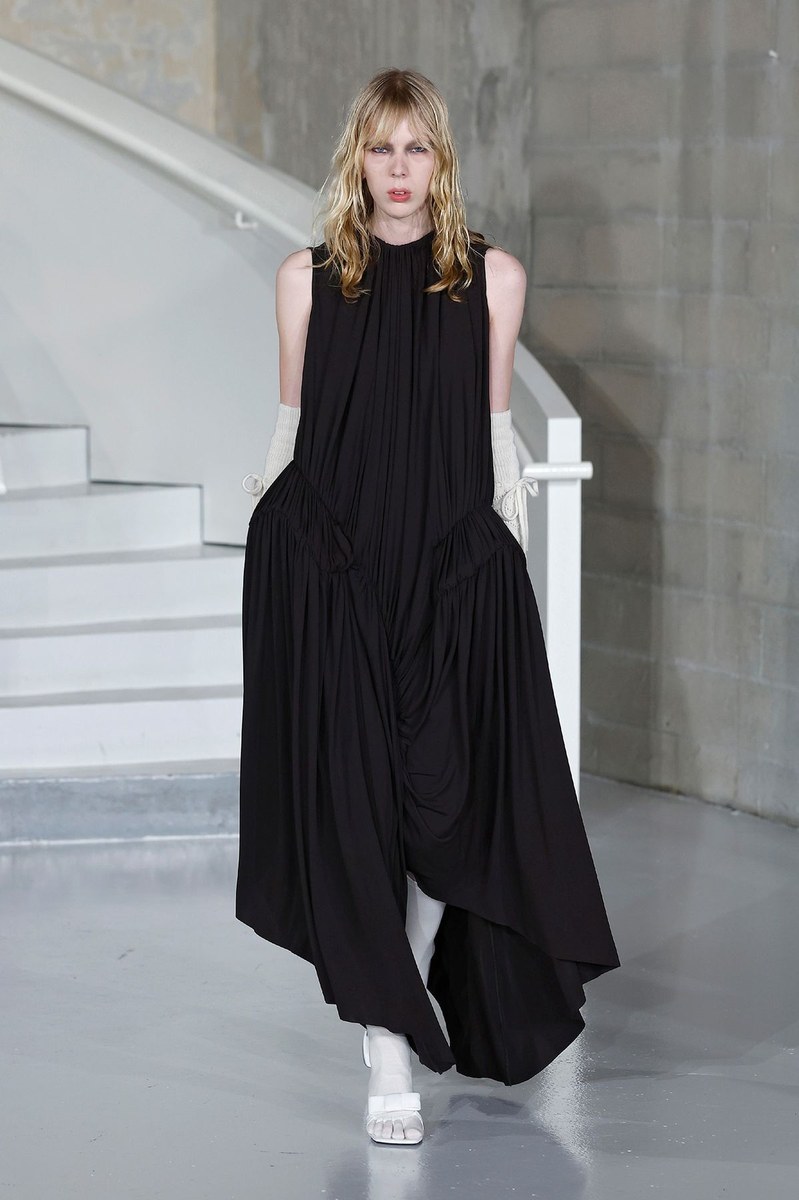
Two silhouettes dominate and rarely compromise. Draped, ruched volume pools and gathers at the hip or hem in Looks 1, 2, 7, and 8, creating an asymmetric, almost sculptural lower body. A sharply constructed, asymmetric wrap blazer with a strong shoulder appears in Looks 3, 4, 9, 22, and 38, cinching at the waist before releasing into wide, fluid trousers or skirts. Looks 13 and 16 introduce a voluminous sheer rectangle laid over the entire body, dissolving the silhouette into something almost two-dimensional.
Color Palette
A strict black and off-white axis dominates, with both tones appearing together and separately across tailoring, jersey, satin, and organza. Deep chocolate brown shows up in Looks 3, 6, 34, and 35 as a credible alternative to black, carrying the same authority with slightly more warmth. Dusty blush pink runs through Looks 13, 14, 17, 28, 32, 33, 36, and 41, functioning as the collection's most commercial and wearable secondary story. A single high-impact red moment in Look 7 and a muted sage green in Look 36 act as punctuation rather than full narratives.

Materials and Textures
Consistent contrast emerges between stiff or crinkled materials and those with liquid movement. Crinkled cotton and coated or patent-finished fabrics appear in the shirts of Looks 5 and 33 and the puffer jacket of Look 10, giving a deliberately papery, almost origami quality to otherwise relaxed shapes. Fluid satin in black and blush falls through Looks 27, 34, 36, 39, 44, and 45 with oily weight. Sheer organza in white or pale grey serves as a layering membrane in Looks 13, 15, 16, 31, and 32, adding diffusion without bulk. Heavyweight wool flannel and bouclé anchor the tailored looks, particularly the grey coat in Look 28 and the grey skirt suit in Look 38, giving the structured pieces real seasonal credibility.

Styling and Layering
Gloves are a persistent signature throughout, appearing in at least fifteen looks in ribbed knit, crochet, leather, and metallic finishes, always tied at the wrist with a small ribbon or bow detail. Both a recurring brand code and a retail opportunity exist here. Footwear splits between a squared-toe mule in white or off-white, a black closed-toe flat, and a series of slides with heavy fringe trim that appear in Looks 5, 10, 15, 22, 24, 26, and others, making the fringe shoe one of the most consistent and commercially distinct accessories in the lineup. Layering logic favors placing a sheer or airy garment over something opaque and structured, or wrapping a knit over a slim printed dress as in Look 17, rather than building conventional outerwear over base layer combinations.

Look by Look Highlights
Look 3 anchors the tailoring story in deep espresso brown wool with an asymmetric wrap blazer and wide-leg trousers. A strong buy for the elevated suiting customer who wants to move away from black.

Look 7 delivers the collection's most immediate editorial impact. A full crimson red ensemble builds from a fringed knit wrap vest, a draped jersey midi skirt, and matching long gloves, with the bow and ruffle details across the body creating maximum visual return for minimal SKU complexity.
Look 16 is the collection's most conceptual piece. A full sheer grey organza suit places over a slim pink shirt and grey trousers with pendant ribbon ties scattered across the surface, making this a strong capsule or editorial exclusive rather than a broad commercial bet.

Look 21 presents a fitted ivory jacket with scattered hand-applied fur or feather tufts that read as paint strokes. A precise and restrained decorative moment that translates well to a premium outerwear or eveningwear buyer.

Look 29 features a strapless column dress in grey flannel with loose painterly brushstroke florals in blush, navy, and terracotta. One of the cleanest and most wearable silhouettes in the collection with strong formal occasion potential.

Look 38 is the most directly commercial tailored look. A grey herringbone wool jacket and pencil skirt with a ruffled insert at the jacket hem creates a structured suit with a feminine disruption that should perform across both European and American contemporary luxury retail.

Look 43 closes the tailored menswear-adjacent thread with a crushed black velvet double-breasted suit with wrap closure and white cuff detail at the wrist. A strong evening proposal that addresses demand for luxurious but unembellished occasion dressing.

Look 45 pairs a sheer chevron-knit crystal or metallic mesh crop top with a voluminous black satin wide-leg trouser tied at the waist with a bow. A precise top-and-bottom proposal that works as separates and addresses both the party and resort buy.

Operational Insights
Glove program: The recurring wrist-tied glove across fifteen-plus looks in multiple fabrications and colors represents a clear accessory expansion opportunity. Buyers should request the glove as a standalone SKU in ribbed ivory, charcoal grey, black crochet, and blush, all of which already have proven runway context.
Fringe footwear: The heavy-fringe flat shoe or slide appears in at least seven looks across both men's and women's silhouettes and functions as the collection's most consistent footwear signature. Style directors should confirm exclusivity windows and production volume early, as this detail will move fast in editorial placements.
Sheer overlay layer: Organza or chiffon overlay garments in Looks 13, 15, 16, and 31 are modular add-ons to existing wardrobe pieces. Product managers should consider positioning this as a layering piece sold with an underlying dress or suit, creating a two-piece ticket average lift.
Blush pink assortment depth: Blush appears across eight or more looks in different fabrics, from organza to satin to knit to printed jersey. This is the collection's strongest color commercial story outside black and white, and buyers should build meaningful depth in blush across at least three categories: knitwear, satin separates, and outerwear.
Asymmetric wrap blazer as hero: The deconstructed asymmetric blazer silhouette seen in Looks 3, 4, 9, 22, 27, and 38 across brown wool, black bouclé, and grey flannel constitutes a clear house signature and a repeatable core product. Style directors should treat this as a franchise piece across seasonal colorways rather than a one-time runway statement.
Complete Collection


Fashion Designer

Alain Paul was born in Hong Kong in 1989 to a French father and a Danish-Brazilian mother, a combination that already suggests someone who would never quite fit a single category. At eight, the family moved to France, and by nine he was enrolled at the École Nationale Supérieure de Danse de Marseille, where he spent the next decade training as a ballet dancer. He was, by his own description, the most eccentric person in the room: the one who, during warm-up sessions, was quietly layering clothes over his rehearsal wear, playing with asymmetry and volume while everyone else was focused on the steps.
The turn toward fashion came gradually during his mid-teens, when a new experimental creative director arrived at the dance school and Paul started staging his own productions with friends. He was the only one thinking about how the dancers should be dressed, how a garment could change the weight and meaning of a body in motion. By eighteen, the choice between auditioning for dance companies and applying to fashion school felt less like a decision than an acknowledgment of something already decided. He moved to Paris to study, and has been there since.
His entry into the industry was unconventional. Rather than pursuing the standard internship circuit at the major Parisian houses, he was introduced to Demna's brother while sneaking into fashion shows, and ended up joining Vetements in 2014 as one of the label's first employees, working in what was still Demna's living room. Three years later he moved to Louis Vuitton, where he spent nearly five years on Virgil Abloh's design team, including the period after Abloh's death when the team worked to complete his final collections.
In 2023, together with his husband Luis Philippe, a former visual merchandiser at Colette, he launched ALAINPAUL. The brand's DNA is rooted in everything he absorbed in the studio: the physical intelligence of Pina Bausch, the structural severity of Martha Graham, the idea that freedom of movement and construction are not opposites but the same thing approached from different directions. Fabrics come from Italy, Japan and England. Pieces are made in France, Portugal and Belgium. The brand is deliberately small and slow.
"In dance, you start with classical to know the rules, and then you learn about contemporary, and you realize there are no rules at all. But you have this base that is so strong. It's the same with fashion. You cannot do a great collection without knowing how to make a jacket."
"I'm not here to be disruptive. I'm here to be me, I'm here to be honest."
✦ This report was generated with AI — combining human editorial vision with Claude by Anthropic. Because the future of fashion intelligence is already here.