Ann Demeulemeester FW26 Details
Ann Demeulemeester FW26 Details Report
Ann Demeulemeester FW26 builds its accessories language around a sustained tension between restraint and exposure, binding and release, with corsetry hardware, embroidered headbands, and frayed lace cuffs doing the ideological work of the collection. For buyers and product managers, this signals a clear commercial opportunity in elevated everyday wearables that carry a strong conceptual load without requiring full runway commitment.
Category Overview
Three categories anchor the accessories program: belts, dress details, and headwear. The belt category is lean but architecturally dense, relying on lace-up corset construction and perforated leather rather than conventional buckle formats. Dress details carry the heaviest volume, spanning shearling, velvet, mohair knitwear, lace, and leather, each communicating a distinct subcultural reference while remaining within a unified gothic-romantic syntax. Minimal in count but maximal in impact, headwear introduces an embroidered ribbon headband with feather trim that functions almost as a mask.
Material and Construction
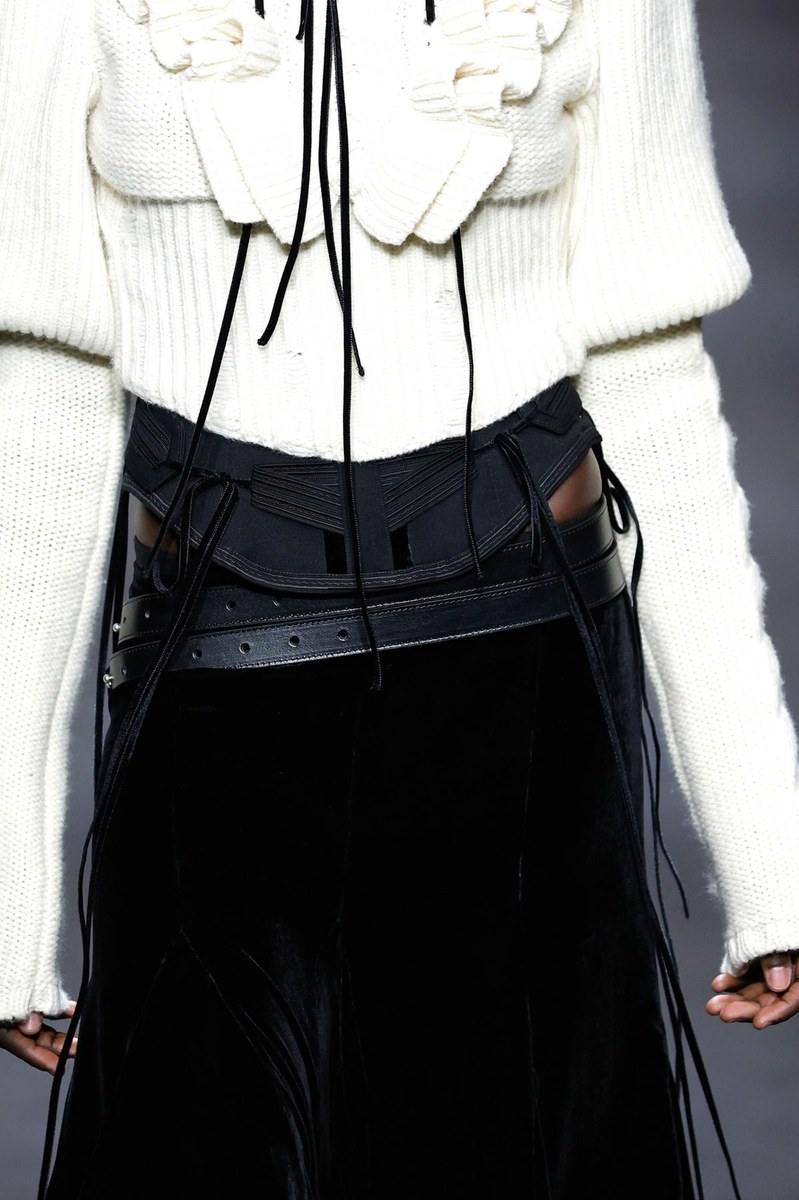
Black leather with punched eyelets and woven lace-up cording dominates the belt category, as seen in Detail 1 and Detail 9, where a multi-panel corset belt layers cording grids above a studded leather strap. Deliberate laddering and drop-stitch patterning appears throughout Detail 3, 4, 5, and 9 in mohair and open-weave knit constructions, treated as design rather than flaw. A tan suede face with full curly ivory fleece trim characterizes the shearling pieces in Detail 7 and Detail 12. Velvet in Detail 11 and Detail 13 reads as unlined and lightly distressed at the hems. Fraying trim at cuffs and hemlines defines the lace used across Details 10, 14, 15, and 16, always raw-edged and intentionally unfinished.

Color and Finish Direction
Two clear camps divide the palette. Ivory, cream, and off-white dominate the knitwear, lace, and shearling pieces, with burgundy and navy appearing only as stripe accents on mohair knits in Details 3, 4, 5, and 9. Matte, patent, and woven finishes in black appear across leather, velvet, and headwear depending on the piece. Deep crimson velvet in Detail 13 serves as the single chromatic departure, reading as a deliberate punctuation mark against the otherwise achromatic collection story.

Key Pieces and Details
Most commercially transferable is the corset belt in Detail 1. It layers a woven cording harness over a perforated leather base strap, and the two-component construction allows for modular production, letting buyers consider the leather strap and the cording overlay as separable SKUs. Strong visual authority comes from the embroidered headband across Details 17, 18, and 19, which reads as an immediate entry-price accessory. The raw-edge lace cuff detail recurring in Details 14, 15, and 16 presents a trim opportunity for licensed production or private label adaptation.
Detail by Detail Highlights
Detail 1 (Belt) presents a two-tier construction pairing a black perforated leather strap with punched silver eyelets against an upper panel of black woven cording strung through metal loops, creating a corset silhouette at the waist.
Detail 3 (Dress Detail) shows an ivory mohair open-knit pullover with burgundy, white, and navy varsity stripe trim at the V-neck, layered over a high-neck white lace blouse with a black ribbon tie closure at the throat.

Detail 4 (Dress Detail) captures the cuff of the same mohair knit, revealing a fluted bell sleeve with burgundy and navy stripe at the wrist and a scalloped knit hem edge in deep wine, an unexpectedly sharp finish on an otherwise deliberately undone garment.

Detail 8 (Dress Detail) presents a sleeveless black chiffon dress with near-total transparency, structured only by two diagonal black lace and embroidered ribbon bands crossing the torso in an X configuration, with a single vertical ruffle at the side seam.

Detail 11 (Dress Detail) shows a deep charcoal brown velvet blazer with a patch pocket and deliberately frayed hem, the sleeve ending to reveal black and charcoal narrow-stripe shirting underneath, with loose threads left intact at the cuff.

Detail 15 (Dress Detail) depicts a midnight black military-style coat cuff with velvet applique panels, a chain-stitch embroidered motif on the velvet, and a white lace undershirt cuff with a raw eyelash edge and a trailing ivory satin ribbon.

Detail 17 (Headwear) shows the embroidered black grosgrain headband worn low across the forehead, the center panel worked with a repeating chain-link embroidery motif, with a feather-trimmed black bow positioned at the crown and long ribbon tails trailing at the back.

Detail 2 (Belt) presents a black leather waist belt with scalloped upper edge, a central gold and silver metallic woven ribbon inset, and structural boning beneath the outer shell, positioned over a double-breasted black wool suiting jacket with a tassel chain pendant at the lapel.

Operational Insights
Corset belt production: The two-component structure in Detail 1 justifies tooling two separate production lines, a perforated leather strap and a woven cording overlay, allowing mix-and-match assortments and tiered price points across belt SKUs.
Mohair knit stripe trim: Appearing at collar and cuff across Details 3, 4, 5, and 9, the burgundy and navy varsity stripe is a narrow repeating trim, not an allover pattern, which reduces yarn consumption and allows buyers to introduce collegiate accent color with minimal fabric risk.
Raw lace trim standardization: Consistent lace weight and construction characterize the frayed lace cuff appearing in Details 14, 15, and 16. Buyers should negotiate a bulk trim yardage commitment early, because this finish reads across multiple garment categories and will drive repeat orders.
Headband entry-price strategy: Extremely low material cost relative to its visual impact defines the embroidered grosgrain headband in Details 17, 18, and 19, with the feather trim as the only variable cost element. Product managers should evaluate a feather-free version for markets with import restrictions on natural plume materials.
Shearling face and fleece sourcing: A consistent tan suede face with ivory curly fleece appears in Details 7 and 12, suggesting a single tannery or shearling supplier relationship. Buyers entering production on similar pieces should secure full-season shearling allocation before confirming range depth, as curly fleece availability is seasonally constrained.
More Details


✦ This report was generated with AI — combining human editorial vision with Claude by Anthropic. Because the future of fashion intelligence is already here.