Ann Demeulemeester FW26 Shoes

Ann Demeulemeester FW26 Shoes
Did you know? Ann Demeulemeester was one of the first Belgian designers to establish her own production facilities in Belgium rather than outsourcing to Italy or Asia, maintaining complete control over her craft techniques and quality standards since the label's 1987 founding. This vertical integration approach became a defining characteristic of her atelier model and influenced how Belgian fashion houses approached manufacturing independence.

Ann Demeulemeester FW26 Shoes Report

Ann Demeulemeester FW26 grounds its footwear in two parallel tracks: studded harness engineer boots across multiple colorways and constructions, and distressed lace-up combat and ankle boots with deliberately aged finishes. Buyers and product managers should pay attention to the commercial repeatability of the harness boot silhouette alongside the runway credibility of the hand-finished distressed styles, which together map a clear tiered assortment strategy.

Silhouettes and Construction

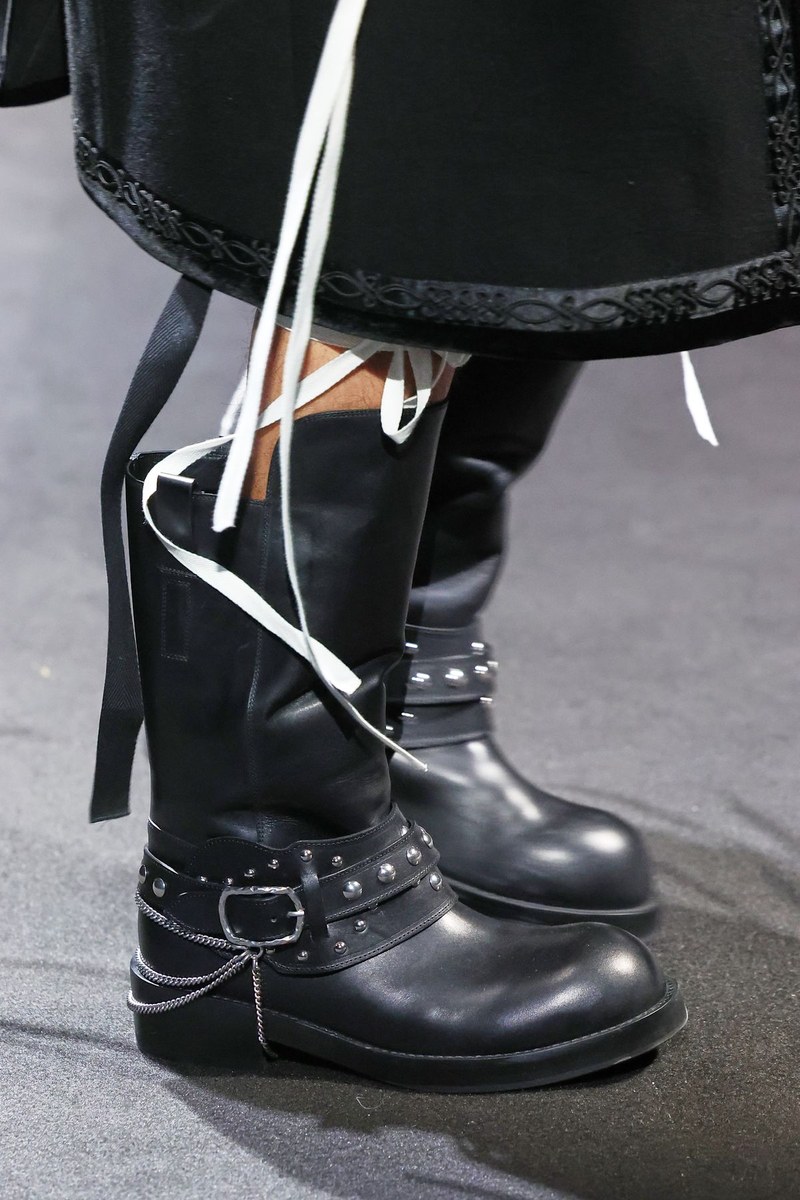
The harness engineer boot, appearing in both mid-calf and ankle heights, forms the dominant silhouette of the collection, built on a flat or near-flat rubber sole with a rounded toe and sturdy welt construction. Combat lace-up boots in ankle to mid-calf heights offer a second strong silhouette, sitting on flat platforms with cap-toe construction and visible heavy-duty sole stitching. Shoe 10 features a pointed-toe heeled ankle bootie with a sculptural curved heel, while Shoe 14 presents a cage-lace cutout ankle boot, both representing sharper, more directional silhouette bets for fashion-forward doors. Slip-on sneaker shapes in Shoes 9, 12, and 16 close the range with low-profile canvas construction on a slightly oversized cupsole.
Materials and Finishes

Black smooth calfskin leather dominates the harness boots, with a high gloss on the toe cap and shaft in styles like Shoe 17 and Shoe 18. Tan distressed suede makes its appearance in Shoe 4 and Shoe 15, giving buyers a warm-toned alternative within the same harness boot architecture. Shoes 6, 7, 19, and 13 use leather treated with a bleached, chalky surface finish that reads as intentional hand-distressing rather than wear. Hardware throughout the harness styles is polished silver, comprising dome studs, rectangular roller buckles, and a looped chain drop that sits across the vamp.

Color Direction

Black is the clear anchor of the collection, used across calfskin leather, suede, and canvas in at least twelve of the nineteen styles. Tan distressed suede in Shoes 4 and 15 provides the only warm chromatic break and signals a deliberate nod to workwear heritage. Bleached grey and white marbling on the distressed combat boots in Shoes 6, 7, and 19 functions as a tonal accent rather than a true color statement. A tightly edited palette simplifies open-to-buy decisions and minimizes SKU risk for stockists.

Key Models and Details

The studded harness boot is the hero model of the collection, appearing in at least seven variations across leather, suede, ankle height, and mid-calf height, with a consistent studded strap, roller buckle, and chain drape as unifying details. Shoe 2 stands out as the most complex construction in the range, a mid-calf lace-up boot with an angled cowboy-derived heel, pointed toe, and eyelets running the full shaft length. Shoe 13 and Shoe 6 represent the cleaner combat boot option, with minimal branding visible and a construction that leans heavily on the aged leather surface treatment as the primary design statement. Shoes 9, 12, and 16 use a low canvas upper with a molded oversized cupsole, deliberately worn and soiled in finish, positioning them as an anti-sneaker statement within the broader range.

Shoe by Shoe Highlights

Shoe 1 Mid-calf black calfskin engineer boot with white ribbon ties at the shaft, a studded harness strap, roller buckle, and chain drop, making it the most layered and editorial version of the core boot for flagship and concept store placement.

Shoe 1
Shoe 1

Shoe 2 Pointed-toe mid-calf lace-up boot in black leather with a stacked angled heel of approximately 6 to 7 centimeters and full-length eyelet lacing, the strongest commercial proposition for womens specialty boot buyers.

Shoe 2
Shoe 2

Shoe 4 Ankle-height tan distressed suede harness boot with dome studs, a roller buckle, and chain, the only warm-toned harness style and the clearest entry point for buyers seeking colorway differentiation within the silhouette.

Shoe 4
Shoe 4

Shoe 10 Black leather lace-up ankle bootie with a sculptural curved heel of approximately 8 centimeters and a pointed toe, representing the highest fashion-forward risk in the range but with strong editorial placement value.

Shoe 10
Shoe 10

Shoe 14 Black cutout cage ankle boot with a blocked heel and dense horizontal lace wrapping across the vamp, a production-intensive style best suited to limited-run or directional accounts.

Shoe 14
Shoe 14

Shoe 15 Tan suede mid-calf harness boot with black hardware and a wide flat sole, the most wearable and seasonally versatile version of the harness silhouette for broader distribution.

Shoe 15
Shoe 15

Shoe 19 Ankle-height lace-up combat boot in black leather with heavy hand-applied bleached distressing, a flat rubber sole, and cap toe, strong for streetwear-adjacent accounts where surface treatment drives purchase intent.

Shoe 19
Shoe 19

Shoe 11 Black leather monk-strap style shoe with a single polished buckle closure, a squared bulbous toe, and a flat platform sole, the quietest silhouette in the collection and likely the easiest to place across multiple market levels.

Shoe 11
Shoe 11

Operational Insights

Harness boot architecture: The roller buckle, dome stud, and chain drape configuration appears across at least seven styles, which means a single hardware component set can service the majority of the boot range. Request component consolidation from production partners to reduce tooling costs.

Colorway strategy: Black dominates the collection with one tan suede deviation. Product managers building assortments for multi-brand retail should push for a third colorway, such as dark brown or oxblood leather, to improve sell-through across the harness boot family without redesigning the last or construction.

Distressed finish scalability: The hand-applied bleached finish on Shoes 6, 7, and 19 is visually compelling but operationally difficult to reproduce at scale with consistent results. Evaluate whether a machine-applied tumbled finish can approximate the aesthetic before committing to production volumes above 500 pairs per style.

Heel architecture risk: Shoe 10 carries a sculptural curved heel that requires a separate heel mold and structural reinforcement. This adds cost and lead time. Limit initial buy depth on this style and treat it as a traffic driver rather than a volume unit.

Sneaker positioning: The cupsole canvas sneakers in Shoes 9, 12, and 16 carry deliberate soiling and distressing as a design feature. Retailers should build clear visual merchandising guidance into their buying agreements to ensure the distressed finish reads as intentional to floor staff and end consumers, preventing returns driven by perceived quality issues.

More Shoes

More Shoes

More Shoes

More Shoes

Shoe 3
Shoe 3
Shoe 5
Shoe 5
Shoe 6
Shoe 6
Shoe 7
Shoe 7
Shoe 8
Shoe 8
Shoe 9
Shoe 9
Shoe 12
Shoe 12
Shoe 13
Shoe 13
Shoe 16
Shoe 16
Shoe 17
Shoe 17
Shoe 18
Shoe 18

✦ This report was generated with AI — combining human editorial vision with Claude by Anthropic. Because the future of fashion intelligence is already here.