Anteprima FW26 Women Looks Report

Anteprima FW26 Women Looks Report
Anteprima FW26 Women Looks Report

Milan Fashion Week

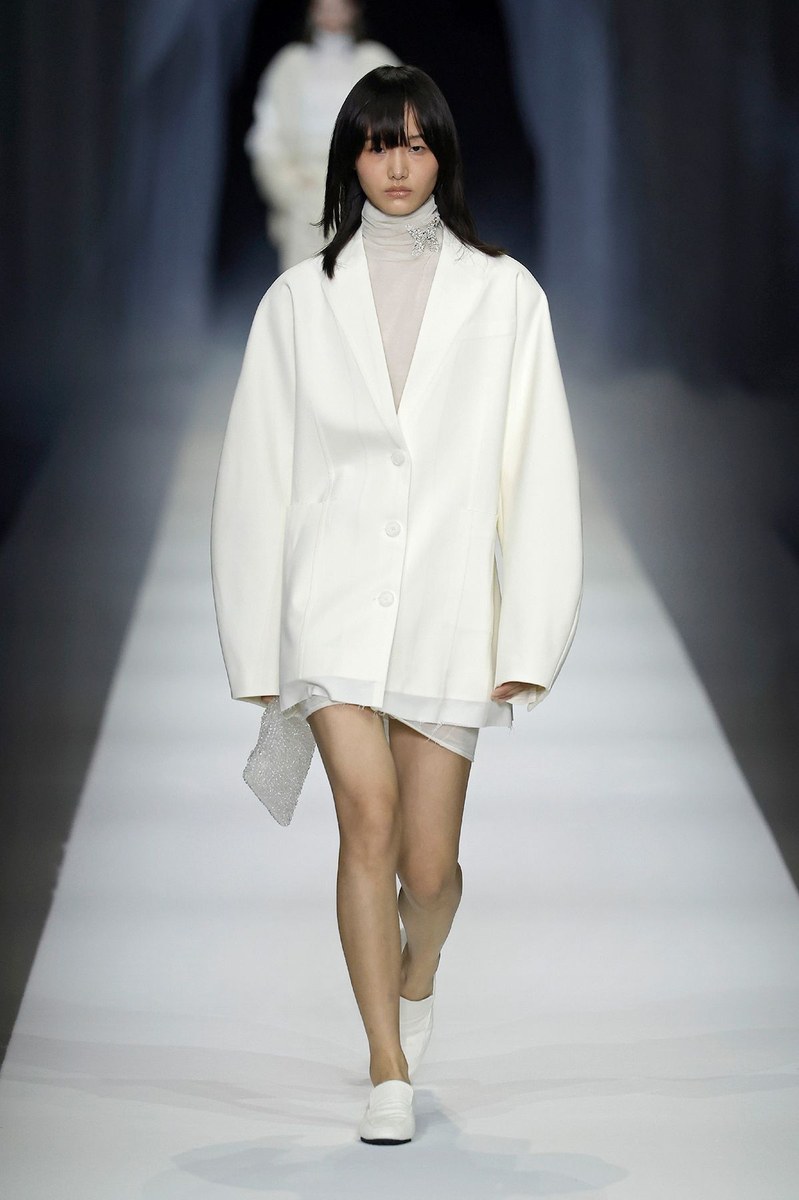
Anteprima FW26 builds a wardrobe around cocooning volume and tonal restraint, moving from an all-white opening sequence through greyed neutrals and into deep, saturated earth tones. Buyers navigating a market hungry for quieter luxury with genuine wearability will find silhouettes and material stories that translate directly into mid-to-high retail.

Silhouette and Volume

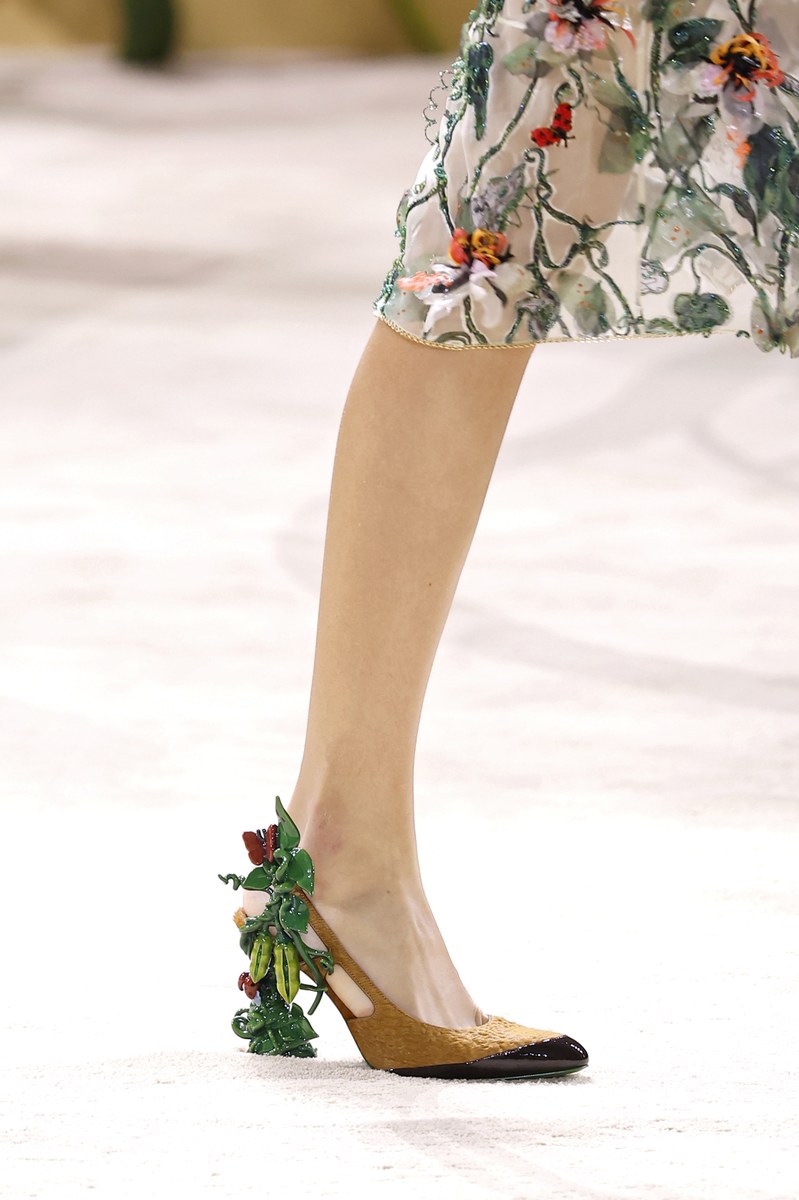
Generous, body-obscuring shapes dominate every category, from oversized blazers and cape-draped coats to ballooning sweater dresses and wide-leg trousers with deep pleating at the waistband. Looks 1 through 4 anchor the opening in boxy, shoulder-dropped outerwear worn over short hemlines, creating a deliberate proportion tension between volume above and exposed leg below. By mid-collection, full-length wide trousers ground the volume at the floor rather than the shoulder. Look 12 pushes this furthest, a single-button, floor-skimming wool coat with a flared A-line hem that reads almost monastic in its severity.
Look 12
Look 12

Color Palette

An extended sequence of off-white and warm ivory runs through Looks 1 to 4 and returns in Look 19, before breaking into ash grey and slate in Looks 5 through 8. Mid-collection introduces a precise olive and sage range, seen in Looks 14, 16 and 18, paired with dark khaki trousers or burgundy socks to prevent the palette from reading flat. Chocolate brown anchors Looks 10 and 17 with real depth, while charcoal and near-black close the collection in Looks 11, 15 and 7. Within each look, the logic stays tonal, with one accent doing the work of punctuation, a burgundy accessory, a caramel shirt, a sage collar.

Look 19
Look 19

Materials and Textures

Knitwear carries significant weight here, appearing as chunky cable-knit sweater dresses in Look 5 and Look 19, a textured speckled cardigan in Look 6, and a peplum-waisted ribbed knit vest in Look 17. Smooth-faced wool and wool-blend cloths handle the coat and trouser pieces, with Look 12 and Look 14 reading dense and matte, built for structure without stiffness. Sheer elements provide contrast against the heavier knit and woven surfaces without reducing warmth, a fine mesh turtleneck base in Looks 8 and 17, and a translucent wide-leg trouser layer in Look 19. A teddy shearling drape appears in Look 2, adding tactile variety and a surface that will photograph well in retail environments.

Look 5
Look 5

Styling and Layering

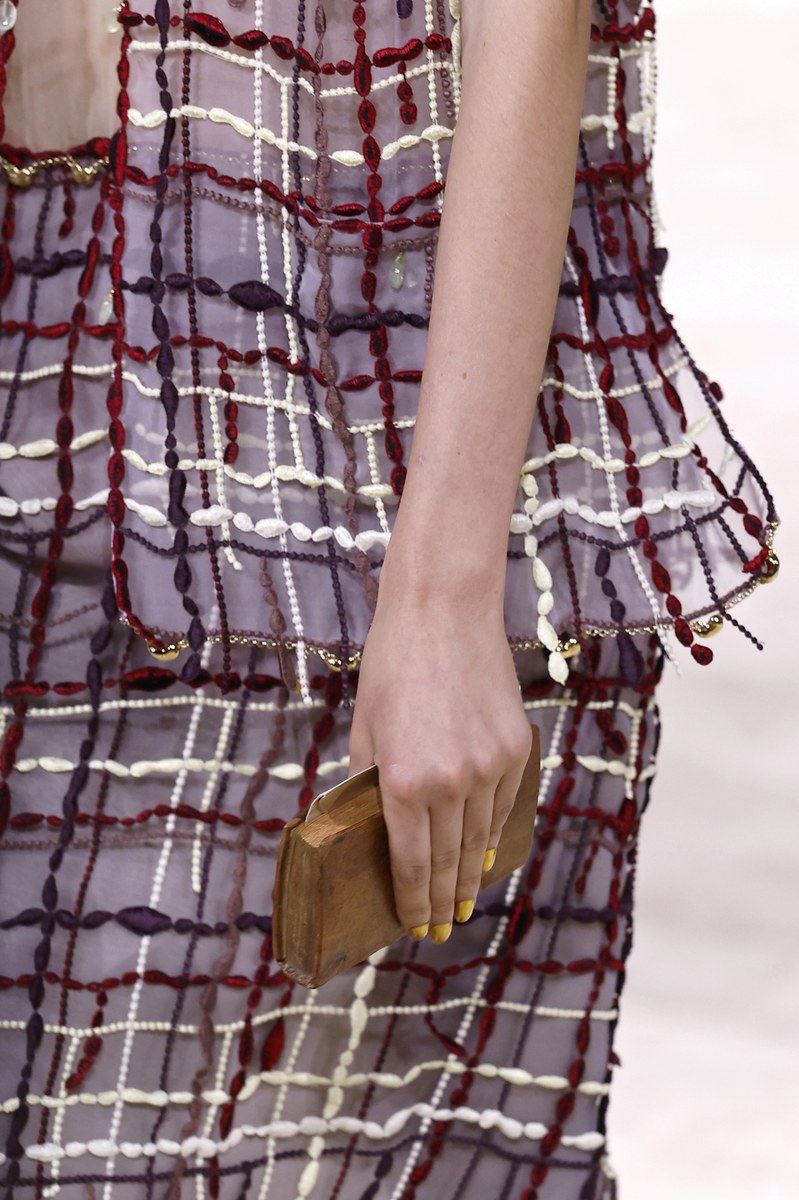
Layering follows a base-then-bury logic. A fine-gauge knit or sheer turtleneck sits closest to the body, followed by a heavier mid-layer, a sweater, cardigan or structured vest, then outerwear on top. Look 4 stacks a turtleneck, collared shirt, tailored vest and relaxed blazer in all-white, making the layering itself the visual event. Footwear stays deliberately low, flat loafers in white or black throughout, with occasional block-heeled ankle boots in burgundy suede keeping the proportion focus on the upper body and torso volume. Accessories pull toward the sculptural and muted, with beaded and woven clutch bags in ivory, taupe and dark berry appearing across multiple looks.

Look 4
Look 4

Look by Look Highlights

Look 1 A cream oversized blazer over a sheer ribbed turtleneck and a white micro-shorts base establishes the collection's opening proposition, a proportion play that will drive editorial pickup and should be bought as a separates story.

Look 1
Look 1

Look 3 The ivory cape coat with a ribbed panel front and exaggerated draped sleeves worn over a boucle mini dress is the most directly commercial outerwear piece in the collection, with a silhouette that works across age and body demographics.

Look 3
Look 3

Look 5 A heather-grey chunky cable-knit sweater dress with bishop sleeves and side lacing details, worn over a fine grey turtleneck and grey knee socks, lands as a complete ready-to-wear unit that requires no additional styling investment from retail.

Look 7 The black glitter-threaded knit sleeveless top with raw fringe hem, worn with deep charcoal wide-leg trousers and a belted waist, is the sharpest day-to-evening pivot in the collection and will function as a high-turn floor piece.

Look 7
Look 7

Look 14 An olive double-faced wool duster coat draped over a sage floral-print chiffon blouse, dark khaki wide trousers and a visible ribbed knit panel at the back collar demonstrates how Anteprima layers within a single chromatic family without monotony.

Look 14
Look 14

Look 17 The all-chocolate-brown ensemble, a sheer knit base, ribbed peplum vest, oversized ribbed tube scarf doubling as a balaclava hat, and a column skirt with asymmetric hem, reads as the highest editorial risk and the strongest social media candidate.

Look 17
Look 17

Look 18 A chartreuse yellow-green long coat with V-neckline and bell sleeves, worn loosely open over a nude underlayer, is a clear hero coat for buyers looking for one statement color item in an otherwise neutral assortment.

Look 18
Look 18

Look 19 The cream cable-knit sweater dress layered over sheer wide-leg ivory trousers with fringe tie details at the cuffs completes the return to the opening white story and functions as a direct closing reference for buyers building a coherent color capsule.

Operational Insights

Knit depth: At least six distinct knitwear constructions appear here, cable, rib, boucle, open mesh, shearling and textured speckle, giving product managers strong grounds to negotiate a dedicated knitwear buy that spans price architecture from entry-level sweater dresses to elevated outerwear-weight knits.

Separates logic: Nearly every look reads as separates rather than coordinated sets, which means buyers can build flexible open-to-buy strategies around tops, trousers and outerwear bought independently and restyled on the floor.

Color entry points: The ivory-to-white and ash grey runs are the safest commercial entry points for volume ordering, while the chartreuse and chocolate brown pieces carry stronger margin potential as limited-depth fashion items for style directors building newness into an otherwise neutral floor.

Accessory attachment: Beaded and woven clutch bags in coordinating tones appear across almost every look, signaling that Anteprima intends accessories to carry attachment rate weight at retail. Buyers should plan display strategies that place bags directly adjacent to coordinating garments.

Footwear proportion: The flat loafer worn throughout, in white leather and in black, confirms a low-silhouette footwear direction that product managers should cross-reference when planning shoe adjacencies, as elevated or pointed-toe styles will conflict with the deliberate proportion logic of these looks on the sales floor.

Complete Collection

Look 2
Look 2
Look 6
Look 6
Look 8
Look 8
Look 9
Look 9
Look 10
Look 10
Look 11
Look 11
Look 13
Look 13
Look 15
Look 15
Look 16
Look 16
Look 20
Look 20
Look 21
Look 21
Look 22
Look 22
Look 23
Look 23
Look 24
Look 24
Look 25
Look 25
Look 26
Look 26
Look 27
Look 27
Look 28
Look 28
Look 29
Look 29
Look 30
Look 30
Look 31
Look 31

About the Designer

Izumi Ogino made her first mark on fashion not in Tokyo where she grew up, but across borders in Hong Kong during the 1980s, where she built Italian luxury brands in Asia while living as a housewife in her twenties. This retail experience with European fashion houses planted the seeds for her understanding of what modern women desired: timeless luxury without cultural constraints. By her late thirties, Ogino had crossed another continent to Milan, where she founded Anteprima in 1993 with no formal fashion training, learning the industry as she went.

Her path into fashion came through commerce rather than design school. After establishing herself as a successful retailer specializing in Italian brands throughout Asia, Ogino recognized a gap in the market for sophisticated women's fashion that transcended geographical boundaries. Five years after launching Anteprima, she became the first Japanese woman to join Milan Fashion Week in 1998, the same year she introduced the brand's now-signature Wirebag, conceived from a wire glasses strap she discovered in Italian material shops.

Ogino's aesthetic draws from her extensive travels and deep engagement with contemporary art, which began forty years ago and has evolved into active partnerships with artists like Izumi Kato, Mika Ninagawa, and Takahiro Iwasaki. Her collections reflect this cross-cultural dialogue, combining minimalist Japanese sensibilities with Italian craftsmanship and a global perspective. She serves on the collectors' circle of the Venice Biennale and actively supports art institutions from the M+ museum in Hong Kong to CHAT (Centre for Heritage, Arts and Textile), viewing fashion as a frame for artistic expression.

As Creative Director, Ogino continues to guide Anteprima from bases in Tokyo, Milan, and Hong Kong, maintaining her focus on creating clothes that serve as canvases for individual expression. Now in her seventies and considering retirement, she has increasingly integrated art collaborations into her seasonal collections, moving beyond travel-inspired designs to incorporate artists' philosophies and worldviews directly into the creative process.

"Art can express emotions and ideas that fashion cannot. Fashion constantly requires consideration of the market, deadlines, costs, and the realities of mass production, whereas artists create with greater freedom and depth of thought."

"I see fashion as a powerful medium to connect people, and I envision my work as a beautiful wall or frame for the art."

✦ This report was generated with AI — combining human editorial vision with Claude by Anthropic. Because the future of fashion intelligence is already here.