Antonio Marras FW26 Details
Antonio Marras FW26 Details Report
Antonio Marras FW26 anchors its accessories and detail language around layered textile craft, botanical embellishment, and the collision of heritage tailoring codes with painterly surface decoration. For buyers and product managers, this collection signals a clear commercial appetite for handcraft-driven embellishment that reads as artisanal without sacrificing wearability.
Category Overview
Two categories anchor the detail strategy here: Dress Details and Headwear. Volume and complexity dominate the Dress Details, working across printed silk charmeuse, structured wool crepe, sheer organza, and patchwork constructions. Detail 5 functions as a punctuation mark in Headwear, translating the collection's embellishment logic directly onto a structured hat form. These categories communicate a house direction that treats surface decoration as architecture, not afterthought.
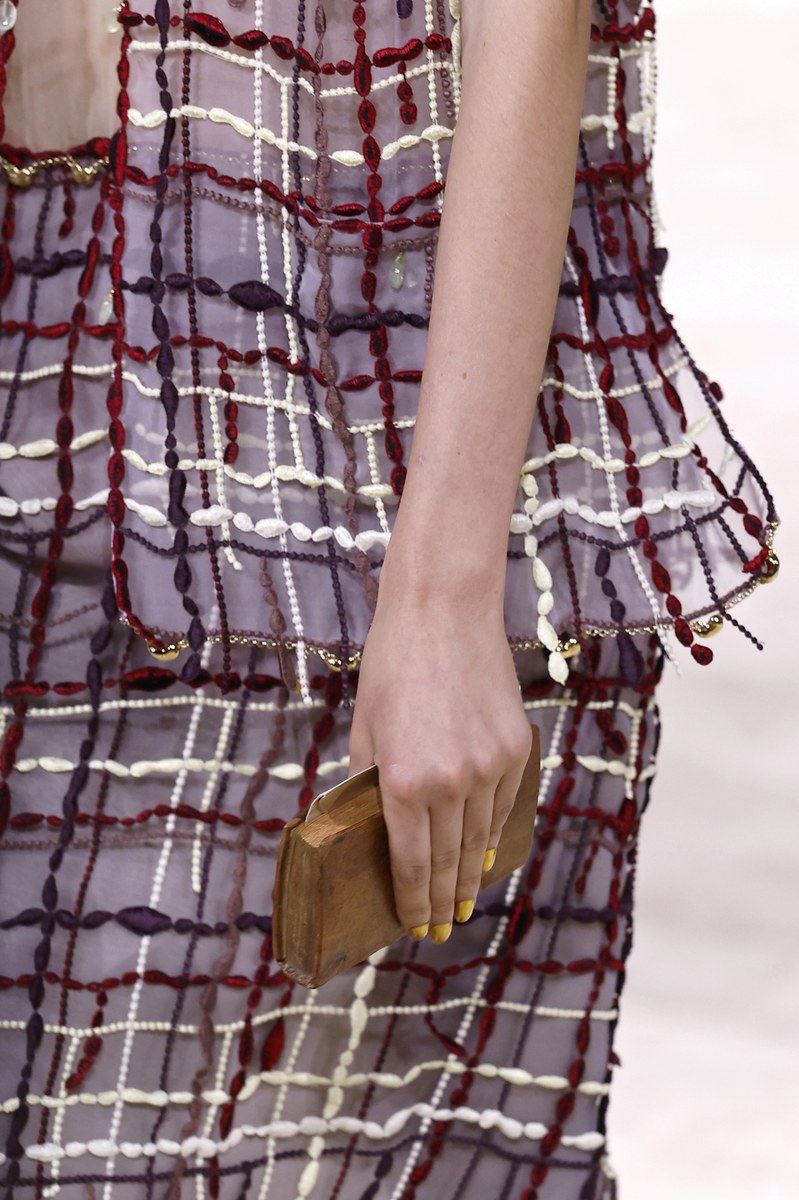
Material and Construction
Detail 1 layers a matte dove-grey crepe base with sheer silver-ground metallic organza sleeves, the two fabrics working in deliberate contrast of opacity and weight. Detail 2 and Detail 3 share a family of three-dimensional beaded rose appliqués, executed in sequin-stitched petals with oxidized silver and dusty rose tonal variation, applied to both a patchwork jacket ground and a fitted structured jacket respectively. Detail 4 moves into a heavy ivory silk charmeuse with puff sleeves gathered and ruched at the elbow, the fabric carrying a hand-drawn quality botanical print in matte black. Detail 5 constructs its fedora crown from a herringbone wool tweed, then layers torn lace fragments, metallic thread embroidery, and beaded appliqués directly onto the brim and crown face.

Color and Finish Direction
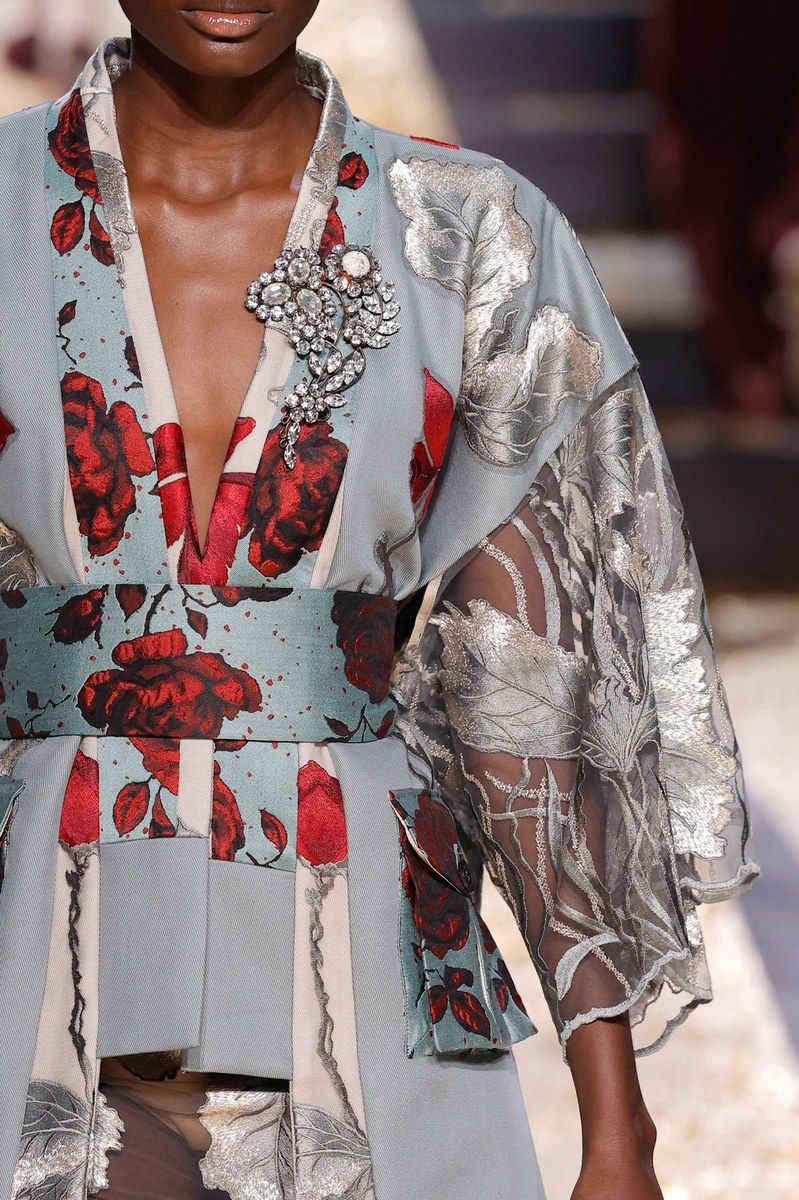
Dusty slate blue, warm stone grey, and ivory silk run through the dominant palette, with the beaded embellishments introducing dusty rose and gunmetal silver as recurring accent tones. Detail 1 introduces the strongest chromatic contrast in the collection, pairing the grey crepe body with bold crimson and charcoal printed roses, then anchoring the lapel with a large crystal brooch in clear and pale champagne stones. Detail 4 holds to a restrained ivory and matte black, which will read broadly across markets. Deliberately matte base fabrics characterize the finish direction here, with metallic and crystal moments placed surgically to avoid an all-over shine read.
Key Pieces and Details
Detail 3 emerges as the strongest commercial proposition in the group. The fitted slate blue jacket with a central button placket and climbing beaded rose vine is structured, size-adaptable, and carries an embellishment story that works for both ready-to-wear retail and made-to-order contexts. Detail 5, the embellished herringbone fedora, answers the current buying market's demand for accessory pieces that carry storytelling weight without relying on logomarks. Product managers sourcing patchwork and mixed-media outerwear will appreciate Detail 2, as the construction combines organza, tweed, lace, and sheer panels in a single jacket that demonstrates controlled complexity.

Detail by Detail Highlights
Detail 1 (Dress Detail) A deep V-neck dove-grey crepe kimono-cut jacket printed with loose crimson and charcoal roses pairs with sheer metallic silver organza sleeves carrying embossed leaf motifs, anchored at the lapel by a large pavé crystal brooch in clear and warm champagne tones.
Detail 2 (Dress Detail) A patchwork single-breasted jacket combines herringbone wool, sheer organza panels, ribbed tape, and lace grounds, then applies three-dimensional beaded roses in dusty rose and gunmetal sequins across the full front face, with clear bubble-like resin accents at two points.

Detail 3 (Dress Detail) A tailored slate blue jacket with strong shoulder structure and a column of covered self-buttons carries a climbing vine of beaded roses, built from layered sequin petals in dusty rose and oxidized silver with gunmetal leaf motifs, running symmetrically from collar to hem.
Detail 4 (Dress Detail) A ruched puff sleeve in heavy ivory silk charmeuse, gathered at mid-elbow, carries a matte black hand-drawn botanical print of ribbon-like stems, scattered seed dots, and loose flora, with a separate black velvet floral appliqué at the shoulder seam.

Detail 5 (Headwear) A structured herringbone grey wool fedora with a shallow crown receives torn black lace fragments, metallic gold thread embroidery, and small beaded appliqués pressed into the upper brim and crown face, creating a surface texture that reads as deliberately distressed and layered.
Detail 2 (Dress Detail) Large square patch pockets in plain grey wool cut against the mixed-media body give buyers a practical anchor point in an otherwise complex construction, making the piece easier to position at retail.
Detail 3 (Dress Detail) The jacket's waist seaming pulls into a visible suppressed silhouette below the rib cage, confirming that the embellishment program sits on a structured, fitted technical base rather than a relaxed or oversized form.
Detail 1 (Dress Detail) Worn as a separate statement closure rather than sewn into the garment, the crystal brooch signals an accessory layering strategy that buyers can exploit by selling the brooch as a standalone SKU alongside the jacket.
Operational Insights
Embellishment sourcing Identify ateliers capable of the three-dimensional beaded rose construction visible in Detail 2 and Detail 3 early in the development cycle. The layered sequin petal technique requires specialized hand-application and carries a long lead time at volume.
Brooch as separate SKU The pavé crystal brooch in Detail 1 functions independently of the jacket it pins. Product managers should evaluate it as a standalone accessories entry that extends the collection's commercial reach without requiring a garment purchase.
Mixed-media construction minimums Five or more distinct fabric types appear in the patchwork jacket in Detail 2 within a single construction, which raises per-unit costs and requires small-batch or made-to-order positioning for most retail channels.
Headwear embellishment direction Detail 5 confirms that embellished structured hats with textile appliqué and metallic thread are viable in a luxury accessories context. Accessories directors should assess current hat suppliers for their capacity to apply lace and bead work directly onto wool felt or tweed crown forms.
Print versus embellishment hierarchy Details 1 and 4 carry their narrative through surface print while Details 2 and 3 use applied embellishment. Buyers can use this split to build a price ladder within the category, with printed pieces anchoring the accessible end and embellished constructions positioned at the top of the range.
✦ This report was generated with AI — combining human editorial vision with Claude by Anthropic. Because the future of fashion intelligence is already here.