AWGE FW26 Women Looks Report

AWGE FW26 Women Looks Report
AWGE FW26 Women Looks Report

New York Fashion Week

AWGE FW26 collapses the distance between luxury dressing and street vernacular, running chinchilla and mink directly against patent leather, racing graphics and oversized denim within a single collection narrative. Buyers and style directors should pay attention: this signals a sustained commercial appetite for high-low tension that goes beyond surface-level juxtaposition and demands genuine material investment on both ends of the spectrum.

Silhouette and Volume

Two body propositions clash here. Fitted, seamed torsos anchor Looks 1 and 15, while exaggerated width dominates Looks 2, 7, 10 and 17 through billowing trousers, dropped shoulders and ballooned denim. A midi pencil skirt recurs in Looks 1 and 9, grounding some silhouettes in a structured femininity that reads as deliberate counterweight to the slouch elsewhere. Volume is never casual here. It is engineered.
Color Palette

Optical white and deep matte black form the collection's spine, appearing across at least eight looks and creating a clean visual anchor for everything louder around them. Saturated red lands with force in Looks 9, 10 and 18, used on outerwear and graphic elements rather than as an accent. Look 14's cricket-shirt teal-and-white stripe and the electric cobalt of Look 15 introduce a sporting brightness that reads as a separate but coherent chapter. Rich chocolate brown in Looks 12 and 13 closes the palette on a warmer, more intimate register.

Look 14
Look 14

Materials and Textures

Patent and lacquered surfaces run throughout, appearing on shirts in Looks 1, 7 and 8, the jacket in Look 6 and the full leather suit in Look 5, creating a high-gloss film that reads as armor under runway lighting. Chinchilla fur moves from bag to coat to stole across Looks 3, 4, 10, 19 and 20, always presented in its full volumetric weight rather than trimmed down. A mink-trim wool coat in Look 11 and a mink-bodice slip dress in Look 13 use fur as structural definition rather than decoration. Washed denim in Looks 16 and 17 introduces a softer, matte counterpoint that reads as intentional tonal relief.

Look 6
Look 6

Styling and Layering

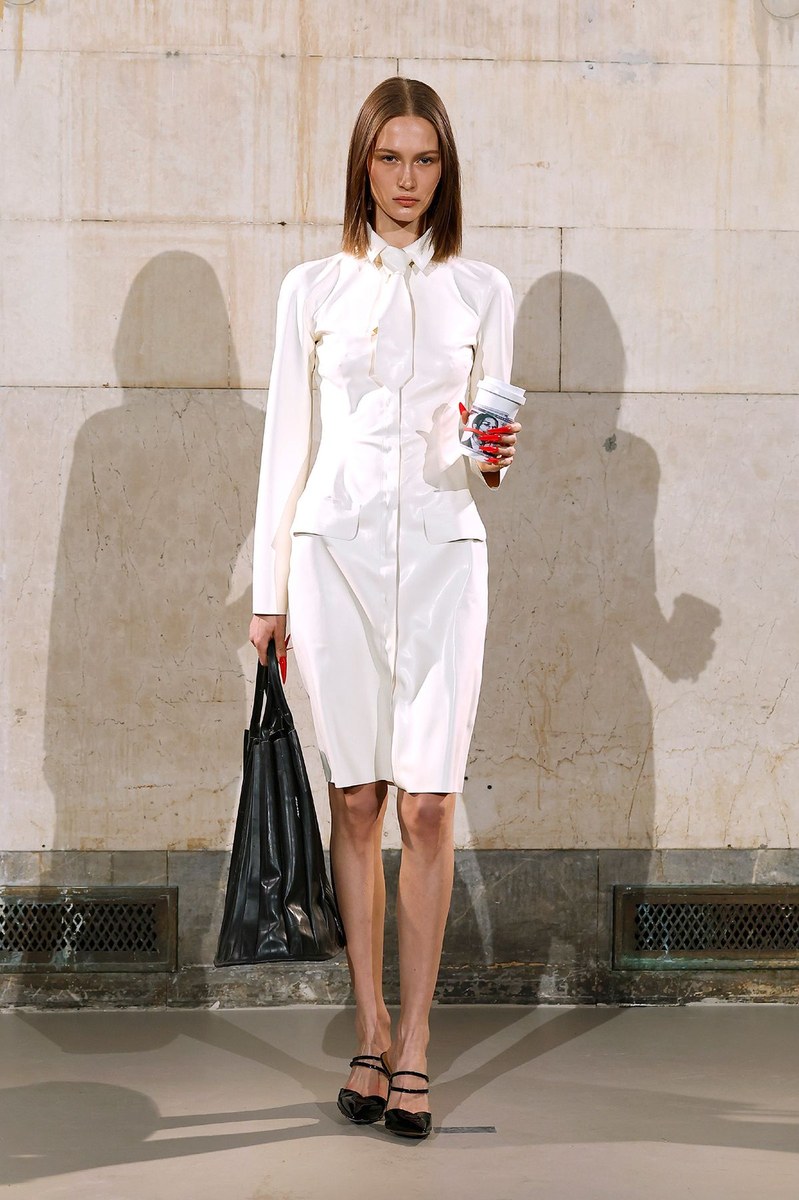
Accessories carry real editorial weight here. A takeaway coffee cup in Looks 1 and 2, a motor oil can bag in Look 6 and a race bib on Look 16 function as props that embed the clothes in a specific urban, in-motion lifestyle. Footwear ranges from split-toe red rubber shoes in Look 2 and blue knit Vibram-adjacent slides in Look 14 to patent kitten heels and pointed mules repeated across the women's looks, keeping the shoe story broad enough for multiple retail channels. Layering logic follows an additive principle: a waistcoat over a check shirt over a pencil skirt in Look 9, or a hoodie over a flannel over cargo pants in Look 18, building outfits that reward close inspection.

Look by Look Highlights

Look 1 The white patent-finish tailored shirtdress worn as a two-piece with a zip-front pencil skirt establishes the collection's luxury-workwear entry point and is the most directly transferable piece to a premium contemporary buyer.

Look 1
Look 1

Look 3 A full-length black lacquered leather trench coat held open against a chainmail column skirt, with an armful of loose chinchilla used as an accessory rather than a garment, reframes fur as a portable object with strong editorial and social media cut-through.

Look 3
Look 3

Look 7 An oversized white cotton poplin shirt with a red lacquered tie worn loose over wide-leg black suiting trousers and a black beanie layers workwear codes against streetwear proportion in a way that has direct relevance for gender-neutral buying strategies.

Look 7
Look 7

Look 11 A belted black wool coat with mink hem trim and mink collar, paired with a patent pointed-toe kitten heel and an open orange-lined umbrella, delivers a restrained, wearable luxury look with strong outerwear production potential.

Look 11
Look 11

Look 13 A chocolate brown mink-bodice bias-cut slip dress worn floor-length with a matching mink stole draped off the shoulder is the collection's clearest eveningwear statement and the piece most likely to perform in trunk show or made-to-order contexts.

Look 13
Look 13

Look 15 A blue striped cricket shirt reconstructed as a draped midi dress with AWGE Cricket branding intact demonstrates a viable licensed-sportswear-to-luxury-dress conversion that product managers should note for potential collaboration structures.

Look 15
Look 15

Look 20 A black satin slip minidress with open-front tie detail worn under a voluminous silver fox jacket with a small red belt bag anchors the collection's closing proposition in a high-impact, three-item formula that works as a complete buy for evening-adjacent retail.

Look 20
Look 20

Look 6 A cropped black leather bomber with shearling collar over black patent flared trousers with a branded waistband and a motor oil canister-shaped bag delivers the collection's strongest streetwear-to-luxury crossover moment with clear appeal to sneaker and action-sport adjacent accounts.

Operational Insights

Fur sourcing: The collection commits to real chinchilla, mink and fox fur across at least seven looks, which means buyers in regulated markets including California and several EU territories will need to plan alternative fabrications or restrict orders to non-fur SKUs from the outset.

Branding architecture: AWGE Cricket and AWGE motorsport graphic language appears across Looks 14, 15, 16 and 17 as a standalone sub-category, and style directors should evaluate whether the branded sportswear chapter warrants a separate buy or rollout from the mainline luxury pieces.

Patent and lacquered fabrics: High-gloss patent finishes on shirts, trousers and jackets throughout require specific care labeling, specialized packaging and climate-controlled storage, all of which add cost that buyers should factor into margin planning before committing to these SKUs.

Footwear range: Pointed patent kitten heels, split-toe rubber shoes, knit platform slides and ankle boots span too wide a range for a single footwear partner. Style directors should identify which two or three silhouettes align with their specific customer and build a curated buy rather than attempting to carry the full footwear breadth.

Accessory entry price: Fur bags in Looks 4, 7 and 10 and branded prop accessories in Looks 1, 6 and 14 provide a lower-commitment entry point into the AWGE world for accounts not ready to invest in the full outerwear or eveningwear tier, and buyers should prioritize these as traffic-driving front-of-floor items.

Complete Collection

Look 2
Look 2
Look 4
Look 4
Look 5
Look 5
Look 8
Look 8
Look 9
Look 9
Look 10
Look 10
Look 12
Look 12
Look 16
Look 16
Look 17
Look 17
Look 18
Look 18
Look 19
Look 19
Look 21
Look 21
Look 22
Look 22
Look 23
Look 23
Look 24
Look 24
Look 25
Look 25
Look 26
Look 26
Look 27
Look 27
Look 28
Look 28
Look 29
Look 29
Look 30
Look 30
Look 31
Look 31
Look 32
Look 32
Look 33
Look 33
Look 34
Look 34
Look 35
Look 35
Look 36
Look 36
Look 37
Look 37
Look 38
Look 38
Look 39
Look 39
Look 40
Look 40

About the Designer

Rakim Mayers, known professionally as A$AP Rocky, was born on October 3, 1988, in Harlem, New York, and grew up in the concentrated geography of 118th Street, a neighborhood whose particular conditions he has described with clarity as both a limitation and a formation. His father had Barbadian roots and kept him in Jordans and Guess before being arrested for drug dealing when Rocky was twelve. His older brother Ricky was shot and killed around the same time. The family moved through a succession of homeless shelters across New York, Philadelphia, and North Carolina during his teenage years, and Rocky sold drugs to contribute, which led to an arrest at sixteen and a stint at Rikers Island. It was there, in a cell briefly shared with the Brooklyn rapper later known as Casanova, that he began taking music seriously as a route out rather than a side interest. When he describes his relationship to clothing from that period, it is always in material terms: in the projects, looking good was how you compensated for poverty, and the instinct ran deep from the beginning.

When he was in high school, while his Harlem peers were in Air Max, he and his circle were in Gucci loafers. The gap between those two choices contains the early logic of his entire aesthetic project: not aspirational in the obvious sense, but adversarial, eccentric, willfully out of step with what was expected from someone in his situation. He emerged into the music industry through the collective AAPMob,whichheco−foundedandwhichoperatedasmuchasacreativecommunityasamusicalone,pairingrapwithfashion,visualdirection,andaself−consciousculturalposition.Hisdebutmixtape,releasedin2011,establishedhimasthecentralfigureofamomentthatcriticscalledcloudrapandthathenavigatedasalaunchpadforsomethingwider.BythetimehisdebutalbumLong.Live.AAP Mob, which he co-founded and which operated as much as a creative community as a musical one, pairing rap with fashion, visual direction, and a self-conscious cultural position. His debut mixtape, released in 2011, established him as the central figure of a moment that critics called cloud rap and that he navigated as a launchpad for something wider. By the time his debut album Long.Live.A APMob,whichheco−foundedandwhichoperatedasmuchasacreativecommunityasamusicalone,pairingrapwithfashion,visualdirection,andaself−consciousculturalposition.Hisdebutmixtape,releasedin2011,establishedhimasthecentralfigureofamomentthatcriticscalledcloudrapandthathenavigatedasalaunchpadforsomethingwider.BythetimehisdebutalbumLong.Live.AAP charted at number one in 2013, he was already appearing in campaigns for DKNY and building a reputation as someone the fashion industry needed to understand rather than simply hire.

He founded AWGE in 2014, a creative agency whose acronym's meaning he has protected with a standing rule: never reveal it. The organization has produced collaborations with Marine Serre, JW Anderson, Moncler, Vans, Mercedes-Benz, Selfridges, and Needles, functioning as an umbrella for his visual direction, music video production, and clothing. The conceptual framework he calls "ghetto expressionism" is the axis of his design thinking: a collision between the visual language of German Expressionist cinema, particularly Fritz Lang's Metropolis, and the aesthetics of Black urban life in Harlem, with Tim Burton's distorted, macabre visual sensibility as a recurring third reference. In June 2024 AWGE staged its first Paris Men's Fashion Week show, titled "American Sabotage," thirty looks decorated with phrases like "Political Satire," bald eagles, the year 1865, and silhouettes drawn from police and paramedic uniforms, presenting what he described as a direct translation of his native environment into cloth. He received the Fashion Icon award from the CFDA in 2025 and serves simultaneously as first-ever creative director of Ray-Ban and creative director for Puma's F1 line.

"I've been into fashion since birth. I grew up in the 'hood, and everybody in the 'hood wants to compensate for being in poverty, so they want to look good to keep themselves up. That's been embedded in me."

"I took German Expressionism and Ghetto Futurism and merged it. I find inspiration in everything, and I think being able to flip things and make it your own and make an origin out of it and start something new, that's the trick and that's the magic within it all."

✦ This report was generated with AI — combining human editorial vision with Claude by Anthropic. Because the future of fashion intelligence is already here.