Balenciaga FW26 Women Looks Report

Balenciaga FW26 Women Looks Report
Balenciaga FW26 Women Looks Report

Paris Fashion Week

Demna builds a collection around two opposing forces: the oversized protective coat and the body-conscious draped dress, pulling both to extremes within a single runway. For buyers and style directors, the proposition is unusually clear, because the commercial anchors (leather, tailoring, color-block outerwear) sit alongside evening pieces strong enough to drive editorial placement and wholesale premiumization.

Silhouette and Volume

A dramatically inflated cocoon dominates the lineup, most legible in the double-breasted wool coats of Looks 2, 47, and 56, where the shoulder rounds outward and the hem drops to mid-calf, erasing any trace of the waist beneath. Against this sits a lean, draped jersey line in Looks 4, 18, 20, and 35 that reads as near-sculptural against the body, with asymmetric cut-outs at the waist. Short silhouettes appear in Looks 59, 61, and 63, structured mini dresses paired with over-the-knee boots, providing a third volume register that breaks the runway rhythm deliberately. Beyond these anchors, the belted jumpsuit in Look 5 and the all-denim set in Look 52 add a utilitarian flatness that grounds the collection and broadens its wearability arc.
Look 5
Look 5

Color Palette

Black dominates the first third of the collection and returns at the finale, functioning as both a reset tone and a commercial constant across leathers, jerseys, wools, and sequins. Mid-collection brings a deliberate signal flare in vermillion red (Looks 64, 69, 72, 74, 77) and neon coral (Looks 10, 11, 17), loud enough to anchor display floors and campaign imagery. Deep burgundy and oxblood thread through Looks 13, 14, 15, 17, 18, and 76 as a more wearable accent family that connects the red narrative to evening dressing. Cobalt blue (Look 67), forest green (Looks 27, 28, 46, 48), and a single amethyst purple (Look 30) close out the chromatic range, giving buyers distinct color stories to build capsule buys around.

Look 67
Look 67

Materials and Textures

Heavyweight double-faced wool carries the outerwear program, appearing in the cocoon coats and structured pea coats with enough body to hold the extreme volume without padding. Leather reads across three distinct weights: a soft, buttery finish in Look 1 and Look 64, a high-gloss patent in Look 57, and a crinkled distressed surface in Look 21 and Look 51. Draped jersey in Looks 4, 20, 50, and 77 brings a fluid counter-weight to the stiff outerwear, with a matte surface and enough stretch to allow complex wrapped construction. Sequined and embellished fabrics close the show in Looks 79, 80, and 81, moving from a dense black paillette to a delicate nude scatter-sequin, differentiating eveningwear tiers for retail segmentation.

Look 1
Look 1

Styling and Layering

Leggings function as the primary bottom throughout, appearing under coats and oversized leather jackets in Looks 2, 11, 12, 19, 28, 42, and 57, which makes the outerwear the commercial unit and the underneath nearly irrelevant from a buying standpoint. Long leather gloves recur in Looks 4, 8, 25, 35, 50, and 77, adding a theatrical edge to otherwise restrained draped dresses and confirming that accessories will carry strong margin potential here. Footwear splits cleanly between pointed-toe kitten heels and chunky over-the-knee or knee-high boots, with chunky platform mules appearing on the draped evening looks. A structured bucket silhouette with distinctive hardware appears in virtually every look and confirms its role as the primary accessory anchor for retail execution.

Look by Look Highlights

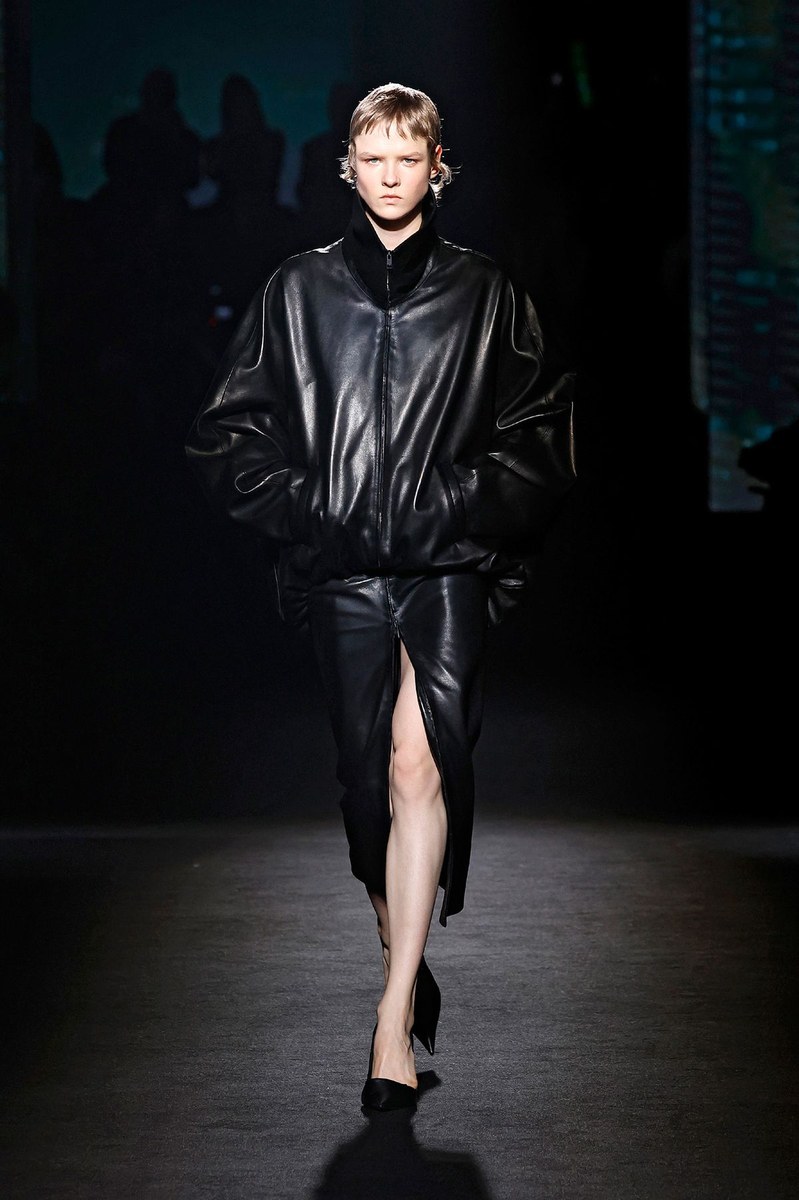
Look 1 An all-black oversized leather bomber over a leather midi skirt with a front slit establishes the opening thesis on volume and material consistency, making it a strong first-buy candidate for leather category planning.

Look 4 A wrapped black jersey dress with a waist cut-out, long leather gloves, and crystal-embellished eyewear delivers the most directional editorial image and sets the template for the draped-with-hardware styling logic that runs through the evening segment.

Look 4
Look 4

Look 27 Deep forest green draped cape-sleeve gown with a waist cut-out and contrasting electric blue gloves reads as the single strongest color-clash moment and will drive press imagery disproportionate to its unit volume.

Look 27
Look 27

Look 40 A charcoal double-faced wool coat with applied leather leaf-shaped cutouts along the sleeves and body reads as the most craft-intensive outerwear piece, relevant for buyers targeting the premium specialty channel.

Look 40
Look 40

Look 44 A structured camel single-breasted coat with exaggerated folded shoulder wings and a red-lined interior V-neckline is the most architecturally precise garment in the collection, with strong potential for trunk show and made-to-order programs.

Look 44
Look 44

Look 64 Full red leather look, bomber jacket over matching front-zip midi skirt, mirrors Look 1 in construction but lands as a statement colorway that will test red leather appetite across markets before a broader leather color expansion.

Look 64
Look 64

Look 76 A strapless draped burgundy crepe gown with a knotted bow at the waist and a full pleated skirt is the clearest evening commercial piece in the collection, accessible enough for bridal-adjacent retail and formal dressing buyers.

Look 76
Look 76

Look 81 Black sequin asymmetric cut-out column gown mixing raised floral texture on the bodice with flat paillette on the skirt closes the show as the top-of-range evening anchor and will set the retail price ceiling for the collection.

Look 81
Look 81

Operational Insights

Outerwear as hero unit: Cocoon and pea coat silhouettes in heavyweight wool (Looks 2, 3, 36, 42, 47, 68, 70) are the clearest commercial throughline. Buyers should treat these as the primary door-driving category, with color options spanning black, charcoal, hot pink, and camel for tiered price architecture.

Leather category breadth: Leather appears across seven silhouette types including bombers, capes, skirts, and structured jackets in at least five colorways. Style directors should build a leather capsule rather than treating it as a single statement category, since the range supports both opening-price and top-of-range positions.

Legging as styling infrastructure: Consistent pairing of leggings under oversized outerwear across 15 or more looks signals a deliberate styling recommendation that buyers can replicate as an in-store display strategy, bundling leggings with outerwear to drive multiple-unit transactions.

Color drop sequencing: The collection moves from black to burgundy to red to coral to green to blue in a legible chromatic arc. Product managers can use this sequence to plan color delivery drops across the season, holding the black foundation for immediate delivery and releasing the red and coral family as a mid-season injection.

Evening tier segmentation: Finale sequence from Look 75 through Look 81 offers three distinct price tiers: draped crepe gowns for accessible evening, the embellished print dress in Look 58 for mid-tier, and the sequin column gowns in Looks 79 and 81 for the top-of-range. Style directors should map these to their existing evening business by door volume rather than treating the full evening segment as a single buy.

Look 75
Look 75

Complete Collection

Look 2
Look 2
Look 3
Look 3
Look 6
Look 6
Look 7
Look 7
Look 8
Look 8
Look 9
Look 9
Look 10
Look 10
Look 11
Look 11
Look 12
Look 12
Look 13
Look 13
Look 14
Look 14
Look 15
Look 15
Look 16
Look 16
Look 17
Look 17
Look 18
Look 18
Look 19
Look 19
Look 20
Look 20
Look 21
Look 21
Look 22
Look 22
Look 23
Look 23
Look 24
Look 24
Look 25
Look 25
Look 26
Look 26
Look 28
Look 28
Look 29
Look 29
Look 30
Look 30
Look 31
Look 31
Look 32
Look 32
Look 33
Look 33
Look 34
Look 34
Look 35
Look 35
Look 36
Look 36
Look 37
Look 37
Look 38
Look 38
Look 39
Look 39
Look 41
Look 41
Look 42
Look 42
Look 43
Look 43
Look 45
Look 45
Look 46
Look 46
Look 47
Look 47
Look 48
Look 48
Look 49
Look 49
Look 50
Look 50
Look 51
Look 51
Look 52
Look 52
Look 53
Look 53
Look 54
Look 54
Look 55
Look 55
Look 56
Look 56
Look 57
Look 57
Look 58
Look 58
Look 59
Look 59
Look 60
Look 60
Look 61
Look 61
Look 62
Look 62
Look 63
Look 63
Look 65
Look 65
Look 66
Look 66
Look 68
Look 68
Look 69
Look 69
Look 70
Look 70
Look 71
Look 71
Look 72
Look 72
Look 73
Look 73
Look 74
Look 74
Look 77
Look 77
Look 78
Look 78
Look 79
Look 79
Look 80
Look 80

Fashion Designer

Pierpaolo Piccioli was born in 1967 and grew up in Nettuno, a modest coastal town south of Rome where his parents ran a tobacco shop. As a teenager he dreamed of cinema, not fashion: Pasolini, Antonioni, Fellini, the visual grammar of Italian film. He studied literature at the Sapienza University of Rome before pivoting to fashion design at the Istituto Europeo di Design, a shift less dramatic than it sounds — both disciplines were, for him, about reading and interpreting the world rather than decorating it.

His career began at Fendi in 1990, working on accessories alongside Maria Grazia Chiuri under Karl Lagerfeld. The lesson he took from those years wasn't about aesthetics: it was about the idea of the team, building something together. In 1999 the two moved to Valentino, initially to develop the accessories line, then rising to co-creative directors in 2008. When Chiuri left for Dior in 2016, Piccioli took sole control and spent the next eight years turning Valentino into one of fashion's most emotionally charged propositions: monumental silhouettes, colors mixed with an almost reckless confidence, couture shows staged on the Spanish Steps in Rome or in a Venice campo at dusk.

His references are literary and cinematic more than fashion-historical. Color is not decoration for him but structure and argument: in 2022 he created a custom pink shade with Pantone, and the entire culture briefly followed. He still lives in Nettuno, commuting to Paris, and describes his daily uniform of black t-shirt, black trousers and white sneakers as a worker's decision, a way to stay out of the way of the clothes. In July 2025 he became creative director of Balenciaga, succeeding Demna after a decade. His first collection debuted in October 2025.

"Couture is pure as a process, so when you generate attention with couture, it can have a bigger impact. It's an instrument to say, in an even louder way, what I believe in, what I stand for."

"There's nothing worse than trying to be cool."

✦ This report was generated with AI — combining human editorial vision with Claude by Anthropic. Because the future of fashion intelligence is already here.