Bora Aksu FW26 Details

Bora Aksu FW26 Details
Bora Aksu FW26 Details Report

Bora Aksu FW26 builds its accessories and detail language around layered textile contrasts, bridal-coded headwear, and a recurring vocabulary of bows, ribbons, and ruffle trims that cross categories from outerwear to knit to sheer gowns. Buyers sourcing feminine occasion product and editorial-facing accessories will find strong directional signal here, particularly in the white-on-white ceremonial references and the collision of utility structure with soft decorative trim.

Category Overview

The collection splits across dress details and headwear, with no footwear or bag accessories driving the narrative. Headwear carries the highest fashion authority, anchored by two veil-based looks in Details 19 and 20 that read directly as bridal or bridal-adjacent occasion product. Dress details dominate the volume of the shoot. They communicate a single overarching strategy: layering incompatible textures and patterns within one silhouette to create deliberate visual tension. Material choice is consistently craft-forward, favoring handwork, lace, embroidery, and textile mixing over clean tailoring or minimalist finishes.
Material and Construction

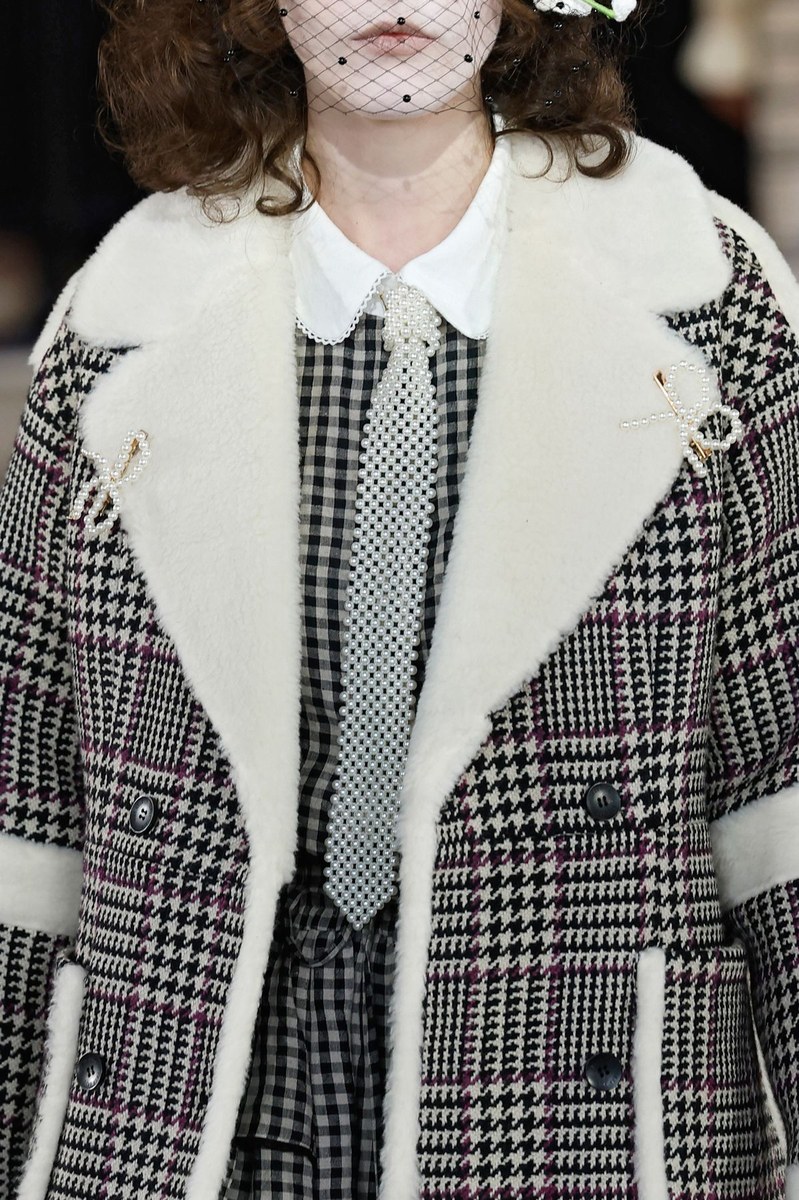
Wool coating in houndstooth and glen plaid appears in Details 1, 13, and 14, edged with a thick cream shearling trim that replaces conventional facing or piping. Tulle recurs throughout, in the skirt hem of Detail 13, as layered ruffle trim on the jacket hem of Detail 18, and as veil material in Details 19 and 20. Details 5 and 6 use dotted silk organza sleeves, Chantilly-style lace panels, and a lace-up corset boning construction in ivory, all worked at a couture-adjacent level of finishing. Knit construction in Details 10, 11, and 12 incorporates zigzag intarsia stripes in black on cream, with attached pleated and ruffled hem trims that switch from rib knit to organza within the same garment.

Detail 13
Detail 13

Color and Finish Direction

Ivory and off-white dominate across more than half the details, running from the cream shearling of Detail 1 and 14 through the ecru lace of Details 5 and 6 to the polka-dot tulle of Detail 7. Black functions as a consistent accent, appearing as velvet ribbon ties in Detail 15, grosgrain trim on the white jacket of Detail 3, intarsia stripe in Details 10 and 11, and gingham and houndstooth checks in Details 1, 13, 14, and 16. Detail 2 introduces the only true color note in the collection, lime green crochet stems and leaf embroidery against blush pink and white lace, which reads as a deliberate seasonal contrast moment. Warm camel velvet in Detail 15 and blush chiffon in Details 8 and 9 provide mid-tone softness within an otherwise high-contrast black and white palette.

Detail 1
Detail 1

Key Pieces and Details

Among the strongest pieces, the shearling-trimmed houndstooth coat in Details 1 and 14 stands out as the most commercially transferable option, with a double-breasted closure, pearl-pin embellishment, and fold-back cuffs that read as a clear buying proposition for outerwear. Detail 15, the camel silk velvet dress with center-front ruffled placket and black velvet bow pockets, combines fabrication richness with a distinctive construction detail that product managers can isolate for private label or licensed development. Occasion and bridal accessories continue to gain market relevance, and Details 19 and 20 address that gap directly, with Detail 20 adding a hand-crocheted floral crown that positions it above commodity bridal product. Particularly striking are the dotted tulle dress in Detail 7, with its bishop sleeves and crossover bodice, and the mixed-polka-dot patchwork of Details 8 and 9, together pointing toward print-mixing as a construction technique rather than a surface print. That shift has direct implications for fabric sourcing and cut-and-sew complexity.

Detail 15
Detail 15

Detail by Detail Highlights

Detail 1 (Dress Detail) The houndstooth wool coat pairs a wide cream shearling lapel and shearling cuff detail with pearl-and-gold safety pin embellishments at the chest, layered over a gingham shirt dress and a micro-dot knit tie, creating a deliberate pattern density that reads as a styling signature rather than a mistake.

Detail 2 (Dress Detail) Lime green crochet stems trail across a sheer blush tulle bodice embroidered with pink and white floral lace appliqué, the three-dimensional crochet work attached loosely enough to suggest movement and botanical randomness.

Detail 2
Detail 2

Detail 3 (Dress Detail) A crisp white cotton jacket uses narrow black grosgrain tape as seam trim and a single black ribbon bow at the breast pocket, with sheer organza sleeves finishing in white 3D floral appliqué cuffs, placing it squarely at the intersection of schoolwear and bridal suiting.

Detail 3
Detail 3

Detail 7 (Dress Detail) White polka-dot tulle is cut on the bias and layered in multiple panels across the full skirt, with full bishop sleeves in the same spot-tulle gathering at the wrist into a tight cuff, the translucency making the layering count visible and structurally relevant.

Detail 7
Detail 7

Detail 15 (Dress Detail) Camel silk velvet is cut into a tiered shirt dress with a center-front ruffled placket closed by small rhinestone or jet buttons, with twin black velvet ribbon bows tied through loops at the hip-level patch pockets, the material contrast between matte velvet and glossy ribbon adding tactile precision.

Detail 18 (Dress Detail) A charcoal wool field jacket with utilitarian chest pockets and a center-front zip finishes at the hem with two tiers of grey tulle ruffle, layered over a grey button-front waistcoat and lace-trimmed trousers, the combination fusing military structure with the kind of petticoat volume normally reserved for ball gowns.

Detail 18
Detail 18

Detail 19 (Headwear) A plain white tulle veil is draped over center-parted hair and trimmed at the face-line with a narrow white broderie anglaise ribbon, the minimal construction putting full emphasis on silhouette and proportion rather than surface embellishment.

Detail 19
Detail 19

Detail 20 (Headwear) A tulle veil is anchored by a hand-crocheted floral crown in white and pale mint green, with a matching crocheted stem-and-blossom accessory held at the chest, the two pieces designed as a coordinated set that extends the bridal craft narrative from head to hand.

Detail 20
Detail 20

Operational Insights

Shearling trim sourcing The shearling used in Details 1 and 14 functions as both structural facing and decorative edge, which means buyers need to confirm whether real or faux shearling was used, as this directly affects cost brackets, animal-welfare compliance requirements, and cross-border import classification.

Veil headwear as a standalone category Details 19 and 20 signal that bridal and occasion headwear is returning to fashion-week level visibility, and accessories directors should evaluate whether current veil and crown assortments can absorb a craft-forward, hand-finished positioning without requiring new supplier development.

Pattern mixing as construction complexity The mixed polka-dot patchwork in Details 8 and 9 requires multiple fabric SKUs cut into the same garment, which raises both material waste ratios and sewing time per unit. Product managers should factor a 20 to 30 percent cost premium over single-fabric equivalents when costing similar styles.

Tulle application breadth Tulle appears in at least five distinct applications across this collection, from veil to ruffle hem to skirt panel to petticoat trim, and a single tulle supplier capable of delivering multiple weights and finishes could simplify vendor management for buyers building a coordinated range.

Pearl and ribbon trims as modular embellishment The pearl safety pins in Detail 1 and the black velvet ribbon bows in Details 3 and 15 are detachable or separately attached trims that could be developed as add-on accessories or garment-attached hardware elements, creating upsell potential within a core product framework without requiring full garment redesign.

More Details

Detail 4
Detail 4
Detail 5
Detail 5
Detail 6
Detail 6
Detail 8
Detail 8
Detail 9
Detail 9
Detail 10
Detail 10
Detail 11
Detail 11
Detail 12
Detail 12
Detail 14
Detail 14
Detail 16
Detail 16
Detail 17
Detail 17
Detail 21
Detail 21
Detail 22
Detail 22
Detail 23
Detail 23
Detail 24
Detail 24
Detail 25
Detail 25
Detail 26
Detail 26
Detail 27
Detail 27
Detail 28
Detail 28
Detail 29
Detail 29
Detail 30
Detail 30
Detail 31
Detail 31
Detail 32
Detail 32
Detail 33
Detail 33
Detail 34
Detail 34
Detail 35
Detail 35
Detail 36
Detail 36
Detail 37
Detail 37
Detail 38
Detail 38
Detail 39
Detail 39
Detail 40
Detail 40
Detail 41
Detail 41
Detail 42
Detail 42
Detail 43
Detail 43
Detail 44
Detail 44
Detail 45
Detail 45
Detail 46
Detail 46
Detail 47
Detail 47
Detail 48
Detail 48
Detail 49
Detail 49
Detail 50
Detail 50
Detail 51
Detail 51
Detail 52
Detail 52
Detail 53
Detail 53
Detail 54
Detail 54
Detail 55
Detail 55
Detail 56
Detail 56
Detail 57
Detail 57
Detail 58
Detail 58
Detail 59
Detail 59
Detail 60
Detail 60
Detail 61
Detail 61
Detail 62
Detail 62
Detail 63
Detail 63
Detail 64
Detail 64
Detail 65
Detail 65
Detail 66
Detail 66
Detail 67
Detail 67
Detail 68
Detail 68
Detail 69
Detail 69
Detail 70
Detail 70
Detail 71
Detail 71
Detail 72
Detail 72
Detail 73
Detail 73
Detail 74
Detail 74
Detail 75
Detail 75

✦ This report was generated with AI — combining human editorial vision with Claude by Anthropic. Because the future of fashion intelligence is already here.