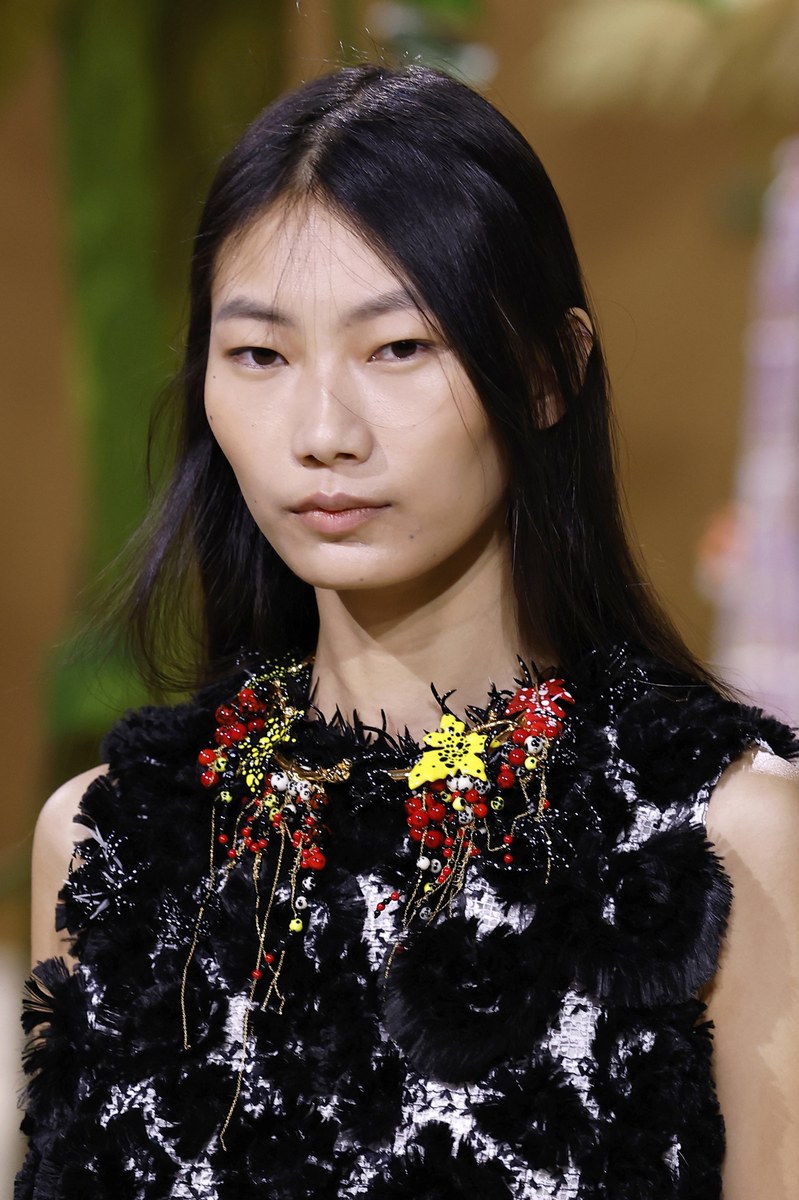
Bora Aksu FW26 Women Looks Report
London Fashion Week
Bora Aksu FW26 builds a wardrobe around Victorian and Edwardian feminine archetypes, then fractures them with utility hardware, sheer tulle insertions, and deliberate layering that leaves construction visible rather than concealed. For buyers, this arrives at a moment when the market is actively seeking emotional, narrative-driven product that reads as wearable yet distinct from the minimalist consensus dominating contemporary floors.
Silhouette and Volume
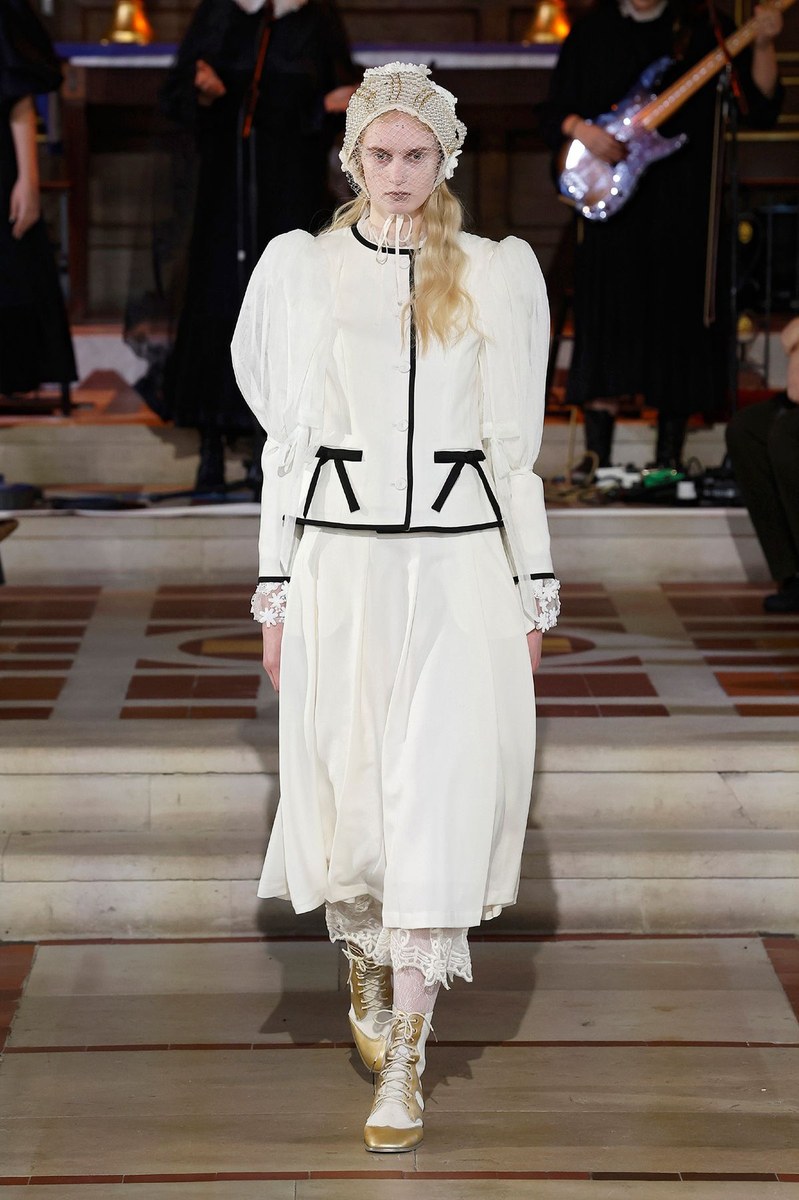
Puffed sleeves set at the shoulder, gathered and ballooned from elbow to wrist, appear in nearly every look and constitute the single most consistent silhouette signal across the collection. Skirts operate in two registers: a mid-calf A-line in structured tailoring fabric, and a floor-grazing tier system built from ruffled tulle or velvet panels. Look 19 takes volume to its logical extreme with a full tulle tent silhouette that envelops the body entirely. Jackets cut with structured peplums and belted waists, as in Look 2, offer a more commercial proportion for buyers who need wearability without abandoning the visual language.
Color Palette
Opening in ivory and chalk white, the palette works through warm blush and nude tones in the mid-section, then pivots hard into navy, charcoal, slate grey, and black in the final third. Black and white emerges as the most commercially potent combination, appearing in houndstooth checks across Looks 7 and 9 and in the graphic velvet-trim-on-ivory construction of Look 1. Look 15 breaks from the tonal logic entirely with saturated crimson poppy appliqué on black tulle, making it the loudest and most directional statement. For eveningwear floors, the blush-and-black pairing in Look 13 reads as the most immediately buyable color story.

Materials and Textures
Tulle carries the most structural weight here, used not as decoration but as volume-building architecture in skirt tiers, capes, and full outer layers across at least a third of all looks. Silk velvet in tobacco brown (Look 8) and dusty powder blue (Look 17) brings a heaviness and light-absorbing surface quality that grounds the more ethereal tulle constructions. Tweed and boucle appear in Look 2 in a dense ivory weave, while houndstooth and gingham wools anchor the darker middle section of the show. Lace, broderie anglaise cuffs, and Swiss dot organza in Look 4 add a period-specific surface detail that reinforces the Victorian reference without tipping into costume.

Styling and Layering
Layering here is additive and transparent, placing a lighter fabric over a denser one so both remain readable rather than merging into a single silhouette. Sheer lace or tulle trousers worn beneath mini or midi lengths, as in Looks 9, 10, and 16, create a leg-extending proportion that generates commercial interest in separates as well as in full looks. Footwear runs consistently between two poles: gold metallic lace-up ankle boots or low-heeled metallic platforms for the white looks, and flat black Mary Janes or velvet block-heel boots for the darker looks. Headwear is aggressive and editorial, running from pearl-encrusted bonnets and floral crowns to birdcage veils and red velvet hoods, but buyers can read these as set-dressing that amplifies the clothes rather than as product directives.
Look by Look Highlights
Look 1 Ivory wool jacket with black velvet trim piping and black velvet bow pockets sits over a fluid midi skirt in matching ivory, making it the most immediately transferable tailoring proposition for contemporary and premium department store floors.
Look 3 A layered ivory lace and chiffon dress with wide ruffled sleeves and a lace-edged tiered hem reads as a strong bridal or bridal-adjacent SKU with clear sell-through potential outside strictly editorial contexts.

Look 8 The tobacco silk velvet drop-waist dress with black velvet ribbon trim and polka-dot tulle panels at the hem combines two distinct surface qualities in one garment, creating a production-complexity proposition worth evaluating for premium positioning.
Look 13 A blush pink tiered tulle ballgown with black lace trim and black velvet bows at each tier hem, worn with long black lace gloves, is the most resolved eveningwear statement and the look most likely to drive press placement and wholesale demand simultaneously.

Look 15 Strapless black tulle densely covered in three-dimensional crimson velvet poppy appliqués functions as a singular, high-craft piece and hero SKU for buyers seeking one statement evening garment with editorial pull.

Look 16 A navy double-breasted gilet layered over a powder blue puffed-sleeve organza blouse, worn with white lace-paneled tights and silver platforms, compresses the key separates into a single look that buyers can break apart and sell as three individual pieces.

Look 18 Navy tiered ruffle-skirt dress with powder blue organza cape sleeves and a layered white tulle underskirt demonstrates how Aksu builds color contrast through layering rather than print, offering a production template for differentiated eveningwear without reliance on surface pattern.

Look 19 Full floor-length white tulle veil-cape over a simple white dress functions as a closing statement about volume and ceremony, and while not a commercial look, it defines the mood ceiling that gives the rest of the collection its emotional authority.
Operational Insights
Separates strategy: Jackets, blouses, gilets, skirts, and trousers are consistently designed with layering logic that allows them to work independently. Buyers should evaluate the collection as a separates program rather than a full-look buy, as individual pieces from Looks 6, 10, and 16 carry strong standalone retail narratives.
Eveningwear tier: Looks 13, 15, and 17 form a coherent evening capsule in blush-and-black, red-and-black, and powder blue that can anchor a dedicated eveningwear buy. Style directors should note that all three avoid conventional floor-length column or wrap silhouettes, offering differentiation from incumbent eveningwear brands.
Craft and price architecture: Three-dimensional poppy appliqués in Look 15, hand-applied broderie cuffs in Look 3, and dense velvet trim work throughout Looks 1 and 8 signal significant hand-finishing content. Product managers should build costing and lead-time expectations around artisanal construction, and retail pricing should reflect and communicate this rather than absorbing the cost as margin compression.
Headwear as a category opportunity: Pearl-beaded bonnets, floral crowns, and velvet-trimmed birdcage veils appear across more than half the looks and are styled with deliberate consistency. Buyers with accessories floors should open a conversation about exclusivity or limited run on the bonnet and crown styles, which read as gift and occasion purchases with strong gift-with-purchase or editorial loan potential.
Color sequencing for floor presentation: Moving logically from white and ivory through blush and nude into deep navy and black, the palette invites thoughtful floor presentation. Style directors building floor sets or lookbook narratives should honor this sequence, as it allows a single brand story to move from bridal and occasion through to everyday premium and evening without visual dissonance.
Complete Collection


About the Designer
Childhood in Izmir shaped Bora Aksu in ways that would echo through every collection. Born into a family of doctors in 1969, he spent his early years surrounded by the handcraft traditions that defined Turkish households. His grandmother and aunt worked constantly with crochet, needlework, and lace, their fingers creating beauty from nothing while he watched and absorbed their patient dedication to craft. His mother, despite her demanding career as a physician, possessed a creativity that would later inspire his entire aesthetic philosophy.
After persuading his skeptical parents to let him pursue fashion instead of medicine, Aksu arrived at Central Saint Martins with only sketches and raw talent. He had no technical skills or foundation course behind him, yet the school took a chance. The struggle to master pattern making, draping, and construction became transformative, teaching him that ideas without craft remain incomplete. A year working for Ghost between his undergraduate and master's degrees provided the "clicking moment" where his vision crystallized. Under the demanding guidance of Louise Wilson, he developed the design philosophy that would define his career: the pursuit of imperfection as a source of beauty.
Upon graduating in 2002, Aksu launched his eponymous label when Dolce & Gabbana purchased pieces from his graduate collection. His debut at London Fashion Week in 2003 earned recognition from major newspapers, and the NewGen award followed, placing him on the official schedule. His work draws from overlooked women in history, from 18th-century mathematician Sophie Germain to Empress Sisi, transforming their stories into contemporary fashion that celebrates both vulnerability and strength. Turkish craft traditions remain central to his process, with old fabrics and rejected materials finding new life through meticulous handiwork.
"There is an imperfection to my work which creates purity and beauty," he explains. "My grandma and my aunt were constantly working on creating something beautiful and I try to bring this handcrafted approach into my own design identity, to make the designs unique, but also to keep craftwork relevant to fashion today."
✦ This report was generated with AI — combining human editorial vision with Claude by Anthropic. Because the future of fashion intelligence is already here.