Boss FW26 Women Looks Report
Milan Fashion Week
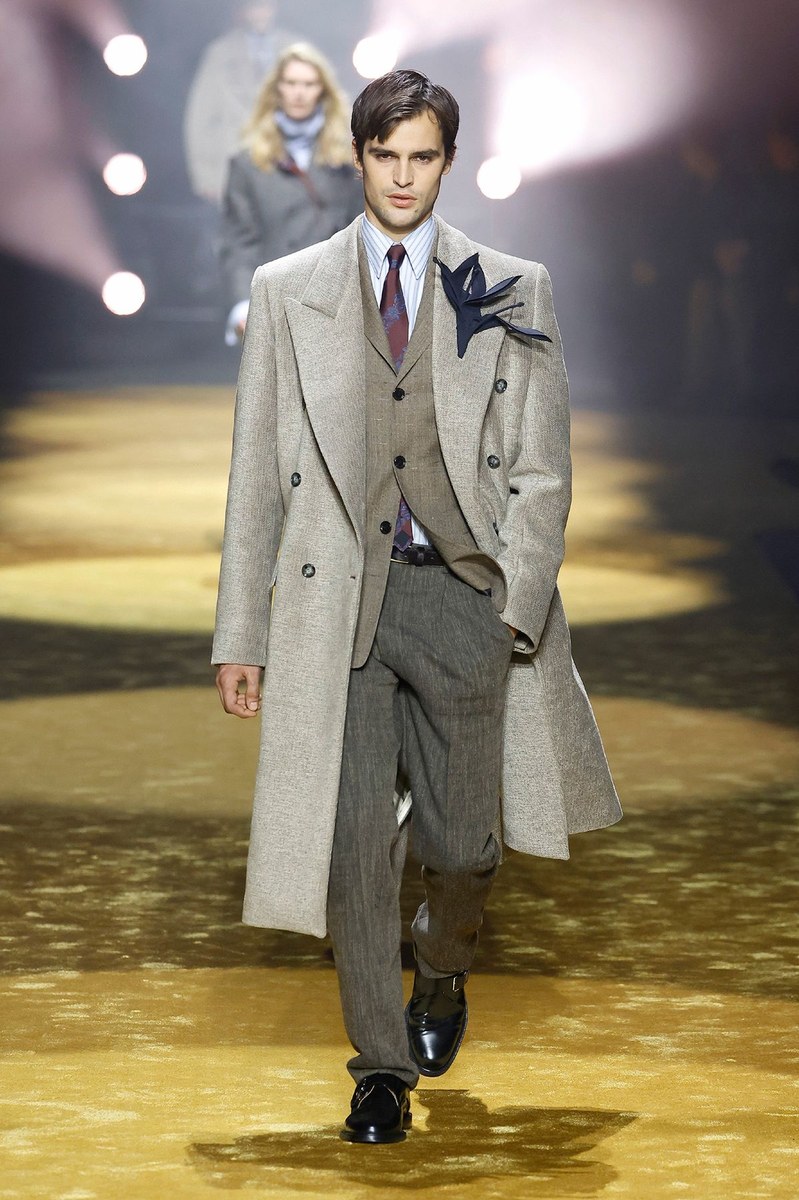
Boss FW26 plants itself firmly in the territory of fluid gender codes, pulling tailoring, outerwear and knitwear from the men's wardrobe and recutting them for a women's market that is actively spending on investment dressing with a relaxed authority. For buyers, this collection arrives at exactly the moment when the power-suit trend is maturing past its stiffest phase and customers are seeking structured pieces that read as personal rather than corporate.
Silhouette and Volume
Wide, pleated trousers anchor nearly every look, paired with either oversized suiting on top or close-fitted knit bases that keep the proportions legible. Coats run floor-length and column-like, as in Look 4 and Look 15, with enough interior structure to hold the shoulder without padding. Look 8 breaks the trouser dominance with a belted midi dress that layers a wrap panel over a long-sleeved body, proving the collection can expand beyond separates without losing its through-line. Volumes are deliberately generous but never shapeless because belts, placed low and in black leather, anchor the waist and restore proportion.
Color Palette
Heather grey in multiple weights runs through at least half the looks, from the herringbone of Look 2 to the flannel of Look 7. Warm russet brown, appearing in Look 4, Look 5, Look 8 and Look 13, functions as the season's accent, warm enough to read as luxurious but muted enough to coordinate with the grey base. Navy surfaces selectively, most assertively in Look 19 where a near-black suit with satin-finish lapels shifts the mood toward eveningwear. Strong contrast combinations are notably absent, keeping the palette coherent and positioning the collection as a strong candidate for capsule merchandising.

Materials and Textures
Worsted and flannel wools in medium-to-heavy weights dominate the suiting and coating, giving each piece enough body to hold structure through a full day of wear. Look 5 introduces a textured leather coat in cognac that has a crinkled, almost reptilian surface quality without crossing into novelty territory. A chunky cable knit appears in Look 16, while the zip-front bouclé-effect sweatshirt hybrid in Look 14 brings tactile contrast to the suiting, giving wholesale buyers reason to think in terms of cross-category merchandising. Look 8 uses what reads as a fluid crepe or lightweight jersey in russet against a heavier grey wool panel, layering two distinct fabric hands in a single look.

Styling and Layering
Depth comes from stacking categories rather than volume alone, placing a waistcoat over a shirt inside a suit inside a coat, as in Look 3, to create an effect that reads as considered rather than bulky. Paisley scarves and silk pocket squares in blue and rust thread through many of the men-oriented looks and reappear on the women's side in Look 12 and Look 17, functioning as the collection's primary print vehicle. Footwear stays in two clear lanes: black leather lace-up oxford or derby styles for suiting looks, and flat or low-heeled black knee boots for the outerwear and dress looks. Black leather bags, whether the structured duffle or the bucket silhouette, appear consistently enough to read as a deliberate accessory strategy rather than a styling afterthought.

Look by Look Highlights
Look 2 Delivers a grey herringbone double-breasted blazer with wide-leg matching trousers, a clean and immediately buyable suit option with strong co-ord retail potential.
Look 4 Pairs a belted grey flannel midi shirtdress with a rust wool coat carried in hand, making the case for the dress as a standalone hero piece that needs no suiting layer to work.
Look 5 Presents a cognac crinkled leather longline coat over grey flannel trousers and a white turtleneck, the single most commercially differentiated piece in the collection given the leather's surface texture and silhouette length.
Look 7 Builds a minimal, wearable look from a black turtleneck, a grey wool belted longline coat and grey pleated trousers, the kind of three-piece uniform dressing that resonates with a professional customer who shops by wardrobe logic.

Look 12 Layers a grey herringbone overcoat over a single-button grey suit with a blue paisley waistcoat and matching pocket square, the layering sequence giving product managers a clear basis for a curated set sell.

Look 15 Closes its collar with a patterned scarf tucked under a slate grey single-button longline coat worn over navy jodhpur-cut trousers and tall riding boots, the equestrian reference precise enough to feel directional without alienating mainstream buyers.

Look 17 Puts an olive double-breasted suit in heavy wool twill with structured shoulders and a wide leg against a rust and navy paisley underlayer, the military-meets-archive print combination that gives the olive suit a personality that straight suiting often lacks.

Look 19 Constructs a tuxedo-adjacent look in near-black with a satin-panel oversized blazer, white ribbed turtleneck, a corsage brooch in dark purple and wide-leg black trousers, positioning Boss to compete in the evening dressing segment without requiring a separate eveningwear range.

Operational Insights
Co-ord investment: The trouser-and-blazer suit formula repeats across six or more looks in compatible fabrics and tones, giving buyers the ability to merchandise the collection as mix-and-match separates with a high attachment rate at point of sale.
Accessory margin opportunity: Leather bags, belts and printed scarves appear consistently throughout, signaling that Boss is building accessory revenue directly into the runway narrative. Buyers should plan accessory depth alongside apparel buys to match the editorial logic.
Fabric hand as a key differentiator: Visual merchandising can be built around texture groupings rather than color groupings alone, which aids in-store fixture planning. The contrast between heavy worsted tailoring, the crinkled leather of Look 5 and the cable knit of Look 16 makes this approach viable.
Gender-fluid positioning: Many silhouettes and fabrics run parallel to the men's collection visible in the background of several looks, making Boss a natural fit for retailers with a unisex or dual-floor strategy. Cross-floor brand storytelling is achievable without inconsistency.
Eveningwear entry point: Look 19 requires minimal additional development to sit in an evening or occasion category. Style directors should flag it as a candidate for targeted drops around holiday or awards season, reducing the need to carry a separate formal capsule.
Complete Collection


About the Designer
Marco Falcioni emerged from Rome's nightclub scene to become one of fashion's most thoughtful design voices. After graduating from the Italian Fashion Institute of Rome in 2001, he spent his early career at smaller brands like Sixty spa before joining Diesel in 2003, where he progressed from menswear designer to head of design over more than a decade. His formative years were shaped by the city's vibrant club culture, where he first discovered fashion as a form of self-expression and creative experimentation. The energy of those nocturnal spaces, with their mix of music, art and style, would later inform his understanding of how clothing can communicate attitude and individuality.
When he joined Hugo Boss in 2015, Falcioni started in the design studio working on Boss Orange and menswear projects. He spent seven years learning the brand's codes before stepping into the spotlight in 2022 as senior vice president of creative direction, later becoming creative director. His mission has been to broaden Boss's appeal to younger consumers while respecting its tailoring heritage. Art remains central to his creative process, with weekly gallery visits and deep engagement with Italian movements like Arte Povera and Spatialism. Artists like Alberto Burri, Lucio Fontana and Katharina Grosse inform his approach to texture, space and materiality.
Falcioni's design philosophy centers on what he calls "the pleasure of dressing up," rejecting uniformity in favor of personal expression through tailoring. He draws inspiration from Boss's 1980s archives, particularly the brand's old "selling books" that showed how to style complete looks. His collections blend archival references with contemporary sensibilities, always maintaining the suit as the core while exploring forgotten corners of the brand's heritage. This approach reflects his belief that fashion should create bridges between communities rather than divisions.
"One of the very first things that was very important to me was to give tailoring a meaning. Uniformity is not our way to go into the future." His vision extends beyond clothing to encompass what he describes as togetherness in an increasingly fractured world. "If there is one meaningful role fashion can play, it is to bring people together. True togetherness means building bridges, fostering understanding, and creating spaces where people feel seen, heard, and united."
✦ This report was generated with AI — combining human editorial vision with Claude by Anthropic. Because the future of fashion intelligence is already here.