Bottega Veneta FW26 Details
Bottega Veneta FW26 Details Report
Bottega Veneta FW26 positions accessories as structural protagonists, not supporting cast, with belts, headwear, eyewear, and garment construction details each carrying distinct material authority and formal weight. For buyers and product managers, this signals a clear commercial directive: accessories must read as objects with their own logic, not add-ons to clothing.
Category Overview
Four categories anchor the accessories program: belts, dress details, eyewear, and headwear. Headwear carries the largest volume and the widest range, moving from utilitarian ribbed knit beanies in charcoal and black to monumental sculptural fur hats in saturated red. Dress details function as accessories in their own right, with construction choices, closures, and surface treatments doing the work that applied decoration might do elsewhere. Materials lead here, form follows, and branding stays quiet, a positioning that rewards specialist buyers who can source at the level of craft these pieces demand.
Material and Construction
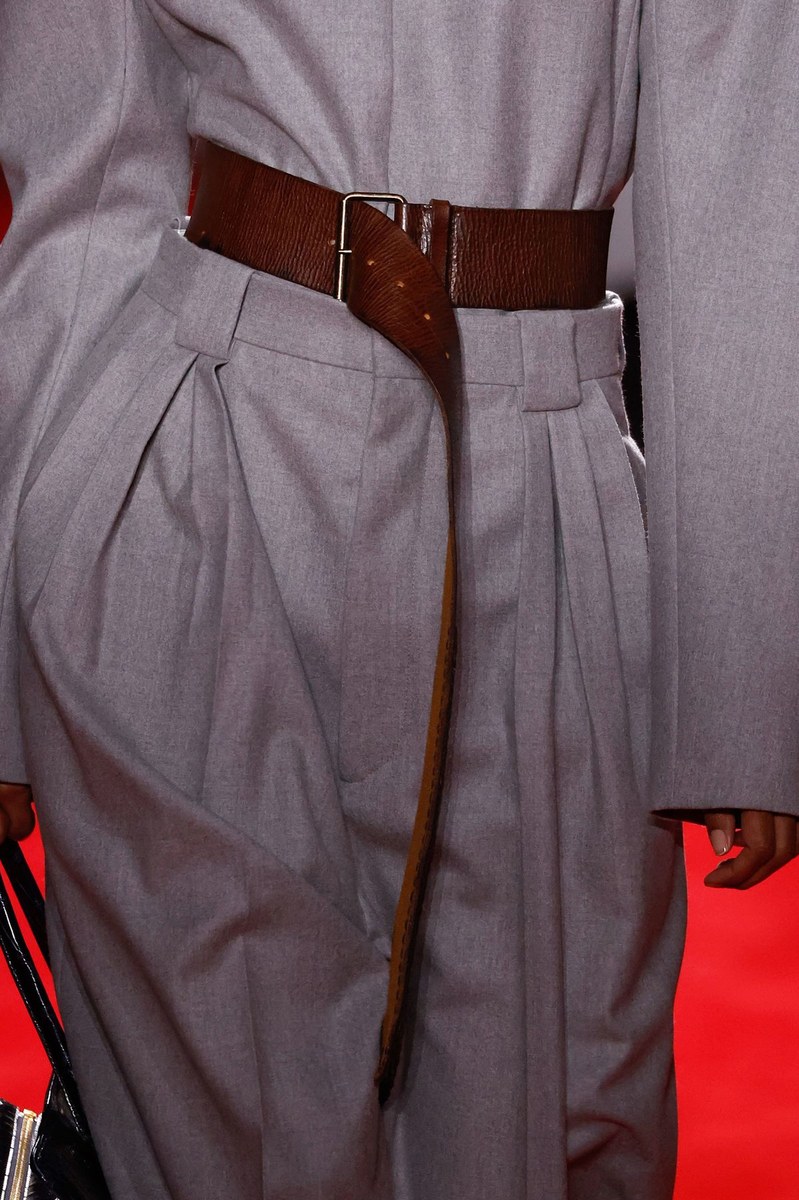
Belts in Detail 1 and Detail 2 use dark brown leather with a visible grain surface and a simple rectangular silver-tone buckle, the width in Detail 1 noticeably broader and layered over a coordinating woven elastic waistband insert. Detail 3 pairs a self-fabric buckle closure in navy textured weave directly into the garment waist, collapsing the boundary between belt and garment construction. Across the fur dress details, Details 5 and 6 use self-fur buttons and knotted fur ties as functional closures, while Detail 8 shows a high-contrast spotted short-pile fur and Detail 9 presents what appears to be speckled quill or straw-textured fiber laid vertically in a directional pattern. Detail 7 uses fine accordion pleating in a blush fabric with a single small navy stud closure, a construction choice that requires precision cutting at scale.

Color and Finish Direction
Deep brown dominates the belt category, a warm cognac-adjacent shade that reads across grey suiting in Detail 1 and black woven leather in Detail 2 without competing with either ground. Headwear splits into two distinct palettes: a neutral axis of black and slate grey across Details 11 through 18, and a single high-impact chromatic statement in Details 19 and 20 where a saturated fire red fur hat absorbs almost all the visual energy in the frame. Amber, burnt orange, and white appear together in the fur coat textile of Detail 10, producing a paint-stroke stripe effect closer to a dyeing or printing technique than a woven pattern. Color throughout the season lives in materials that carry it through surface and texture rather than print or appliqué.
Key Pieces and Details
Detail 1 is the most immediately commercial piece in the lineup, a broad dark brown leather belt with a clean buckle hardware and a proportional width that defines a high waist over generous pleated trousers. It's a strong candidate for standalone accessory buying, not just styled editorial use. Details 19 and 20 present the collection's loudest proposal in the red fur sculptural hat, and while volume production is unlikely, its silhouette sets a directional reference for buyers sourcing statement headwear at any price tier. Details 12 through 18 represent the highest-volume and highest-accessibility piece in the assortment, ribbed knit beanies with jewelry pairings that include the gold clustered necklace in Detail 16, the silver bubble necklace in Detail 15, and the clear resin version in Detail 18. A single hat SKU can serve multiple customer profiles.
Detail by Detail Highlights
Detail 1 (Belt) A wide dark brown grained leather belt with a silver rectangular frame buckle sits over deep pleated grey wool trousers, the proportional width critical to its waist-defining function.
Detail 2 (Belt) A narrower version of the same brown leather belt with punched holes and a matching rectangular buckle trails loose past the hip of a black intrecciato woven leather skirt, demonstrating length and flexibility as a styling variable.

Detail 3 (Dress Detail) A self-fabric navy textured buckle tab integrates directly into the waist seam of a wrap skirt, making the closure the sole formal detail on the garment.

Detail 7 (Dress Detail) Fine vertical accordion pleats in blush-white fabric create a compressed sculptural volume at the sleeve, fastened at the cuff with a single small navy dome stud, the entire construction requiring flat precision that complicates mass production.

Detail 9 (Dress Detail) Directional vertical rows of black-tipped white quill or straw fiber produce a dense, brush-like surface texture with a radiating center seam, a textile construction with no obvious mass-market equivalent.

Detail 11 (Eyewear) A half-rim frame in tortoise acetate with an exposed metal upper wire sits extremely low on the nose bridge, the lens shape minimal and nearly flat, reading as an optical frame repurposed for runway proportion.

Detail 19 (Headwear) A voluminous fire-red fur hat with an irregular, cloud-like silhouette completely obscures the forehead and brow, pairing with a coral-toned long-pile fur coat to create a total-look monochrome statement in the most aggressive color in the collection.

Detail 6 (Dress Detail) A cream shearling coat with a curly lamb exterior uses small mink or fox fur knots as toggle closures, the fastening system entirely constructed from the same fur family as the coat body.

Operational Insights
Belt width as a buying variable: Detail 1 and Detail 2 present two belt widths in the same leather and finish, and these should be treated as separate SKUs with different customer use cases. Wide versions work for tailoring, narrow versions for fluid skirts and dresses.
Knit beanie as a platform product: Details 12 through 18 consistently pair the same ribbed knit beanie silhouette in black or grey with rotating jewelry, earrings, and necklaces. Product managers can build a single hat into multiple market segments through accessory cross-selling.
Fur closure construction: Details 5 and 6 use fur-on-fur button and knot closures that eliminate metal hardware entirely, a sourcing consideration for markets with import restrictions on mixed material goods. Suppliers should review this construction point on lead time and durability.
Textile surface innovation at limited scale: Details 9 and 10 present surface constructions, the quill-texture fiber and the dye-striped long pile, that do not translate to standard mill production. These function as directional references rather than direct sourcing targets, but they're useful for briefing in-house textile development teams.
Jewelry as a beanie accessory system: Bold necklaces and statement earrings worn with beanies at low crown create a visible narrative throughout the collection. This gives accessories buyers a clear argument for bundling knit headwear with jewelry in editorial assets, shop floor styling, and e-commerce product photography.
More Details


✦ This report was generated with AI — combining human editorial vision with Claude by Anthropic. Because the future of fashion intelligence is already here.