Bottega Veneta FW26 Shoes
Bottega Veneta FW26 Shoes Report
Bottega Veneta FW26 delivers a footwear collection built on two opposing poles: grounded, flat-soled leather oxfords and lace-ups on one end, and maximalist fur-covered mules, sliders and sculptural flats on the other. For buyers and product managers, this split signals a deliberate strategy to serve both the minimalist wardrobe and the statement-driven luxury consumer within a single collection.
Silhouettes and Construction
A flat or near-flat square-toe shoe dominates across oxfords, lace-ups, loafers and mules, with virtually no elevation beyond a slim, 10 to 15mm blocked heel or a thin leather sole. When heel height does appear, as in the fur mule styles (Shoe 2, Shoe 16, Shoe 19), it's a slender stiletto of approximately 80mm, creating a sharp contrast to the otherwise grounded lineup. Ankle height stays low across the board. No boots appear in the visible selection, with a clear bias toward slip-on or low-cut constructions. The fur flat styles (Shoe 6, Shoe 11, Shoe 15, Shoe 20) sit directly on a minimal leather-wrapped sole, with the fur material forming the full upper structure rather than sitting over a conventional last.
Materials and Finishes
Patent leather dominates the oxford and lace-up group, appearing in a high-gloss, mirror-like finish across Shoes 1, 13 and 8. Matte or semi-matte leather shows up on Shoes 3, 7 and 12. Fur application spans both genuine-appearing long-pile fur on the mules and sliders (Shoes 2, 16, 19) and a shorter, denser pile on the full-upper fur flats (Shoes 6, 11, 15, 20). Shoe 9 introduces a reptile-embossed leather, likely python or a scaled print, in an off-white or bone tone, adding a textural disruption to the otherwise smooth leather narrative. Metal hardware studs of varying lengths appear densely across the entire vamp and toe on the spiked styles (Shoe 10, Shoe 17), with a simple buckled strap construction suggesting a Mary Jane base beneath the hardware.
Color Direction
The palette divides sharply into neutral foundations and two strong accent colors. Black (Shoes 2, 3, 6, 7, 10, 11, 12, 13, 16, 20) and white or off-white (Shoes 5, 8, 14, 15, 17) carry the majority of the lineup, functioning as the commercial core. Red is the season's primary accent color, appearing as a full-coverage tone-on-tone statement in Shoes 4 and 18, where the shoe and the garment above share the same saturated red. Orange fur (Shoe 6 and Shoe 19) operates as the most directional, editorial color in the collection, likely produced in limited quantity for runway impact rather than broad commercial distribution.
Key Models and Details
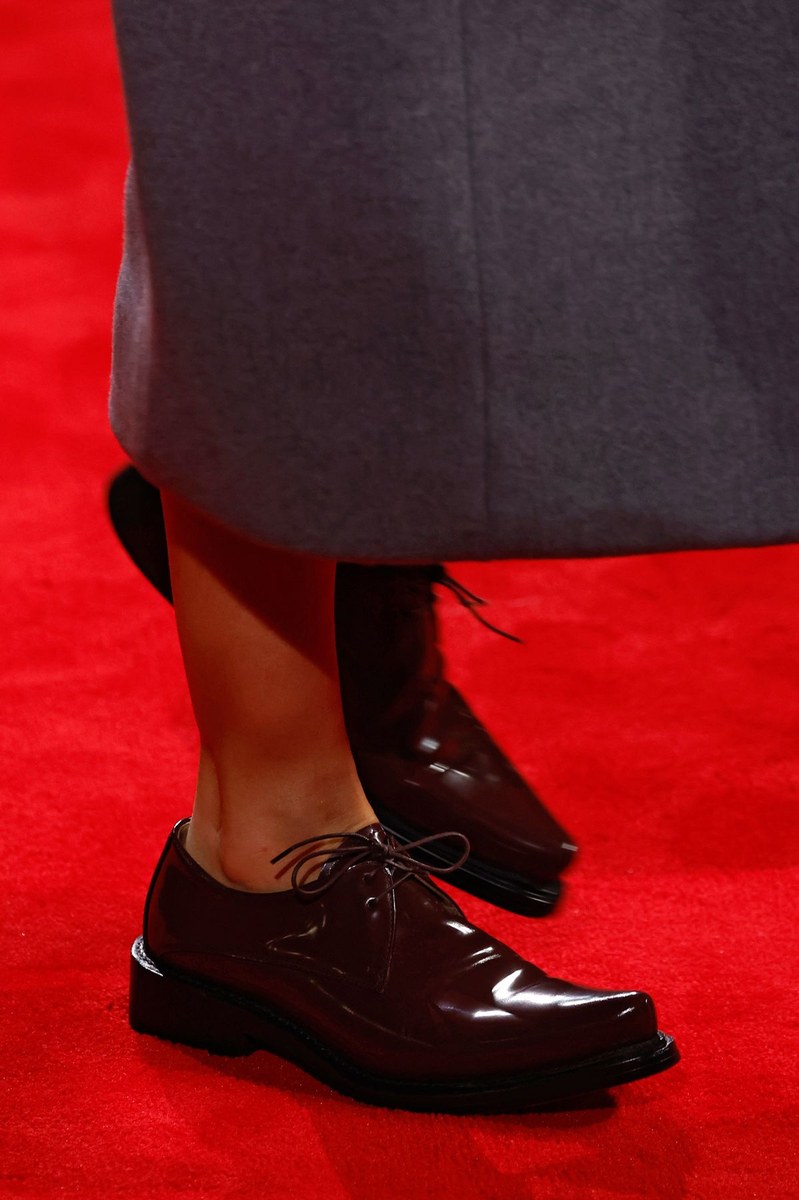
A patent leather square-toe oxford with a lace-up closure and a slim lug or leather sole serves as the collection's anchor model, present in burgundy (Shoe 1), black (Shoe 13) and white (Shoe 8 and Shoe 14), establishing a clear color run for buyers. The fur mule with a stiletto heel (Shoes 2, 16, 19) is the second hero style, built on what appears to be a transparent or minimal leather footbed with the fur forming a wide, enveloping toe cover. Most striking is the spiked Mary Jane flat (Shoes 10 and 17), representing the collection's highest-risk, highest-visibility model, with an all-over spike treatment that reads as a direct nod to punk and goth subcultural references in an otherwise refined collection. The red velvet or satin loafer with knotted cord embellishment at the toe (Shoes 4 and 18) sits closest to a traditional house-slipper silhouette, with a square toe, a low wedge-shaped heel of roughly 20mm, and a slip-on construction with no closure hardware.
Shoe by Shoe Highlights
Shoe 1 The burgundy patent leather oxford with a lace-up closure and square toe anchors the commercial core of the collection, offering a strong repeat-buy silhouette with clear color-family potential.

Shoe 4 The red tone-on-tone velvet loafer with knotted cord toe trim and a low wedge heel reads as the collection's most wearable statement piece, likely appealing to buyers seeking dressed-up flat alternatives to heels.

Shoe 6 The orange fur flat with a minimal black leather sole is the most editorial piece in the collection, designed for runway visibility rather than volume, but useful as a conversion driver in windows and editorial placements.

Shoe 9 The off-white reptile-embossed flat with a pointed or softly tapered toe and trouser-breaking length creates a strong contrast to the rest of the lineup's square toes, signaling that the brand is testing multiple toe shapes within the season.

Shoe 10 The black Mary Jane flat with an all-over metal spike application on a dense, closely set hardware field represents the most technically complex production challenge in the collection, with significant implications for cost-per-unit and minimum order quantities.

Shoe 15 The white fur lace-up flat with visible black tips at the toe and a short bow tie closure fuses the oxford construction language of the leather styles with the fur material story, functioning as a bridge style between the two dominant themes.

Shoe 17 The white spiked Mary Jane mirrors Shoe 10 in construction but shifts the colorway to white with silver hardware, broadening the spike style's commercial reach and suggesting the brand intends this as a two-SKU model rather than a single runway experiment.

Shoe 19 The red fur stiletto mule with a narrow heel and a wide fur toe cover operates as a direct red-palette complement to the red loafers in Shoes 4 and 18, indicating the brand built intentional within-collection capsule groupings by color.

Operational Insights
Toe shape standardization: The square toe appears across no fewer than twelve styles, making it the non-negotiable construction baseline for any Bottega-inspired development in your own line for FW26.
Fur sourcing lead times: At least seven distinct fur applications appear across the collection, which means buyers must confirm material sourcing and CITES compliance well in advance of production, particularly for genuine fur components. Lead times and import regulations vary significantly by market.
Color capsule strategy: The red grouping (Shoes 4, 18, 19) and the black-and-white groupings operate as self-contained capsules. Visual merchandising and buy planning should treat them as coordinated sets rather than individual SKUs.
Spike hardware production cost: Substantial per-unit hardware costs and extended production timelines characterize the spiked Mary Jane styles (Shoes 10 and 17). Product managers targeting this aesthetic should evaluate cast versus pressed metal spike options and prototype both finishes before committing to a production run.
Patent leather durability positioning: The high-gloss patent oxfords (Shoes 1, 13) will require clear communication to retail partners about care and scuff sensitivity, particularly for the square toe edge, which is the highest-contact point on this silhouette during wear.
More Shoes
More Shoes
More Shoes
More Shoes


✦ This report was generated with AI — combining human editorial vision with Claude by Anthropic. Because the future of fashion intelligence is already here.