Burberry FW26 Shoes
Burberry FW26 Shoes Report
Burberry FW26 plants its footwear firmly in structured utility and after-dark glamour, running two clear tracks through the collection: rugged moto-inflected boots with flat or low block heels, and polished Mary Jane pumps and strappy heeled sandals with an unmistakably vintage sensibility. Both tracks carry strong commercial momentum heading into the second half of 2026, as the moto boot cycle shows no sign of contracting and the Mary Jane silhouette continues to convert at retail across price tiers.
Silhouettes and Construction
The collection divides cleanly into three silhouette families. First, the tall and mid-shaft pull-on boot, ranging from knee-height (Shoes 3, 14) to ankle-height (Shoes 6, 9, 12, 16, 17), built on a curved sculptural heel of approximately 8 to 9 centimeters with a rounded, slightly squared toe and a thin platform. Then there's the moto boot (Shoes 10, 19) on a flat lug sole with a reinforced ankle cuff, side zip, and gold studs. Finally, a Mary Jane and strappy heeled sandal group (Shoes 1, 4, 5, 11, 13, 15, 20) sitting on stiletto or mid-block heels between 7 and 10 centimeters, all with a rounded closed toe or open peep toe. Throughout the boots, construction suggests a single-piece upper with minimal seaming, relying on the gathered elastic cuff panel as the primary design articulation.
Materials and Finishes
Smooth calf leather dominates across the boot styles, with a matte finish on the darker colorways and a light burnish on the brown tones. The Mary Jane group (Shoes 1, 13, 20) uses a higher-gloss polished calf that catches runway light and reads patent-adjacent without committing to full patent. Shoes 2 and 15 break from leather entirely, using a woven metallic mesh or chainmail-style textile across the vamp and toe box, with braided bands creating a structured cage effect. Gold-toned hardware appears on the brown and tan shoes while silver or antique silver finishes the black and navy pieces, consistent with Burberry's ongoing metal bifurcation strategy.
Color Direction
Dark navy and near-black anchor the majority of the collection, appearing across Shoes 3, 4, 5, 7, 10, 11, 12, 13, 14, 19, and 20. Chocolate brown (Shoes 6, 8, 16, 17, 18) reads as the primary warm accent and carries the most differentiated commercial potential given how saturated the market remains in black footwear. Shoe 9 introduces an off-white or pale ivory tone, the single lightest point in an otherwise deep palette. Shoes 2 and 15 add pewter and gunmetal through their metallic textile construction, acting as embellished evening counterpoints to the leather-heavy balance of the range.
Key Models and Details
The gathered-cuff ankle boot, seen across Shoes 6, 9, 12, 16, and 17, is the most commercially transferable model in the collection. It uses a ribbed elastic side panel at the ankle in place of a zip or buckle, creating a pull-on entry with a clean exterior profile. Single straps with small rectangular buckles define the Mary Jane pump (Shoes 1, 13, 20), paired with subtle bows or tabs at the heel counter and micro-stud detailing along the strap edge on Shoe 1. The moto boot (Shoes 10, 19) introduces the collection's most hardware-forward design, with a padlock detail at the cuff, exposed brass rivets, side zipper, and a belted ankle strap that reads directly from Burberry's equestrian and utility heritage.
Shoe by Shoe Highlights
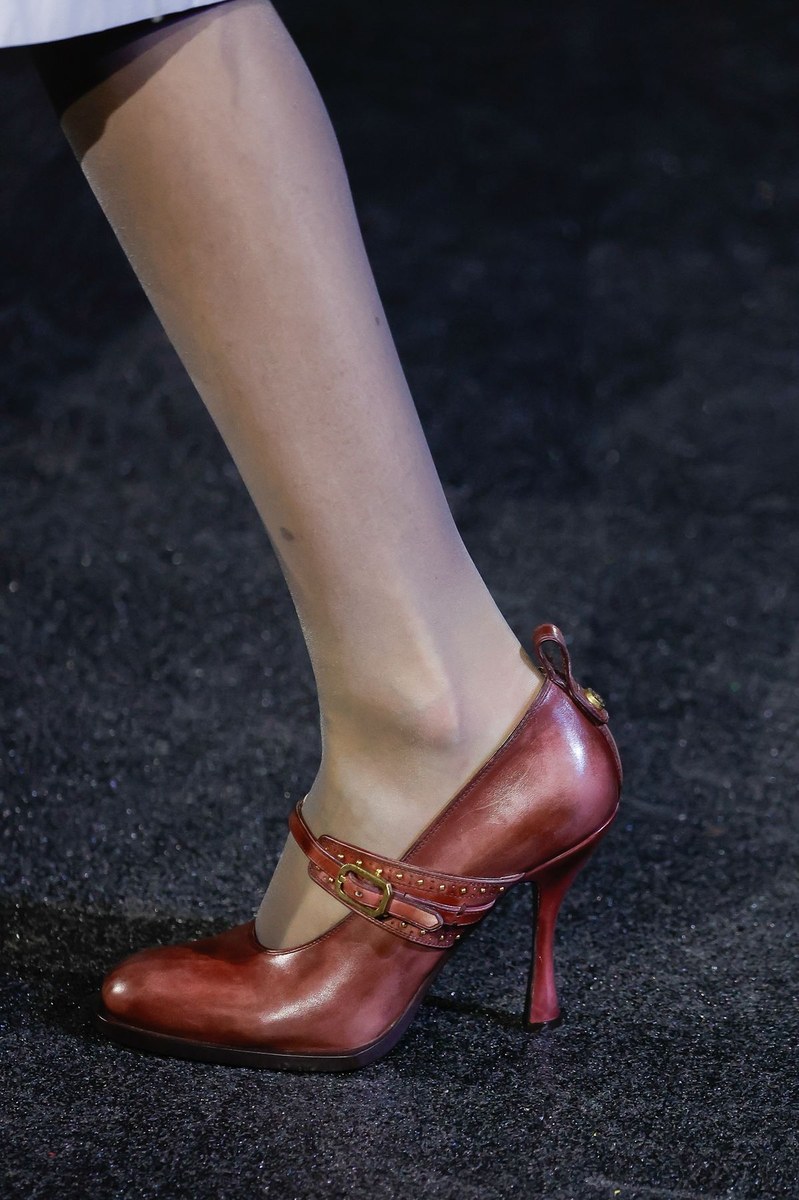
Shoe 1 A cognac polished-calf Mary Jane on a slim 9-centimeter heel with double ankle straps, antique gold buckles, and stud detailing along the vamp. This is the most heritage-coded and retail-ready pump in the range.

Shoe 2 A pewter chainmail-woven cage sandal on a stacked 8-centimeter heel with a leather ankle cuff and silver buckle. This represents the collection's highest fabrication complexity and targets eveningwear and occasion buyers specifically.

Shoe 5 A black leather strappy cage sandal on a slender 10-centimeter stiletto with gold stud rivets and a double-wrap ankle strap. Few pieces deliver such sharp contrast between the structural upper and the precision heel.

Shoe 9 The single light-colorway boot in the collection, an ivory pull-on ankle boot with a ribbed elastic panel and a black sculptural heel. Strong contrast-color entry point for buyers building a capsule from the range.

Shoe 10 A black leather moto boot with a padlock cuff detail, exposed brass rivets, side zip, and flat lug sole. Among flat-heel options in the collection, this is the most wearable and reads most directly on the utility trend running through menswear-influenced womenswear.

Shoe 11 A black patent-finish Mary Jane with a wide rounded toe, a low 5-centimeter block heel, and a fine silver strap with a rectangular buckle. Most accessible heel height in the collection and will convert strongly in markets where lower heels outperform.

Shoe 15 A flat metallic woven sandal with a T-bar strap, leather ankle strap, and silver buckle. The collection's only flat-heeled dress sandal, opening a daytime occasion category that the rest of the range does not address.

Shoe 18 A knee-high smooth chocolate brown boot with a subtle center-front seam, rounded toe, and sculptural flared heel. Cleanest and most versatile tall boot in the collection and the strongest candidate for broad wholesale placement.

Operational Insights
Heel architecture: The sculptural curved heel that widens slightly at the base, used across Shoes 3, 6, 7, 8, 9, 12, 14, 16, 17, and 18, requires a dedicated heel mold and cannot be substituted with a standard cone or block heel without losing the silhouette's defining proportion. Buyers sourcing close product should confirm heel geometry with factories early.
Elastic panel construction: The gathered ribbed ankle panel on the pull-on boot family (Shoes 6, 9, 12, 16, 17) functions as both an aesthetic and functional choice. Product managers should specify panel elasticity range and stitch density, as poor execution at this point collapses the boot's clean profile.
Metallic textile sourcing: The woven chainmail or metallic mesh fabric on Shoes 2 and 15 is a specialty construction with limited supplier availability. Buyers looking to develop similar fabrications should initiate sourcing conversations now, as lead times on metallic weave components typically run 14 to 18 weeks ahead of standard leather upper schedules.
Color pairing signal: Chocolate brown leather consistently pairs with gold hardware (Shoes 1, 6, 16, 17, 18) while black or navy leather pairs with silver hardware (Shoes 3, 10, 11, 12, 13, 19, 20). This sets a clear colorway-to-hardware rule that product managers can apply directly to their own range architecture without deviation from current consumer expectations.
Flat options gap: With only Shoes 10, 15, and 19 sitting at flat or near-flat heel heights, the collection skews heavily toward heeled product. Buyers building a full floor from this direction should supplement with flat interpretations of the moto and pull-on boot silhouettes to cover the comfort and commuter customer, particularly in markets where flat boot penetration exceeds 40 percent of total boot sales.
More Shoes
More Shoes
More Shoes


✦ This report was generated with AI — combining human editorial vision with Claude by Anthropic. Because the future of fashion intelligence is already here.