Burberry FW26 Women Looks Report

Burberry FW26 Women Looks Report
Burberry FW26 Women Looks Report

London Fashion Week

Burberry FW26 reframes the trench coat as the central architecture of a collection built around outerwear drama, leather utility, and a deliberately blurred line between menswear and womenswear. For buyers, this is a strong commercial signal that investment outerwear in heritage silhouettes with elevated material execution will drive full-price sell-through this season.

Silhouette and Volume

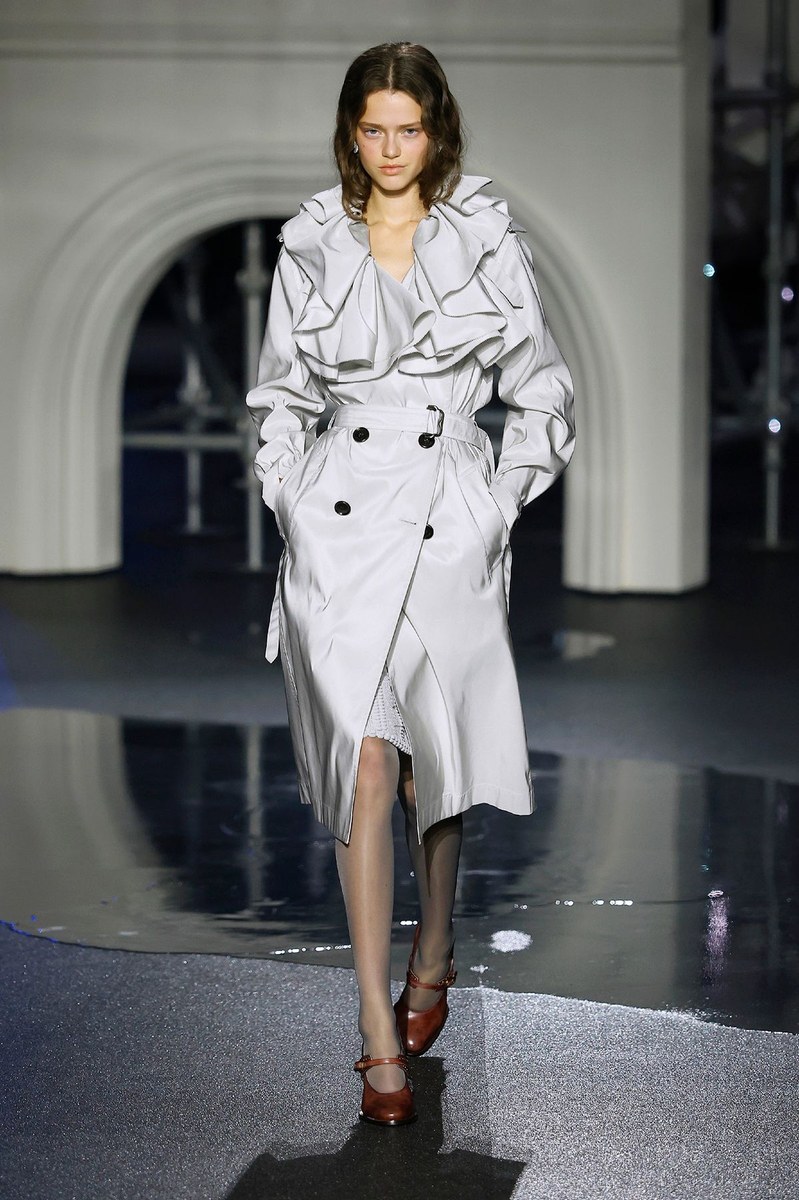
Two distinct registers drive the collection: oversized, floor-grazing coats that swallow the body, and belted mid-length shapes that cinch and define the waist without sacrificing volume in the shoulders or hem. Ruffled trench constructions in Looks 1, 3, 10, and 20 push volume upward onto the chest and collar, creating a sculptural top-heaviness that reads as both theatrical and wearable. Straight-leg trousers anchor the bottom half across multiple looks, wide and slightly pooling at the ankle. Nothing tapers.
Color Palette

Midnight navy and charcoal dominate the collection, running through the leather trench in Look 7, the ruffled coat in Look 10, and the pleated leather separates in Look 5. Look 1 opens with pale dove grey, and this lighter tone returns in Look 4 as a glen plaid, keeping the lighter end of the palette grounded rather than soft. Black serves as a neutral canvas for textural experimentation, appearing in croc-embossed lacquer in Look 19, quilted moto leather in Look 9, and full leather coordinated sets in Looks 6 and 17. A caramel and tobacco fur coat in Look 16 reads as deliberate punctuation against the overwhelmingly cool, nocturnal palette.

Look 7
Look 7

Materials and Textures

Leather and leather-adjacent fabrications carry the collection forward. Smooth lambskin in charcoal grey appears in Looks 7 and 12, while glossy croc-embossed patent in Look 19 and diamond-quilted moto leather in Look 9 stay within a tight material family that prioritizes surface tension and weight. Taffeta-like technical fabrics handle the ruffled trench structures in Looks 1, 3, 10, and 20, with a crinkled, high-sheen finish on the lacquered version in Look 20 that reads as deliberately distressed. Wool boucle in Look 13 and plaid wool tweed with fur-trimmed lapels in Look 8 introduce softness and warmth mid-collection, giving buyers a viable cold-weather story beyond leather.

Look 19
Look 19

Styling and Layering

Consistent layering logic runs through every look. Coats open over belted inner layers, with the belt often rendered in contrasting wide leather to create a second waistline beneath the outer garment, as seen in Looks 7, 8, and 13. Footwear splits between two directions: flat-heeled Mary Janes and block-heeled mules with ankle straps in brown or black, and lug-sole boots or gladiator sandals that push the styling into utility territory. Accessories stay minimal and structured, with boxy handbags in Look 13, an oversized unstructured tote in Look 5, and a dark shearling shoulder bag in Look 6 reinforcing the weight and materiality of the clothing rather than competing with it.

Look 13
Look 13

Look by Look Highlights

Look 1 A dove grey ruffled trench in technical taffeta over a matching belted skirt establishes the collection's central proposition: heritage outerwear construction broken open through volume and surface manipulation.

Look 1
Look 1

Look 4 A floor-length glen plaid trench in cream and taupe with an oversized double-breasted front and integrated belt delivers the collection's most immediately commercial piece for a broad buying audience.

Look 4
Look 4

Look 7 A charcoal grey lambskin leather trench in a classic wrap silhouette, belted low at the hip, is the clearest candidate for a hero SKU with a high repeat-purchase potential across both womenswear and crossover menswear buyers.

Look 8 A navy and charcoal plaid wool coat with fur-trimmed lapels, leather belt, and teal leather gloves is a strong layered complete look for editorial placement and wholesale presentation.

Look 8
Look 8

Look 12 A full grey leather suit, blazer and wide-leg trouser, worn over a hooded sweatshirt in coordinating grey, is the sharpest gender-fluid styling moment in the collection and the most direct signal toward a unisex product strategy.

Look 12
Look 12

Look 16 A floor-length caramel and tobacco fur coat worn open over a black tailored suit is the collection's single maximum-impact statement piece, positioned at the luxury ceiling for top-door placement.

Look 16
Look 16

Look 19 A black patent croc-embossed oversized trench coat with extreme shoulder width and a self-belt is the collection's most directional men's look and carries immediate potential for limited-run capsule production.

Look 20 A lacquered black croc-embossed ruffled trench with a matching ruched skirt merges the collection's two key themes, sculptural volume and high-gloss leather texture, into a single closing-act look suited for campaign and trunk show use.

Look 20
Look 20

Operational Insights

Trench coat diversification: Buyers should plan assortments that treat the trench as a material and construction variable, not a silhouette repeat. This collection runs the trench through taffeta, lambskin, patent croc, glen plaid, and crinkled nylon, each requiring distinct sourcing and margin strategies.

Leather category depth: The breadth of leather applications across Looks 5, 6, 7, 9, 12, 17, and 19 signals that Burberry is committing to leather as a category anchor for FW26. Product managers should plan for a wider leather SKU range than previous seasons, including separates, also outerwear.

Belt as a design component: The wide leather self-belt appears across at least eight looks as a structural styling device rather than an accessory add-on. Accessory buyers should treat belts as a standalone commercial category with strong attach-rate potential to outerwear purchases.

Color entry point: Dove grey in Look 1, stone plaid in Look 4, and caramel in Look 16 provide accessible entry points within a predominantly dark collection. Style directors building floor sets should use these lighter pieces as visual anchors to prevent the floor from reading as monolithic.

Gender-fluid crossover potential: Looks 2, 4, 7, 12, 17, and 19 cross cleanly between womenswear and menswear contexts in both silhouette and styling. Buyers operating dual-gender floors or building crossover capsules should flag these pieces early for allocation planning across both departments.

Complete Collection

Look 2
Look 2
Look 3
Look 3
Look 5
Look 5
Look 6
Look 6
Look 9
Look 9
Look 10
Look 10
Look 11
Look 11
Look 14
Look 14
Look 15
Look 15
Look 17
Look 17
Look 18
Look 18
Look 21
Look 21
Look 22
Look 22
Look 23
Look 23
Look 24
Look 24
Look 25
Look 25
Look 26
Look 26
Look 27
Look 27
Look 28
Look 28
Look 29
Look 29
Look 30
Look 30
Look 31
Look 31
Look 32
Look 32
Look 33
Look 33
Look 34
Look 34
Look 35
Look 35
Look 36
Look 36
Look 37
Look 37
Look 38
Look 38
Look 39
Look 39
Look 40
Look 40
Look 41
Look 41
Look 42
Look 42
Look 43
Look 43
Look 44
Look 44
Look 45
Look 45
Look 46
Look 46
Look 47
Look 47
Look 48
Look 48
Look 49
Look 49
Look 50
Look 50
Look 51
Look 51
Look 52
Look 52
Look 53
Look 53
Look 54
Look 54
Look 55
Look 55

About the Designer

Growing up the eldest child of a mechanic father and office worker mother on the outskirts of Bradford, West Yorkshire, Daniel Lee discovered his fascination with fashion during a childhood visit to the local Bombay Stores with his mother. The multicultural fabric of Bradford's city centre, with friends from completely different backgrounds, shaped his worldview and creative perspective. There was no fashion connection in his family, but Lee found joy in making things, studying textiles, woodwork, and art at Dixons City Academy before realizing by age 18 that fashion could become his career.

After graduating from Central Saint Martins in 2011 with guidance from Louise Wilson, Lee's entry into fashion began with internships at Maison Margiela and Balenciaga under Nicolas Ghesquière, where he absorbed experimental deconstruction techniques and precision in design. He then worked briefly at Donna Karan in New York before joining Céline in 2012 under Phoebe Philo, rising to director of ready-to-wear design. His six years there, crafting the minimalist language that defined Old Céline, became foundational to his aesthetic philosophy. The training ground of Philo's atelier taught him to synthesize aspiration with everyday practicality.

Lee's creative process draws from street culture, British music subcultures of the 1990s, and what he calls the "positivity of creativity" that defines contemporary British culture. At Bottega Veneta from 2018 to 2021, he transformed heritage craftsmanship through inflated Intrecciato weaves and the pillow-soft Pouch bag, earning four British Fashion Awards in a single night. Since joining Burberry in September 2022, he has focused on reinterpreting the brand's codes through body-conscious silhouettes, vibrant blue accents, and campaigns featuring British cultural figures from Skepta to Olivia Colman.

"Burberry is a national institution, it's almost more than fashion in the way that it's always been there. These kinds of institutions give comfort." "It was exciting to try to find the narrative of Burberry. And I wanted to go back to the idea of functionality, men and women on the go, and clothes that will last, that are not too precious."

✦ This report was generated with AI — combining human editorial vision with Claude by Anthropic. Because the future of fashion intelligence is already here.