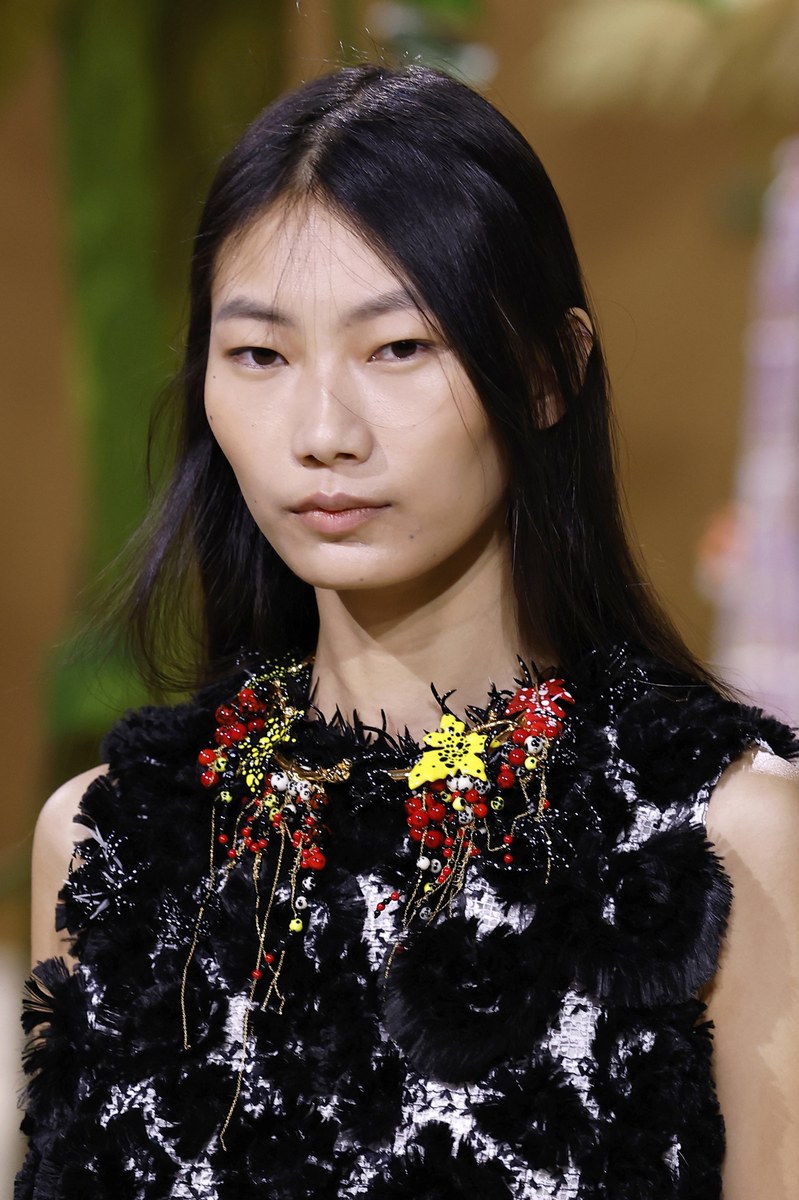
Burc Akyol FW26 Women Looks Report
Paris Fashion Week
Akyol built this collection on a fundamental tension between mass and exposure, wrapping the body in monumental volume one moment and stripping it back to near-transparent jersey or patent vinyl the next. For buyers, that polarity matters commercially: the collection covers both the demand for dramatic outerwear statements and the growing appetite for body-conscious eveningwear in a single, coherent brand logic.
Silhouette and Volume
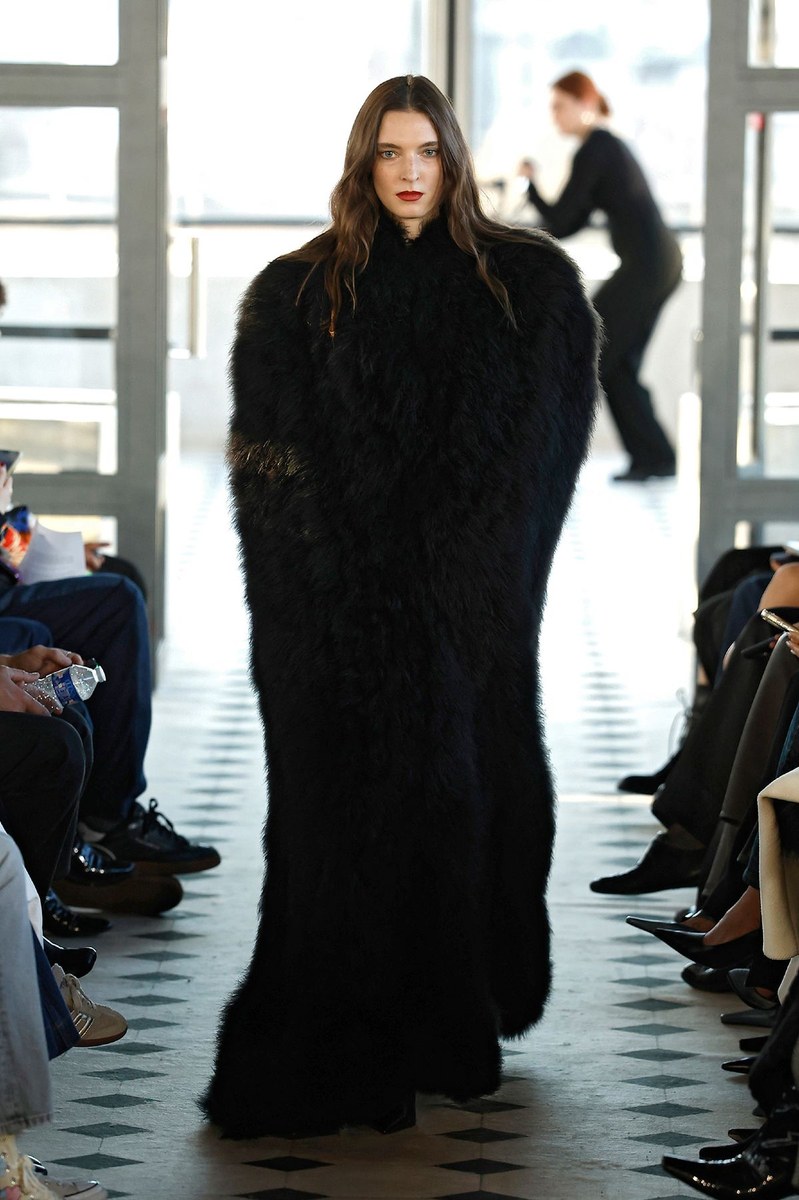
The show opens with extreme volume and closes with skin-close precision. Looks 1 through 4 establish an architectural macro-silhouette: floor-length shaggy coats, cape coats with squared shoulders that read almost as geometric planes, and a camel double-breasted coat in Look 4 that rounds at the hem into a barrel shape. From Look 7 onward, volume migrates into wide-leg trousers and draped bodices rather than outerwear. By the final third, the show narrows dramatically into column silhouettes, catsuits, and strapless tubes. The shift is deliberate and sequential, giving range-planning real clarity.
Color Palette
Black is the spine, present in at least eighteen of the thirty-two looks and running across every category from outerwear to lace. Accent colors hit in concentrated bursts: deep magenta in Look 9, burnt red in Look 20 and Look 30, mustard yellow in Look 25, and a cool pale celadon that threads through Looks 27 and 31. Look 23 features leopard-print jersey and Look 9 shows gold silk, reading as the two moments of deliberate maximalism. Dark and controlled, the palette uses color as punctuation rather than theme.

Materials and Textures
Four distinct material registers move through the lineup. Heavy boiled wool and structured double-face fabric carry Looks 2, 4, and 6, giving those pieces architectural hold without visible construction. Fluid matte satin and silk charmeuse appear in Looks 3, 9, 21, and 27, pooling and gathering at the waist and hem in ways that require no lining structure. Patent vinyl arrives twice, in Looks 10 and 13, with a high-gloss surface that picks up light like lacquer. Shaggy feather-trimmed or mohair-loop fabric in Looks 1 and 11 closes the material loop back to maximum tactile weight, creating a deliberate rhythm of heavy, fluid, hard, and soft across the lineup.
Styling and Layering
Footwear stays consistent: pointed-toe black pump or matching sock boot, both close to the foot, keeping the leg line clean even under the widest trousers. Nearly absent throughout, accessories put all commercial weight on the garments themselves and make merchandising straightforward without accessory dependency. Look 14 shows a denim utility jacket worn over wide black trousers, while Look 15 features a white poplin shirt knotted diagonally across the torso, both suggesting the designer is thinking about how separates can be sold in combination. A turtleneck, in knit or jersey, functions as the collection's recurring foundational piece across Looks 5, 7, 9, 20, 22, 25, 29, and 30.

Look by Look Highlights
Look 1 The floor-length black shaggy coat is the collection's opening statement and its most immediately buyable hero piece. A single-item look with no styling competition that photographs at maximum drama.

Look 2 The navy cape coat with pronounced squared shoulders and double-breast button placket is a structured outerwear option that crosses tailoring and eveningwear categories, giving it broader placement potential across department store floors.

Look 4 The camel barrel-hem double-breasted coat in what reads as boiled wool lands as the most accessible commercial coat, proportioned to feel current without requiring the customer to commit to full-length volume.
Look 6 The ivory sculptural short jacket with its torqued lapel and ballooning sleeves paired with black high-waisted stirrup pants is the sharpest day-to-evening transition in the lineup and most likely to generate editorial placement.

Look 10 The black patent vinyl wrap dress, draped and knotted at the hip with sharp shoulder construction, is technically complex and will require careful sourcing of a vinyl with enough hand to drape without cracking at the seams.

Look 23 The leopard-print long-sleeve deep-V jumpsuit in soft jersey cut with flared legs is the loudest print statement and the most straightforward reorder candidate for specialty retailers with an existing animal-print customer.

Look 25 The mustard yellow mock-neck draped jersey gown, gathered at the hip and asymmetric at the hem, is the strongest color argument and most likely to convert buyers who need a non-black evening option.

Look 32 The head-to-toe black lace column, sheer from turtleneck to floor with visible lingerie beneath, closes the show as the most directional piece and will appeal to eveningwear buyers seeking high-impact, low-fabric-weight options.

Operational Insights
Outerwear hierarchy: Looks 1, 2, and 4 represent three distinct price and drama tiers within outerwear, allowing buyers to ladder the category from accessible camel wool to statement cape to maximum-impact shaggy coat without cannibalizing each other.
Fabric sourcing complexity: Patent vinyl in Looks 10 and 13 and shaggy looped fabric in Looks 1 and 11 are the two highest-risk materials for production scaling. Buyers should confirm minimum order quantities and lead times with mills before committing, as both fabrics narrow the supplier pool significantly.
Turtleneck separates program: The turtleneck top appears in at least eight looks across knit, jersey, and fine-gauge constructions, suggesting a strong separates program beneath the dramatic outerwear. Style directors should consider pulling it as a standalone SKU in multiple colors, given its role as the collection's most repeated building block.
Gender-fluid tailoring opportunity: Looks 17, 18, and 19 share an identical deep-V double-breasted blazer structure across womenswear and menswear silhouettes, pointing to a gender-neutral tailoring program that could serve multi-gender buying budgets and reduce SKU count without reducing breadth of offer.
Color drop sequencing: Accent colors, magenta, mustard, red, and celadon, each appear in isolated clusters rather than throughout, which gives product managers a clear basis for color drop sequencing across the delivery calendar. Black core styles ship first with accent-color statements arriving as mid-season newness.
Complete Collection


Fashion Designer

Burç Akyol grew up in Dreux, a small town west of Paris, in a Turkish immigrant household dominated by women: his mother, two sisters and an aunt. His father, a tailor, was the one who introduced him to the physical language of cloth and construction. Growing up between two cultures shaped the way he reads a room and reads a body, as an outsider who observes carefully before he speaks. He moved to Paris at sixteen and never left.
He studied at the Institut Français de la Mode, graduating in 2007, then spent over a decade working inside some of the most technically demanding ateliers in the city, including Christian Dior under John Galliano and Balenciaga under Nicolas Ghesquière. Those years weren't just technical training; Galliano taught him theatricality, the idea that clothes are always telling a story even when they appear to stand still. He launched his own label in 2019, showing collections from his apartment building in Paris, going door to door to collect signatures from his seventy neighbors so he could use the courtyard as a runway. The building's residents eventually mobilized around the shows, bringing food during all-nighters and serving champagne to guests afterward.
His references are personal and specific: the flamenco dancer printed on his father's cigarette packets, gypsy children in French schoolyards, the volcanic coastline of Pantelleria where he spends summers, the medieval Persian poet Saadi, whose text Gülistan became the title of his fifth collection. The clothes oscillate between tightly architectural tailoring in black and white and warm, saturated color, between restraint and something close to abandon. Collections are numbered, not dated. Some pieces return in later collections, reinterpreted. He produces ninety-five percent of his work in France, maintains personal relationships with his pattern-makers and seamstresses, and in 2024 won the Pierre Bergé Prize at the ANDAM Fashion Awards — a house that had previously rejected him for not being French enough.
"I think you have to be as close and personal as possible to make a design. There's more room for personal expression than for yet another black skirt. It's all about bringing your extra soul and therefore your uniqueness to it."
"When you come from an immigrant community, survival instinct is super important. If you can be comfortable in any situation and adapt to any environment, you can go beyond the workshop stage and become a designer."
✦ This report was generated with AI — combining human editorial vision with Claude by Anthropic. Because the future of fashion intelligence is already here.