Campillo FW26 Bags

Campillo FW26 Bags

Campillo FW26 Bags Report

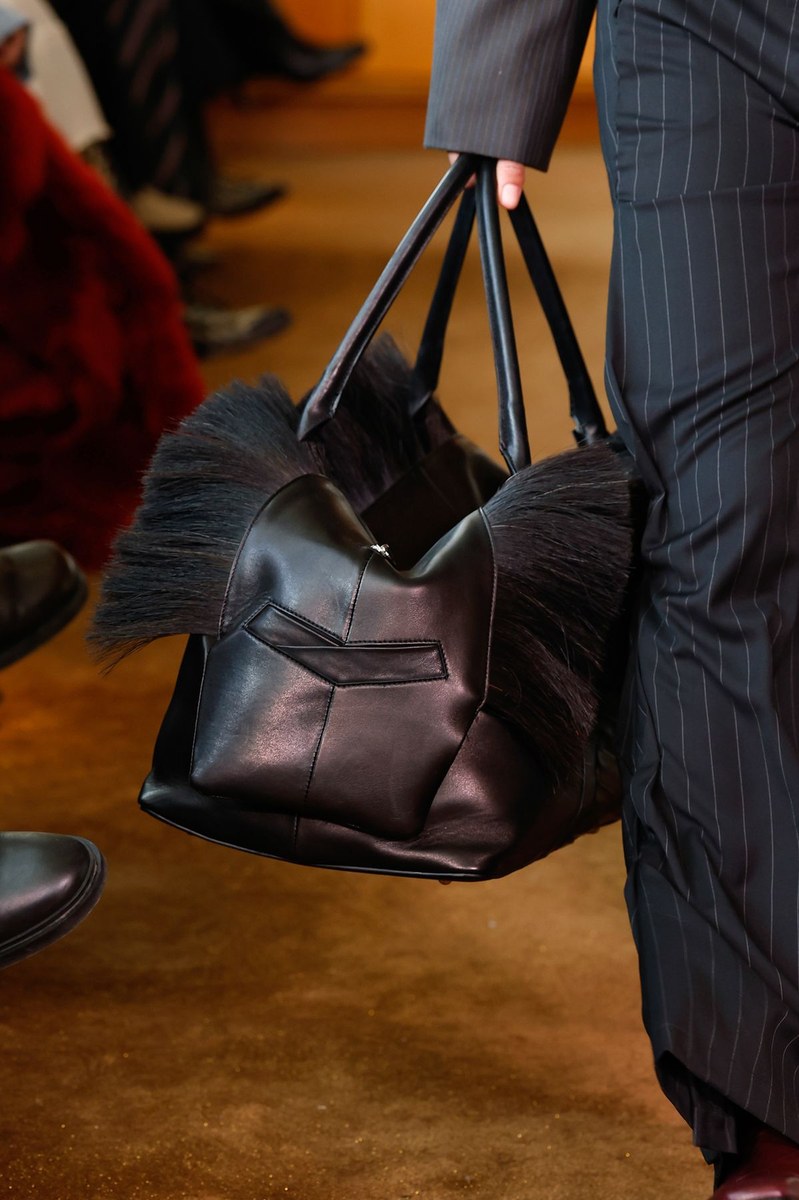
Campillo FW26 anchors its accessories direction in oversized, fur-trimmed black leather totes that merge utility volume with a raw, almost architectural edge. Buyers drawn to statement carry pieces with tactile contrast will find both models commercially viable and editorially strong.

Silhouettes and Shapes

Both bags read as large-format top-handle totes, built for maximum visual impact and genuine carry capacity. Bag 1 sits in a slightly more collapsed, slouchy posture, the leather gathering softly under the weight of the fur trim. Bag 2 presents a more structured base with visible feet and a firmer body, suggesting a bolstered or board-lined construction. Narrow, cylindrical, and closely spaced, the dual top handles on both models concentrate the carry point and amplify the dramatic silhouette below.
Materials and Hardware

Smooth black calfskin forms the primary shell on both bags, with panel piecing on Bag 1 creating a geometric patchwork effect across the front face. A chevron-quilted leather panel at the center body on Bag 2 adds dimensional texture without departing from the monochrome palette. Dense and matte black, the fur trim on both models reads as mink or a high-grade faux alternative placed at the upper flanks. Brushed or matte silver hardware appears on Bag 1, while gold-toned studs sit at the base corners of Bag 2.

Color Direction

Jet black dominates the entire accessories palette here. No tonal variation. No contrast piping. No accent color. It's a deliberate and confident commitment to a single color story that signals nocturnal luxury and wardrobe versatility in equal measure. The matte fur against the slightly reflective calfskin creates the only visual tension the designer needs. For buyers, this monochromatic focus simplifies inventory management while positioning the bags as easy pairing pieces across a wide customer wardrobe.

Key Models and Details

Bag 1 reads as the more editorial of the two, with its patchwork paneling and organic slouch giving it a deconstructed sensibility that will pull strong press placement. Bag 2 is the more commercial proposition, its chevron quilting and structured base with protective feet suggesting durability and a cleaner, more accessible silhouette for retail. Both models appear to close with a zip at the top, though the fur trim partially obscures the closure on Bag 1. No visible logo hardware appears on Bag 1, while Bag 2 carries a small embossed or engraved logo plate on the handle junction.

Bag by Bag Highlights

Bag 1 The front panel patchwork in geometric shapes gives the calfskin body a handcraft quality that separates it from straightforward tote production and justifies a premium price architecture.

Bag 1
Bag 1

Bag 1 Fur placement at the upper lateral sides rather than along the base or handles is unconventional and creates a silhouette that reads as a living, almost creaturely form when carried.

Bag 1 Its collapsed, organic body volume positions this model within the broader oversized slouch tote trend that has driven strong sell-through at luxury multi-brand retail since FW24.

Bag 2 The chevron-quilted center panel introduces a stitching-intensive construction detail that will require careful production costing but delivers a strong visual differentiator on the shop floor.

Bag 2
Bag 2

Bag 2 Protective metal feet at the base corners signal a product manager's awareness that large carry bags need functional support, and this detail will resonate with quality-focused buyers.

Bag 2 Placement of the logo plate at the handle junction is the most visible branding moment across both models, precisely where the carrying hand draws the eye during wear.

Operational Insights

Fur trim sourcing: Confirm early whether the trim is genuine mink or a faux alternative, as this affects pricing, labeling compliance across markets, and the growing retailer restrictions on real fur in key European accounts.

Production complexity: The patchwork paneling on Bag 1 and the chevron quilting on Bag 2 both carry higher cut-and-sew labor costs than a standard tote construction, and margin planning should account for this before opening orders are placed.

Size grading: Both models sit at the large end of the tote spectrum and accessories directors should assess whether a mid-size or mini derivative would extend commercial reach without diluting the design's core visual impact.

Colorway expansion: The all-black launch is strong for press and editorial but a single colorway limits reorder potential. Product managers should open a conversation with the brand about a second colorway, deep burgundy or espresso brown, for mid-season replenishment.

Retail positioning: The combination of oversized volume, fur trim, and premium calfskin places these bags in the 1,500 to 3,000 euro retail range for specialty and department store accounts, and buyers should benchmark against current Loewe and Bottega Veneta large tote performance before committing to depth.

✦ This report was generated with AI — combining human editorial vision with Claude by Anthropic. Because the future of fashion intelligence is already here.