Carven FW26 Bags
Carven FW26 Bags Report
Carven FW26 plants its accessories strategy firmly around a single cylindrical duffle silhouette, reissued across colors, scales, and fringe treatments with enough variation to build a coherent but commercially flexible range. For buyers navigating a market hungry for logo-light, tactile product, this delivers a replicable formula that translates well from runway to open-to-buy planning.
Silhouettes and Shapes
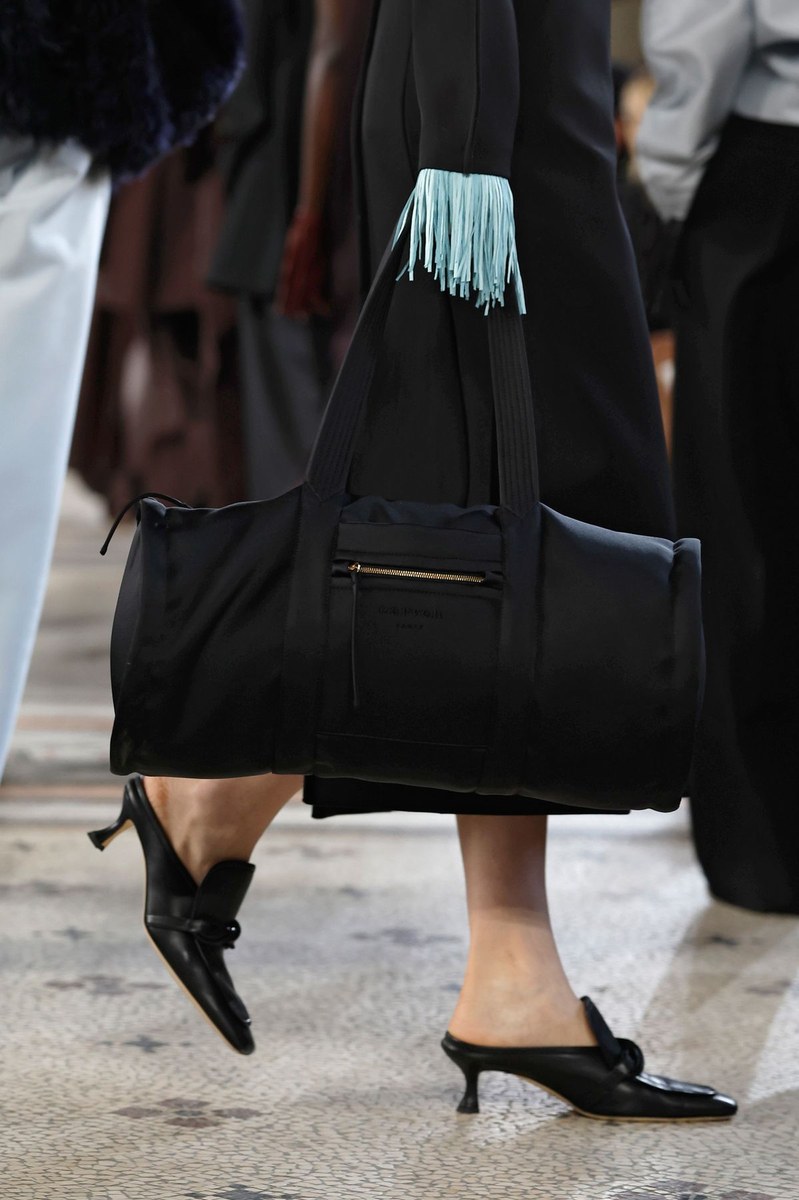
The barrel duffle dominates entirely. Every bag reads as a variation on the same tubular body, carried by twin flat shoulder straps that sit close together at the top rather than spreading to the bag's full width, which tightens the silhouette and reads as intentional rather than sporty. Bags 1 and 2 run in a compact, arm-carried size that sits closer to a medium daily bag than a travel piece, while Bags 3 and 4 push into oversized, body-skimming territory through fringe volume rather than an expanded body. No structured, boxy, or crossbody shapes appear here.
Materials and Hardware
A matte satin or duchess satin forms the base body in Bags 1 and 2, dense enough to hold the cylindrical form without internal structure. Heavy fringe trim appears on Bags 3 and 4, black silk or synthetic yarn in Bag 3 and ivory feather-tipped fringe in Bag 4, applied in layered horizontal rows that nearly obscure the underlying bag body. Hardware stays minimal and consistent throughout. A single zip pull in polished gold runs across a front exterior pocket on all four bags, and the ribbed flat straps appear to be woven in matching fabric rather than leather, keeping the build material-forward.
Color Direction
The palette splits cleanly between two poles: deep black and saturated emerald in Bags 1 and 2, and tonal neutrals anchored by ivory and off-white in Bag 4, with Bag 3 returning to black but expanding its visual weight through fringe. That emerald in Bag 2 reads as a full, jewel-saturated green with no gray or olive undertone, placing it closer to a classic casino green than a botanical or sage direction. Black functions as the workhorse across three of the four bags. For buyers, this signals an autumn range built to sell on two tracks: one safe and covetable in black, one color statement in emerald for accounts that can move non-neutral product.
Key Models and Details
A single barrel duffle serves as the hero model, complete with a front zip pocket, embossed brand name at center front, and flat ribbed double top handles. The zip closure on the main compartment is not visible in most angles, suggesting either a top-zip or drawstring finish beneath the handles. Logo treatment is tone-on-tone embossing, small and centered, with no visible metal logo hardware or brand plates. Fringe layers directly onto this base model in Bags 3 and 4, making the trim the variable rather than the silhouette, which simplifies production planning considerably.
Bag by Bag Highlights
Bag 1 Pairs the black satin duffle with a single aqua blue fringe tassel clipped to the handle junction, a small-scale accent that signals the fringe direction without committing the full bag body to trim.

Bag 2 Presents the cleanest commercial read in the lineup, an unembellished emerald satin barrel in a compact size that functions as the collection's most accessible and buyable entry point.

Bag 3 Scales the fringe application to full coverage on a larger duffle body, with black yarn fringe running in at least three horizontal tiers that extend well below the bag's bottom edge, creating a floor-grazing silhouette when carried at arm length.

Bag 4 Replaces yarn fringe with ivory feather-tipped fringe on the same oversized duffle structure, shifting the texture register from graphic and graphic-heavy to soft and bridal-adjacent, which opens placement in evening and occasion categories.

Bag 1 Also confirms the brand's interest in mixed-tone product, combining a black base with a mint accent in a way that targets buyers who want color presence without a full-color commitment in their assortment.
Bag 3 Carries a production note worth flagging: the fringe volume is extreme enough that it will require specific hanging and packaging solutions to avoid tangling in transit or on-floor display.
Operational Insights
Silhouette consolidation: One base bag shape runs across all four looks, which means buyers can build a tight, coherent accessories assortment without category sprawl, and product managers can negotiate tooling costs against a single mold or pattern.
Fringe as a trim variable: Fringe is applied to an existing base body rather than engineered into the construction, so buyers have a credible argument for sourcing a clean version and a fringed version from the same factory, reducing vendor count.
Color hierarchy: Emerald in Bag 2 is the color to test. It photographs well, reads as premium rather than trend-driven, and carries enough saturation to perform in editorial without alienating conservative accounts.
Evening and occasion crossover: Bag 4 in ivory feather fringe holds real potential for placement in bridal boutiques, occasion retailers, or department store special-event floors, a secondary channel that the black and emerald styles will not reach.
Packaging and display risk: The large fringed styles in Bags 3 and 4 present a visual merchandising challenge. Buyers should confirm with their VM teams before committing to floor quantities, as the fringe requires open hanging display to read correctly and will not work folded or shelved.
✦ This report was generated with AI — combining human editorial vision with Claude by Anthropic. Because the future of fashion intelligence is already here.