Carven FW26 Women Looks Report

Carven FW26 Women Looks Report
Carven FW26 Women's Looks Report

Paris Fashion Week

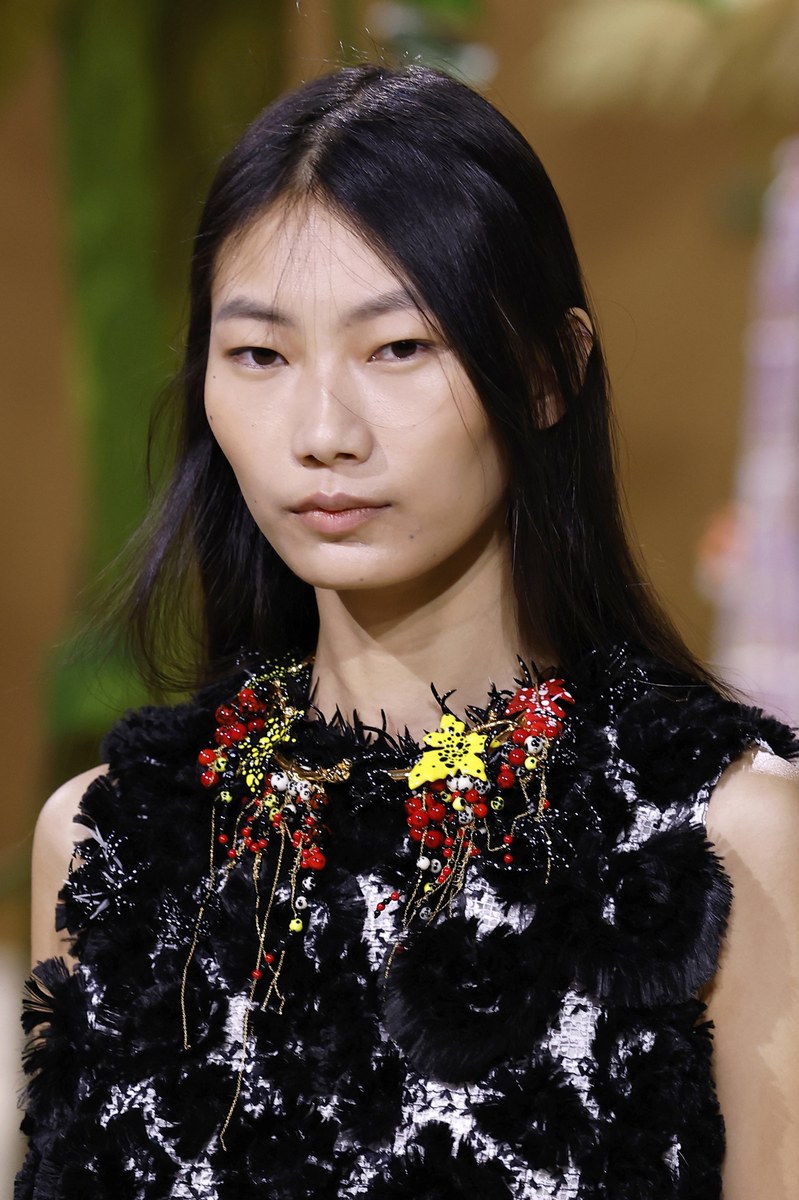
Guillaume Henry constructs this collection around the tension between weight and dissolution, pairing architectural outerwear and sculpted wool silhouettes against slip dresses, sheer organza, and cascading fringe that seems to unravel the structure from below. For buyers, this polarity between the constructed and the fluid translates directly into a dual commercial track, one rooted in investment outerwear and tailoring, the other in occasion and eveningwear with strong visual hook.

Silhouette and Volume

A wide, dropped-shoulder form dominates, inflating at the upper body and releasing into broad, floor-grazing trousers or long skirts. Looks 6, 9, and 10 make this geometry most explicit, with rounded sleeve heads that read almost architectural from the front. Coats in Looks 1, 11, and 13 carry the same expansive shoulder logic but resolve into longline, straight-fall bodies. The slip and column silhouettes in Looks 5, 17, and 29 strip all volume away entirely.
Color Palette

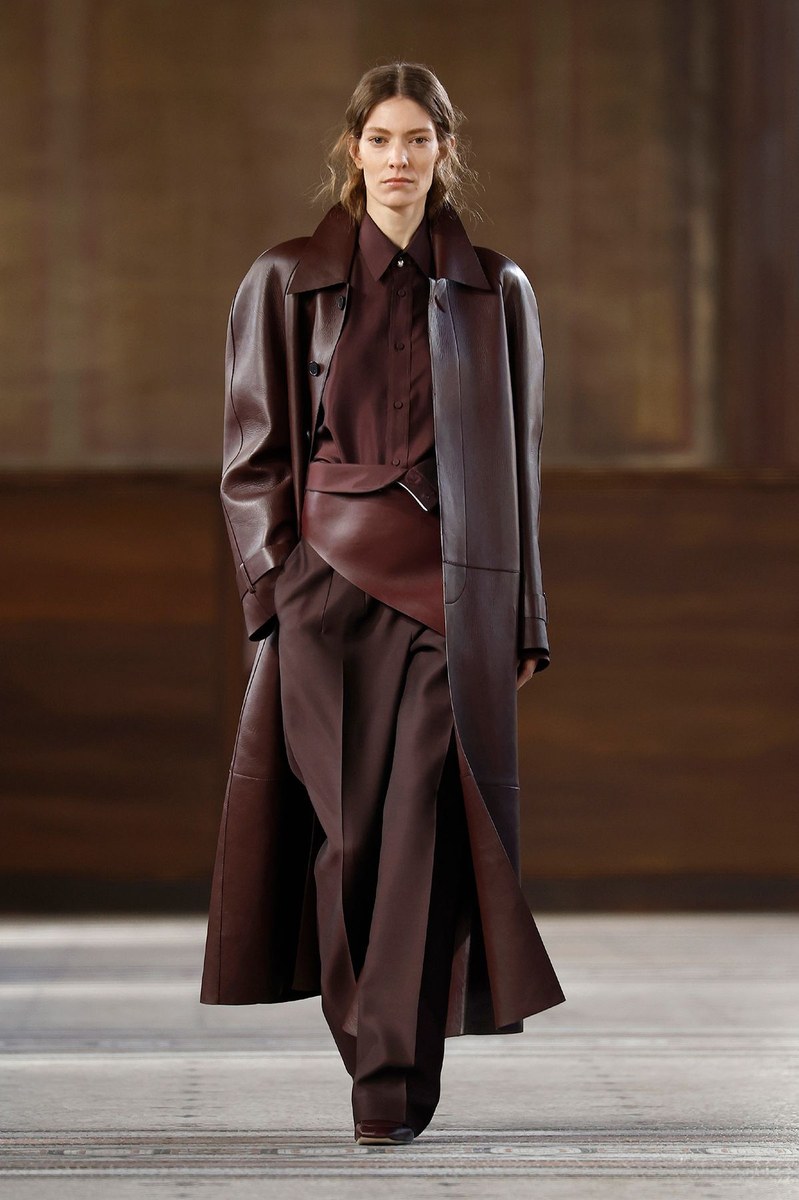
Deep oxblood brown anchors the first third of the collection and recurs in accessories throughout, creating a consistent warm-dark foundation visible in Looks 1, 2, 3, and 26. Chalk white and raw ivory occupy the middle and closing sections, from the fringed coat in Look 22 to the textured column in Look 27. Slate grey appears as a bridge tone in Looks 9, 10, and 12. A single matte black thread runs from Look 4 to Look 34, while the isolated appearance of a pale ice blue in Look 8 and the satin bomber in Look 12 prevents the palette from reading as uniformly somber.

Look 22
Look 22

Materials and Textures

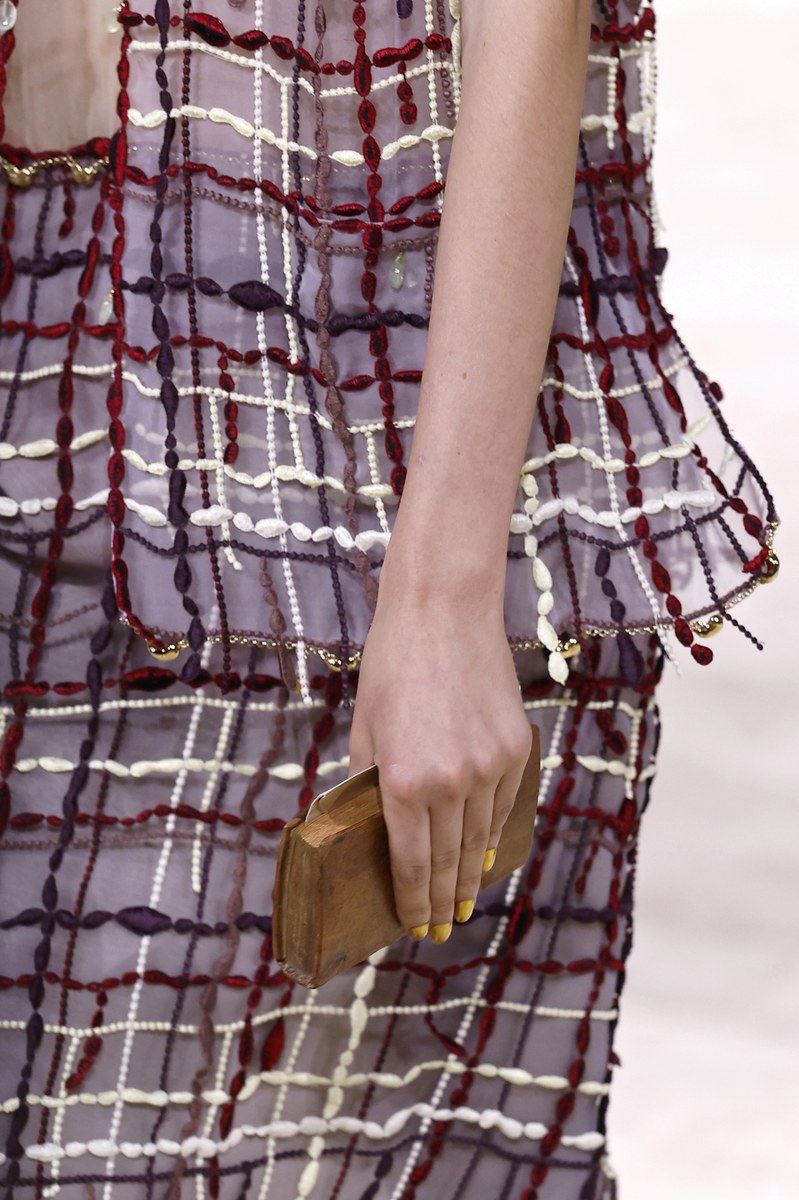
Three distinct material registers move through the collection: heavy structured wools and neoprene-like double fabrics in the tailored pieces, liquid satins and organza in the evening and slip categories, and surface-built textiles covered in fringe, raw loops, or dense shearling. Visible panel seaming on the oxblood leather in Look 1 adds both texture and construction narrative. Looks 27 and 28 employ a looped, rag-cut textile that sits between bouclé and hand-torn fabric, giving them a raw artisanal weight. Fringe here is not trim but a primary surface treatment, appearing as the entire skirt body in Look 26, the full dress structure in Look 32, and cascading trouser panels in Look 30.

Look 1
Look 1

Styling and Layering

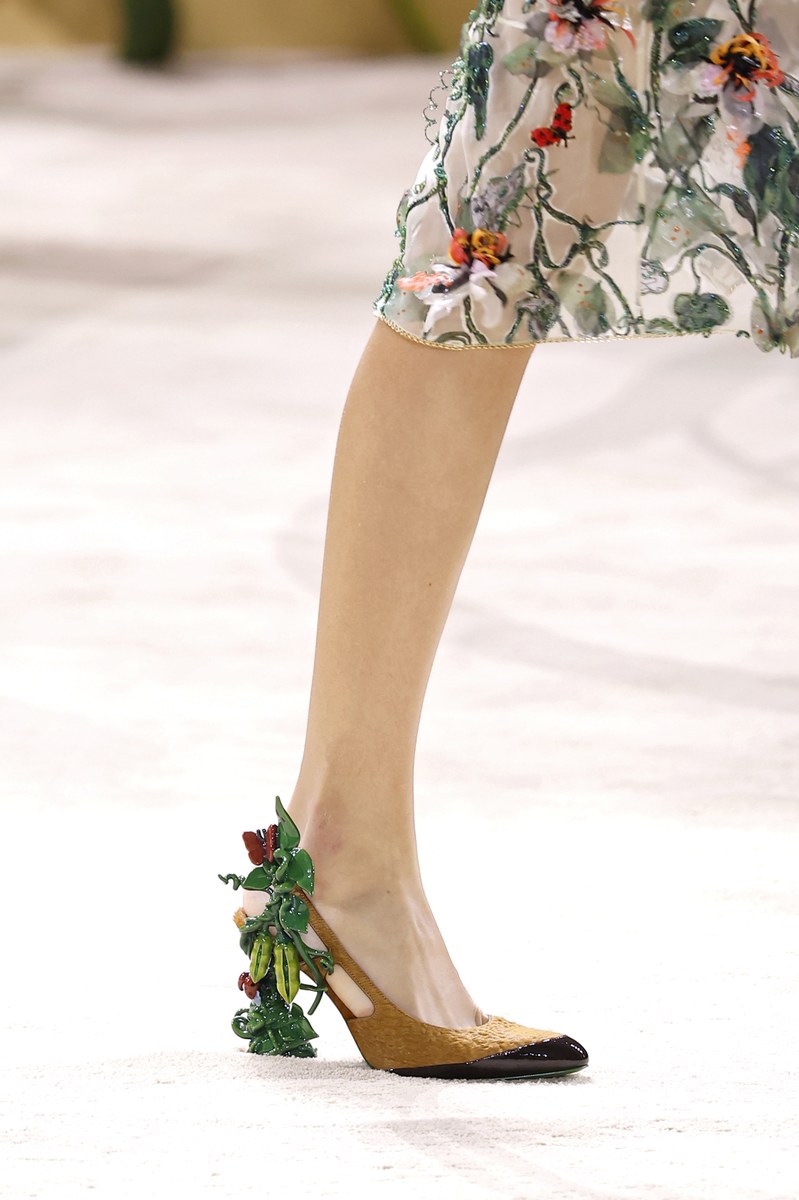
A consistent logic guides the layering: a weighty outer shell placed over something minimal or liquid. Look 11 pairs the dark olive paneled leather coat with a grey turtleneck and a lace-hem skirt visible at the hem. A belted black wool cape wraps over wide ivory trousers with fringe panels falling from the body in Look 23. Footwear repeats in two categories throughout, a flat square-toed loafer in burgundy or black, and a fur-trimmed flat mule that appears under evening looks in Looks 5, 10, and 15, grounding them in a deliberately casual register. Circular drum bags appear in Looks 7 and 18, a feather-trimmed pouch in Look 3, and oversized visor sunglasses recur in Looks 4, 10, 12, and 13.

Look 11
Look 11

Look by Look Highlights

Look 1 The full oxblood leather outfit, trench coat over matching shirt and wide-leg trousers with a leather peplum belt, reads as an immediate hero commercial piece. It functions as a complete monochromatic buy with strong visual impact.

Look 6 Ice-blue leather top with exaggerated spherical shoulders paired with plain black wide-leg trousers. This is the most architecturally extreme look in the collection and anchors the brand's sculptural identity for editorial and window purposes.

Look 6
Look 6

Look 9 The grey double-fabric suit with curved sleeve construction, dark navy fringe gloves, and a chunky green beaded collar demonstrates how Henry layers accessories to shift a tailored look toward ceremony without changing the garment itself.

Look 9
Look 9

Look 18 A ruched camel satin maxi dress with vertical gathering from neck to hem has strong standalone sell-through potential as a wedding-guest or occasion piece and carries no outerwear dependency, making it straightforward to merchandise.

Look 18
Look 18

Look 22 An ivory wool oversized coat layered over a white satin turtleneck and a floor-length fringe skirt in raw cream pulls together the collection's key materials, fringe, tailoring, and fluid satin, into a single shoppable statement.

Look 27 The all-over looped and rag-cut ivory coat reaching the ankle reads as a craft-forward piece that positions Carven against the artisanal luxury segment and will photograph well enough to carry campaign duty.

Look 27
Look 27

Look 30 A black ribbed wrap turtleneck paired with ivory tiered fringe trousers creates a strong contrast buy: the sweater is a clean commercial basic and the trousers are a fashion risk that buyers can weight separately.

Look 30
Look 30

Look 33 The black strapless structured bodice gown with tiered fringe from hip to floor is the most conventionally eveningwear-ready piece in the collection and requires minimal styling context to sell, making it a reliable anchor for special occasion departments.

Look 33
Look 33

Operational Insights

Core outerwear unit: Looks 1, 11, 13, 16, and 22 form a cohesive outerwear assortment across leather, cotton padding, and tailored wool that can be bought as a five-piece capsule with clear price-ladder logic from padded utility to leather statement.

Fringe as construction, not trim: Production teams should note that fringe in this collection is structural, forming entire skirt bodies and trouser panels rather than applied trim, which increases construction time and cost per unit and affects MOQ planning for any adaptation.

Accessories leverage: A drum bag in two colorways, black in Look 7 and ivory in Look 18, fringe gloves in Looks 9 and 17, and visor sunglasses create a repeatable accessories matrix that buyers can activate independently of the apparel to extend margin per transaction.

Look 7
Look 7

Color blocking by section: The collection organizes cleanly into a brown and oxblood opening, a grey and olive mid-section, and an ivory and cream close, which maps directly onto a seasonal drop strategy: launch brown leather and grey tailoring in August, follow with white and ivory occasion in October.

Occasion category depth: Looks 17, 18, 24, 29, 32, and 33 build a standalone occasion and eveningwear assortment strong enough to support a dedicated floor buy, with enough variation in silhouette and fabric to address cocktail, gala, and wedding-guest needs without redundancy.

Complete Collection

Look 2
Look 2
Look 3
Look 3
Look 4
Look 4
Look 5
Look 5
Look 8
Look 8
Look 10
Look 10
Look 12
Look 12
Look 13
Look 13
Look 14
Look 14
Look 15
Look 15
Look 16
Look 16
Look 17
Look 17
Look 19
Look 19
Look 20
Look 20
Look 21
Look 21
Look 23
Look 23
Look 24
Look 24
Look 25
Look 25
Look 26
Look 26
Look 28
Look 28
Look 29
Look 29
Look 31
Look 31
Look 32
Look 32
Look 34
Look 34
Look 35
Look 35
Look 36
Look 36

Fashion Designer

Mark Howard Thomas holds a master's degree from Central Saint Martins, where he studied under Louise Wilson, the notoriously demanding professor who shaped a generation of British designers through pressure rather than encouragement. It was a formative experience he has cited directly as the foundation of how he thinks about clothes. After graduating, he moved not to London or Paris but to Milan, spending nearly a decade there working for Neil Barrett, absorbing Italian tailoring from craftsmen whose knowledge doesn't travel well outside the workshops where it lives.

From Milan he went to Paris and Givenchy under Riccardo Tisci, where the challenge was almost the opposite: not precision for its own sake but the management of contrast, sportswear logic inside Gothic spectacle. Then London, as menswear director at Joseph under Louise Trotter, a collaboration that would repeat itself later. In 2017 he crossed to New York as creative director of Helmut Lang, a house whose founder he shares a birthplace with — both born in Vienna. His reading of Lang was unromantic and direct: not nostalgia for the 1990s but a question about what a uniform means today, how a garment earns its place in someone's actual life rather than on a mood board.

He left New York in 2019, rejoining Trotter at Lacoste in Paris as design director for menswear and global collaborations, then followed her again to Carven in 2023, this time as head of sartorial and creative collaborations. When Trotter left for Bottega Veneta in early 2025, Thomas was promoted to director of design, presenting his first collection on the Paris runway for Autumn/Winter 2025. He left Carven in April 2026.

"Living in Milan for nine years was a schooling in how to construct and understand garments, how to balance for fit and proportion. That kind of knowledge only exists in Italy."

"Helmut Lang has always been a contrast between something quite traditional and something very subversive, even a little perverted in places. For me, that's what makes it utopian rather than minimalist."

✦ This report was generated with AI — combining human editorial vision with Claude by Anthropic. Because the future of fashion intelligence is already here.