Casa Preti FW26 Bags

Casa Preti FW26 Bags
Casa Preti FW26 Bags Report

Casa Preti builds its FW26 bag lineup around a single utilitarian tote silhouette interpreted across radically different materials and surface treatments, from raw textile fringe to fresh baby's breath flowers pressed into service as literal bag fill. For buyers and product managers, this signals a deliberate pivot toward the tote as a concept vehicle rather than a commodity SKU, with each iteration targeting a distinct consumer mood and retail price tier.

Silhouettes and Shapes

Every bag shares the same boxy, top-handle tote architecture, a structured rectangular form sitting roughly in the small-to-medium range, approximately 25 to 30 cm wide. The silhouette holds its shape across all five executions. This tells buyers the base pattern is fixed and the differentiation happens entirely at the material level. Proportions skew slightly taller than wide, giving each bag a compact, hand-carry presence rather than an open market tote feel. No shoulder straps, crossbody chains or belt bag formats appear here. It's a deliberate top-handle-only statement.
Materials and Hardware

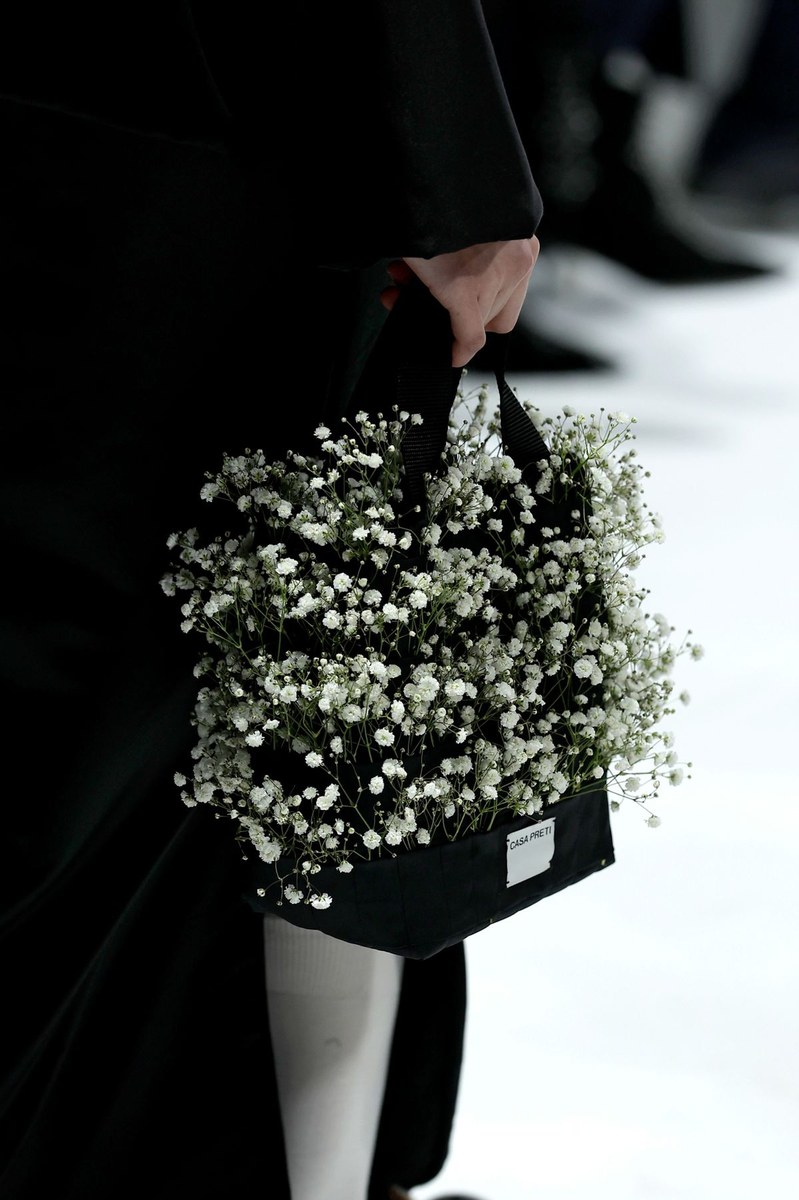
Casa Preti cycles through matte black canvas (Bag 1, Bag 2, Bag 4), glossy patent-finish PVC in near-black (Bag 5), and a heavily textured bouclé or brushed wool fabric (Bag 4) within the same base form. Bag 3 abandons conventional surface material entirely, covering the tote shell in layered strips of black raw-edge fabric and sheer organza fringe. Bag 1 replaces the bag body almost completely with densely packed gypsophila, white baby's breath flowers used as literal volume fill inside the open top. Hardware stays minimal throughout, with narrow black webbing handles and a small white rectangular label bearing the Casa Preti wordmark in a clean serif. That label appears consistently across Bag 1, Bag 2, Bag 4, and Bag 5 as the sole branding element.

Bag 1
Bag 1

Color Direction

Black dominates all five bags without exception, cementing this as a monochrome accessories program. White enters through Bag 1's gypsophila blooms, creating the only significant color contrast in the lineup. Bag 5 breaks the matte surface monopoly with a high-gloss patent finish that reads as near-black under runway lighting, and its sticker embellishments introduce small pops of illustrated color including greens, reds, yellows, and blues in a deliberately naive, almost childlike graphic register. A palette built for easy integration into dark-toned wardrobes, where decorative texture serves as the primary seasonal differentiator rather than color.

Key Models and Details

An open-top boxy tote with webbing handles and no visible closure forms the core model, a format that prioritizes ease of access over security and positions the bag interior as display space rather than concealed storage. The Casa Preti label, a small white patch with black type, appears heat-applied or sewn flat to the lower front panel and functions as the only logo treatment across the range. Bag 5 layers colorful die-cut stickers directly onto the patent PVC surface, a customization gesture that reads as a production-ready decoration technique rather than a one-off styling choice. Bag 3 omits the branding label entirely, which could indicate prototype or editorial-only status within the commercial lineup.

Bag 5
Bag 5

Bag by Bag Highlights

Bag 1 fills the standard canvas tote body with live gypsophila, collapsing the boundary between accessory and floral arrangement, a directional editorial statement that translates commercially into scented or botanical-insert product concepts.

Bag 2 presents the cleanest iteration of the base tote in smooth matte black nylon or coated canvas, making it the most immediately scalable SKU for volume production and private-label adaptation.

Bag 2
Bag 2

Bag 3 covers the tote shell in multi-length strips of raw-edge black fabric and sheer organza, creating a fringe texture that would require intensive hand-finishing and positions this model firmly in a premium or limited-edition tier.

Bag 3
Bag 3

Bag 4 wraps the boxy silhouette in a dense brushed textile, likely a wool or boucle blend, giving it tactile warmth that aligns with cold-weather gifting cycles and separates it from the nylon versions on material feel alone.

Bag 4
Bag 4

Bag 5 applies a glossy black patent PVC coating to the base form and layers on colorful illustrated stickers covering animals, fruit, and text motifs, a direct reference to Gen Z customization culture that makes it the most commercially youth-targeted piece in the lineup.

Bag 3 and Bag 1 together read as the collection's conceptual anchors, establishing that Casa Preti treats the tote form as a modular base for material experimentation rather than a finished design object.

Operational Insights

Modular base construction: All five bags share a single pattern block, which means a buyer can negotiate a base production run on one silhouette and allocate material and decoration variants as separate SKUs, reducing tooling costs significantly.

Tiered pricing potential: The range naturally segments across three price points, Bag 2 as an accessible entry SKU, Bags 4 and 5 as mid-tier with material and decoration premiums, and Bags 1 and 3 as high-touch limited editions requiring hand-finishing or perishable components.

Decoration-as-product strategy: Bag 5's sticker application technique is low-cost to replicate in production and has proven traction in accessories for under-30 consumers, making it a strong candidate for a capsule or collaboration drop format.

Branding consistency: The uniform white label with serif wordmark across four of five bags gives buyers a clear house code to carry into licensed or co-branded negotiations, with no competing logo hardware to complicate brand integration.

Material risk management: Bag 3's raw-edge fringe construction will require careful quality control briefing with manufacturers on fraying tolerance and washing instructions, and buyers should request durability testing data before committing to bulk orders.

✦ This report was generated with AI — combining human editorial vision with Claude by Anthropic. Because the future of fashion intelligence is already here.