Casa Preti FW26 Details
Casa Preti FW26 Details Report
Casa Preti FW26 builds its accessories and detail language around tactile extremes, pairing raw textile manipulation with monastic headwear to define a collection rooted in controlled disruption. For buyers and product managers, this signals a clear commercial appetite for statement sleeves and head-covering silhouettes that can anchor editorial buys without requiring full-look commitment.
Category Overview
Two categories carry the collection's detail work: dress construction details and headwear. Dress details span three distinct textile treatments, from fringe to organza knot belting to shredded silk cuffs, each functioning as a standalone selling point within an otherwise restrained garment architecture. The headwear appears in two shots of the same sheer black organza bonnet style, a deliberate repetition that confirms it as a signature piece rather than a one-off styling choice. Strategy here centers on craft intensity at key focal points, the sleeve, the waist, the head, rather than broad surface decoration.
Material and Construction
Detail 1 relies on layered strips of black wool-weight denim, cut and left raw at the edges to create a dense fringe that covers the entire sleeve cap from shoulder to mid-arm. Shredded and frayed organza panels in warm peach and pale amber tones appear in Detail 3, attached in overlapping rows to form a voluminous cuff skirt around the wrist. A structured obi-style sash in slate grey silk organza introduces Detail 2, wrapped and knotted at the front with visible tension folds, sitting over a pale celadon silk jacquard jacket with black grosgrain trim. Semi-sheer black chiffon or organza shapes Details 4 and 5 into a fitted bonnet with a pinned crown seam and a draped neck panel that falls loose at the back.

Color and Finish Direction
Black dominates across Details 1, 4, and 5, appearing in matte wool, denim, and sheer organza finishes that read very differently in texture despite sharing the same depth of tone. Pale celadon green and slate grey pair in Detail 2, grounded by black grosgrain, a combination that sits cleanly within the grey-sage-neutral palette buyers have been tracking since SS25. Detail 3 breaks the palette entirely with warm peach, burnt apricot, and pale gold organza, the only warm-spectrum moment in the group and likely positioned as an accent piece within an otherwise cool and dark collection. That warmth against the surrounding black signals intentional commercial breadth, one entry point for buyers who need color without committing to a saturated story.

Key Pieces and Details
The black fringe sleeve jacket in Detail 1 is the clearest commercial anchor, a piece that reads as a wearable statement without requiring coordinated styling to land. Strong editorial currency defines the organza bonnet from Details 4 and 5, speaking directly to the veiling and head-covering trend that has been moving steadily from runway to advanced contemporary retail. Detail 3's shredded organza cuff skirt is the riskiest but also the most collectible piece, best positioned for specialty retailers or costume-adjacent buyers rather than volume. Ongoing demand for built-in waist definition through sculptural rather than tailored means informs Detail 2's knotted sash jacket.
Detail by Detail Highlights
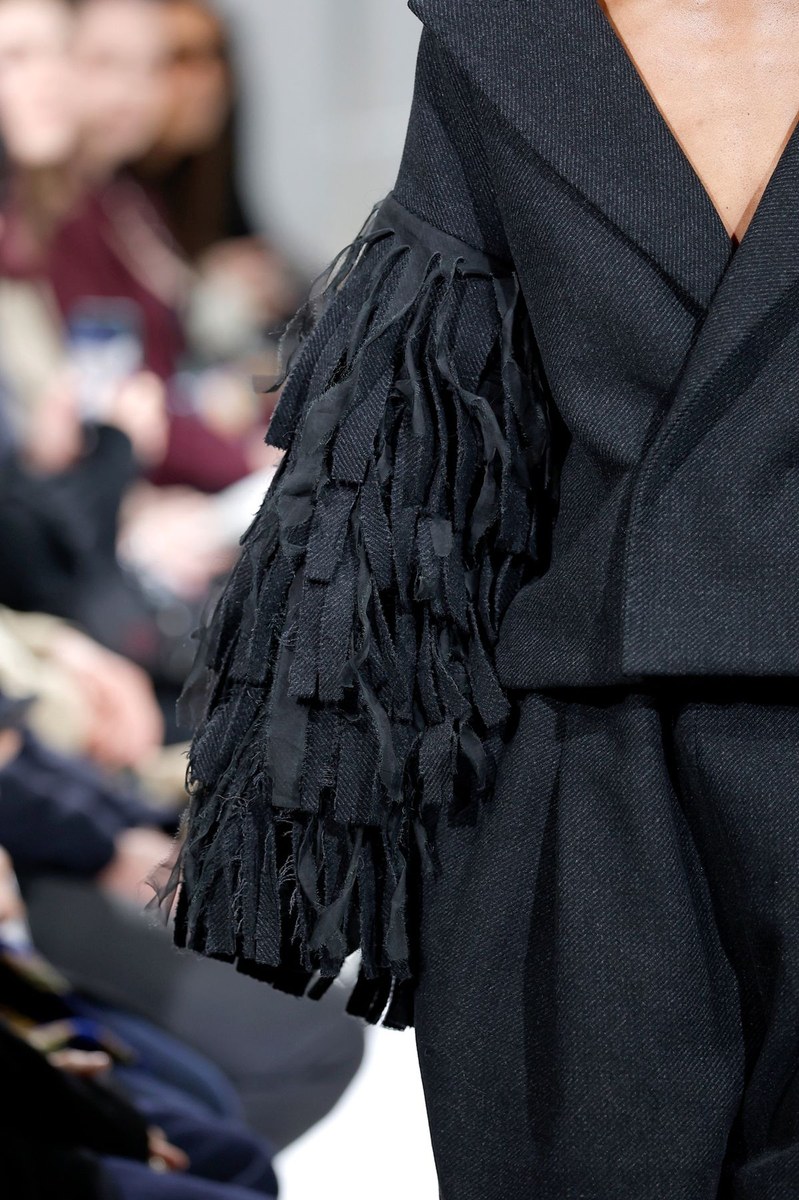
Detail 1 (Dress Detail) The sleeve of this black jacket is fully covered in densely layered raw-edged strips of denim-weight wool, tiered from shoulder to mid-forearm to create a fringe volume that reads closer to architectural texture than embellishment.
Detail 2 (Dress Detail) A pale celadon silk jacquard jacket is cinched with a wide slate grey organza sash knotted firmly at the front, the knot creating asymmetric fabric spill that acts as the garment's primary focal point.
Detail 3 (Dress Detail) Shredded panels of peach and amber organza are attached in overlapping rows at the cuff, forming a short skirt-like burst of warm color against a plain black sleeve, the fraying edges left fully raw.

Detail 4 (Headwear) A semi-sheer black chiffon bonnet sits close to the skull with a pinned seam at the crown and a draped neck panel left untied, framing the face in a shape that references medieval coifs and mourning dress simultaneously.

Detail 5 (Headwear) The same bonnet photographed in profile reveals the construction of the back panel more clearly, a loose gathered fall of chiffon that softens the structured crown and allows the hair to remain visible through the fabric.

Operational Insights
Fringe as sleeve architecture: The tiered raw-edge fringe in Detail 1 is cut and applied as a construction element rather than a trimming afterthought, which means buyers should assess it as a category-defining jacket rather than an embellished style. Production minimums and hand-finishing time will be significant cost factors.
Headwear scalability: The bonnet silhouette in Details 4 and 5 uses minimal material and a simple construction, which makes it unusually scalable for a runway headwear piece. Accessories directors should evaluate it as a standalone retail unit with strong gifting and styling potential.
Organza fringe cuff: The shredded cuff in Detail 3 requires heat-set or hand-cut organza strips and likely significant finishing time per unit. Position this as a limited production or pre-order style rather than a core replenishment piece.
Waist definition through drape: The knotted sash in Detail 2 is integral to the jacket construction rather than removable, which affects how buyers present and merchandise it. Confirm with the house whether the sash can be decoupled for separate retail or wholesale purposes.
Palette split strategy: The warm peach and amber tones in Detail 3 sit in deliberate contrast to the dominant black and grey palette across the remaining details. Buyers should treat these as distinct color stories for different shelf placements rather than mixing them within a single buy.
✦ This report was generated with AI — combining human editorial vision with Claude by Anthropic. Because the future of fashion intelligence is already here.