Casa Preti FW26 Women Looks Report
Milan Fashion Week
Casa Preti FW26 opens with a single garment repeated across seven bodies, a belted black cotton wrap dress cut identically yet resolving differently on every frame, before expanding into sculptural wool, velvet, and iridescent outerwear that fractures gender and silhouette convention. For buyers navigating a market hungry for wardrobe anchors that read as art objects, this collection delivers a commercially viable core with enough editorial weight to generate press coverage across multiple cycles.
Silhouette and Volume
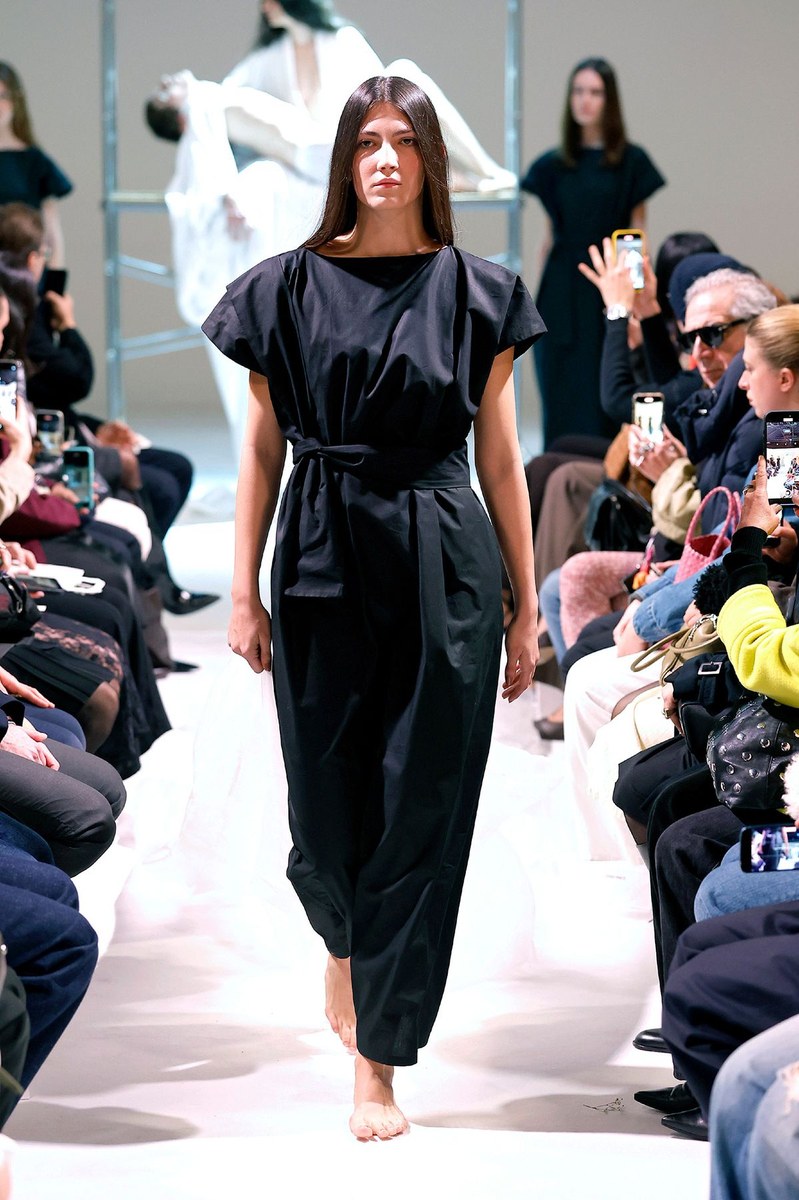
The collection begins deliberately narrow. Looks 1 through 7 all share one garment, a mid-calf black cotton dress with dropped flutter sleeves and a self-tie belt, but the silhouette shifts from columnar to balloon-hemmed to tapered trouser depending on how the fabric pools and folds. Volume escalates aggressively from Look 8 onward: wide-leg pleated trousers in charcoal wool, batwing outerwear with collapsed sleeve heads, and a silver taffeta cape in Look 19 that extends well beyond the shoulders and lifts at the hem like a wing mid-flight. Against this sculptural second half, the restrained opening reads as a clear narrative arc, one that stages wearability first, then spectacle.
Color Palette
Black is total and absolute through the first eleven looks, creating a monastic visual silence that gives garment construction room to speak. Look 13 breaks the sequence with an ivory cotton shirt, cream tailored shorts, and a navy polka-dot bow tie under a black wool cape coat, the only warm-neutral moment in the collection. A pale champagne and blush organza fringed top arrives in Look 15, the single instance of color warmth, worn against matte black wide-leg trousers to prevent it from reading as delicate. Charcoal and graphite enter with Looks 8, 17, 18, and 19, layering cool dark tones that carry weight without full black saturation.

Materials and Textures
Matte black cotton, medium-weight with enough body to hold sculptural folds but light enough to drape cleanly when belted, anchors the opening seven looks. Velvet enters in Look 10 and again in Look 16, a crushed black velvet sweatshirt with exaggerated puffed sleeves in the former, a full velvet wrap suit with wide trousers in the latter, both landing as the richest surface textures in the collection. Look 17 pairs a structured charcoal wool blazer with sleeves entirely covered in layered fabric fringe, a construction detail that adds tactile complexity without relying on embellishment in the traditional sense. High-shine silver taffeta appears in Look 19 as a cape over a charcoal shirt and cropped trousers, the metallic finish catching light in a way that reads photographically even at a distance.

Styling and Layering
Footwear does sharp editorial work throughout. Bare feet on the first seven models grounds the repeated black dress in something almost ritualistic, then Crocs in blush and black, platform and flat, appear on Looks 9, 11, 12, 18, and 19, a deliberate leveling of the footwear hierarchy that reads as a brand statement rather than a styling accident. Look 13 pulls a wide-brim black beret, navy bow tie, white ankle socks, and a structured black tote into a single Parisian schoolboy register that sits in strong contrast to the more austere looks around it. Black bucket bag filled with white gypsophila anchors Look 12, the only accessory in the collection that functions as a prop, and it lands as one of the most immediately shoppable and photographable moments on the runway.
Look by Look Highlights
Look 1 establishes the collection's conceptual spine by placing the identical black cotton belted dress on the first model barefoot, removing all distraction and forcing the eye to read construction alone.

Look 4 on a taller frame with closely braided hair demonstrates how the same dress amplifies its geometric drape, the belt cinching higher and the hem resolving into a sharper diagonal, which has direct implications for how this piece should be sized and fit-graded across a range.

Look 8 marks the collection's pivot, a charcoal boiled wool Mandarin-collar jacket over deeply pleated wide-leg trousers and platform Crocs, signaling the shift from cotton minimalism to structured outerwear and making a strong case for a two-piece separates buy.
Look 11 puts the black taffeta layered coat with oversized structured shoulders on an older model, a casting choice that directly positions this piece for a 40-plus luxury customer who is currently underserved by most runway collections.

Look 12 pairs a black fluid silk or satin oversized cape-dress with a bucket bag of gypsophila, and the combination of architectural volume and organic accessory creates the single most reprintable image in the collection.

Look 15 on a male-presenting model in a bare-shouldered champagne organza fringe top over wide black wool trousers and platform Crocs tests gender-neutral buying in the most commercially risky way possible, making it a directional piece rather than a volume driver but essential for editorial credibility.

Look 17 grounds the collection's most wearable statement piece, a charcoal wool deep-V blazer with full fringe-covered sleeves and matching wide-leg trousers, which functions as a complete look requiring no additional styling and translates directly to trunk show and direct buy.

Look 19 closes the runway with the silver taffeta winged cape over charcoal separates and blush Crocs, a maximum-volume outerwear statement that reads as a hero piece for visual merchandising and window installation regardless of unit sell-through.

Operational Insights
Repeatability risk: The identical black cotton dress across seven looks (Looks 1 through 7) is a compelling editorial device but compresses the apparent SKU range. Before placing orders, buyers should request confirmation of distinct cut variants, as fit differences may not be immediately visible in runway photography.
Crocs collaboration visibility: Platform and flat Crocs appear across at least five looks in blush and black, worn with white socks in some instances. This is not incidental styling. Buyers should investigate whether a formal co-branded accessory program accompanies the collection, as the footwear functions as a recurring brand signal with its own retail logic.
Fringe construction cost: The shredded fabric fringe covering the sleeves of Look 17 and appearing on the organza top in Look 15 requires significant hand labor and likely inflates cost-per-unit. Style directors should assess whether the fringe detail is available as a made-to-order option at a separate price tier or only in full production runs.
Gender-neutral inventory planning: Looks 5, 7, 8, 10, 15, 16, and 18 place male-presenting models in garments that carry no gender-specific cut markers. Buyers operating in markets with established gender-neutral categories should flag these as dual-floor candidates and request unisex size run availability from the brand.
Volume escalation as a buying map: The collection moves from a single restrained black cotton SKU into sculptural wool, velvet, and outerwear in a clear sequence. Style directors can read this as a suggested floor cadence, anchor the floor with the cotton dress, build toward the charcoal wool separates, and position the silver taffeta cape and fringe blazer as hero display pieces that drive traffic rather than volume.
Complete Collection


About the Designer
Mattia Piazza grew up in Palermo where music shaped his early years. After attending the Regina Margherita Music School, he completed formal training in opera singing and classical guitar, skills that would later influence his approach to fashion design. The disciplined rigor of musical composition taught him about structure and harmony, qualities that translate directly into his work as a designer.
His transition from music to fashion came through studies at Palermo's Academy of Fine Arts, where he completed a degree in fashion design in 2016. Rather than moving immediately to the established fashion capitals, Piazza took a year to travel and reflect on what kind of designer he wanted to become. This period of deliberate pause led him back to Sicily, where he founded Casa Preti in 2017, deliberately choosing to root his brand in the Mediterranean rather than chase opportunities elsewhere.
The aesthetic DNA of Casa Preti draws from the compositional rigor of 17th-century Baroque painter Mattia Preti, whose work provides a framework for the brand's essential, clerical lines. Piazza finds inspiration in art that speaks to universal human experiences, from Giovanni Bellini's depictions of cultural diversity to Pellizza da Volpedo's "The Fourth Estate," which informed his recent politically charged collections. His collaborations with contemporary artists like Vanessa Beecroft and Claire Fontaine reflect his belief that fashion should engage with broader cultural conversations.
As Creative Director and founder, Piazza has positioned Casa Preti as more than a clothing brand, treating it as what he calls "a creative forge" that produces performances, fashion films, and art installations alongside collections. His approach to luxury centers on what he terms "silent luxury," emphasizing time, measure, and the idea that garments should be "spaces to inhabit" rather than objects to own.
"I do not want to tell women how they should be seen. I want to offer them a structure they can fill. Casa Preti should not be emptied; it should be inhabited."
"I never think of the 'next' as a rupture. For me, the process is continuous. There is no magic that renews itself every six months."
✦ This report was generated with AI — combining human editorial vision with Claude by Anthropic. Because the future of fashion intelligence is already here.